
Model railways in N scale
Fleischmann, SBB and BLS in N scale
SBB Re 460, Re 4/4 II and Re 6/6, BLS Re 465, EW IV coaches, wagons, track and spare parts: Fleischmann runs a Swiss layout at 1:160, with the rest of Europe alongside.
- 647items in the shop
- 1:160for your N layout
- Since 1887a brand born in Nuremberg
What Fleischmann brings to your layout
- Swiss railways: Re 460, Re 4/4 II, Re 6/6 and Re 620 of SBB and SBB Cargo, BLS Re 465, EW IV coaches of SBB and SOB, silo, stake and container wagons.
- Detail at 1:160: die-cast metal chassis on the Re 460, photo-etched wipers on the Re 6/6 and Re 4/4 II, fine pantographs, bogies with yaw dampers on the EW IV coaches.
- Analogue or with sound: many locomotives come in two versions: DC, or with an on-board decoder, sound, lights and cab lighting switchable in digital mode.
- A brand from Nuremberg: founded in 1887 by Jean Fleischmann, the brand now belongs to the same group as Roco and is devoted to N scale.
Our favourites for a Swiss layout
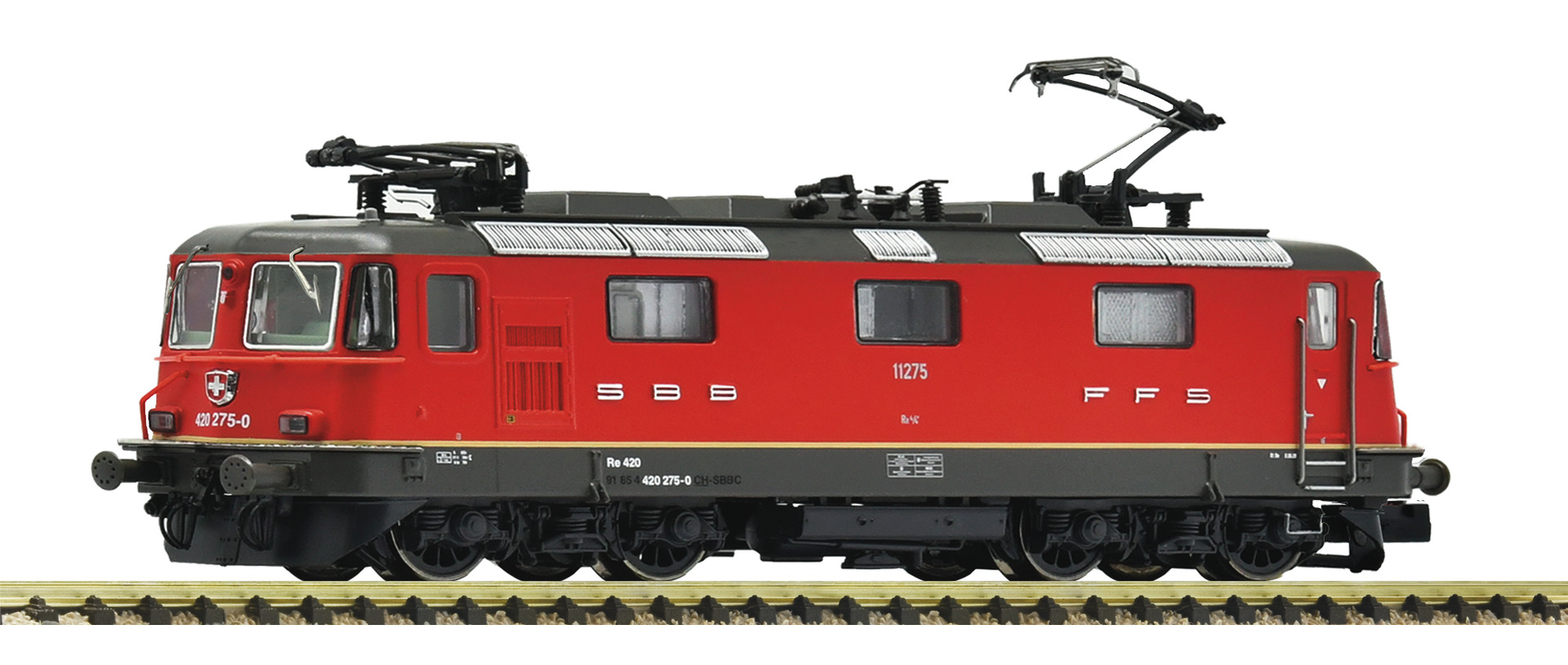
Electric locomotive Re 420 275-0 of the Swiss Federal Railways. Fine windscreen wipers as etched parts Version with air conditioning Delicately detailed pantographs Closed pilots included in the package Z21 driver's cab available The Re 4/4 II are universal locomotives and are therefore used to haul both passenger and goods trains. Heavy trains are typically operated in double traction together with a Re 6/6. With 277 units delivered between 1964 and 1985, the Re 4/4 II series represents the largest class of traction units in the SBB fleet. The locomotives have a power output of 4,700 kW and can reach a maximum speed of 140 km/h.
On order, shipped within 10-15 days

Electric locomotive Re 460 of the Swiss Federal Railways. Original version with "2000" on the front Die-cast metal chassis Closed front apron attached to the package Perfectly matches the EW-IV coaches - items 890326-890329 To implement the concept “Bahn 2000”, the SBB procured twenty-four Re 460 locomotives. A bit later, they had seventy-five more locomotives built to ensure a smooth operation, on the in 1994 introduced piggyback corridor running through Switzerland. The locomotives were later assigned to the passenger transport. Until today they are indispensable when it comes to the traction of the dense Swiss regular traffic.
In stock: 2 on the shelf, shipped within 1-3 days

Electric locomotive Re 6/6 of the Swiss Federal Railways. Completely new design 2022! Version in green livery with round lamps Fine windshield wipers as etched parts Filigree pantographs Closed obstacle deflectors attached to the package With an hourly output of 7.850 kW and a top speed of 140 km/h, the Re 6/6, which first entered service in 1972, is still one of the most powerful locomotives in Switzerland. The DB preferred the Bo'Bo' axle arrangement over the standard Co'Co' to achieve higher curve speeds. The three delicately designed bogies - further developed from the 4/4ˡˡ - also proved very advantageous in terms of wheel flange and track wear. You can find the Re 6/6 everywhere, be it in single traction, in multiple control operations among themselves or especially in freight traffic. However, most of the time, it runs under the designation Re 10/10 together with a Re 4/4ˡˡ or Re 4/4ˡˡˡ.
In stock: 1 on the shelf, shipped within 1-3 days

Electric locomotive Re 465 009 of the Swiss railway company BLS. Livery in refit design Closed front apron included Up until 2022, the 18 BLS locomotives type Re 465 were modernised and received a new livery. In order to facilitate use with Vectron and Traxx locomotives in freight transport, the appropriate multiple-unit controls were installed. Furthermore, an Ethernet Train Backbone has been implemented for traction of the Autotunnel and future GoldenPass trains. The names with which these locomotives were labelled are no longer used. The work was carried out at the company’s own factory in Bönigen.
In stock: 2 on the shelf, shipped within 1-3 days

2nd class passenger coach, type EW IV, type B, of the Swiss Federal Railways. In updated design Bogies with yaw dampers Item no. 6260017: modified running number The standard coaches of the type EW IV were delivered from 1981 to the SBB and form one of the largest Swiss coach fleets with 500 vehicles. The coach body is produced as a welded steel lightweight construction. Travellers loved these coaches due to their generously-sized interiors with face to face seating, and the fact that they ran smoothly even at high speeds. The EW IV coaches have been subjected to diverse modernisations, but still run today across almost all of Switzerland.
In stock: 3 on the shelf, shipped within 1-3 days

2nd class control cab coach type EW IV, type Bt, of the Swiss Federal Railways. In updated design Bogies with yaw dampers Open front apron for coupling installation included With function decoder for white and red light changeover in analogue as well as digital mode When the long-distance trains were converted into shuttle trains from the year 1996 onwards, the SBB procured 60 control cab coaches of the type IC Bt. Such Intercity shuttle trains comprise, in addition to the control cab coach, adapted intermediate EW IV coaches, former French baggage coaches and locomotives of the type Re 460. The design of the coach, featuring 62 seats, is based on the familiar Eurocity coach. The equipment also includes a wheelchair, pushchair and bicycle compartment, as well as a closed toilet system with bioreactor. The front end shape and the driver’s cab look very similar to the Re 460 locomotives, thus producing a homogeneous appearance.
In stock: 3 on the shelf, shipped within 1-3 days

Grain silo wagon, “Feldschlösschen” type Tgpps, operated by the Swiss Federal Railways. Finely detailed model with separately attached plug-in parts Delicately-crafted walkway grids Detailed platform railings
In stock: 1 on the shelf, shipped within 1-3 days

Swivel stake wagon, type Ks-w, of the Swiss Federal Railways. Brakeman's platform and round buffers The Swiss Federal Railways procured the type M5/Ks-w stake wagons, later designated Ks 330, from 1959 to 1970 in seven construction lots. Stake wagons are primarily intended for the transport of bulky goods. These include, for example, steel, wood, large machines and motor vehicles as well as prefabricated parts and heavy individual loads. They are also used to transport soil and gravel.
In stock: 3 on the shelf, shipped within 1-3 days
The Fleischmann families
For a Swiss layout
45 itemsSwiss locomotivesRe 460, Re 4/4 II, Re 6/6 and Ae 6/6 of SBB and SBB Cargo, BLS Re 465 and a Beilhack rotary snowplough.See the items19 itemsSwiss coaches and wagonsEW IV coaches of SBB and SOB, silo, stake and container wagons.See the itemsAll rolling stock
196 itemsLocomotivesSteam, diesel and electric locomotives from Switzerland, Germany, Austria and France, DC or with sound.See the items64 itemsPassenger coachesEW IV, ICE and Flixtrain coaches, coaches of the DB, DR and SNCF.See the items108 itemsGoods wagonsPocket, container, tank, covered and RoLa wagons, from Switzerland and Europe.See the itemsTrack and spare parts
All Fleischmann items

Turntable controller with track pre-selection TURN-CONTROL is suitable for analogue and digital control of the turntables art. no. 6152, 6154, 665201, 9152 and 35900. An LCD display gives a visual indication of the setting of the turntable bridge, the location of the track exits installed and shows the active track exit, together with additional functions. Symbols of the active functions give it a simple, user-friendly operation. Each track exit can be individually controlled. Because the polarity change is catered for by the switch, when rotating through 360°, the turntable is protected against short circuit. The turntable control switch is suitable for operation wtih 2-rail DC operation, the 3-rail AC operation, and will also operate with all digital systems - DCC, FMZ and Märklin-Digital (contains a turntable decoder). No changes or alterations to the turntable are necessary. Content: - TURN-CONTROL 6915 Controller - Connection cable 396865 (for power feed) - 7-pole connecting plug - Operating manual Märklin is a registered trademark of the company of Gebr. Märklin & Cie. GmbH, Göppingen.
On order, shipped within 10-15 days

To operate double-arm semaphore signals with electric motor.
On order, shipped within 10-15 days

Point switch to operate two points, or two double slips.
On order, shipped within 10-15 days

With train control - to operate colour light signals without electric motor.
On order, shipped within 10-15 days

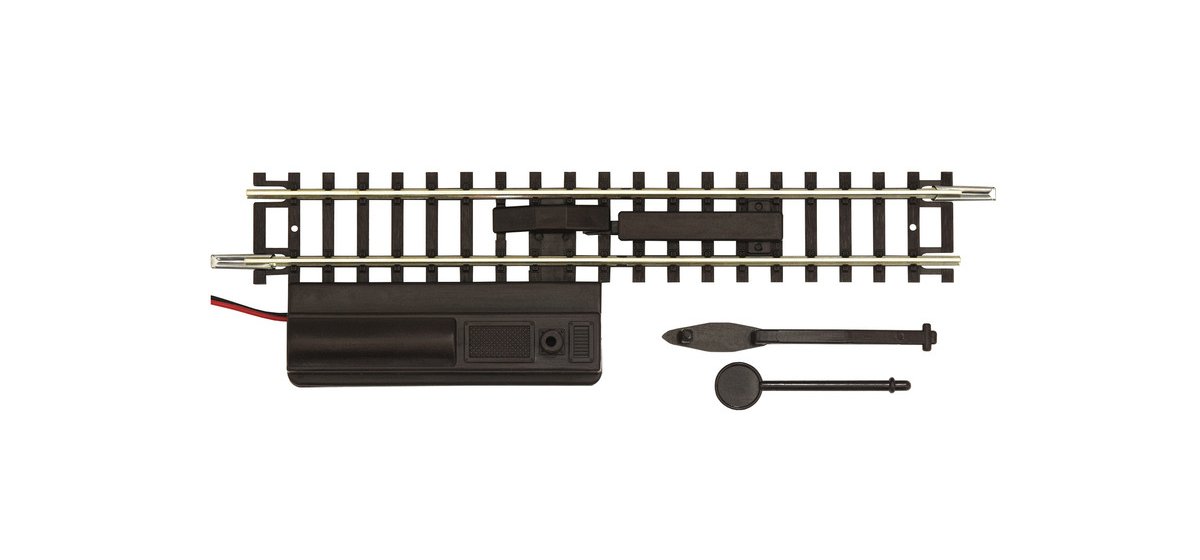
I. e. to operate four uncoupler tracks.
On order, shipped within 10-15 days

For example to turn power on/off to circuits, isolated sections or lighting, etc.
On order, shipped within 10-15 days

To reverse the direction of running.
On order, shipped within 10-15 days

To operate one three-way point.
On order, shipped within 10-15 days

Signal switch to operate single-arm semaphore signals.
On order, shipped within 10-15 days

2 pole for 10 connections each side.
On order, shipped within 10-15 days

Connector panel to extend and connect up to 10 wires.
On order, shipped within 10-15 days

Steam locomotive 01 200 of the Deutsche Bundesbahn. Operation condition: 1950s Used in high-quality express train services "Wagner" smoke deflectors Unobstructed view between boiler and chassis Tender 2'2' T 32 The two-cylinder engines of class 01 are considered the first express train locomotives to be produced according to the standard construction programme. The first construction lots had leading wheels with a diameter of 800 mm and were approved for a maximum speed of 120 km/h. Later models, starting from 01 102, were equipped with 1.000 mm leading wheels and reinforced brakes, allowing for an increased maximum speed of 130 km/h. The golden age of the class 01 locomotives began in 1934 with the summer timetable. The high level of commitment and performance expected from them in the following years posed significant challenges for both the locomotives and the personnel. After the Second World War, these standards were not achieved again until the introduction of electric locomotives and large-scale diesel locomotives. In 1935, locomotive 01 200 was transferred from Henschel to the Hof depot, and from there it was called upon to haul fast and express trains between Bamberg and Hof on the Schiefen Ebene line.
On order, shipped within 10-15 days

Steam locomotive 01 202 of the Verein Pacific 01 202. Version as a museum exhibit locomotive Smoke chamber door with central lock Elaborate printing on the boiler rings and wheel tires Additional alternator Version with open front apron and "Witte" smoke deflectors Unobstructed view between the boiler and chassis The express steam locomotive 01 202 is a living piece of engineering history. Built in 1936 by Henschel & Sohn in Kassel for the former Deutsche Reichsbahn, it later entered service with the Deutsche Bundesbahn after World War II, from which it was primarily used in southern Germany. Its final years in active service were spent at the Hof depot, where it frequently operated on the steep gradients of the inclined plane. On October 2, 1975, the 01 202 arrived in Switzerland. There, it was painstakingly restored to operating condition by Werner Bühlmann of Münsingen, together with a dedicated group of passionate, optimistic volunteers, working in their spare time without pay. Thanks to more than 20 years of continuous effort, the locomotive is now considered the finest operational specimen of the Class 01 and remains in remarkably well-maintained condition. Since 1991, the Pacific 01 202 Association has been responsible for all aspects of the locomotive's maintenance and operation.
On order, shipped within 10-15 days

Steam locomotive 86 049 of the Deutsche Reichsbahn. Next18 interface and LED headlights on both sides of the locomotive Fine leading and trailing wheels with perforated spokes The Deutsche Reichsbahn-Gesellschaft (DRG) designed the class 86 based on the technical standards of the tender locomotive 1’D1’, and from 1928 on, the locomotives were built in large numbers. 244 locomotives remained in the former GDR, however, 71 of them had to be transferred to the Soviet Union. At the beginning of the 1950s, the DR had 164 locomotives in the vehicle fleet. The locomotives were mainly used on the lines of the Harz foreland, in the Ore Mountains and in Upper Lusatia.
On order, shipped within 10-15 days

Steam locomotive class 232 TC of the French State Railways. Round roof Die-cast metal chassis The SNCF purchased twenty-seven locomotives of type T18 from the Reichseisenbahnen in Alsace-Lorraine. The locomotives were built between 1915 and 1918 by the Vulcan works. They were stationed in Strasbourg, Haguenau, Sélestat, Colmar, and Mulhouse. Due to their incredible top speed of 100 km/h, large water reservoir, and much-appreciated smooth-running characteristics, they were mainly used in fast suburban traffic. The last 232 TCs quit regular services at the SNCF and were decommissioned in 1966.
On order, shipped within 10-15 days

Steam locomotive 23 071 of the Veluwsche Stoomtrein Maatschappij (VSM). Version as a museum exhibit locomotive Movable Heusinger control system The Class 23 locomotives were passenger train steam locomotives operated by the Deutsche Bundesbahn. Starting in 1950, a total of 105 units of this newly designed class were built. The Veluwsche Stoomtrein Maatschappij (VSM) owns two Class 23 locomotives: 23 076, which was the first to arrive at the VSM in 1976, and 23 071, which followed in 1978. Both locomotives remain operational to this day.
On order, shipped within 10-15 days

Heavy goods steam locomotive class 44 0104-8 of the Deutsche Reichsbahn. Variant with oil firing High-positioned DR smoke deflectors Smoke chamber door with central lock Middle driving axles with reduced wheel flanges Unobstructed view between the boiler and running gear Pumps at the front Home base Rbd Erfurt, Bw Saalfeld Many of the DR locomotives that remained in the country after the end of the war were converted to oil firing. Until they were gradually replaced by modern diesel and electric locomotives, the Class 44 locomotives formed the backbone of heavy goods services. Due to their enormous tractive power, they were nicknamed 'Jumbos.' The DR retired the last of these "Pachyderms" in 1986.
On order, shipped within 10-15 days

Steam locomotive 001 168 of the Deutsche Bundesbahn. Mould variant! Variant with DB reflex lamps Version used in its final years of service in the early 1970s With closed front skirt Witte smoke deflectors Used for high-quality express train services Tender 2’2’ T 34 Unobstructed view between the boiler and the chassis The two-cylinder locomotives of the Class 01 are regarded as the first express train locomotives to have been built under the standardised construction programme. The DR retained the original design, featuring the large Wagner smoke deflectors and the air and feed pumps in the smoke box recesses, after the Second World War. The DB, by contrast, gradually relocated them to the centre of the locomotive, giving the driver a better view of the track. Almost simultaneously, it replaced the large smoke deflectors with Witte-type ones and modified the majority of the running plates. The first production batches were fitted with leading wheels 800 mm in diameter and were approved for 120 km/h. From locomotive 01 102 onwards, they were fitted with 1,000 mm leading wheels and reinforced brakes, increasing the approved maximum speed to 130 km/h. Until 1939, the locomotives were fitted with riveted tenders of the 2‘2‘ T 32 type. After that, newly delivered locomotives were fitted with welded 2‘2‘ T 34 tenders, whilst those already in service were gradually retrofitted with them.
Pre-order, release expected in Q4 2027

Steam locomotive Class 92.5–10 of the Deutsche Bundesbahn. With Next18 interface Authentic unobstructed view between the boiler and running gear With a maintenance-free bell-shaped armature motor With delicate pipes on the boiler Between 1910 and 1916, a total of 512 T 13 locomotives were built by various manufacturers for the Prussian State Railways. In 1925, the T 13 was reclassified by the Deutsche Reichsbahn as Class 92.5–10, with locomotive numbers 92 501–913 and 92 1001–1072 according to its official numbering scheme. The DB decommissioned the last machine in 1965 at the Kassel railway depot.
On order, shipped within 10-15 days

Steam locomotive Class 86 261 of the Deutsche Reichsbahn-Gesellschaft. Back in stock as a DRG version for a long time Next18 interface and LED headlights on both ends Fine leading and trailing wheels with open spokes Die-cast metal chassis From 1928 to 1943, nearly all German locomotive factories supplied a total of 775 locomotives of this class to the Deutsche Reichsbahn Gesellschaft. The 1,000 hp locomotives were designed for speeds of 70–80 km/h, which meant that, in addition to their primary use on "branch lines", they could also operate on main and feeder lines.
On order, shipped within 10-15 days

Steam locomotive 150.Y.3 of the French State Railways. Variant with smoke deflectors Leading wheels with spokes Z21 driver's cab available
On order, shipped within 10-15 days

Steam locomotive 52 5365 of the German Federal Railway. Design with tub-style Front wheelset with disc wheels Z21 driver's cab available Over 7,000 class 52 units of the war locomotive were built from 1942 to 1950. These were designed with as little effort as possible and material use was also reduced wherever possible. With a weight of 84 tonnes, it achieved an output of 1,192 kW and a maximum speed of 80 km/h. Even after 1945, the locomotives were still indispensable for reconstruction in many parts of Europe.
On order, shipped within 10-15 days

Steam locomotive 62 005 of the Deutsche Bundesbahn. Version with Witte smoke deflectors Operating condition: 1954/55 All six Class 62 steam locomotives were brought together by the Deutsche Bundesbahn at the Krefeld depot in the early 1950s. From there, they were used on passenger services on main lines until they were withdrawn from service.
Pre-order, release expected in Q1 2027

Steam locomotive 064 305 of the Deutsche Bundesbahn. Replica of the version with welded water tanks The Class 64 tank locomotives were developed by the Deutsche Reichsbahn Gesellschaft from 1926 onwards. After the Second World War, 278 locomotives remained with the DB, where they were mainly used for passenger and freight services on branch lines.
Pre-order, release expected in Q1 2027