
Model railways in N scale
Fleischmann, SBB and BLS in N scale
SBB Re 460, Re 4/4 II and Re 6/6, BLS Re 465, EW IV coaches, wagons, track and spare parts: Fleischmann runs a Swiss layout at 1:160, with the rest of Europe alongside.
- 647items in the shop
- 1:160for your N layout
- Since 1887a brand born in Nuremberg
What Fleischmann brings to your layout
- Swiss railways: Re 460, Re 4/4 II, Re 6/6 and Re 620 of SBB and SBB Cargo, BLS Re 465, EW IV coaches of SBB and SOB, silo, stake and container wagons.
- Detail at 1:160: die-cast metal chassis on the Re 460, photo-etched wipers on the Re 6/6 and Re 4/4 II, fine pantographs, bogies with yaw dampers on the EW IV coaches.
- Analogue or with sound: many locomotives come in two versions: DC, or with an on-board decoder, sound, lights and cab lighting switchable in digital mode.
- A brand from Nuremberg: founded in 1887 by Jean Fleischmann, the brand now belongs to the same group as Roco and is devoted to N scale.
Our favourites for a Swiss layout
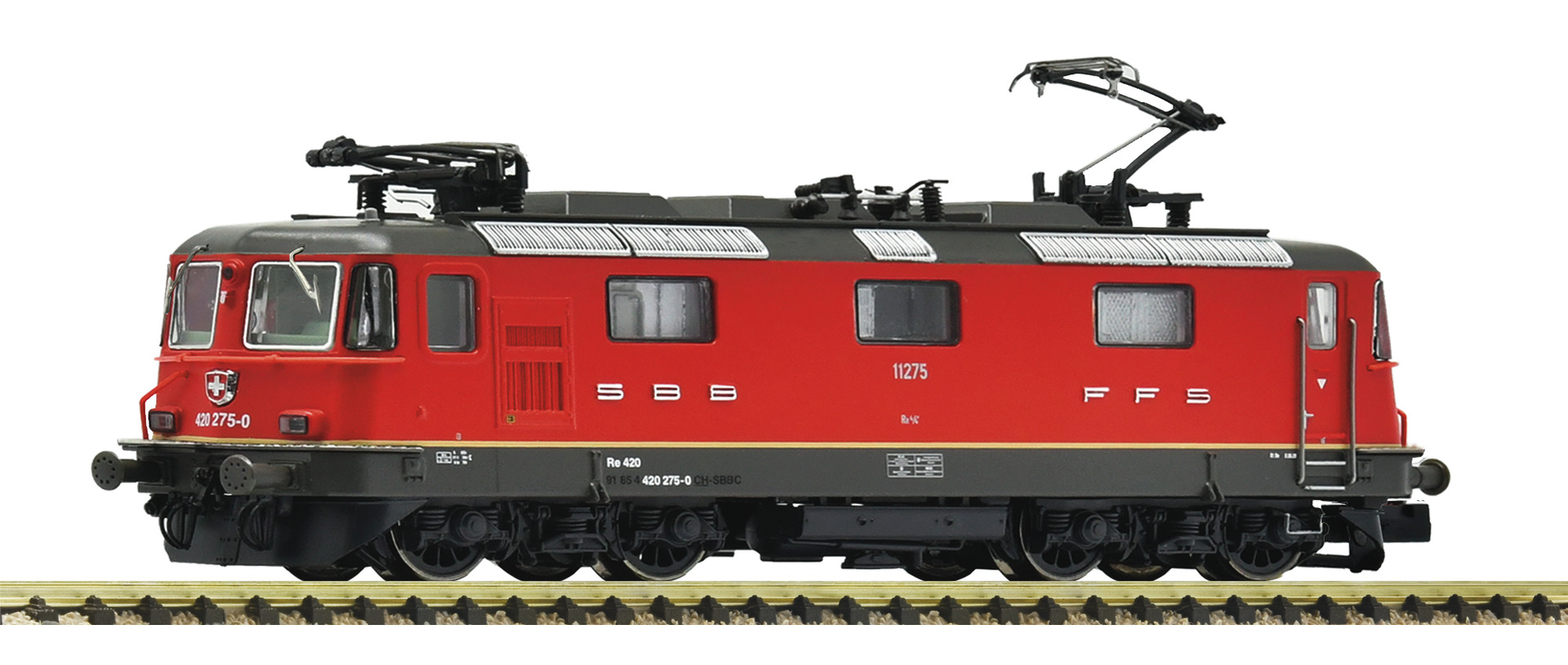
Electric locomotive Re 420 275-0 of the Swiss Federal Railways. Fine windscreen wipers as etched parts Version with air conditioning Delicately detailed pantographs Closed pilots included in the package Z21 driver's cab available The Re 4/4 II are universal locomotives and are therefore used to haul both passenger and goods trains. Heavy trains are typically operated in double traction together with a Re 6/6. With 277 units delivered between 1964 and 1985, the Re 4/4 II series represents the largest class of traction units in the SBB fleet. The locomotives have a power output of 4,700 kW and can reach a maximum speed of 140 km/h.
On order, shipped within 10-15 days

Electric locomotive Re 460 of the Swiss Federal Railways. Original version with "2000" on the front Die-cast metal chassis Closed front apron attached to the package Perfectly matches the EW-IV coaches - items 890326-890329 To implement the concept “Bahn 2000”, the SBB procured twenty-four Re 460 locomotives. A bit later, they had seventy-five more locomotives built to ensure a smooth operation, on the in 1994 introduced piggyback corridor running through Switzerland. The locomotives were later assigned to the passenger transport. Until today they are indispensable when it comes to the traction of the dense Swiss regular traffic.
In stock: 2 on the shelf, shipped within 1-3 days

Electric locomotive Re 6/6 of the Swiss Federal Railways. Completely new design 2022! Version in green livery with round lamps Fine windshield wipers as etched parts Filigree pantographs Closed obstacle deflectors attached to the package With an hourly output of 7.850 kW and a top speed of 140 km/h, the Re 6/6, which first entered service in 1972, is still one of the most powerful locomotives in Switzerland. The DB preferred the Bo'Bo' axle arrangement over the standard Co'Co' to achieve higher curve speeds. The three delicately designed bogies - further developed from the 4/4ˡˡ - also proved very advantageous in terms of wheel flange and track wear. You can find the Re 6/6 everywhere, be it in single traction, in multiple control operations among themselves or especially in freight traffic. However, most of the time, it runs under the designation Re 10/10 together with a Re 4/4ˡˡ or Re 4/4ˡˡˡ.
In stock: 1 on the shelf, shipped within 1-3 days

Electric locomotive Re 465 009 of the Swiss railway company BLS. Livery in refit design Closed front apron included Up until 2022, the 18 BLS locomotives type Re 465 were modernised and received a new livery. In order to facilitate use with Vectron and Traxx locomotives in freight transport, the appropriate multiple-unit controls were installed. Furthermore, an Ethernet Train Backbone has been implemented for traction of the Autotunnel and future GoldenPass trains. The names with which these locomotives were labelled are no longer used. The work was carried out at the company’s own factory in Bönigen.
In stock: 2 on the shelf, shipped within 1-3 days

2nd class passenger coach, type EW IV, type B, of the Swiss Federal Railways. In updated design Bogies with yaw dampers Item no. 6260017: modified running number The standard coaches of the type EW IV were delivered from 1981 to the SBB and form one of the largest Swiss coach fleets with 500 vehicles. The coach body is produced as a welded steel lightweight construction. Travellers loved these coaches due to their generously-sized interiors with face to face seating, and the fact that they ran smoothly even at high speeds. The EW IV coaches have been subjected to diverse modernisations, but still run today across almost all of Switzerland.
In stock: 3 on the shelf, shipped within 1-3 days

2nd class control cab coach type EW IV, type Bt, of the Swiss Federal Railways. In updated design Bogies with yaw dampers Open front apron for coupling installation included With function decoder for white and red light changeover in analogue as well as digital mode When the long-distance trains were converted into shuttle trains from the year 1996 onwards, the SBB procured 60 control cab coaches of the type IC Bt. Such Intercity shuttle trains comprise, in addition to the control cab coach, adapted intermediate EW IV coaches, former French baggage coaches and locomotives of the type Re 460. The design of the coach, featuring 62 seats, is based on the familiar Eurocity coach. The equipment also includes a wheelchair, pushchair and bicycle compartment, as well as a closed toilet system with bioreactor. The front end shape and the driver’s cab look very similar to the Re 460 locomotives, thus producing a homogeneous appearance.
In stock: 3 on the shelf, shipped within 1-3 days

Grain silo wagon, “Feldschlösschen” type Tgpps, operated by the Swiss Federal Railways. Finely detailed model with separately attached plug-in parts Delicately-crafted walkway grids Detailed platform railings
In stock: 1 on the shelf, shipped within 1-3 days

Swivel stake wagon, type Ks-w, of the Swiss Federal Railways. Brakeman's platform and round buffers The Swiss Federal Railways procured the type M5/Ks-w stake wagons, later designated Ks 330, from 1959 to 1970 in seven construction lots. Stake wagons are primarily intended for the transport of bulky goods. These include, for example, steel, wood, large machines and motor vehicles as well as prefabricated parts and heavy individual loads. They are also used to transport soil and gravel.
In stock: 3 on the shelf, shipped within 1-3 days
The Fleischmann families
For a Swiss layout
45 itemsSwiss locomotivesRe 460, Re 4/4 II, Re 6/6 and Ae 6/6 of SBB and SBB Cargo, BLS Re 465 and a Beilhack rotary snowplough.See the items19 itemsSwiss coaches and wagonsEW IV coaches of SBB and SOB, silo, stake and container wagons.See the itemsAll rolling stock
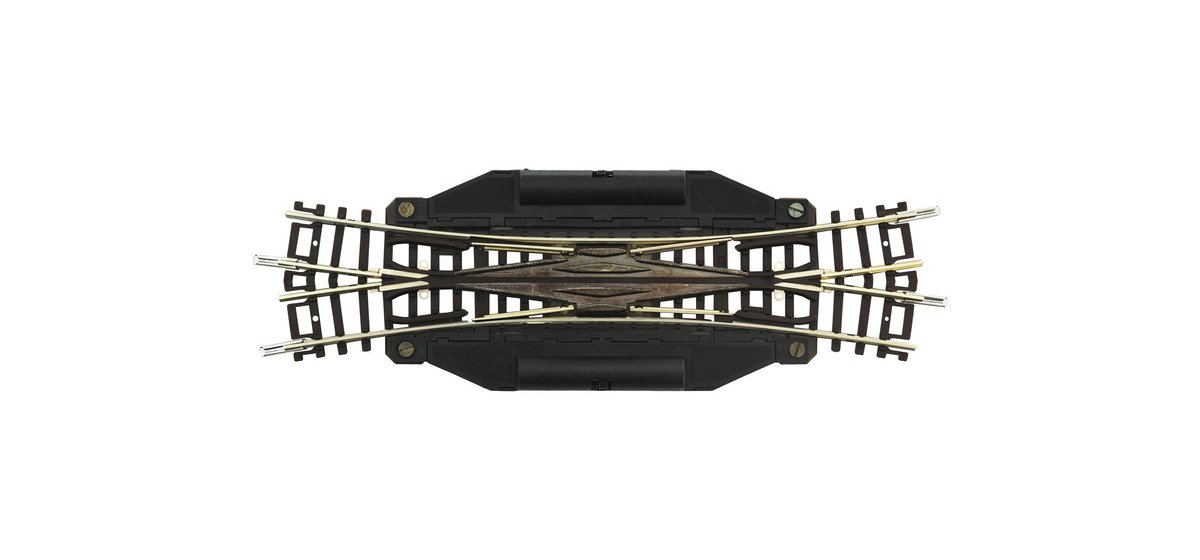
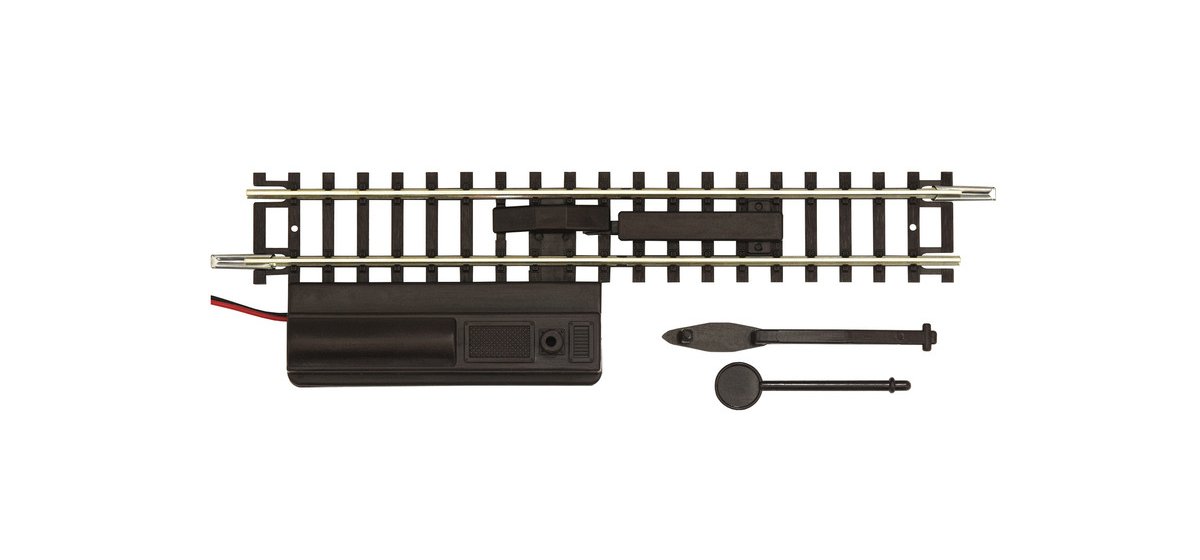
196 itemsLocomotivesSteam, diesel and electric locomotives from Switzerland, Germany, Austria and France, DC or with sound.See the items64 itemsPassenger coachesEW IV, ICE and Flixtrain coaches, coaches of the DB, DR and SNCF.See the items108 itemsGoods wagonsPocket, container, tank, covered and RoLa wagons, from Switzerland and Europe.See the itemsTrack and spare parts
All Fleischmann items

Diesel locomotive 2048 012 of the Austrian Federal Railways. Finely detailed model with many separately attached plug-in parts Clear view through driver’s cab Brake blocks exactly at wheel tread level Finest handles and steps The introduction of the New Austro-Takt (NAT) in June 1991 resulted in a deficit of diesel locomotives with electric train heating for the ÖBB. In order to leave the classes 2043 and 2143 free for passenger train service, 34 locomotives of the DB class 211 were procured. These locomotives, remotorised with a Caterpillar motor, were used in shunting and freight train services at the Wels, Wien Nord, Amstetten and Krems depots.
On order, shipped within 10-15 days

Diesel locomotive 218 144 of the Deutsche Bundesbahn. Version in CityBahn livery Model with fine, separately applied plug-in parts Taillights switchable with a DIP switch Z21 driver's cab available In 1984, the Deutsche Bundesbahn introduced the new "CityBahn" train type to make branch lines more attractive for local transport. To achieve this, 25 n-coaches (Silberlinge) were refurbished with a modern interior and received a pure orange/pebble grey livery. Additionally, ten class 218 locomotives were given the same striking colour scheme.
On order, shipped within 10-15 days

Diesel locomotive class 260 of the Deutsche Bundesbahn. Separately attached shunter's grab rails Metal linkage Unobstructed view through the driver's cab The Deutsche Bundesbahn procured 942 locomotives of the class V 60/V 60.1 from the mid-1950s to use them for heavy and light shunting services. The difference between the series V 60 (260) and V 60.1 (261) consists of the higher friction load of the Class 261. The machines achieved a top speed of 30 km/h during shunting manoeuvres and a line speed of 60 km/h. It has a power output of 478 kW. After the decommissioning of the first locomotives in the 1980s, many of them were delivered to domestic and foreign railway administrations.
On order, shipped within 10-15 days

Diesel locomotive 118 104 of the Deutsche Reichsbahn 4-axle version Engine room window designed as a half window Rich detailing on the model with separately applied plug-in parts Taillights switchable with a DIP switch The locomotive series V 180 of the Deutsche Reichsbahn was the largest diesel series ever built in the GDR. It was initially built in a four-axle version with two 2-axle bogies - later there were also 6-axle variants. The six-axle version with a low axle load of 15.6 t is even today still considered to be a masterpiece of the engineers involved. The low axle load allows for an universal use so the locomotive can also operate on branchlines. In addition to that, it has also the license to haul trains over steep railway sections. The resulting potential application area is unique with large German diesel locomotives.
On order, lead time to be confirmed

Diesel electric double locomotive D311.02 of the German Armed Forces (1933-45). Elaborate printing with winter camouflage Rich detailing on the model with separately applied plug-in parts Large socket at each end of the locomotive Frame trims with 8 sandboxes each Headlights with blackout lamps, depending on driving direction Driver's cab and engine room lighting installed; switchable in digital mode When operating on digital layouts, both halves of the locomotive must be equipped with a Next18 decoder! Between 1941 and 1942, four double locomotives of the type D 311 were put into operation by the German Armed Forces. The locomotive designated D 311.02 a/b shunted the "Dora", the largest railway gun ever built on the Crimean peninsula, together with its sister locomotive D 311.01 a/b. Locomotives D 311.03 and 04 were intended to be used with the "Heavy Gustav 2" guns and probably served in the West. A fifth and sixth double locomotive was still ordered from Krupp but could not be built anymore due to the war events.
On order, shipped within 10-15 days

Diesel locomotive 203 303-3 of DB Netz AG. With grey grab irons and lamp rings Primarily used as a construction locomotive and for hauling materials trains DB Netz AG is the rail infrastructure company of Deutsche Bahn AG, responsible for managing the nearly 33,400-kilometre-long rail network, including all facilities necessary for railway operations. To support these tasks, the company operates its own fleet of locomotives and wagons.
On order, shipped within 10-15 days

Diesel locomotive V 160.6 of the Havelländischen Eisenbahn. With filigree platform railings on the running board Die-cast metal chassis In 1972, several Class 110 locomotives were fitted with a more powerful 1200 hp diesel motor for testing purposes. This upgrade was necessary to enable their use in fast train services. Additional components were also adapted to the locomotives. Due to the positive test results, nearly 500 locomotives were subsequently converted to the more powerful Class 112 at the Reichsbahnausbesserungswerk (railway repair works) in Stendal. The locomotive that entered service with the Deutsche Reichsbahn in 1975 as 110 831 was rebuilt in 1988. After being withdrawn from service by the Deutsche Bahn in 1998 as 202 831, it was rebuilt by the company Alstom in Stendal. In 2008, the locomotive joined the fleet of the Havelländische Eisenbahn.
On order, shipped within 10-15 days

Diesel locomotive 218 406-7 of the DB Regio AG. Current operating condition Bogies with "Megi" rubber suspension Authentic roof design Version with pilots Tail light switchable with a DIP switch Driver's cab lighting installed; switchable in digital operation Z21 driver's cab available Locomotive 218 406 was delivered to the Deutsche Bundesbahn in April 1976 by Friedrich Krupp in Essen, finished in the then-standard ocean blue and beige livery. It was initially assigned to the depot in Kempten in the Allgäu region. Between 1993 and 2018, the locomotive was based at various depots, including Regensburg, Stendal, Halberstadt, and Ulm. In June 2017, it was involved in an accident in Langenargen on Lake Constance, during which it caught fire and suffered severe damage. In June 2023, 218 406 returned to its original home depot in Kempten. Since September 2023, it has been back in service, now wearing a new oriental red livery with a bib design.
On order, shipped within 10-15 days

Diesel locomotive 203 500-4 of RTS Rail Transport Service. Ideal for use in front of construction trains Finely detailed model with intricate printing With filigree platform railings on the running board The locomotive is employed in Austria and Germany for freight and engineering trains.
On order, shipped within 10-15 days

Diesel locomotive 218 218-6 of the Deutsche Bundesbahn. Mold variant! For the first time with an ocean blue roof Typical vehicle of Epoch IV Used in front of goods and passenger trains Headlight/tail light switchable with a DIP switch Driver's cab and engine room lighting installed; switchable in digital mode Z21 driver's cab available The 218 218-6 diesel locomotive, delivered by Krupp in 1974, was the first of its class to be painted ocean blue/beige. It was assigned to the Nuremberg Federal Railway Directorate (BD) and then transferred to the traction maintenance depot in Regensburg. The locomotive was in service with this livery until it was repainted in orient red in 1987.
On order, shipped within 10-15 days

Diesel locomotive T 679 1502 of the Czechoslovak State Railways. Version with wide chrome strip under the front windows Finely detailed model with separately applied plug-in parts Roof variant with silencer Starting in 1966, CSD received a total of 599 locomotives of the T 679 class. Some locomotives were built as broad gauge versions designated T 679.5. The locomotives were primarily used to haul heavy goods trains.
Pre-order, ships on release

Diesel locomotive V 180 206 of the railway company of the German Democratic Republic (Deutschen Reichsbahn). 6-axle design with single banderole Based at BD Berlin, Grunewald depot Switchable rear light with DIP switch Class V 180 of the railway company of the German Democratic Republic was the largest diesel locomotive built in the GDR. It was initially built as a four-axle version with two 2-axle bogies, later 6-axle variants were also made. The low axle mass of 15.6 tonnes of the six-axle version is still considered an engineering masterpiece today; it means that this locomotive can also be used universally on secondary railways. It also has a licence for steep sections. The area of application that this makes possible is unique for large German diesel locomotives.
Pre-order, ships on release

Diesel locomotive 111 018-8 of the Deutsche Reichsbahn. Factory-delivery condition: 1982 Based at the depot Rostock To meet the demand for heavy shunting locomotives, the DR ordered 37 units from LEW Hennigsdorf at the end of the 1970s, as the company had already developed such locomotives for export. The locomotives, built in three batches between 1981 and 1983, featured the proven 1,000 hp motor but a gearbox with a modified transmission ratio, similar to the first V 100 locomotives. The maximum speed was therefore only 65 km/h. A ballast weight replaced the boiler. Like all DR shunting locomotives, these units were painted orange-yellow, and railings were installed on the front hoods to ensure the safety of shunting personnel during travel.
On order, shipped within 10-15 days

Diesel locomotive 212 176-2 of the Deutsche Bundesbahn. Version in Orient red livery and with old DB logo Finely detailed model with many separately applied plug-in parts Unobstructed view through the driver's cab Brake shoes precisely at wheel arch level Finest grab rails and steps In the 1950s, the Deutsche Bundesbahn developed a diesel locomotive standardisation programme to modernize its rolling stock. The main goal was to replace steam traction on the still extensive branch line network. The single-engine Class V 100, equipped with 1100 hp motors, was designed for mixed branch line service. Alongside these V 100.10 locomotives, a total of 380 units with 1350 hp engines were delivered as V 100.20 between 1962 and 1965. With the introduction of computerised numbering, the class designation of the more powerful locomotives was changed to 212. The 212 class has experienced several colour variations over time, with Orient Red becoming the standard colour from 1987 onward.
On order, shipped within 10-15 days

Diesel locomotive 218 391 of the DB Bahnbau Gruppe. In the current operating condition Model with fine, separately applied plug-in parts The driver's cab lighting can be retrofitted and in digital operation, it is switchable Z21 driver's cab available
Pre-order, release expected in Q1 2027

Diesel locomotive 2016 015 of the Austrian Federal Railways. Finely detailed model with separately applied plug-in parts Brake discs in contrasting colours Like the "Taurus" locomotives, the 2016 class has also been given a classic name: "Hercules", named after the hero of Greek mythology known for his superhuman strength. Between 2002 and 2004, a total of 100 of these diesel-electric universal locomotives were put into service by the ÖBB. The locomotive is capable of both multiple-unit and push-pull operation. It has a motor power of 2,000 kW and a top speed of 140 km/h. With an axle load of 20 tonnes, it can also be used on branch lines.
Pre-order, release expected in Q1 2027

Diesel locomotive 212 053 of the Deutsche Bundesbahn. Model in ocean blue/beige livery Finely detailed model with many separately applied plug-in parts Clear view through the driver’s cab Brake shoes follow exactly the wheel arch
Pre-order, release expected in Q1 2027

Diesel locomotive 218 497 of the Deutsche Bahn. Accurate representation of current operational condition Intricate printing Driver's cab and engine room lighting installed; switchable in digital mode Z21 driver's cab available Diesel locomotive 218 497-6 belongs to the legendary V 160 family of diesel locomotives and was built in 1979 by MaK in Kiel. For decades, locomotives of this class were a staple of passenger and freight services on non-electrified main lines throughout Germany. After extensive service, including in high-quality long-distance passenger services, 218 497-6 underwent a comprehensive overhaul in 2021 at the Cottbus works of DB Fahrzeuginstandhaltung GmbH (FZI). As part of this overhaul, the locomotive received a particularly striking design: one side features a black-and-red colour scheme as a tribute to the tradition of steam locomotives. The other side is painted in the modern ICE design – white with a red decorative stripe – symbolising the Cottbus works’ current role as a modern maintenance centre for high-speed trains.
Pre-order, release expected in Q3 2027

Diesel locomotive 110 613 of the Deutsche Reichsbahn. Version with a dark, weathered roof Die-cast metal chassis Based at Rbd Erfurt, Bw Gera The original Class 110 was developed for the DR for passenger and freight services, and as a variant for shunting operations. The top speed was 100 km/h with an output of 1,000 hp. It thus quickly became a ‘jack-of-all-trades’ and bridged the gap between the less powerful Class 106 and the more powerful Class 118.
Pre-order, release expected in Q2 2027

Diesel locomotive 203-5 of VolkerRail. Version with a mix of buffer shapes (round/square) With delicate platform railings along the running plate Die-cast metal chassis VolkerRail’s 203-5 diesel locomotive belongs to the 203 series, which evolved from the modernised former DR V 100 series locomotives. In 2002, it was converted by Alstom and used as a Dispolok. In 2007, the locomotive was sold to VolkerRail. It is used by the Dutch railway construction company primarily for construction and freight services.
Pre-order, release expected in Q2 2027

Diesel locomotive 120 004 of the Deutsche Reichsbahn. Version with a weathered, paint-patched roof Roof variant with silencer Based at RBD Greifswald, at Bw Stralsund With its 1,470 kW, the V 200 – later designated Class 120 – is ideally suited to freight train service. This type was based on the tried-and-tested M 62 design, which had been supplied from Luhansk (Ukraine) for years to Soviet and foreign railways. Between 1966 and 1975, the Deutsche Reichsbahn acquired 378 locomotives of this class.
Pre-order, release expected in Q3 2027

Diesel locomotive 218 189 of the Deutsche Bundesbahn. Finished in "oxide red" livery Model with fine, separately applied plug-in parts Driver's cab lighting installed, switchable in digital mode Rail guards included Z21 driver's cab available The 218 189-9 diesel locomotive was delivered by Krupp to the Deutsche Bundesbahn in 1973. It formed part of the second production series of the versatile Class 218, which was used for both passenger and freight services. A defining feature was the combination of a powerful diesel engine, hydrodynamic power transmission and electric train heating. A distinctive feature of the 218 189-9 was its colour scheme: whilst numerous Class 218 locomotives were gradually repainted in the new ocean blue/beige scheme from the mid-1970s onwards, the 218 189-9 initially retained its classic crimson livery. As a result, it continued to represent the typical appearance of early Class 218 locomotives operated by the Bundesbahn for a long time.
Pre-order, release expected in Q4 2027

Diesel locomotive 2048 012 of the Austrian Federal Railways. Finely detailed model with many separately attached plug-in parts Clear view through driver’s cab Brake blocks exactly at wheel tread level Finest handles and steps With switchable headlight or tail light and driver’s cab lighting in digital mode The introduction of the New Austro-Takt (NAT) in June 1991 resulted in a deficit of diesel locomotives with electric train heating for the ÖBB. In order to leave the classes 2043 and 2143 free for passenger train service, 34 locomotives of the DB class 211 were procured. These locomotives, remotorised with a Caterpillar motor, were used in shunting and freight train services at the Wels, Wien Nord, Amstetten and Krems depots.
- Sound
On order, shipped within 10-15 days

Beilhack rotary snow blower of ÖBB-Infrastruktur. Digital functional model! Self-propelled model Large impeller wheels fully functional Vehicle platform can be turned 180° Elaborately designed model with many digitally switchable functions In 2019, the ÖBB-Infrastruktur AG put a new high-performance snow blower in service. Even two 793 kW (approx. 1,100 hp) MAN twelve-cylinder motors are installed in the locomotive, which is used to clear snow-covered railway tracks. One motor powers the vehicle, and the other operates the blower. The snow blower can handle up to 10.000 tonnes of snow per hour with a throwing range of 40 metres. It is allowed to run at speeds up to 100 km/h during transfer travels. A rim that can be rotated by 180° lets it turn on the spot. So railway companies can cope with even the most demanding alpine weather conditions. Note: The model can only be used to a limited extent in analogue mode, so we recommend digital operation. In analogue mode, the snow blower starts to move, the headlights and the driving sound are activated and the blade wheels also turn.
On order, shipped within 10-15 days