
Model railways in N scale
Fleischmann, SBB and BLS in N scale
SBB Re 460, Re 4/4 II and Re 6/6, BLS Re 465, EW IV coaches, wagons, track and spare parts: Fleischmann runs a Swiss layout at 1:160, with the rest of Europe alongside.
- 647items in the shop
- 1:160for your N layout
- Since 1887a brand born in Nuremberg
What Fleischmann brings to your layout
- Swiss railways: Re 460, Re 4/4 II, Re 6/6 and Re 620 of SBB and SBB Cargo, BLS Re 465, EW IV coaches of SBB and SOB, silo, stake and container wagons.
- Detail at 1:160: die-cast metal chassis on the Re 460, photo-etched wipers on the Re 6/6 and Re 4/4 II, fine pantographs, bogies with yaw dampers on the EW IV coaches.
- Analogue or with sound: many locomotives come in two versions: DC, or with an on-board decoder, sound, lights and cab lighting switchable in digital mode.
- A brand from Nuremberg: founded in 1887 by Jean Fleischmann, the brand now belongs to the same group as Roco and is devoted to N scale.
Our favourites for a Swiss layout
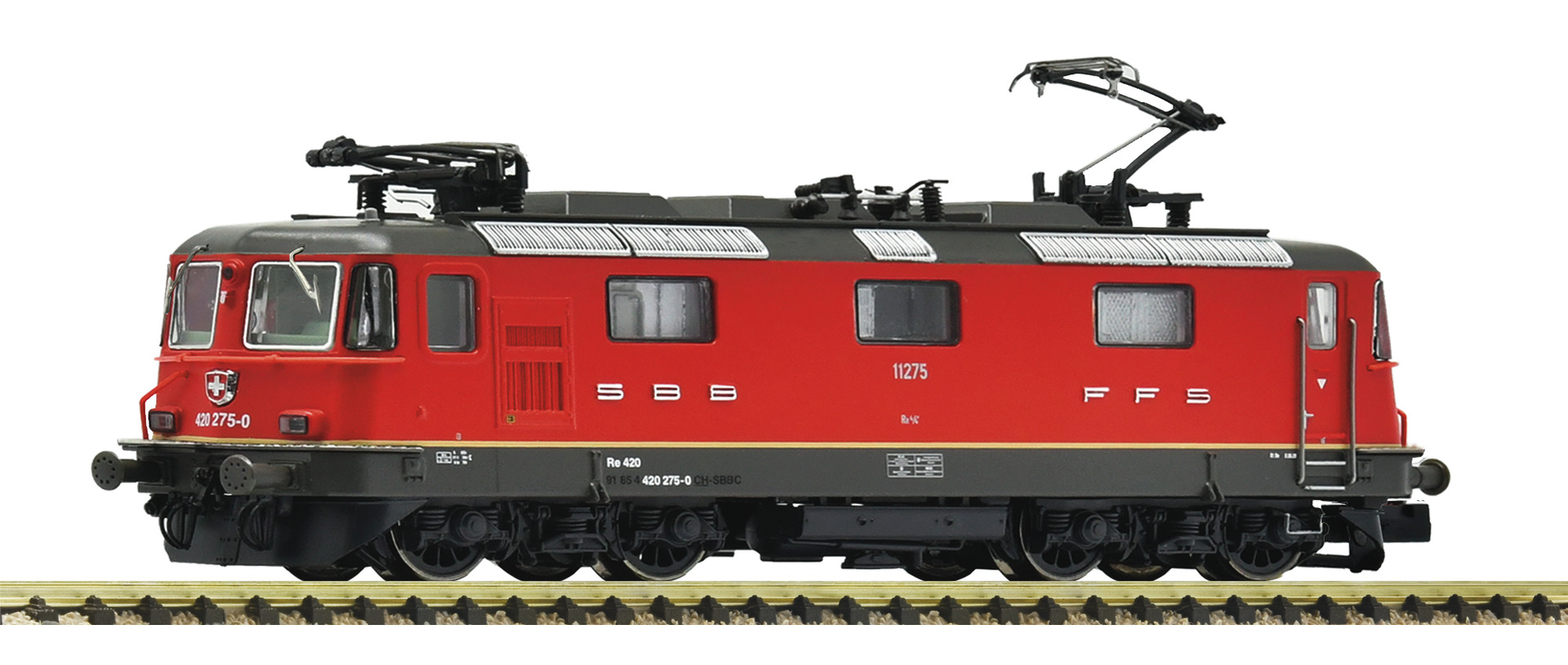
Electric locomotive Re 420 275-0 of the Swiss Federal Railways. Fine windscreen wipers as etched parts Version with air conditioning Delicately detailed pantographs Closed pilots included in the package Z21 driver's cab available The Re 4/4 II are universal locomotives and are therefore used to haul both passenger and goods trains. Heavy trains are typically operated in double traction together with a Re 6/6. With 277 units delivered between 1964 and 1985, the Re 4/4 II series represents the largest class of traction units in the SBB fleet. The locomotives have a power output of 4,700 kW and can reach a maximum speed of 140 km/h.
On order, shipped within 10-15 days

Electric locomotive Re 460 of the Swiss Federal Railways. Original version with "2000" on the front Die-cast metal chassis Closed front apron attached to the package Perfectly matches the EW-IV coaches - items 890326-890329 To implement the concept “Bahn 2000”, the SBB procured twenty-four Re 460 locomotives. A bit later, they had seventy-five more locomotives built to ensure a smooth operation, on the in 1994 introduced piggyback corridor running through Switzerland. The locomotives were later assigned to the passenger transport. Until today they are indispensable when it comes to the traction of the dense Swiss regular traffic.
In stock: 2 on the shelf, shipped within 1-3 days

Electric locomotive Re 6/6 of the Swiss Federal Railways. Completely new design 2022! Version in green livery with round lamps Fine windshield wipers as etched parts Filigree pantographs Closed obstacle deflectors attached to the package With an hourly output of 7.850 kW and a top speed of 140 km/h, the Re 6/6, which first entered service in 1972, is still one of the most powerful locomotives in Switzerland. The DB preferred the Bo'Bo' axle arrangement over the standard Co'Co' to achieve higher curve speeds. The three delicately designed bogies - further developed from the 4/4ˡˡ - also proved very advantageous in terms of wheel flange and track wear. You can find the Re 6/6 everywhere, be it in single traction, in multiple control operations among themselves or especially in freight traffic. However, most of the time, it runs under the designation Re 10/10 together with a Re 4/4ˡˡ or Re 4/4ˡˡˡ.
In stock: 1 on the shelf, shipped within 1-3 days

Electric locomotive Re 465 009 of the Swiss railway company BLS. Livery in refit design Closed front apron included Up until 2022, the 18 BLS locomotives type Re 465 were modernised and received a new livery. In order to facilitate use with Vectron and Traxx locomotives in freight transport, the appropriate multiple-unit controls were installed. Furthermore, an Ethernet Train Backbone has been implemented for traction of the Autotunnel and future GoldenPass trains. The names with which these locomotives were labelled are no longer used. The work was carried out at the company’s own factory in Bönigen.
In stock: 2 on the shelf, shipped within 1-3 days

2nd class passenger coach, type EW IV, type B, of the Swiss Federal Railways. In updated design Bogies with yaw dampers Item no. 6260017: modified running number The standard coaches of the type EW IV were delivered from 1981 to the SBB and form one of the largest Swiss coach fleets with 500 vehicles. The coach body is produced as a welded steel lightweight construction. Travellers loved these coaches due to their generously-sized interiors with face to face seating, and the fact that they ran smoothly even at high speeds. The EW IV coaches have been subjected to diverse modernisations, but still run today across almost all of Switzerland.
In stock: 3 on the shelf, shipped within 1-3 days

2nd class control cab coach type EW IV, type Bt, of the Swiss Federal Railways. In updated design Bogies with yaw dampers Open front apron for coupling installation included With function decoder for white and red light changeover in analogue as well as digital mode When the long-distance trains were converted into shuttle trains from the year 1996 onwards, the SBB procured 60 control cab coaches of the type IC Bt. Such Intercity shuttle trains comprise, in addition to the control cab coach, adapted intermediate EW IV coaches, former French baggage coaches and locomotives of the type Re 460. The design of the coach, featuring 62 seats, is based on the familiar Eurocity coach. The equipment also includes a wheelchair, pushchair and bicycle compartment, as well as a closed toilet system with bioreactor. The front end shape and the driver’s cab look very similar to the Re 460 locomotives, thus producing a homogeneous appearance.
In stock: 3 on the shelf, shipped within 1-3 days

Grain silo wagon, “Feldschlösschen” type Tgpps, operated by the Swiss Federal Railways. Finely detailed model with separately attached plug-in parts Delicately-crafted walkway grids Detailed platform railings
In stock: 1 on the shelf, shipped within 1-3 days

Swivel stake wagon, type Ks-w, of the Swiss Federal Railways. Brakeman's platform and round buffers The Swiss Federal Railways procured the type M5/Ks-w stake wagons, later designated Ks 330, from 1959 to 1970 in seven construction lots. Stake wagons are primarily intended for the transport of bulky goods. These include, for example, steel, wood, large machines and motor vehicles as well as prefabricated parts and heavy individual loads. They are also used to transport soil and gravel.
In stock: 3 on the shelf, shipped within 1-3 days
The Fleischmann families
For a Swiss layout
45 itemsSwiss locomotivesRe 460, Re 4/4 II, Re 6/6 and Ae 6/6 of SBB and SBB Cargo, BLS Re 465 and a Beilhack rotary snowplough.See the items19 itemsSwiss coaches and wagonsEW IV coaches of SBB and SOB, silo, stake and container wagons.See the itemsAll rolling stock
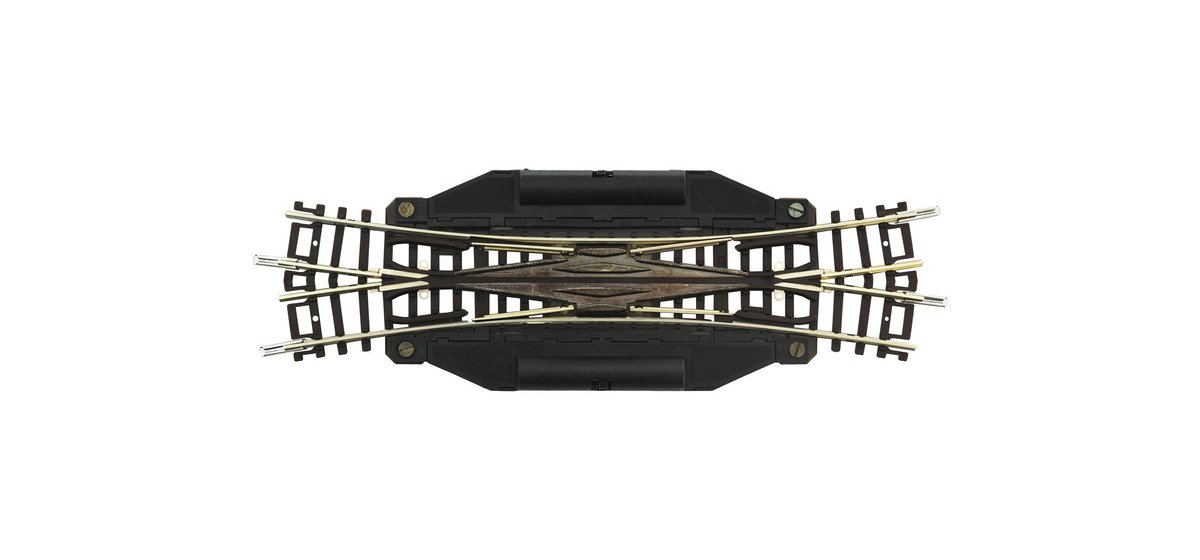
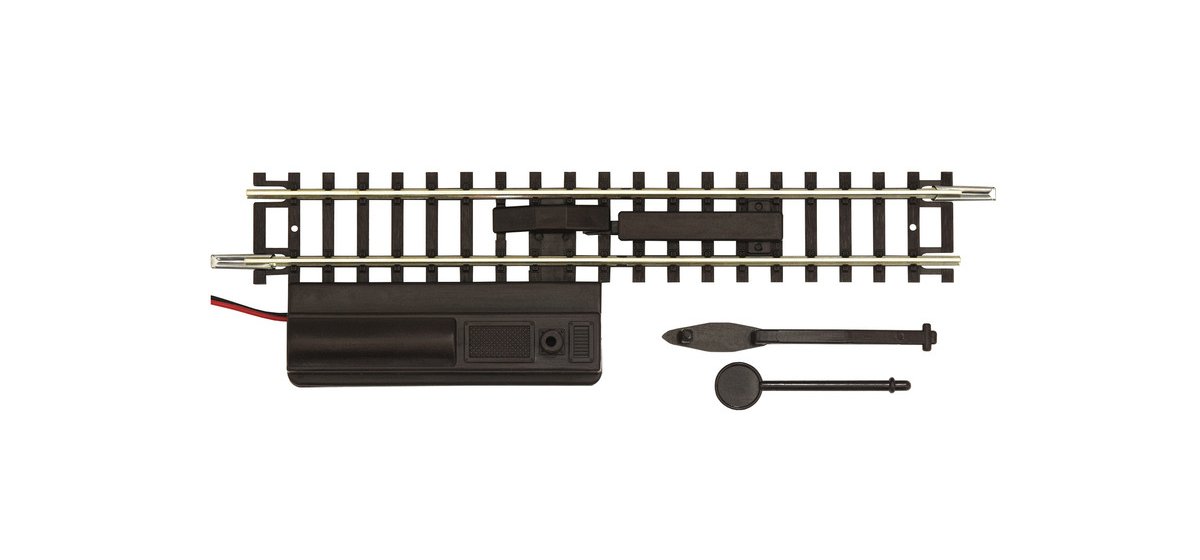
196 itemsLocomotivesSteam, diesel and electric locomotives from Switzerland, Germany, Austria and France, DC or with sound.See the items64 itemsPassenger coachesEW IV, ICE and Flixtrain coaches, coaches of the DB, DR and SNCF.See the items108 itemsGoods wagonsPocket, container, tank, covered and RoLa wagons, from Switzerland and Europe.See the itemsTrack and spare parts
All Fleischmann items

Electric locomotive Class 101 of the Deutsche Bahn. Version in traffic-red livery The Deutsche Bahn Class 101 was equipped with state-of-the-art technology as the successor to the tried-and-tested but technically obsolete Class 103. The three-phase asynchronous motors with single-axle drive had a continuous output of 6,400 kW and a starting tractive effort of 300 kN. This enabled them to reach a top speed of 220 km/h. A total of 145 Class 101 locomotives were brought into service between summer 1996 and the end of 1999. The first three locomotives were still painted in the Orient Red colour scheme.
Pre-order, release expected in Q4 2027

Electric locomotive 7193 833 of SBB Cargo International. Christened as "Matterhorn" With detailed roof design Cross-border use in freight transport In collaboration with Railcolor Design The 7193 833-9 electric locomotive is a modern Siemens Vectron MS and forms part of a new series of locomotives operated by SBB Cargo International. These multi-system locomotives were procured for cross-border European freight transport and, thanks to their specifications, can operate on various traction power supply and train protection systems. The locomotives are leased to SBB Cargo International by SüdLeasing. The 193 833, which entered service in 2026, bears the name "Matterhorn" and thus joins a class of locomotives named after famous Swiss mountain peaks. Its sister locomotives, 193 830 to 193 832, are named "Eiger", "Mönch" and "Jungfrau", for example.
Pre-order, release expected in Q4 2027

Electric locomotive Re 4/4 II 11181 of the Swiss Federal Railways. Elaborate printing in Bourret design Fine windscreen wipers as etched parts Filigree design of the pantographs Closed pilots included in the package Z21 driver's cab available The Re 4/4 11181 ran from 1983 onwards in a special, colourful livery. Its vibrant appearance was created by the artist Daniel Bourret from Wettingen and caused quite a stir on the railway lines over the years.
Pre-order, release expected in Q3 2027

Electric locomotive Ae 6/6 11485 of the Swiss Federal Railways. Cantonal locomotive "Thun" Red livery version, featuring the Next18 interface for the first time With a completely overhauled motor Finely detailed model with many separately applied plug-in parts Delicate pantographs with innovative mounting Fine windscreen wipers as etched parts To replace the legendary "Crocodiles", the SBB began procuring several batches totalling 120 Ae 6/6 locomotives from 1952 onwards for use on the Gotthard route. Each locomotive bore the coat of arms of a canton, a cantonal capital, or a major Swiss city. The city locomotive 11485 "Thun" entered service on 11 March 1965. The locomotive was given its red livery in 1996. With the 2012 timetable change, SBB Cargo took the Ae 6/6 (Ae 610) fleet out of service. In March 2013, locomotive 11485 "Thun" was scrapped.
Pre-order, release expected in Q2 2027

Railpool’s 188 125 “Frankreichpiercer” electric locomotive, leased to SBB Cargo International. New design! Nickname “Tour Eiffel” With detailed roof design Cross-border use in freight transport In cooperation with Railcolor Design The TRAXX 3 MS locomotives were developed specifically for cross-border transport on the most important European freight corridors. Thanks to their multi-system capability, they can operate on various power supply systems. The class reaches a top speed of 160 km/h and delivers up to 6,400 kW in AC operation. What sets this TRAXX generation apart is the optional ‘last-mile’ function – a small additional diesel engine with a battery, enabling the electric locomotives to cover short distances on sidings or in ports without overhead lines entirely without the need for a shunting locomotive.
Pre-order, release expected in 2028

Electric locomotive 193 818 from Siemens Mobility GmbH. Used as an advertising medium for Siemens. Provides services across Europe for various railway companies Sophisticated roof design Switchable high beam and separately switchable headlights/taillights The introduction of the Vectron opened a new chapter in Siemens locomotive history. An exceptionally aerodynamic design, excellent crash safety and great flexibility speak in favour of the Vectron. The advantage for customers of the Vectron lies in the countless possibilities for customising its technical features. A modular system ensures that the most diverse requirements of the respective railway companies can be met. Locomotives are available at different speeds and with power and train control systems. Siemens test, homologation or demonstration locomotives include all locomotives used by Siemens Mobility for its purpose. The locomotives have a dark grey frame and are painted white.
- Sound
On order, shipped within 10-15 days

Electric locomotive BB 422275 of the French State Railways. Version in "FRET" livery with the Carmillon logo Finely detailed model with separately applied plug-in parts Delicate pantograph design In digital operation, headlight switchable, true to the original French model Digitally switchable sound functions The BB 22200 is a French electric locomotive class designed for use on both SNCF’s 1.5 kV DC electrified network and its 25 kV 50 Hz AC electrified network. The locomotives’ design, featuring the so-called “nez cassé” (broken nose), was created by the Frenchman Paul Arzens, who was responsible for several SNCF locomotive designs at the time. Between 1976 and 1986, Alstom built a total of 205 locomotives across six production batches. From 1999 onwards, the locomotives were allocated to the various business divisions. Those assigned to the freight division received the grey/green/white FRET livery.
Pre-order, release expected in Q2 2027

Electric locomotive BB 426063 of the French State Railways. Rich detailing on the model with separately applied plug-in parts Filigree design of the two different pantographs In digital operation, light functions can be switched according to the French model Digitally switchable sound functions Between 1988 and 1998, 234 BB 26000 series dual-system electric locomotives were delivered to the French State Railways. Known under the brand name 'Sybic', these locomotives are used throughout France to haul all types of trains. These multi-purpose locomotives have a top speed of 200 km/h and a power output of 5.600 kW.
- Sound
On order, shipped within 10-15 days

Electric locomotive Ae 6/6 11407 of the Swiss Federal Railways. Update! Canton locomotive "Aargau" Green livery version with Next18 interface available for the first time With a completely redesigned motor Finely detailed model with many separately applied plug-in parts Delicate pantographs with innovative mounting Fine windscreen wipers as etched parts In digital operation with switchable headlight or tail light and driver's cab lighting As the successor to the legendary Crocodiles, the SBB procured a larger series of Ae 6/6 locomotives from 1952 onwards, intended as universal locomotives for use on the Gotthard route. Each locomotive bore the coat of arms of a canton, a cantonal capital, or a major Swiss city. For this reason, they became known as “coat of arms locomotives.
- Sound
Pre-order, ships on release

Electric locomotive class 1110 of the Austrian Federal Railways. New design! Rich detailing on the model with many separately applied plug-in parts Filigree pantographs with an innovative fastening Fine windscreen wipers as etched parts Lamp enclosures completely engraved Authentic bogies With Next18 Interface available for the first time In digital operation with switchable headlights or taillights and driver's cab illumination In the booming years following the war, the Austrian Federal Railways made a push for modernization, focusing on electrifying the most important railway lines in the country. This allowed for faster travel speeds and led to the introduction of the six-axle electric locomotive series 1010 in the mid-1950s. Based on this design, a series of locomotives with increased power output and a slightly lower maximum speed was developed for use on the mountain lines of the Tauern, Brenner, and Arlberg railway. These locomotives were incorporated into the ÖBB fleet as the 1110 class.
- Sound
On order, shipped within 10-15 days

Electric locomotive 1116 195 "Nightjet" of the Austrian Federal Railways. In the current "Nightjet" livery Authentic sound functions switchable via onboard decoder In digital operation with switchable high beam Licensed ÖBB model Z21 driver's cab available The locomotives previously in the Nightjet design have been given an overhaul. Instead of foiling, preference was given to a livery scheme in the colours of the latest Nightjet design. The previously used starry sky is now a thing of the past.
- Sound
On order, shipped within 10-15 days

Electric locomotive 190 311-7 of the RailAdventure. Elaborate roof design Used for test and transfer runs Authentic sound functions, switchable with an onboard decoder In digital operation with switchable high beam RailAdventure GmbH, based in Munich, is the market leader for test and transfer runs of rail vehicles across Europe. The company operates its own fleet of locomotives, coupling adapters, and brake wagons. Locomotive 190 311 was previously part of InRail’s fleet and has been part of RailAdventure’s inventory since May 2023, having since been redesigned to meet the company’s standards.
- Sound
On order, shipped within 10-15 days

Electric locomotive 230 003 of the Deutsche Reichsbahn Rich detailing on the model with many separately applied plug-in parts Elaborate roof design with authentic pantographs In digital operation with separately switchable headlights/taillights In the 1980s, the DR purchased electric dual-system locomotives to enhance its ability to manage cross-border traffic operations and the steadily growing traffic volume on the lines between the GDR and Czechoslovakia. However, due to a lack of experience in dual voltage technology (GDR: AC voltage 15 kV/16⅔ Hz, ČSSR: DC voltage 3 kV) and the full capacity production at the electric locomotive manufacturer LEW in Hennigsdorf, the locomotives were built based on the ČSD series ES 499.1 and 499.2. The Škoda locomotive factory had no prior experience in manufacturing locomotives for the AC system 15 kV/16⅔ Hz. Consequently, the AC equipment components were sourced from the GDR. The ČSD's demand led to a double order for Škoda, resulting in 15 locomotives of class 372 and 20 locomotives of class 230 for the DR.
- Sound
On order, shipped within 10-15 days

Electric locomotive Re 420 275-0 of the Swiss Federal Railways. Fine windscreen wipers as etched parts Version with air conditioning Delicately detailed pantographs Closed pilots included in the package In digital operation with switchable headlight/tail light and driver's cab lighting Z21 driver's cab available The Re 4/4 II are universal locomotives and are therefore used to haul both passenger and goods trains. Heavy trains are typically operated in double traction together with a Re 6/6. With 277 units delivered between 1964 and 1985, the Re 4/4 II series represents the largest class of traction units in the SBB fleet. The locomotives have a power output of 4,700 kW and can reach a maximum speed of 140 km/h.
- Sound
On order, shipped within 10-15 days

Electric locomotive Re 6/6 11626 of the Swiss Federal Railways. Version with air conditioning and distinctive "Schnauz"(nose) Filigree design of the pantographs Delicately crafted windscreen wipers as etched parts Closed pilots included in the package In digital operation with switchable headlight or tail light and driver's cab illumination The Re 6/6 is a six-axle electric locomotive operated by the Swiss Federal Railways, designed to replace the Ae 6/6 for heavy-duty service on the Gotthard line. First introduced in 1972, the Re 6/6 boasts an impressive hourly output of 7,850 kW and a top speed of 140 km/h, making it one of the most powerful locomotives still in service in Switzerland today.
- Sound
On order, shipped within 10-15 days

Electric locomotive 193 451 of SBB Cargo International. Baptismal name "Bavaria Munich" With detailed roof design Use in cross-border goods transport Swiss light change and high beam switchable In co-operation with Railcolor Design In July 2022, the Swiss company SBB Cargo International AG, in cooperation with SüdLeasing GmbH, ordered 20 Vectron multi-system locomotives from Siemens Mobility, including the XLoad equipment package. The Vectron XLoad is intended to improve friction coefficient utilization, enabling the transport of increased trailer loads.
- Sound
On order, shipped within 10-15 days

Electric locomotive double traction Re 10/10 of the Swiss Federal Railways. The set contains Re 6/6 11672 and Re 4/4 III 11361 Each locomotives are fully equipped Re 6/6 with the coat of arm "Balerna" Fine, separately applied ventilation grilles and windscreen wipers made of etched sheet metal Each locomotive in traffic red livery In digital operation with switchable headlights or taillights and driver's cab illumination The double traction of the Re 4/4ˡˡˡ and the Re 6/6 is named Re 10/10 for simplicity. This designation is derived from the ten powered axles that the double train has and, therefore, does not refer to a particular locomotive type. The Re 10/10 are used by the SBB almost exclusively in front of heavy goods trains on the Saint Gotthard line. The potent duo manages to pull the allowed maximum load of 1.400 tonnes with the towing hook at a speed of 80 kilometres per hour on a gradient of 26 per thousand.
- Sound
On order, shipped within 10-15 days

Electric locomotive 460 100-1 of the Swiss Federal Railways. Named "Tösstal" Closed front apron included in the package In digital operation with switchable headlight/tail light and driver's cab lighting In 1992, the first Re 460 of the Swiss Federal Railways rolled out of the SLM and BBC factory halls in Oerlikon, Switzerland. The locomotive became known to the public as the "Lok 2000" and came to symbolise fast and modern passenger transport in Switzerland. Its striking and highly aerodynamic design, with a large front window, roof panelling, and distinctive beading along the side walls, makes the Re 460 an eye-catching rail vehicle.
- Sound
On order, shipped within 10-15 days

Electric locomotive E 10 228 of the Deutsche Bundesbahn. Version with rain gutter, double lamps and all-around grab rail In digital operation with switchable headlights/taillights The E 10 class locomotives were put into service by the Deutsche Bundesbahn in 1956 for heavy express and fast trains on main lines. The locomotives reached a top speed of 150 km/h and had an output of 3,260 kW. During production (starting with E 10 216), the large single lamps were replaced by two smaller lamps (one as a headlight and one as a tail light); this version was designated E 10.2 according to the serial numbers.
- Sound
On order, shipped within 10-15 days

Electric locomotive 120 001 of the Deutsche Bundesbahn. Completely new design! Precise realisation of the pre-series locomotive Fine windscreen wipers Roof garden, multi-part and elaborately modelled Filigree pantographs In digital operation with switchable headlights/taillights and driver's cab illumination Five prototypes of the new Class 120 with three-phase asynchronous traction motors were built in 1979 and 1980. These locomotives were initially approved for 160 km/h. After extensive test runs, all of them were approved for 200 km/h, with the 120 001 reaching a record speed of 265 km/h in 1984.
- Sound
On order, shipped within 10-15 days

Electric locomotive 120.1 of the Deutsche Bahn. Completely new design! Precise realisation of the Class 120.1 Traffic red livery Fine windscreen wipers Roof garden, multi-part and elaborately modelled Filigree pantographs In digital operation with switchable headlights or taillights and drivers's cab illumination The class 120 three-phase electric locomotives heralded a technological upheaval in the railway industry that originated in Germany. This made it possible to overcome the existing limitations of conventional electric locomotive construction. The class 120 series locomotives were delivered from 1987 onwards. They differed from the pre-series models in a number of modifications (e.g. catenary, sandboxes and buffer beams). The locomotives were equally suitable for hauling fast passenger trains and heavy goods trains.
- Sound
On order, shipped within 10-15 days

Electric locomotive Ae 610 487 of the Swiss Federal Railways. Update! With “Langenthal” coat of arms With completely revised motor Rich detailing on the model with many separately applied plug-in parts Filigree pantographs with an innovative fastening Fine windscreen wipers as etched parts With Next18 sound decoder available for the first time In digital operation with switchable headlights or taillights and driver's cab illumination As a successor to the legendary Crocodiles, the SBB procured a larger series of Ae 6/6 locomotives as universal locomotives for the Gotthard from 1952. Each locomotive featured the coat of arms of a canton, a cantonal capital or a larger Swiss city. They were, therefore, referred to as "Coat of arms locomotives".
- Sound
On order, shipped within 10-15 days

Electric locomotive 1110 529-3 of the Austrian Federal Railways. Form variation! Finely detailed model with many separately attached plug-in parts Finely-detailed current collectors with innovative attachment Delicately crafted, etched windscreen wiper Complete engraving of the attached lamp sockets Prototypical bogies With switchable headlight/rear light and driver’s cab lighting in digital mode Class 1110 was an ÖBB electric locomotive designed as an express train locomotive that was delivered from the mid-1950s. In 1974 and 1975, ten 1110 units were fitted with DC dynamic brakes. The converted machines were given class designation 1110.5 while retaining the old serial number. Special distinguishing features were the large superstructures on the roof ends with the fans for the electric brakes as well as the single-arm roof current collectors. With a maximum speed of 110 km/h, the locomotives were used in both express and freight traffic service.
- Sound
Pre-order, ships on release

Electric locomotive 1044 282 of the Austrian Federal Railways. In the authentic "Kinder-Kunst-Lok" design Filigree pantographs Digitally switchable light and sound functions. The KINDER-KUNST-LOK was a joint project of ÖBB, ORF Confetti-TiVi and ROCO. In autumn 1998, a drawing competition for children up to the age of 12 was held under the motto "Bahn fahren – Natur bewahren". More than 60,000 participants from all over Austria took part. The jury chose as winners 5-year-old Nino Zorzi from Wiener Neudorf and 12-year-old Christian Jaritz from Graz. Their drawings were greatly enlarged and applied as film to the left and right sides of electric locomotive 1044 282-0. The locomotive therefore has two different sides. The cabs were designed with the mascots "Rolf Rüdiger" and "Confetti" from ORF Confetti-TiVi. The prototype could be seen in regular service in Austria and Germany until early 2000.
On order, shipped within 10-15 days