
Model railways in N scale
Fleischmann, SBB and BLS in N scale
SBB Re 460, Re 4/4 II and Re 6/6, BLS Re 465, EW IV coaches, wagons, track and spare parts: Fleischmann runs a Swiss layout at 1:160, with the rest of Europe alongside.
- 647items in the shop
- 1:160for your N layout
- Since 1887a brand born in Nuremberg
What Fleischmann brings to your layout
- Swiss railways: Re 460, Re 4/4 II, Re 6/6 and Re 620 of SBB and SBB Cargo, BLS Re 465, EW IV coaches of SBB and SOB, silo, stake and container wagons.
- Detail at 1:160: die-cast metal chassis on the Re 460, photo-etched wipers on the Re 6/6 and Re 4/4 II, fine pantographs, bogies with yaw dampers on the EW IV coaches.
- Analogue or with sound: many locomotives come in two versions: DC, or with an on-board decoder, sound, lights and cab lighting switchable in digital mode.
- A brand from Nuremberg: founded in 1887 by Jean Fleischmann, the brand now belongs to the same group as Roco and is devoted to N scale.
Our favourites for a Swiss layout
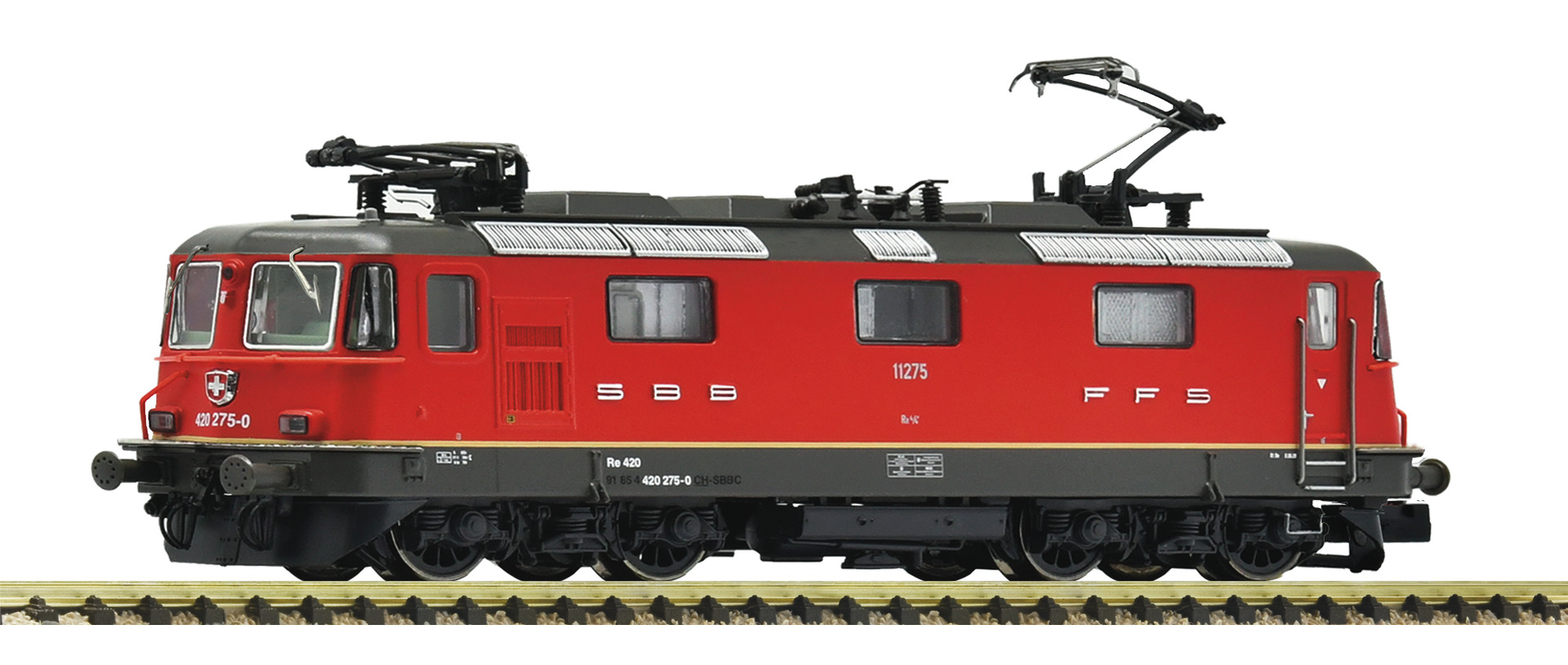
Electric locomotive Re 420 275-0 of the Swiss Federal Railways. Fine windscreen wipers as etched parts Version with air conditioning Delicately detailed pantographs Closed pilots included in the package Z21 driver's cab available The Re 4/4 II are universal locomotives and are therefore used to haul both passenger and goods trains. Heavy trains are typically operated in double traction together with a Re 6/6. With 277 units delivered between 1964 and 1985, the Re 4/4 II series represents the largest class of traction units in the SBB fleet. The locomotives have a power output of 4,700 kW and can reach a maximum speed of 140 km/h.
On order, shipped within 10-15 days

Electric locomotive Re 460 of the Swiss Federal Railways. Original version with "2000" on the front Die-cast metal chassis Closed front apron attached to the package Perfectly matches the EW-IV coaches - items 890326-890329 To implement the concept “Bahn 2000”, the SBB procured twenty-four Re 460 locomotives. A bit later, they had seventy-five more locomotives built to ensure a smooth operation, on the in 1994 introduced piggyback corridor running through Switzerland. The locomotives were later assigned to the passenger transport. Until today they are indispensable when it comes to the traction of the dense Swiss regular traffic.
In stock: 2 on the shelf, shipped within 1-3 days

Electric locomotive Re 6/6 of the Swiss Federal Railways. Completely new design 2022! Version in green livery with round lamps Fine windshield wipers as etched parts Filigree pantographs Closed obstacle deflectors attached to the package With an hourly output of 7.850 kW and a top speed of 140 km/h, the Re 6/6, which first entered service in 1972, is still one of the most powerful locomotives in Switzerland. The DB preferred the Bo'Bo' axle arrangement over the standard Co'Co' to achieve higher curve speeds. The three delicately designed bogies - further developed from the 4/4ˡˡ - also proved very advantageous in terms of wheel flange and track wear. You can find the Re 6/6 everywhere, be it in single traction, in multiple control operations among themselves or especially in freight traffic. However, most of the time, it runs under the designation Re 10/10 together with a Re 4/4ˡˡ or Re 4/4ˡˡˡ.
In stock: 1 on the shelf, shipped within 1-3 days

Electric locomotive Re 465 009 of the Swiss railway company BLS. Livery in refit design Closed front apron included Up until 2022, the 18 BLS locomotives type Re 465 were modernised and received a new livery. In order to facilitate use with Vectron and Traxx locomotives in freight transport, the appropriate multiple-unit controls were installed. Furthermore, an Ethernet Train Backbone has been implemented for traction of the Autotunnel and future GoldenPass trains. The names with which these locomotives were labelled are no longer used. The work was carried out at the company’s own factory in Bönigen.
In stock: 2 on the shelf, shipped within 1-3 days

2nd class passenger coach, type EW IV, type B, of the Swiss Federal Railways. In updated design Bogies with yaw dampers Item no. 6260017: modified running number The standard coaches of the type EW IV were delivered from 1981 to the SBB and form one of the largest Swiss coach fleets with 500 vehicles. The coach body is produced as a welded steel lightweight construction. Travellers loved these coaches due to their generously-sized interiors with face to face seating, and the fact that they ran smoothly even at high speeds. The EW IV coaches have been subjected to diverse modernisations, but still run today across almost all of Switzerland.
In stock: 3 on the shelf, shipped within 1-3 days

2nd class control cab coach type EW IV, type Bt, of the Swiss Federal Railways. In updated design Bogies with yaw dampers Open front apron for coupling installation included With function decoder for white and red light changeover in analogue as well as digital mode When the long-distance trains were converted into shuttle trains from the year 1996 onwards, the SBB procured 60 control cab coaches of the type IC Bt. Such Intercity shuttle trains comprise, in addition to the control cab coach, adapted intermediate EW IV coaches, former French baggage coaches and locomotives of the type Re 460. The design of the coach, featuring 62 seats, is based on the familiar Eurocity coach. The equipment also includes a wheelchair, pushchair and bicycle compartment, as well as a closed toilet system with bioreactor. The front end shape and the driver’s cab look very similar to the Re 460 locomotives, thus producing a homogeneous appearance.
In stock: 3 on the shelf, shipped within 1-3 days

Grain silo wagon, “Feldschlösschen” type Tgpps, operated by the Swiss Federal Railways. Finely detailed model with separately attached plug-in parts Delicately-crafted walkway grids Detailed platform railings
In stock: 1 on the shelf, shipped within 1-3 days

Swivel stake wagon, type Ks-w, of the Swiss Federal Railways. Brakeman's platform and round buffers The Swiss Federal Railways procured the type M5/Ks-w stake wagons, later designated Ks 330, from 1959 to 1970 in seven construction lots. Stake wagons are primarily intended for the transport of bulky goods. These include, for example, steel, wood, large machines and motor vehicles as well as prefabricated parts and heavy individual loads. They are also used to transport soil and gravel.
In stock: 3 on the shelf, shipped within 1-3 days
The Fleischmann families
For a Swiss layout
45 itemsSwiss locomotivesRe 460, Re 4/4 II, Re 6/6 and Ae 6/6 of SBB and SBB Cargo, BLS Re 465 and a Beilhack rotary snowplough.See the items19 itemsSwiss coaches and wagonsEW IV coaches of SBB and SOB, silo, stake and container wagons.See the itemsAll rolling stock
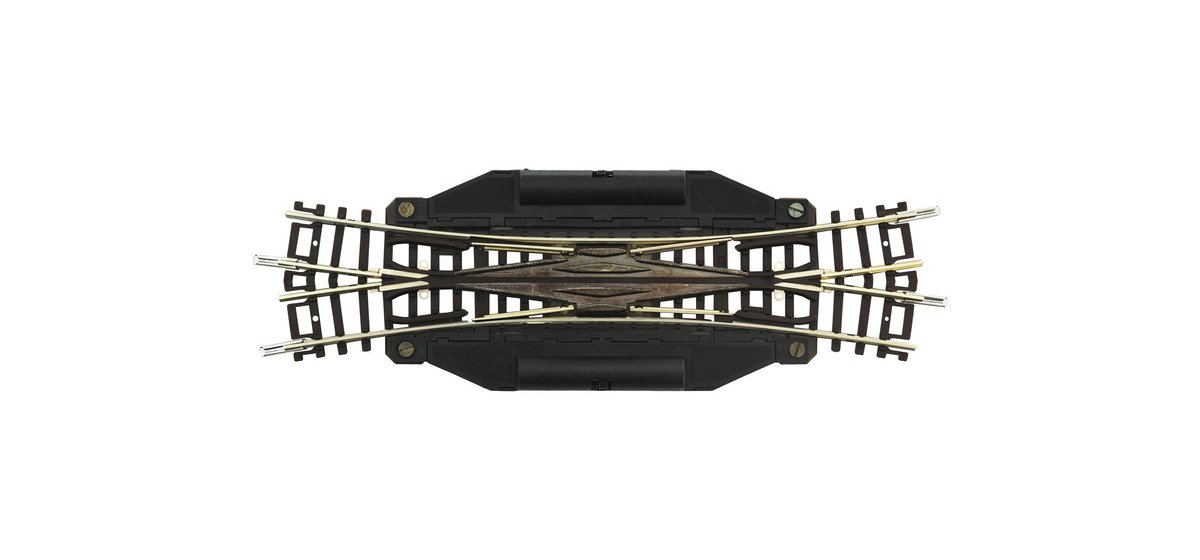
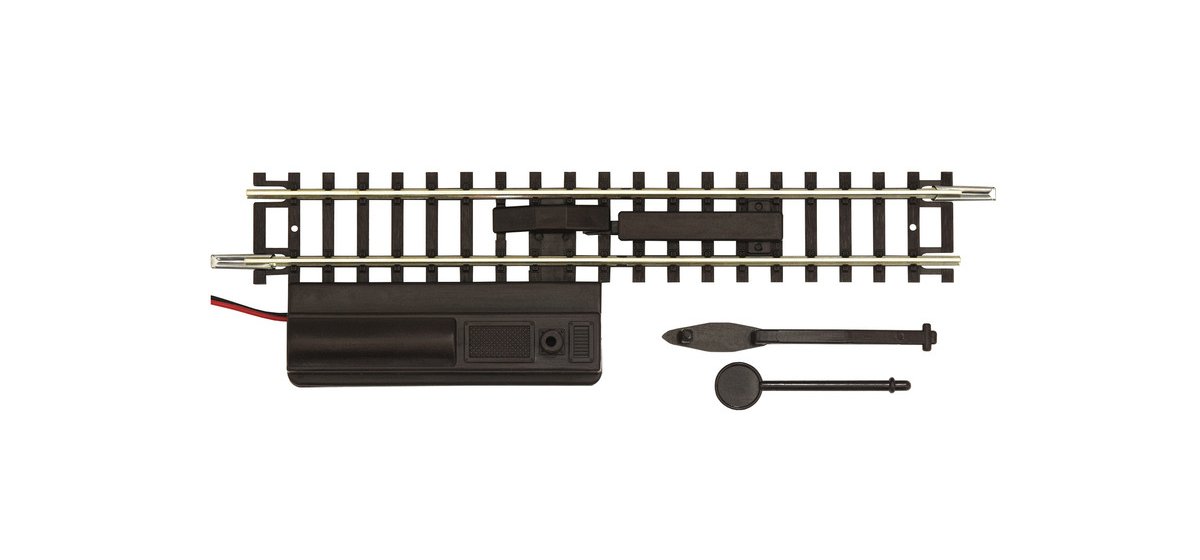
196 itemsLocomotivesSteam, diesel and electric locomotives from Switzerland, Germany, Austria and France, DC or with sound.See the items64 itemsPassenger coachesEW IV, ICE and Flixtrain coaches, coaches of the DB, DR and SNCF.See the items108 itemsGoods wagonsPocket, container, tank, covered and RoLa wagons, from Switzerland and Europe.See the itemsTrack and spare parts
All Fleischmann items

Electric locomotive 141 152 of the Deutsche Bundesbahn. In orient-red livery, with a lower front panel "Latz" Version featuring the Bundesbahn logo Digitally switchable sound functions The Class E 41 locomotives (Class 141 from 1968 onward) were first delivered to the Deutsche Bundesbahn in 1956 for light and mixed service on main lines. They had a maximum speed of 120 km/h and a continuous power output of 2,310 kW. As the only class in the standardised locomotive programme, they were fitted with a tap changer on the low-voltage side of the transformer. The tap changer produced a characteristic sound, which, together with the large jumps in tractive effort, led to the nickname "Knallfrosch" ("Firecracker"). From 1987 onwards, the locomotives were given an orient red livery.
Pre-order, release expected in Q3 2027

Electric locomotive 372 001 of the Czechoslovak State Railways. Finely detailed model with many separately applied plug-in parts Detailed roof design with authentic pantographs In digital operation with switchable headlight/tail light In the 1980s, CSD and the DR decided to procure dual-system locomotives to cope with the steadily increasing traffic and simplify operations for cross-border services on the Berlin–Dresden–Prague route. In 1988, one prototype was delivered to each of the two railways. The CSD prototype, 372 001, was finished in a blue livery with a yellow waist stripe and a grey roof. Following a four-year testing period, the findings were incorporated by the manufacturers into series production, and from 1991 onwards, a further 14 Class 372 locomotives were delivered to CSD and 19 Class 230 locomotives to the DR.
Pre-order, release expected in Q3 2027

Electric locomotive 372 008 of the Czechoslovak State Railways. Finely detailed model with many separately applied plug-in parts Detailed roof design with authentic pantographs In digital operation with switchable headlight/tail light In the 1980s, CSD and the DR decided to procure dual-system locomotives to cope with the steadily increasing traffic and simplify operations for cross-border services on the Berlin–Dresden–Prague route. However, the locomotive manufacturer in the GDR, LEW Hennigsdorf, was operating at full capacity at the time, so the contract was awarded to the Czech locomotive manufacturer Škoda, which already had considerable experience with such locomotives. The CSD Classes ES 499.1 and 499.2 provided a suitable basis. However, the German 15 kV/16⅔ Hz electrical system represented new territory. The contract comprised 15 Class 372 locomotives for ČSD and 20 Class 230 locomotives for the DR. The universal locomotives were used for passenger and freight services. With an hourly output of 3,260 kW, they reached a top speed of 120 km/h. In Germany, the class is affectionately known as the "Knödelpresse" (dumpling press), whilst its Czech counterpart is referred to as the "Bastard" in the neighbouring country.
Pre-order, release expected in Q2 2027

Electric locomotive BB 26092 of the French State Railways. "Fantôme" livery Finely detailed model with separately applied plug-in parts Finely detailed versions of the two different pantographs In digital operation, switchable headlight based on French practice Digitally switchable sound functions Between 1988 and 1998, 234 dual-system BB 26000 series electric locomotives were delivered to the French State Railways. Known by the trade name "Sybic", these locomotives are used throughout France to haul all types of trains. These multi-purpose locomotives reach a top speed of 200 km/h and are capable of delivering a power output of 5,600 kW.
Pre-order, release expected in Q3 2027

Electric locomotive 1293 164 of the Austrian Federal Railways. In the "Vectron No. 2000" design With a detailed roof design Operates in cross-border freight transport In digital mode with switchable main beam and switchable headligh/tail light Licensed ÖBB model During a ceremonial event at the Munich factory on 23 July 2026, Siemens Mobility handed over the 2,000th Vectron locomotive to the Austrian Federal Railways. This anniversary locomotive – 1293 164 – was built for ÖBB. With almost 3,000 locomotives sold since its market launch in 2012 and orders from more than 115 customers, the Vectron is Europe’s best-selling and most versatile locomotive platform. The locomotives are authorised for operation in 20 countries and hold unique certification for speeds of up to 230 km/h in passenger services.
Pre-order, release expected in Q3 2027

Electric locomotive 1608 of the Dutch State Railways. Original version without air conditioning Locomotive number in the centre of the side panel Finely detailed model with separately attached plug-in parts Delicate design of the pantographs In digital operation with switchable headlight/tail light and driver's cab lighting Based on the French BB 7200 electric locomotive, the NS acquired the four-axle electric locomotives of the 1600 series. Introduced in 1981, they were the most powerful in the NS fleet. With a service weight of 83 tonnes, they delivered 4,540 kW and reached a top speed of 140 km/h.
Pre-order, release expected in Q4 2027

Electric locomotive 143 352 of the DB Bahnbau Group. In the eye-catching livery of Bahnbau Gruppe Digitally switchable sound functions The Class 143 electric locomotives shaped Deutsche Bahn’s regional and S-Bahn services for decades. Some of these locomotives are still in service with the DB Bahnbau Group today, carrying out construction, survey and work train operations across the entire German rail network. With their distinctive yellow livery, they can be seen on construction sites as well as on transfer and supply runs, where they provide a valuable service thanks to their robust engineering and high reliability.
Pre-order, release expected in Q3 2027

Electric locomotive 120 160 of DB Netz AG. Fine windscreen wipers Highly detailed and multi-part roof equipment Delicate design of the pantographs In digital mode with switchable headlight/tail light and driver's cab lighting Electric locomotive 120 160-7 belongs to the legendary DB Class 120, the first series-produced three-phase electric locomotive class of the Deutsche Bundesbahn. Built in 1988, the locomotive was initially used on high-quality InterCity services and played a key role in introducing modern three-phase drive technology, which later became standard in European locomotive production. After its time in long-distance service, the locomotive was converted in 2005 to 120 502-0 for DB Systemtechnik and, from 2013, was deployed as 91 80 6120 160-7 D-DB in the yellow livery of DB Netz AG. In this role, it serves as a hauling locomotive for measurement and test trains and operates nationwide on routes to monitor and test railway infrastructure.
Pre-order, release expected in Q4 2027

Electric locomotive 120 145 of Widmer Rail Services (WRS). Fine windscreen wipers Highly detailed and multi-part roof equipment Delicate design of the pantographs In digital mode with switchable headlight/tail light and driver's cab lighting The 120 145 belongs to the pioneering DB Class 120, the world's first series-produced three-phase electric locomotive class. Introduced into service in the late 1980s, the locomotive was a hallmark of the Deutsche Bahn's high-quality long-distance services for many years and paved the way for the development of modern three-phase electric locomotives. Since 2019, the locomotive has been part of the Widmer Rail Services (WRS) fleet. In its distinctive ultramarine blue livery, it is used for special services, transfer runs and freight transport.
Pre-order, release expected in Q4 2027

Electric locomotive Class 101 of the Deutsche Bahn. Version in traffic-red livery In digital mode with switchable shunting light and switchable headlight/tail light Digitally switchable sound functions The Deutsche Bahn Class 101 was equipped with state-of-the-art technology as the successor to the tried-and-tested but technically obsolete Class 103. The three-phase asynchronous motors with single-axle drive had a continuous output of 6,400 kW and a starting tractive effort of 300 kN. This enabled them to reach a top speed of 220 km/h. A total of 145 Class 101 locomotives were brought into service between summer 1996 and the end of 1999. The first three locomotives were still painted in the Orient Red colour scheme.
Pre-order, release expected in Q4 2027

Electric locomotive 7193 833 of SBB Cargo International. Christened as "Matterhorn" With detailed roof design Cross-border use in freight transport In digital mode with switchable main beam and switchable head/tail lights In collaboration with Railcolor Design The 7193 833-9 electric locomotive is a modern Siemens Vectron MS and forms part of a new series of locomotives operated by SBB Cargo International. These multi-system locomotives were procured for cross-border European freight transport and, thanks to their specifications, can operate on various traction power supply and train protection systems. The locomotives are leased to SBB Cargo International by SüdLeasing. The 193 833, which entered service in 2026, bears the name "Matterhorn" and thus joins a class of locomotives named after famous Swiss mountain peaks. Its sister locomotives, 193 830 to 193 832, are named "Eiger", "Mönch" and "Jungfrau", for example.
Pre-order, release expected in Q4 2027

Electric locomotive Re 4/4 II 11181 of the Swiss Federal Railways. Elaborate printing in Bourret design Fine windscreen wipers as etched parts Delicately detailed pantographs Closed pilots included in the package In digital operation with switchable headlight or tail light and driver's cab lighting Z21 driver's cab available The Re 4/4 11181 ran from 1983 onwards in a special, colourful livery. Its vibrant appearance was created by the artist Daniel Bourret from Wettingen and caused quite a stir on the railway lines over the years.
Pre-order, release expected in Q3 2027

Electric locomotive Ae 6/6 11485 of the Swiss Federal Railways. Cantonal locomotive "Thun" Red livery version, featuring the Next18 interface for the first time With a completely overhauled motor Finely detailed model with many separately applied plug-in parts Delicate pantographs with innovative mounting Fine windscreen wipers as etched parts In digital mode with switchable headlight/tail light and driver's cab lighting To replace the legendary "Crocodiles", the SBB began procuring several batches totalling 120 Ae 6/6 locomotives from 1952 onwards for use on the Gotthard route. Each locomotive bore the coat of arms of a canton, a cantonal capital, or a major Swiss city. The city locomotive 11485 "Thun" entered service on 11 March 1965. The locomotive was given its red livery in 1996. With the 2012 timetable change, SBB Cargo took the Ae 6/6 (Ae 610) fleet out of service. In March 2013, locomotive 11485 "Thun" was scrapped.
Pre-order, release expected in Q2 2027

Railpool’s 188 125 “Frankreichpiercer” electric locomotive, leased to SBB Cargo International. New design! Nickname “Tour Eiffel” With detailed roof design Cross-border use in freight transport Digital operation with switchable headlight/tail light In cooperation with Railcolor Design The TRAXX 3 MS locomotives were developed specifically for cross-border transport on the most important European freight corridors. Thanks to their multi-system capability, they can be operated on various power supply systems. The class reaches a top speed of 160 km/h and delivers up to 6,400 kW in AC operation. What sets this TRAXX generation apart is the optional ‘last-mile’ function – a small additional diesel engine with a battery, enabling the electric locomotives to cover short distances on sidings or in ports without overhead lines entirely without the need for a shunting locomotive.
Pre-order, release expected in 2028

4-piece electrical multiple unit trainset for the Deutsche Bahn ICE-2 multiple unit. Consisting of a 402 class multiple unit, a 1st class coach type 805.0, an “on-board restaurant” coach type 807.0 and a controller car type 808.0. Update! For the first time with Next18 interface and LED headlight In “Redesign 2005” operating condition With green stripes on the end car Deutsche Bahn uses the ICE 2 as a half train consisting of a traction unit, six intermediate coaches and a controller car. If necessary, two half trains are coupled together to form a full set. If possible, the full sets run controller car to controller car in order to achieve the speed of 250 km/h at the ends of the train with the traction units in front. However, the traction unit/controller car or traction unit/traction unit combinations are also possible. The traction units of the 402 class differ from their predecessors mainly with the modified front, which can be opened for coupling. The controller car is also equipped with this front.
On order, shipped within 10-15 days

Wagon set with four intermediate coaches for the ICE-2 multiple unit of the Deutsche Bahn. Consisting of a 1st class wagon type 805.3, a 2nd class wagon type 806.0, a 2nd class wagon type 806.3 and a 2nd class wagon type 806.6. In “Redesign 2005” operating condition Also suitable for ICE-2 start set, art. no. 931884 Deutsche Bahn uses the ICE 2 as a half train consisting of a traction unit, six intermediate coaches and a controller car. If necessary, two half trains are coupled together to form a full set. If possible, the full sets run controller car to controller car in order to achieve the speed of 250 km/h at the ends of the train with the traction units in front. However, the traction unit/controller car or traction unit/traction unit combinations are also possible. The traction units of the 402 class differ from their predecessors mainly with the modified front, which can be opened for coupling. The controller car is also equipped with this front.
On order, shipped within 10-15 days

DMU class 601 "Zughotel" of the RailAdventure. The set contains two power cars (one motorised) and two intermediate coaches. One-time edition Elegant design as a “Zughotel” Equipped with interior lighting from the factory RailAdventure operates the "Zughotel" in Braunschweig to offer optimal customer service. It is composed of former coaches from the legendary VT 11.5 train of the Deutsche Bundesbahn.
On order, shipped within 10-15 days

Diesel multiple unit set, Class 601, of the Deutsche Reichsbahn. The set contains two power cars (one motorised) and four intermediate coaches. Version as IC "Max Liebermann" Operating condition: 1990 Livery and lettering true to the original model Equipped with factory-installed interior lighting One of the legendary TEE multiple units made a spectacular comeback in the summer of 1990. Leased by the Deutsche Reichsbahn as a ten-coach train formation, including a spare power car, it operated regularly as InterCity "Max Liebermann" between Hamburg and Berlin from August 1 to September 29, just before the reunification of East and West Germany, following in the footsteps of an equally legendary predecessor. As early as the 1930s, the DRG had established a multiple-unit rail link between these two cities with the "Flying Hamburger".
On order, shipped within 10-15 days

Wagon set with four supplementary coaches for the "Max Liebermann" diesel multiple unit of the Deutsche Reichsbahn. The set contains a compartment coach and three open coaches. Design as IC "Max Liebermann" Operating condition: 1990 Equipped with factory-installed interior lighting Matches the train set items 7760010 and 7770010 One of the legendary TEE multiple units made a spectacular comeback in the summer of 1990. Leased by the Deutsche Reichsbahn as a ten-coach train formation, including a spare power car, it operated regularly as InterCity "Max Liebermann" between Hamburg and Berlin from August 1 to September 29, just before the reunification of East and West Germany, following in the footsteps of an equally legendary predecessor. As early as the 1930s, the DRG had established a multiple-unit rail link between these two cities with the "Flying Hamburger".
On order, shipped within 10-15 days

4-piece starter set for the ICE 1 multiple unit of the Deutsche Bahn. The set contains a class 401.0 power car (motorised), a type 801.8 1st class coach, a type 802.8 2nd class coach and a type 401.5 power car (not motorised). Power cars in "30 years of ICE" design One power car is motorised The era of high-speed transport at the Deutsche Bundesbahn began in the summer of 1991 with the introduction of the ICE 1. For the first time, an entirely new railway system was introduced, comprising newly developed multiple units, dedicated high-speed lines, and comprehensive timetable restructuring. The railcar concept, featuring closed, wide gangways between coaches, was groundbreaking for modern high-speed rail travel. With a maximum service speed of 280 km/h and a high level of passenger comfort, the ICE 1 revolutionised long-distance rail transport and gained significant market share in competition with both road and air travel.
Pre-order, ships on release

Wagon set of four supplementary coaches for the ICE 1 multiple unit "30 Years of ICE" of the Deutsche Bahn. The set contains a 2nd class service coach, type 803.1, a 2nd class coach, type 802.4, and two 2nd class coaches, type 802.0.
Pre-order, ships on release

Wagon set of four supplementary coaches for the ICE 1 multiple unit "30 Years of ICE" of the Deutsche Bahn. The set contains a 1st class coach, type 801.4, a "Bord Restaurant" coach, 804.0, and a 2nd class coach, type 802.3.
Pre-order, ships on release

Diesel multiple unit 642 039-1 of the Deutsche Bahn. Elaborate printing Ideal for simulating regional transport on diesel lines Inserted windows Integrated die-cast metal chassis in both vehicles Close coupling via a Jacobs bogie between the vehicles. Dummy couplings fitted at the vehicle ends. An adapter with a coupling pocket according to NEM 355, along with PROFI couplings 9545 for multiple traction, is included.
On order, shipped within 10-15 days

Diesel Multiple Unit 642 213 of the Deutsche Bahn. Version with the Bahnland Bayern logo Fitted windows Die-cast metal chassis integrated into both vehicles Close coupling via a Jacobs bogie between the vehicles. Dummy couplings fitted at the vehicle ends. An adapter with a coupling pocket according to NEM 355, along with PROFI couplings 9545 for multiple traction, is included.
Pre-order, release expected in Q4 2027