
Model trains in H0, N, TT and G
Piko, Swiss and European trains in H0 and N
Re 4/4 I, Ae 4/7, RABDe 12/12 "Mirage", Giruno, EW I coaches of the SBB and BLS: Piko reproduces Swiss railways in H0 and N, often for both DC and AC, and also covers TT and large-scale G for the garden.
- 3647items in the shop
- G, H0, TT and Nfour scales
- Since 1949founded in Chemnitz
What Piko brings to your layout
- Swiss railways: Re 4/4 I, Ae 4/7, Ae 6/6, Re 6/6, RBe 4/4, RABDe 12/12 "Mirage", Giruno, SBB Cargo and BLS Vectron, EW I and EW II coaches of the SBB and BLS.
- DC or AC: many H0 models come in both a DC and an AC version, with or without sound.
- Everything for H0 and G: locomotives, coaches and wagons, buildings, track, starter sets and an in-house digital system. In TT and N, locomotives and rolling stock.
- A company from Sonneberg: founded in 1949 in Chemnitz, Piko is based in Sonneberg, Thuringia, and has been owned by René F. Wilfer since 1992.
Our favourites for a Swiss layout
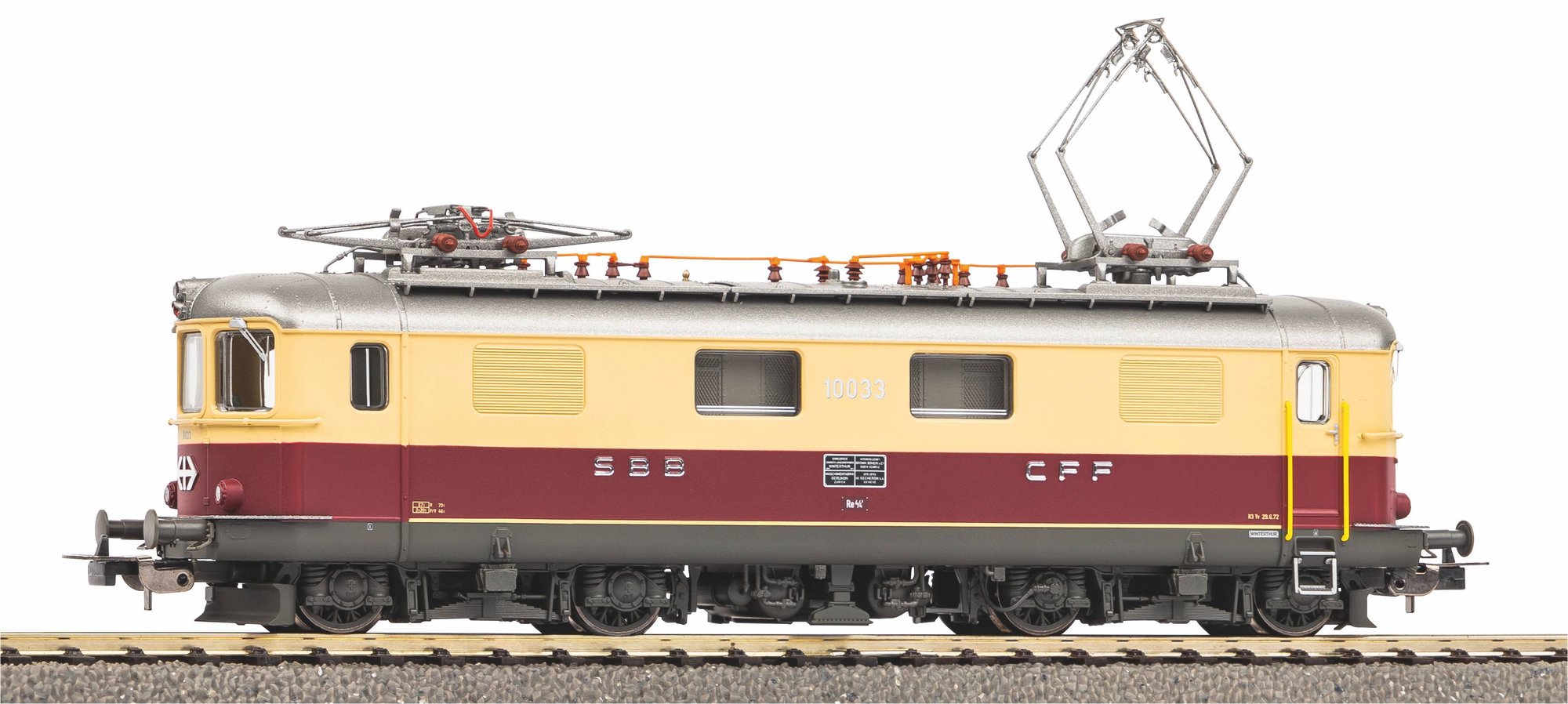
New for 2024: SBB Re 4/4 electric locomotive in TEE livery, Era IV. The model impresses with its well-proportioned body, finely detailed metal pantographs, a prototypical roof equipment layout, and numerous separately applied details. Technologically, the model is up to date, boasting excellent running characteristics and modern LED lighting. The locomotive comes fitted with a PSD XP sound decoder and features a wide range of digital and sound functions.
- 2-rail, direct current
- Sound
In stock: 1 on the shelf, shipped within 1-3 days

The prototype: During overhauls, the roofs received a new coat of paint mixed with micaceous iron oxide, which was more resistant to damage. In addition, a train dispatch switch was fitted, the rounded roof ventilators were replaced by rectangular ones and lettering and pictograms current for that period were applied. Features and properties: Tooling change, condition of the 1980s. Additional switch for train dispatch. Rectangular roof ventilators. Three roof resistors instead of four on the intermediate coach, true to the prototype. Radio antenna on the two end coaches. Dark grey roof colour. Operating number 1116. New lettering and pictograms. Without the yellow 1st class stripe above the luggage compartment. Delicate bogies, pantographs and windscreen wipers. Multicoloured interior. Drive in the intermediate coach. Powerful 5-pole motor with two flywheels. Four powered axles with two traction tyres. Current-carrying close coupling between the individual coaches. Buffer capacitor. Interior lighting, cab lighting and driver's desk lighting. Luggage compartment lighting that can be switched separately. Different front aprons. Trains can be run in multiple-unit operation thanks to the current-carrying close coupling and the new NEM pocket. Imitation GF coupling (cannot be uncoupled) and an uncouplable standard coupling are included. Exclusive model for Switzerland
- 2-rail, direct current
- Sound
In stock: 1 on the shelf, shipped within 1-3 days

Item no.: 21692
- 2-rail, direct current
In stock: 2 on the shelf, shipped within 1-3 days

Item no.: 96859
- 3-rail, alternating current
- Sound
On order, shipped within 4-5 days

New for 2024: The German workhorse locomotive in the version as Am 847 of the Swiss Sersa Group in Era V. The specific features of the prototype were taken into account during the design and precisely transferred to the model. A particular highlight is the locomotive's cooling system with finely etched grilles and the fan wheel visible underneath. The plastic-looking engravings on the hoods and cab additionally structure the functional vehicle body. The overall impression is rounded off by the filigree bogies with numerous separately applied parts. The model comes with switchable cab and control desk lighting from the factory. Thanks to the factory-integrated PSD XP sound decoder with the largest possible speaker, the sound of the prototype is perfectly brought out on the model railway layout.
- 2-rail, direct current
- Sound
In stock: 1 on the shelf, shipped within 1-3 days

The locomotive has an mfx+ digital decoder. It also has sound and light functions. The locomotive is equipped with a regulated high-performance drive. The locomotive has a centrally mounted motor. The locomotive has a flywheel. The locomotive has traction tyres. The locomotive has 3 axles powered. The locomotive has close coupling with a guide mechanism. The locomotive has NEM pockets. The locomotive has bogies. The locomotive has buffers. The locomotive has buffer beams. The locomotive has handrails. The locomotive has brake hoses. The locomotive has brake lines. The locomotive has separately applied details. The locomotive has truss rods. The locomotive has a brake platform. The locomotive has end panel reinforcement. The locomotive has a pantograph. The locomotive has headlights. The locomotive has dual headlights. The locomotive has tail lamps. The locomotive has cab lighting. The locomotive has control desk lighting. The locomotive has firebox flickering. The locomotive has double "A" light function. The locomotive has LEDs. The locomotive has warm white lighting. The locomotive has maintenance-free lighting. The locomotive has a smoke unit. The locomotive has dynamic smoke output. The locomotive has a tender. The locomotive has piston rod protective sleeves. The locomotive has oil firing. The locomotive has a cab. The locomotive has smoke deflectors. The locomotive has a smoke box. The locomotive has a boiler. The locomotive has a firebox. The locomotive has a dome. The locomotive has a dome cover. The locomotive has cylinder steam. The locomotive has a bell. The locomotive has a whistle. The locomotive has sand boxes. The locomotive has windscreen wipers. The locomotive has skirting. The locomotive has steps. The locomotive has shunting steps. The locomotive has access ladders. The locomotive has a working platform. The locomotive has a running plate. The locomotive has downpipes. The locomotive has roof conduits. The locomotive has roof equipment. The locomotive has discharge pipes. The locomotive has a replacement boiler. The locomotive has Witte smoke deflectors. The locomotive has Wagner smoke deflectors. The locomotive has valve gear parts. The locomotive has a smoke box door. The locomotive has an upper boiler section. The locomotive has a tender body. The locomotive has a coal tender. The locomotive has a main frame. The locomotive has a frame. The locomotive has a locomotive body. The locomotive has a locomotive section. The locomotive has a body. The locomotive has a metal body. The locomotive has cab doors. The locomotive has driver's cabs. The locomotive has cab interior details. The locomotive has a driver figure. The locomotive has a driver. The locomotive has a wheel arrangement. The locomotive has an axle bearing. The locomotive has wheel sets. The locomotive has metal wheel sets. The locomotive has driving wheel sets. The locomotive has carrying wheel sets. The locomotive has an Express wheel set. The locomotive has a disc brake. The locomotive has a braking system. The locomotive has a hand brake. The locomotive has a hand brake crank. The locomotive has a sand pipe. The locomotive has a silencer. The locomotive has a metal part. The locomotive has a metal construction. The locomotive has cooling tubes. The locomotive has transformer oil. The locomotive has bronze. The locomotive has a grain size. The locomotive has roof superstructures. The locomotive has roof walkways. The locomotive has roof ventilators. The locomotive has roof shapes. The locomotive has a roof pantograph. The locomotive has a single-arm pantograph. The locomotive can be raised and lowered. The locomotive has insulators. The locomotive has a coupling pocket. The locomotive has a system coupling. The locomotive has an oval of track. The locomotive has a circle of track. The locomotive has track radii. The locomotive has a track connection box. The locomotive has track fastening. The locomotive has a re-railer. The locomotive has an elevated railway. The locomotive has elevated railway pillars. The locomotive has an extension. The locomotive has freight trains. The locomotive has passenger trains. The locomotive has long-distance service. The locomotive has express service. The locomotive has Regio. The locomotive has a work train. The locomotive has a destination display. The locomotive has a movement authority signal. The locomotive has an entry. The locomotive has a railway administration. The locomotive has an Association standard design. The locomotive has a "Donnerbüchse". The locomotive has a "Landi-Lok". The locomotive has a paint scheme. The locomotive has traffic red. The locomotive has light grey. The locomotive has fir green. The locomotive has bottle green. The locomotive has deep black. The locomotive has a headlight. The locomotive has a speed controller. The locomotive has a thumb wheel. The locomotive has building blocks. The locomotive has adapter building blocks. The locomotive has layout options. The locomotive has assembly instructions. The locomotive has a charging cable. The locomotive has a battery compartment. The locomotive has a hand crank. The locomotive has plug-in parts. The locomotive has a collector's series. The locomotive has a one-time series. The locomotive has a model of the year. The locomotive has an annual vehicle. The locomotive has a special model. The locomotive has a trade fair locomotive. The locomotive has a functional display case. The locomotive has a Spielewelt decoder. The locomotive has a play value. The locomotive has new tooling. The locomotive has a rebuilt version. The locomotive has an original design. The locomotive has a finely detailed version. The locomotive has Minden-Deutz. The locomotive has a fireman figure. The locomotive has a haulage company. The locomotive has a fold-out leaflet. The locomotive has a buffer stop. The locomotive has a buffer stop track. The locomotive has a driving axle. The locomotive has a cardan shaft. The locomotive has a sliding tarpaulin wagon. The locomotive has a multi-system locomotive. The locomotive has a multi-system electric locomotive. The locomotive has a main coal firing. The locomotive has a dome. The locomotive has a dome cover. The locomotive has an etched part. The locomotive has an etched metal part. The locomotive has cylinder steam. The locomotive has a bell. The locomotive has a firebox. The locomotive has a coaling plant. The locomotive has a large coaling plant. The locomotive has a flange depth. The locomotive has a full-colour print. The locomotive has a ready-to-assemble kit. The locomotive has a track layout. The locomotive has a double-deck coach. The locomotive has an ultramarine blue colour. The locomotive has double stanchions. The locomotive has a bogie side frame. The locomotive has a purple red colour. The locomotive has a sound-equipped version. The locomotive has a DC with sound version. The locomotive has an AC with sound version. The locomotive has a set of 2. The locomotive has a set of 3. The locomotive has a set of 4. The locomotive has a set of 5. The locomotive has a set of 6. The locomotive has a coach. The locomotive has a goods wagon. The locomotive has a bulk freight wagon. The locomotive has a Reko coach. The locomotive has a tank wagon. The locomotive has a chemical tank wagon. The locomotive has a pressurised gas tank wagon. The locomotive has a drop-centre tank wagon. The locomotive has an acid-pot wagon. The locomotive has a silo wagon. The locomotive has a cement silo wagon. The locomotive has a skirted express coach. The locomotive has a diesel railcar. The locomotive has a railcar. The locomotive has a diesel multiple unit. The locomotive has an electric multiple unit. The locomotive has a stanchion wagon. The locomotive has a compartment coach. The locomotive has a centre-entrance coach. The locomotive has a centre-entrance driving trailer. The locomotive has a driving trailer. The locomotive has a rebuilt coach. The locomotive has a luggage van. The locomotive has a luggage van. The locomotive has a restaurant car. The locomotive has an open saloon coach. The locomotive has a local-service coach. The locomotive has a mail van. The locomotive has a measuring coach. The locomotive has a goods brake van. The locomotive has a low-sided open wagon. The locomotive has a flat wagon. The locomotive has a container flat wagon. The locomotive has a refrigerated van. The locomotive has a self-unloading hopper wagon. The locomotive has a track-cleaning wagon. The locomotive has a lime-tub wagon. The locomotive has a beer wagon. The locomotive has a Christmas wagon. The locomotive has Christmas. The locomotive has a railbus. The locomotive has a coal load. The locomotive has a timber load. The locomotive has a straight track. The locomotive has a curved point. The locomotive has concrete sleepers. The locomotive has a gear wheel. The locomotive has a worm. The locomotive has a worm gear. The locomotive has spokes. The locomotive has a wheelset contact. The locomotive has a drive unit. The locomotive has a sound kit. The locomotive has a transmitter. The locomotive has a connecting cable. The locomotive has a crank pin set. The locomotive has a rail grinder. The locomotive has a carrier board. The locomotive has a starter set. The locomotive has an extension set. The locomotive has a lighting kit. The locomotive has product colours. The locomotive has graffiti. The locomotive has a Halberstädter. The locomotive has a Wittenberg. The locomotive has a Wittenberger. The locomotive has a Silberling. The locomotive has a Desiro. The locomotive has a T
In stock: 1 on the shelf, shipped within 1-3 days

New for 2024: The BR 185 electric locomotive of the BLS in Era VI as a contemporary model in N gauge. The distinctive proportions of the prototype have been transferred to the model perfectly to scale. The richly detailed engraved bogies, individually applied sand boxes, free-standing handrails and delicate pantographs bear witness to modern tooling and outstanding manufacturing techniques.
In stock: 1 on the shelf, shipped within 1-3 days

New for 2026: Electric multiple unit GTW 2/6 THURBO bwegt (SBB) for N scale model railways, Era VI The Stadler articulated electric multiple units, the prototypes of the PIKO model, are characterised by the central integration of the drive in the intermediate vehicle of the train. The three-part electric multiple unit GTW 2/6 THURBO bwegt SBB of Era VI impresses in N gauge with a motor featuring a flywheel and high tractive effort, switchable interior lighting, and modern LED headlights with direction-dependent white/red lighting. Suitable for N gauge | Prototypical drive in the intermediate vehicle | LED headlights and LED lighting changeover in white, direction-dependent | Switchable interior lighting | Next18 interface for easy decoder retrofitting
In stock: 1 on the shelf, shipped within 1-3 days
The Piko families
Swiss railways
 129 itemsSwitzerland H0Locomotives, multiple units, coaches and wagons of the SBB, BLS and Swiss companies.See the items
 27 itemsSwitzerland NRBe 4/4, EW I coaches of the SBB and BLS, SBB Cargo and BLS Cargo locomotives.See the items
For your H0 layout (1:87)
 1219 itemsLocomotives H0Electric, diesel and steam, for DC or AC, with or without sound.See the items
 391 itemsPassenger coaches H0EW I and EW II, Eurofima, Corail, regional and express coaches.See the items
 349 itemsFreight wagons H0Covered wagons, tank wagons, container wagons, open wagons and pocket wagons.See the items
In N, TT and G
All Piko items

The prototype: A total of 108 EW I coaches were delivered to the BLS and its associated railways between 1957 and 1977. During their service life until the early 2020s, the coaches underwent various conversions, as well as changes to their livery and lettering. In the early 1990s, the coaches were subject to a «refit programme». Among other changes, the coaches were fitted with outward-swinging doors. The Piko model: The new EW I models show the condition after the refit programme, with outward-swinging doors and the wordmark as lettering, which has not been produced by Piko until now. Matching vehicles: - ESU BLS driving trailer (34.36652) - Rivarossi BLS Re 4/4 (02.HR2959/02.HR2959S/02.HR2959ACS)
On order, shipped within 4-5 days

The prototype: A total of 108 EW I coaches were delivered to the BLS and its associated railways between 1957 and 1977. During their service life until the early 2020s, the coaches underwent various conversions, as well as changes to their paint schemes and lettering. In the early 1990s, the coaches were subject to a «refit programme». Among other changes, the coaches were fitted with outward-swinging doors. The Piko model: The new EW I models show the condition after the refit programme, with outward-swinging doors and the wordmark as lettering, which has not been produced by Piko until now. Matching vehicles: - ESU BLS driving trailer (34.36652) - Rivarossi BLS Re 4/4 (02.HR2959/02.HR2959S/02.HR2959ACS)
On order, shipped within 4-5 days

New for 2023: livery variant of the EW I coaches with Freshor air conditioning of the BLS in Era V. The coaches feature the finest paint scheme and printing, excellent running characteristics, and convincingly reflect all differences between the respective variants, including the design of the roofs, the various interior fittings, the style of the toilet windows, folding or swing doors, and the types of suspension on the bogies. The coaches also have many separately applied details, such as handrails, steps, battery boxes, and brake blocks. Interior lighting can be easily retrofitted to all coaches.
On order, lead time to be confirmed

The prototype: To improve comfort, BLS sought a solution to reduce the oppressive heat in the coaches and, correspondingly, the disruptive noise from open windows on hot days. In August 1984, AB 804 ran on the Interlaken – Brig – Zurich Airport – Chur route with a novel air conditioning system. This system removed heat from the outside air using a water evaporator and directed the cooled air into the passenger area. Compared to a conventional air conditioning system, the advantage of such a system was its lower energy consumption. In total, nine coaches were equipped with this system. The Piko model: Both models are based on the 1st class coach (ex B) in the special livery with swing-out doors and new lettering, and the mixed 1st/2nd class coach in the standard livery with blue folding doors and wordmark.
On order, shipped within 4-5 days

New for 2025: A beautifully shaped first-class EW I coach of the SBB with green livery and new lettering in Era V. The coach model impresses not only with its crystal-clear, flush-fitted windows but also with its detailed interior and excellent running characteristics.
On order, shipped within 4-5 days

New for 2025: A beautifully shaped 2nd class EW I coach of the SBB with green livery and new lettering in Era V. The coach model impresses not only with its crystal-clear, flush-fitted windows but also with its detailed interior and excellent running characteristics.
On order, shipped within 4-5 days

New for 2023: a printed version of the SBB Rbe 4/4 2nd series multiple unit in Era IV with green livery and old-style lettering. For straightforward digitalisation, the model features a PluX22 interface and is prepared for retrofitting with sound.
- 2-rail, direct current
On order, shipped within 4-5 days

New for 2023: Livery variant of the SBB Rbe 4/4 2nd series multiple unit in Era IV with green paint scheme and old-style lettering. The model is supplied with a PIKO sound decoder and matching speaker.
- 2-rail, direct current
- Sound
On order, shipped within 4-5 days

New for 2023: Livery variant of the SBB Rbe 4/4 2nd series multiple unit in Era IV with green paint scheme and old-style lettering. The model comes fitted from the factory with a PIKO sound decoder and matching speaker.
- 3-rail, alternating current
- Sound
On order, shipped within 4-5 days

Prototype: To prepare the RBe 4/4 units for their upcoming deployment in the S-Bahn network, series railcars 1407–1482 underwent an R4 overhaul.
- 2-rail, direct current
On order, shipped within 4-5 days

The prototype To prepare the RBe 4/4 units for their upcoming deployment in the S-Bahn network, series railcars 1407–1482 underwent an R4 overhaul. Alongside extensive conversion measures, the RBe 4/4 also received a new paint scheme, although it was initially unclear exactly what the final livery would look like. Railcar 1433 left the main workshop with a blue/light grey/red paint scheme, without a black window band on the front. The doors and head lamps still corresponded to the old design. The Piko model The model corresponds to the version after the R4 revision in the test livery with round lamps and doors. The model features a die-cast zinc frame. The built-in interior lighting and cab lighting can be controlled digitally via a PluXX22 decoder. The five-pole motor with two flywheels and traction tyres ensures excellent running characteristics and high tractive effort. In addition, imitation bellows and brake hoses are included for optimal retrofitting for display case use.
- 2-rail, direct current
- Sound
On order, shipped within 4-5 days

The prototype To prepare the RBe 4/4 units for their upcoming deployment in the S-Bahn network, series railcars 1407–1482 underwent an R4 overhaul. In addition to extensive conversion measures, the RBe 4/4 received a new paint scheme, although it was initially unclear exactly what the final livery would look like. Unit 1433 left the main workshop with a blue/light grey/red paint scheme, without the black window band on the front. The doors and headlamps still corresponded to the old design. The Piko model The model corresponds to the version after the R4 revision in the trial livery with round lamps and doors. The model features a die-cast zinc frame. The fitted interior lighting and cab lighting can be controlled digitally via a PluXX22 decoder. The five-pole motor with two flywheels and traction tyres ensures excellent running characteristics and high tractive effort. In addition, imitation bellows and brake hoses are included to allow optimal retrofitting for display case use.
- 3-rail, alternating current
- Sound
On order, shipped within 4-5 days

New for 2021: The PIKO models of the RBe 4/4 family and the driving trailers from the EW II series feature all the relevant details of their respective prototypes and convincingly reproduce the distinctive head shape. The railcars have built-in interior and cab lighting and are accurately realised in 1:87 scale. Furthermore, the vehicles are characterised by fine paintwork and printing, delicate pantographs, a precise roof landscape, applied grab rails and rear-view mirrors, clear windows, sharply engraved bogies, and a detailed interior. The vehicles have a motor with two flywheels, a PluX22 interface, and are prepared for sound and the installation of a PIKO sound decoder with the largest possible speaker. Interior lighting is also fitted as standard in the driving trailer. Brake hoses for optional retrofitting for display purposes are included.
On order, shipped within 4-5 days

New for 2021: The PIKO models of the RBe 4/4 family and the driving trailers from the EW II series feature all relevant details of their respective prototypes and convincingly reproduce the distinctive head shape. The railcars have built-in interior and cab lighting and are accurately realised in 1:87 scale. Furthermore, the vehicles are characterised by fine paintwork and printing, delicate pantographs, a precise roof landscape, applied grab rails and rear-view mirrors, streak-free windows, sharply engraved bogies, and a detailed interior. The vehicles have a motor with two flywheels, a PluX22 interface, and are prepared for sound and the installation of a PIKO sound decoder with the largest possible speaker. Interior lighting is also fitted as standard in the driving trailer. The PIKO SmartDecoder 4.1 of the latest generation, fitted as standard, supports the data formats DCC with RailComPlus®, Motorola® and Selectrix®. The installed speaker is precisely matched to the locomotive type. Many locomotive-specific sounds such as engine noise, signal horns, brake squeal, and other switchable functions can be called up individually. With adjustable individual mapping for up to 44 functions. The tail lamp is separately switchable. Sound is also possible in analogue operation – engine noise only. The driving trailer is equipped with a function decoder in the digital sets as standard. Brake hoses for optional retrofitting for display purposes are included.
On order, shipped within 4-5 days

Item no.: 96857
- 2-rail, direct current
On order, shipped within 4-5 days

Item no.: 96858
- 2-rail, direct current
- Sound
On order, shipped within 4-5 days
Item no.: 96859
- 3-rail, alternating current
- Sound
On order, shipped within 4-5 days
The prototype: In 1962 the DB put new, high-quality coaches into service specially for the long-distance express trains "Rheingold" and "Rheinpfeil". The cobalt blue/beige train sets consisted exclusively of 1st class coaches. In 1965 the Rheingold was raised to the rank of a TEE train. On Swiss soil the train was hauled by a green electric locomotive of type Re 4/4 I of the second series. A sheet-metal TEE plate was fitted to the front for this purpose. When the TEE "Bavaria" entered service and the coaches received the uniform red/beige TEE livery, the SBB decided from 1972 to repaint four Re 4/4 I locomotives in this livery as well. The Piko model: The Piko model of the Re 4/4 I 10040 shows the version as it was used between 1962 and 1972 at the head of TEE trains. The Swiss lighting changeover takes place according to the direction of travel by means of LEDs. The five-pole motor with two flywheels and traction tyres ensures excellent running characteristics and high tractive effort. The tail lights, which work according to the direction of travel, as well as the cab desk lighting and the cab lighting, can be switched digitally with a PluXX22 decoder. Two metal TEE plates for fitting to the fronts are supplied Matching coaches: 02.HR4346, 02.HR4347 and 02.HR4373
- 2-rail, direct current
On order, lead time to be confirmed

The prototype: In 1962 the DB put new, high-quality coaches into service specially for the long-distance express trains "Rheingold" and "Rheinpfeil". The cobalt blue/beige train sets consisted exclusively of 1st class coaches. In 1965 the Rheingold was raised to the rank of a TEE train. On Swiss soil the train was hauled by a green electric locomotive of type Re 4/4 I of the second series. A sheet-metal TEE plate was fitted to the front for this purpose. When the TEE "Bavaria" entered service and the coaches received the uniform red/beige TEE livery, the SBB decided from 1972 to repaint four Re 4/4 I locomotives in this livery as well. The Piko model: The Piko model of the Re 4/4 I 10040 shows the version as it was used between 1962 and 1972 at the head of TEE trains. The Swiss lighting changeover takes place according to the direction of travel by means of LEDs. The five-pole motor with two flywheels and traction tyres ensures excellent running characteristics and high tractive effort. The tail lights, which work according to the direction of travel, as well as the cab desk lighting and the cab lighting, can be switched digitally with a PluXX22 decoder. Two metal TEE plates for fitting to the fronts are supplied Matching coaches: 02.HR4346, 02.HR4347 and 02.HR4373
- 3-rail, alternating current
- Sound
On order, shipped within 4-5 days

New for 2024: SBB Re 4/4 electric locomotive in TEE livery, Era IV. The model impresses with its well-proportioned body, finely detailed metal pantographs, a prototypical roof equipment layout, and numerous separately applied details. Technologically, the model is up to date, boasting excellent running characteristics and modern LED lighting. A PluX22 interface is provided for the straightforward installation of a digital decoder. The model is also prepared for the retrofitting of sound.
- 2-rail, direct current
On order, shipped within 4-5 days

New for 2024: SBB Re 4/4 electric locomotive in TEE livery, Era IV. The model impresses with its well-proportioned body, finely detailed metal pantographs, a prototypical roof equipment layout, and numerous separately applied details. Technologically, the model is up to date, boasting excellent running characteristics and modern LED lighting. The locomotive is fitted as standard with a PSD XP sound decoder and features a wide range of digital and sound functions. The model carries the "fits mfx®" quality mark. To ensure that digital decoders can be reliably used by all users of the current Märklin Digital Central Station, a new quality mark, "fits mfx®", was introduced in collaboration with Märklin and other manufacturers. This mark can only be used by digital decoders that have successfully passed a special mfx® test. These decoders, and the locomotives in which they are installed, carry the "fits mfx®" quality mark, which certifies unrestricted mfx® functionality. This means that PIKO products with the "fits mfx®" logo now fully support the diverse functions of mfx®.
- 3-rail, alternating current
- Sound
On order, shipped within 4-5 days

New for 2025: The Re 4/4 I 401 to 426 were delivered in the then-regulation tannengrün (fir green) colour. Between 1955 and 1959, two locomotives were fitted with a lindengrün (light green) and a blue body shell for experimental purposes. Passengers at the time were quite surprised, as the railways in Switzerland were mainly defined by green and brown. Locomotive 409 received a sapphire blue livery, which it wore between 1955 and 1959. Locomotive 416 was painted lindengrün (light green) from 1955 to 1959, similar to the three Ae 8/14. Digital control of cab lighting and engine room lighting via retrofitting a digital decoder | Two metal scissors-type pantographs | 1950s design with horizontal louvres | Free-standing windscreen wipers | Detailed roof equipment
- 2-rail, direct current
On order, shipped within 4-5 days

New for 2025: The Re 4/4 I 401 to 426 were delivered in the then-regulation tannengrün (fir green) colour. Between 1955 and 1959, two locomotives were fitted with a lindengrün (light green) and a blue body shell for experimental purposes. Passengers at the time were quite surprised, as the railways in Switzerland were mainly defined by green and brown. Locomotive 409 received a sapphire blue livery, which it wore between 1955 and 1959. Locomotive 416 was given a lindengrün (light green) paint scheme from 1955 to 1959, similar to the three Ae 8/14. Digitally controllable cab lighting | Digitally controllable engine room lighting | Two metal scissors-type pantographs | 1950s design with horizontal louvres | Free-standing windscreen wipers | Detailed roof equipment | Prototypical sound
- 2-rail, direct current
- Sound
On order, shipped within 4-5 days

New for 2025: The Re 4/4 I 401 to 426 were delivered in the then standard fir green colour. Between 1955 and 1959, two locomotives were experimentally fitted with a light green and a blue body. Passengers at the time were quite surprised, as the railways in Switzerland were mainly defined by green and brown. Locomotive 409 received a sapphire blue livery, which it wore between 1955 and 1959. Locomotive 416 was given a light green paint scheme from 1955 to 1959, similar to the three Ae 8/14. Digitally controllable cab lighting | Digitally controllable engine room lighting | Two metal scissors-type pantographs | 1950s design with horizontal louvres | Standalone windscreen wipers | Detailed roof equipment | Prototypical sound | fits mfx®
- 3-rail, alternating current
- Sound
On order, shipped within 4-5 days