
Swiss and German narrow gauge in H0m, H0e and 0m
BEMO, narrow gauge in mass production
Locomotives, railcars, coaches and wagons of the Swiss mountain railways and German branch lines, in H0m, H0e and 0m: the range of a firm of barely twenty people in Uhingen.
- 533items in the shop
- 1976the first narrow-gauge model
- 1:87 and 1:45H0m, H0e and 0m
What makes BEMO
- Narrow gauge in mass production: the first narrow-gauge model made with mass-production technology was announced at the Nuremberg Toy Fair in 1976: the V51/V52 bogie diesel locomotive for the Württemberg lines.
- Swiss mountain railways: two years later came the Rhaetian Railway Ge 4/4 I and the EW I standard coaches, followed by other Swiss lines; the motive power comes in analogue and digital versions, more and more with sound.
- One number per vehicle: each model is offered under several running numbers, often all those of the prototype: your trains combine different vehicles, with no duplicates.
- Three gauges: H0m and H0e at 1:87, the Rhaetian Railway at 1:45 in 0m, and coaches of the great Swiss express trains on H0 standard-gauge bogies; the "Metal Collection" gathers Saxon steam locomotives in metal, assembled by hand.
Our favourites

The RhB and the MGB ordered custom-built dual-mode electric/battery locomotives from Stadler for shunting and light freight duties. The seven Geaf 20601-20607 delivered in 2020 are superior to the old shunting locomotives they replace in terms of cost-effectiveness, environmental impact, susceptibility to faults, and noise and exhaust emissions. Radio remote control, the option of fitting an automatic coupling, and a spacious central cab are further features of this new generation of shunting locomotives. The RhB's procurement is based on the MGB's tender, which had previously undertaken the renewal of its vehicle fleet for shunting and railway service. In contrast to the RhB, however, the MGB is procuring various versions as needed, in the form of four plus one diesel locomotives with or without rack drive, as well as the two Tea 2/2 801-802, which are of identical design to the RhB locomotives, as electric/battery locomotives, to be stationed in Brig and Zermatt. Model details Small-series model in white metal and brass Drive and current pick-up via both axles Sound-ready Model variant: digital version with sound decoder LED headlight 3+1 white LED marker and shunting light function (digital model only) LED cab lighting (digital model only) LED step lighting (digital model only) Cannot be converted to H0e!
In stock: 2 on the shelf, shipped within 1-3 days

Advertising locomotive "Badoux Vins" After the two previously released versions of the GDe 4/4 6005 with revised running gear, the third variant follows: the eye-catching advertising locomotive 6006 for the "Badoux Vins" company in Aigle. The locomotive was delivered in 1983 as GDe 4/4 102 to the neighbouring GFM and taken over by the MOB in 2007 together with its already mentioned sister locomotive 101/6005. After the "login" advertising livery, it received the "Aigle les Murailles" design. Prototype The delivery of the four modern electric locomotives GDe 4/4 6001-6004 caused a great stir in 1983 on the Western Swiss metre-gauge railway between Lake Geneva and the Saanenland. They are a further development of the Deh 4/4 II 91-96 luggage railcars of the Furka-Oberalp-Bahn. Hauling the "Panoramic Express" trains as well as growing goods traffic made enlarging and modernising the motive power fleet unavoidable. Until the Ge 4/4 8001-8004 entered service twelve years later in 1995, these 100 km/h machines shaped the image of the MOB's premium express trains; they were also part of the "Crystal Panoramic Express", created in 1993 with new panoramic coaching stock, a GDe 6000 in the middle of the train and two driving trailers. In 2007 the MOB took over the two locomotives, also built in 1983 by SLM and BBC for the neighbouring GFM, and gave them the running numbers 6005 and 6006. To this day they have carried various liveries, including advertising wraps. The introduction of the Stadler double railcars Be 4/4 9201-9204 + ABe 4/4 9301-9304 has largely displaced the 6000-series from premium service. In the long term, only three of these machines are to be retained for railway (infrastructure) service. Model details Die-cast chassis Drive and current pick-up on all four axles Model variant: digital version with sound decoder 3+1 LED headlights Brake hoses, heating couplings and handrails included for self-assembly can be converted to H0e (exchange wheelsets optionally available)
- Sound
In stock: 1 on the shelf, shipped within 1-3 days

The RhB railcars ABe 4/4 30 and 34 are among the legendary vehicles of the Rhätische Bahn. With their striking yellow livery, they recall the early days of electric railway operation and are today a popular symbol of nostalgia. Both railcars have been modernised several times over the decades. In their yellow version, they are today often used for historic special excursions and tourist purposes. In doing so, they offer passengers a journey into the past and a unique railway experience in the alpine world of Graubünden. With the technical overhaul of the Bernina line veterans ABe 4/4 30-38, we are upgrading the two yellow heritage railcars with LED headlights and the Next18 digital interface. The digital version is now also equipped with sound.
In stock: 1 on the shelf, shipped within 1-3 days

For its 75th anniversary in 1976, the MOB realised the As 110, a prototype panoramic coach based on existing underframes, thereby laying the foundation for the "Panoramic Express", which first ran in 1979 with the As 111 and Bs 220 and 221 – long before the first panoramic coach train ran on the RhB/FO/BVZ network. The tourist success was so great that from 1982 thirteen further coaches followed, and in 1986 the "Superpanoramic Express" was finally created with a panoramic driving trailer. Spare parts 5001 000 wheelsets H0e (10 pcs) 5201 000 wheelsets H0m (10 pcs) 5300 200 standard coupling AMA (10 pcs) 5400 215 close coupling adapter (10 pcs) 4795 300 1 detail parts
In stock: 1 on the shelf, shipped within 1-3 days

In spring 2025, the Märklin company decorated a sliding-wall wagon of the Haik-v 5121-5135 series with posters depicting its various scales H0, 1 and Z, as well as, on the other side of the wagon, its brands LGB, Trix and Minitrix. Spare parts 5001 000 Wheelset H0e (10 pcs) 5201 000 Wheelset H0m (10 pcs) 5300 190 Standard coupling AKA (10 pcs) 5400 190 Close coupling adapter (10 pcs) 5300 210 Standard coupling AOA (10 pcs) for platform side 5400 210 Close coupling adapter (10 pcs) for platform side 4688 000 1 Detail parts – grey brake shoes, brake hoses, levers on the frame only Coloured handwheels, grips and levers are available on request.
In stock: 1 on the shelf, shipped within 1-3 days

Standard design coaches Type I of the Rhaetian Railway The EW I A 1223-1243, AB 1519-1534 and B 2341-2373, procured between 1962 and 1966 for the main network, form the largest coach series in the RhB passenger fleet to date. The coach bodies were painted green on delivery; later, like all the other modern passenger coaches, they were given a red livery. The railway's markings were changed several times: from lettering to the logo, and then to the multilingual logo. For the Arosa line, the B 2315-2319 followed in 1969 with a slightly different window layout. They later received automatic door-closing systems and, as a distinguishing feature, initially yellow brake corners; the door handles and handrails were removed in the process. For the new NEVA Retica train concept, all the AB coaches were converted into A or B coaches in 1998/99 and adapted in terms of braking technology. During their service life, which was drawing to a close, they carried various brake corners and diamonds in different colours. In August 2018, the Bärenland park opened in Arosa. For this occasion, the RhB redesigned the three standard design coaches EW I B 2317-2319 as Bärenland coaches, inside and out. Later, the B 2315 followed as the fourth vehicle of this series still remaining in service. Spare parts 5001 000 Wheelset H0e (10 pcs) 5201 000 Wheelset H0m (10 pcs) 5300 180 Standard coupling AIA (10 pcs) 5400 180 Close coupling adapter (10 pcs) 4750 000 1 Detail parts
In stock: 3 on the shelf, shipped within 1-3 days
The BEMO families
Swiss railways in H0m
 36 itemsH0m locomotivesRhB and BVZ "Crocodiles", RhB Ge 4/4 II and Ge 4/4 III, MGB HGe 4/4 II, MOB Ge 4/4 and GDe 4/4.See the items
 22 itemsRailcars and multiple unitsRhB Capricorn ABe 4/16, Bernina ABe 4/4 railcars, FO baggage railcars and the Wismar railbus.See the items95 itemsH0m passenger coachesRhB EW I to EW IV standard coaches, including the "Bernina Express" ones, MOB "GoldenPass" panoramic coaches and historic coaches.See the items
 74 itemsH0m freight wagonsCoop container wagons, tank and cement wagons, ballast wagons and Vereina spoil wagons.See the items
Other gauges
 65 itemsGerman narrow gauge H0eSaxon I K and IV K steam locomotives, 99.73-76 standard locomotives, L45H diesels, Württemberg coaches and wagons.See the items
 41 itemsRhaetian Railway at 1:45 (0m)Ge 4/4 II and Ge 2/4, RhB standard coaches and wagons at 1:45, with 0m track and turnouts.See the items
 23 itemsExpress trains in H0 standard gauge"Bernina Express", "GoldenPass" and "Glacier Express" coaches and the Capricorn on H0 standard gauge, two-rail or three-rail.See the items
Track and parts

All BEMO items

MOB high-performance locomotive To match the panorama and low-floor coaches in "GoldenPass" design, we offer the visually striking locomotive "Gstaad Mountain Rides" with various sports motifs, for H0 standard gauge in DC and AC. Prototype In its search for a powerful general-purpose locomotive, the MOB joined forces with the western Swiss metre-gauge railway BAM in the series production of the RhB Ge 4/4 III and ordered four locomotives of its own, adapted for operation under DC overhead line. The four Ge 4/4 8001-8004 took over the express train service between Montreux and Zweisimmen and brought relief for the four GDe 4/4 6001-6004 that still existed at the time. After some time, the MOB too began covering the locomotives with advertising films or for its own promotional purposes. The commissioning of the Stadler double railcars Be 4/4 9201-9204 & ABe 4/4 9301-9304 in 2016 was intended to displace the 8000-series locomotives from the premium service with the gauge-changing flagship train "GoldenPass Express" (GPX). As a result, in the summer of 2019 locomotive 8003 was handed over to the RhB, where, however, it has not yet been put into service. Due to the lower output of the new railcars, the three remaining 8000-series locomotives now after all haul the GPX on the MOB line. Model details Die-cast chassis Drive and current pick-up on all four axles LED headlights, 3+1 white Brake hoses, heating couplings and handrails are included for the customer to fit
On order, shipped within 10-21 days

Last summer, the MOB already covered the Ge 4/4 8001 with new decals. It promotes Switzerland Tourism with the slogan "Swisstainable". Three differently coloured locomotives, the Ge 4/4 8001, 8002 and 8004, are thus available for the "Golden-Pass Express" (GPX). In its search for a powerful general-purpose locomotive, the MOB joined forces with the western Swiss metre-gauge railway BAM in the series production of the RhB Ge 4/4 III and ordered four locomotives of its own, adapted for operation under DC overhead line. The four Ge 4/4 8001-8004 took over express train services between Montreux and Zweisimmen, providing relief for the four GDe 4/4 6001-6004 still in service at the time. After some time, the MOB also began covering its locomotives with advertising films or for its own promotional purposes. The commissioning of the Stadler double railcars Be 4/4 9201-9204 & ABe 4/4 9301-9304 in 2016 was intended to displace the 8000-series locomotives from premium service with the gauge-changing flagship train "GoldenPass Express" (GPX). As a result, locomotive 8003 was handed over to the RhB in summer 2019, where it has not yet been put into service. Owing to the lower output of the new railcars, the three remaining 8000-series locomotives nevertheless continue to haul the GPX on the MOB line. For the launch of the GPX in December 2023, a new advertising locomotive "Testuz" was presented. Model features Die-cast chassis Drive and current pick-up on all four axles LED headlights white at the front and red at the rear Brake hoses, heating couplings and handrails included for self-assembly
On order, shipped within 10-21 days

For its 125th anniversary, the MOB covered one of its three Ge 4/4 8000 locomotives in a plain pearl white livery, decorated in the style of traditional Swiss paper-cutting (Scherenschnitt). The design is the work of artist and former railwayman Ueli Hauswirth. The presentation took place on 21 August in Gstaad, deliberately chosen as a location near the language border. At the celebration, the matching GPX set, train 3 "Gstaad", was also presented. Model features Die-cast chassis Drive and current pick-up on all four axles LED headlights white at the front and red at the rear Brake hoses, heating couplings and handrails included for self-assembly
On order, lead time to be confirmed

The previously available running gear 1262 000/1362 000 is being replaced by new running gear with 3+1 white LED lighting. A Next18 digital interface and sound preparation are further improvements designed to upgrade older models of this locomotive type, and to make their digitisation and sound retrofitting easier. Digital running gear also features sound and cab lighting; the version corresponds to the illustration, without a frame cover. Model features Die-cast chassis Drive and current pick-up on all four axles Digital version with sound LED headlights depending on the direction of travel LED tail lamp Convertible to H0e gauge; rack operation is then no longer possible!
On order, shipped within 10-21 days
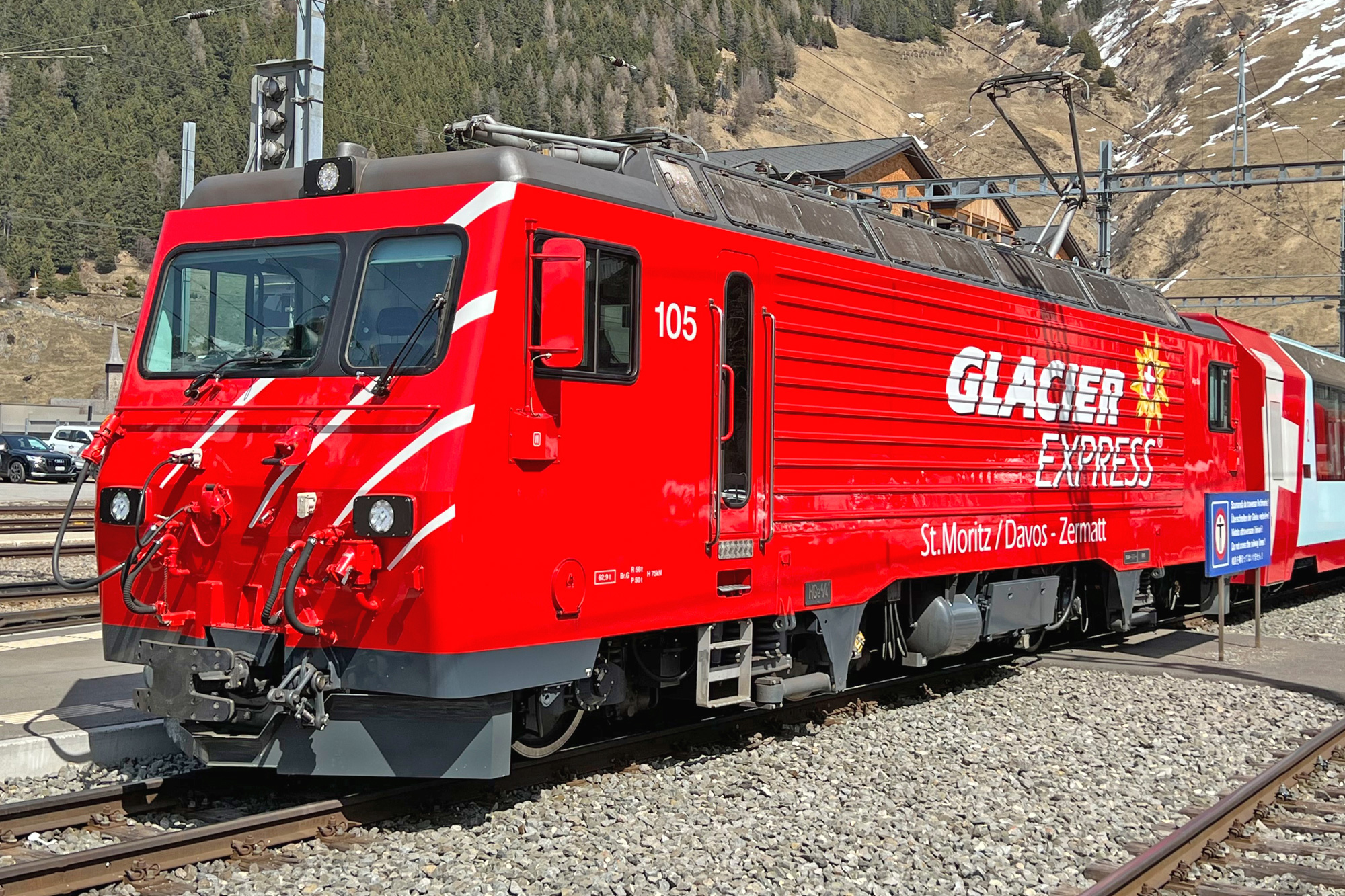
Following a tender issued to SBB, MGB awarded the contract for the refurbishment of nine of its originally 13 HGe 4/4 II rack locomotives, built 1986-1990. The HGe 4/4 II 106 served as the prototype. It was completely stripped out and the parts still fit for use were overhauled. This so-called Refit includes the replacement of the main components. Besides the slightly modified design and the LED headlights, the modern air conditioning unit between the bogies is especially visible from the outside. After the work was completed in 2021 and a successful performance test, locomotives were brought into the Refit programme two at a time. In addition to the eight locomotives 101-108 procured by the FO, it also includes the BVZ's HGe 4/4 1 as the ninth locomotive. Locomotive 105 is the only one to carry advertising livery for the "Glacier Express". Model details Die-cast metal chassis Drive and current pick-up on all four axles Working rack drive, Abt system Headlights in the direction of travel Brake hoses, heating couplings and handrails included for self-assembly Convertible to H0e; this makes operation on the rack no longer possible!
On order, lead time to be confirmed

Following a tender issued to SBB, MGB awarded the contract for the refurbishment of nine of its originally 13 HGe 4/4 II rack locomotives, built 1986-1990. The HGe 4/4 II 106 served as the prototype. It was completely stripped out and the parts still fit for use were overhauled. This so-called Refit includes the replacement of the main components. Besides the slightly modified design and the LED headlights, the modern air conditioning unit between the bogies is especially visible from the outside. After the work was completed in 2021 and a successful performance test, locomotives were brought into the Refit programme two at a time. In addition to the eight locomotives 101-108 procured by the FO, it also includes the BVZ's HGe 4/4 1 as the ninth locomotive. Model details Die-cast metal chassis Drive and current pick-up on all four axles Working rack drive, Abt system Headlights in the direction of travel Brake hoses, heating couplings and handrails included for self-assembly Convertible to H0e; this makes operation on the rack no longer possible!
On order, lead time to be confirmed

After considerable bottlenecks became apparent, especially during the winter high season, in winter sports traffic on the Schöllenen railway to the Andermatt/Oberalp tourist region, in 1972 the FO procured five shuttle trains with the Deh 4/4 51-55 rack baggage railcars, together with corresponding B intermediate coaches and ABt driving trailers. The bogies were largely taken over from the HGm 4/4 61-62 rack diesel locomotives. The BVZ also put into service, with the Deh 4/4 21-24, four rack baggage railcars differing only slightly from these. All eight shuttle-train railcars were still in existence at the time of the merger of the BVZ and the FO into the MGB. With the delivery of new railcar trains, the need for the Deh 4/4 is declining, so that at least some of the railcars will be withdrawn from service in the foreseeable future. Model details Die-cast metal chassis Drive and current pick-up on all four axles Working rack drive, Abt system Headlights in the direction of travel Brake hoses, heating couplings and handrails included for self-assembly Convertible to H0e; this makes operation on the rack no longer possible!
On order, shipped within 10-21 days

After the electrification of the RhB was completed in 1922, line locomotives with rod drive of various power classes were initially procured. Following the trend of the time, four lightweight railcars were ordered from the Swiss locomotive industry in 1938, in order to increase travel speed and to tighten the timetable. The railcars ABe 4/4 501-504, capable of 70 km/h, were delivered in 1939/40 and were initially used mainly in the Engadin in mixed passenger and goods service as tractor railcars. Together with the lightweight steel coaches A 1251-1252 and B 2301-2306 procured at the same time, they ran in the 1940s as the "Fliegende Rhätier" between Chur and St Moritz as well as Davos and Disentis. After the progressive delivery of more powerful bogie locomotives, the railcars were rebuilt between 1968 and 1970 and fitted with multiple-unit control. With the three driving trailers BDt 1721-1723 put into service in 1982, three two-part push-pull trains were formed together with the railcars 501-504. Their home route became the short connecting line Samedan-Pontresina, where additional coaches or through coaches were often attached. They also provided further services on the line to the Lower Engadin or as winter sports trains in the Davos area. At the end of the 1980s, they could be found together with the first Ge 4/4 I push-pull train between Davos and Filisur. After the formation of longer push-pull trains with the Ge 4/4 I, modernised centre-entrance coaches and the three driving trailers 1721-1723, the railcars lost their area of operation. To this day, only the ABe 4/4 501 has been preserved in the heritage vehicle fleet.
On order, shipped within 10-21 days

As a matching power car for the new edition of the two-axle coaches, we are producing the Bernina railcar ABe 4/4 34 as it appeared after its repainting from green/cream to red, lettered RhB. It ran in this livery from 1962 until the early 1980s, when it was relettered with the multilingual logo. Prototype The Bernina line, a good 60 km long and electrically operated on direct current from the outset, began operation with fourteen electric railcars BCe 4/4 1-14 procured in 1908/1909. Due to high demand, three further bogie railcars, the BCFe 4/4 21-23, had to be put into service as early as 1911. These were built with an additional luggage compartment. After the merger with RhB, most of the railcars were fundamentally modernised from the mid-1940s onwards, with considerable changes made to the roof, among other things, and the car bodies re-panelled. Railcars 1, 2, 5 and 4 of the first production series became the BCe 4/4 31-34 in 1946/1947. These four vehicles, along with the BCe 4/4 30 created in 1953 from car 22, were at the same time prepared for peak-traffic duties on the Arosa line, which was still operated on 2200 V DC at the time, and were fitted with the roof rod couplings characteristic of that line. During the electrical conversion, the two lyre pantographs were replaced by a scissors-type pantograph and additional starting and braking resistors were placed on the roof. In 1986, the four railcars remaining after the scrapping of BCe 4/4 33 in 1962 received multiple-unit control. Railcars 10, 14 and 12 became the BCe 4/4 35-37 in 1949-1951, with a window arrangement differing from that of the 31-34. These somewhat more powerful vehicles remained usable only on the Bernina line. Despite the fundamental renewal of the electrical equipment, initially only one of the lyre pantographs was replaced by a scissors-type pantograph. Only from 1968 did the antiquated pantographs give way to a modern single-arm pantograph – since then, two different modern pantographs have been present on the roof. A loner among the modernised Bernina veterans is the BCFe 4/4 38, created as early as 1949 from car 21. As regards roof equipment, the conversions follow those of railcars 35-37, initially with one lyre pantograph and one scissors-type pantograph each. In 1967 the second lyre pantograph was removed, and it was not until 1969 that an additional single-arm pantograph was installed. Unlike cars 35-37, however, the 38 retained its luggage compartment, as the only modernised vehicle to do so. With the procurement of the new-build railcars ABe 4/4 51-56, the older railcars were relegated to subordinate duties; some were later converted for service vehicle purposes. With the commissioning of the "Allegra" railcars, RhB was even able to withdraw many of the younger railcars ABe 4/4 41-49. Today, only the yellow-painted heritage railcars 30+34 are still kept operational.
On order, shipped within 10-21 days

The RhB railcars ABe 4/4 30 and 34 are among the legendary vehicles of the Rhätische Bahn. With their striking yellow livery, they recall the early days of electric railway operation and are today a popular symbol of nostalgia. Both railcars have been modernised several times over the decades. In their yellow version, they are now often used for historic special trips and tourist purposes. In doing so, they offer passengers a journey into the past and a unique railway experience in the Grisons Alpine world. With the technical overhaul of the Bernina railway veterans ABe 4/4 30-38, we are upgrading the two yellow heritage railcars with LED headlight lighting and the Next18 digital interface. The digital version is now also fitted with sound.
On order, shipped within 10-21 days

Detailed model reproduction of the Bernina line railcar ABe 4/4 55 "Diavolezza" in red livery with a brown side skirt. Prototype Based on the latest technical knowledge, the modern railcars ABe 4/4 51-53 using converter technology were delivered to the Bernina railway by Schindler Waggon in 1988. They are fitted with regenerative brakes to feed back the energy recovered during braking and, at a service weight of 47 t, can haul a load of 95 t on 70‰ gradients at a speed of 40 km/h, compared with 70 t at 25 km/h for the preceding vehicles of the 40 series. In 1990, three further vehicles followed, with running numbers 54-56. Like their preceding series ABe 4/4 41-49 and Gem 4/4 801-802, they have a maximum speed of 65 km/h and, thanks to multiple-unit control, can be used universally together with them in passenger service or in snow-clearing duty. As more and more "Capricorn" trains enter service, "Allegra" dual-voltage railcars can be freed up for the Bernina line, so that the 50 series railcars, used in pairs, are currently only needed for the peak season and could one day, in a future that is no longer so distant, be taken out of service. Model details Die-cast metal chassis Drive and current pick-up on all four axles Model variant: digital version with sound decoder LED headlight that changes with the direction of travel Brake hoses, heating couplings and handrails included for self-assembly Convertible to H0e (replacement wheelsets available as an option)
On order, shipped within 10-21 days

Detailed model reproduction of the Bernina line railcar ABe 4/4 53 with the "Tirano" crest and new red livery with a grey side skirt. Prototype Based on the latest technical knowledge, the modern railcars ABe 4/4 51-53 using converter technology were delivered to the Bernina railway by Schindler Waggon in 1988. They are fitted with regenerative brakes to feed back the energy recovered during braking and, at a service weight of 47 t, can haul a load of 95 t on 70‰ gradients at a speed of 40 km/h, compared with 70 t at 25 km/h for the preceding vehicles of the 40 series. In 1990, three further vehicles followed, with running numbers 54-56. Like their preceding series ABe 4/4 41-49 and Gem 4/4 801-802, they have a maximum speed of 65 km/h and, thanks to multiple-unit control, can be used universally together with them in passenger service or in snow-clearing duty. As more and more "Capricorn" trains enter service, "Allegra" dual-voltage railcars can be freed up for the Bernina line, so that the 50 series railcars, used in pairs, are currently only needed for the peak season and could one day, in a future that is no longer so distant, be taken out of service. Model details Die-cast metal chassis Drive and current pick-up on all four axles Model variant: digital version with sound decoder LED headlight that changes with the direction of travel Brake hoses, heating couplings and handrails included for self-assembly Convertible to H0e (replacement wheelsets available as an option)
On order, shipped within 10-21 days

"Fête des Vignerons" advertising locomotive Despite the introduction of the Stadler double railcars Be 4/4 9201-9204 + ABe 4/4 9301-9304, the MOB still cannot do without the originally six luggage locomotives GDe 4/4 6001-6006. Some of these machines will probably be used in railway service, thereby displacing the last three remaining railcars of the 3001-3006 series. We are producing locomotive 6005, once put into service by the neighbouring GFM, in the "Fête des Vignerons" livery that it received in early 2018. Prototype The delivery of the four modern electric locomotives GDe 4/4 6001-6004 caused a great stir in 1983 on the metre-gauge railway in western Switzerland between Lake Geneva and the Saanenland. They are a further development of the luggage railcars Deh 4/4 II 91-96 of the Furka-Oberalp railway. Hauling the "Panoramic Express" trains and the growing freight traffic made the enlargement and modernisation of the traction fleet unavoidable. Until the introduction of the Ge 4/4 8001-8004 twelve years later, in 1995, these 100 km/h machines characterised the image of the MOB's high-quality express trains; they were also part of the "Crystal Panoramic Express", created in 1993 with new panoramic coaching stock, a GDe 6000 in the middle of the train and two driving trailers. In 2007 the MOB took over the two machines likewise built in 1983 by SLM and BBC for the neighbouring GFM, and gave them the running numbers 6005 and 6006. They have carried various liveries to this day, including advertising wraps. The introduction of the Stadler double railcars Be 4/4 9201-9204 + ABe 4/4 9301-9304 has largely displaced the 6000 series from high-quality service. In the long term, only three of these machines are to be retained for railway service (infrastructure). Model details Die-cast metal chassis Drive and current pick-up on all four axles Model variant: digital version with sound decoder 3+1 LED headlight Brake hoses, heating couplings and handrails included for self-assembly Convertible to H0e (replacement wheelsets available as an option)
On order, shipped within 10-21 days

The delivery of the four modern electric locomotives GDe 4/4 6001-6004 caused a great stir in 1983 on the metre-gauge railway in western Switzerland between Lake Geneva and the Saanenland. They are a further development of the luggage railcars Deh 4/4 II 91-96 of the Furka-Oberalp railway. Hauling the "Panoramic Express" trains and the growing freight traffic made the enlargement and modernisation of the traction fleet unavoidable. Until the introduction of the Ge 4/4 8001-8004 twelve years later, in 1995, these 100 km/h machines characterised the image of the MOB's high-quality express trains; they were also part of the "Crystal Panoramic Express", created in 1993 with new panoramic coaching stock, a GDe 6000 in the middle of the train and two driving trailers. In 2007 the MOB took over the two machines likewise built in 1983 by SLM and BBC for the neighbouring GFM, and gave them the running numbers 6005 and 6006. They have carried various liveries to this day, including advertising wraps. The introduction of the Stadler double railcars Be 4/4 9201-9204 + ABe 4/4 9301-9304 has largely displaced the 6000 series from high-quality service. In the long term, only three of these machines are to be retained for railway service (infrastructure). Model details Die-cast metal chassis Drive and current pick-up on all four axles Model variant: digital version with sound decoder 3+1 LED headlight Brake hoses, heating couplings and handrails included for self-assembly Convertible to H0e (replacement wheelsets available as an option)
On order, shipped within 10-21 days

The RhB and the MGB ordered custom-built dual-mode electric/battery locomotives from Stadler for shunting and light freight duties. The seven Geaf 20601-20607 delivered in 2020 are superior to the old shunting locomotives they replace in terms of cost-effectiveness, environmental impact, susceptibility to faults, and noise and exhaust emissions. Radio remote control, the option of fitting an automatic coupling, and a spacious central cab are further features of this new generation of shunting locomotives. The RhB's procurement is based on the MGB's tender, which had previously undertaken the renewal of its vehicle fleet for shunting and railway service. In contrast to the RhB, however, the MGB is procuring various versions as needed, in the form of four plus one diesel locomotives with or without rack drive, as well as the two Tea 2/2 801-802, which are of identical design to the RhB locomotives, as electric/battery locomotives, to be stationed in Brig and Zermatt. Model details Small-series model in white metal and brass Drive and current pick-up via both axles Sound-ready Model variant: digital version with sound decoder LED headlight 3+1 white LED cab lighting LED marker and shunting light function (digital model only) LED step lighting (digital model only) Cannot be converted to H0e!
On order, shipped within 10-21 days

Engineering diesel locomotive With the D3 "Albula", we complete the four-strong series of engineering diesel locomotives Gmf 4/4 234 01-04, placed in service in 2013. As with the last edition, we are producing a model in its current condition, with modified ventilation grilles/filters. Prototype RhB's lengthy search for a powerful metre-gauge diesel locomotive for various fields of application ended with the signing of a contract with Schalker Eisenhütte Maschinenfabrik at the end of 2009 for the supply of four diesel locomotives. PROSE AG in Winterthur took on the development and manufacture of the bogies. Among the key requirements of the specification were a special vehicle clearance profile, dictated by the given tunnel profile of the metre-gauge line, operational capability and reliability under extreme climatic conditions (-35 to +40°C), as well as trailing loads of 140 t on 70‰ gradients on the Bernina line and 420 t on the main network with 25‰ gradients, in each case in double traction. A further key point of the specification was a radio remote control. Construction of the first locomotive body of the lightweight prototype began in spring 2011, with assembly following from January 2012, so that the Gmf 4/4 287 01, weighing 64 t and with a maximum speed of 100 km/h, could be put into service from October of the same year. The length over the centre buffer is 16690 mm. The locomotive, with a rated output of 1800 kW, is powered by a 12-cylinder MTU diesel engine with particulate filter. As required, several independent braking systems are fitted: a liquid-cooled electrodynamic brake, a compressed-air block brake, a magnetic track brake, and, of course, the vacuum brake system for the indirect braking of RhB coaches. The first deployments on the Graubünden metre-gauge network took place in the third quarter of 2013, with some issues, such as winter suitability, still needing to be optimised. In summer 2017, comparative tests with LED or halogen lighting were still underway on the D4 "Bernina". At that time, some ventilation grilles in the side wall and sloping roof of the locomotives had apparently been modified with an additional filter attachment as a result of winter problems. Since July 2015, the four engineering locomotives have carried the new designation Gmf 4/4 234 01-04, or D1-D4, with their respective names. They are now used across the network without a fixed base and, among other things, also haul construction material in double traction to the construction site of the new Albula Tunnel at Preda. Model details Die-cast chassis Drive and current pick-up on all four axles Model variant: digital version with curve squeal sound LED lighting, changing over with direction of travel, 3+1 white LED work lights and warning lamps for radio control – can only be switched digitally LED cab lighting Etched roof and side wall ventilation grilles Free-standing metal handrails Exterior mirrors included as a separately applied part Can be converted to H0e gauge (replacement wheelsets available as an option)
On order, shipped within 10-21 days

Following positive operating experience with the first bogie locomotives with individual axle drive at BLS, RhB adopted the new drive concept when modernising its vehicle fleet. From 1947 to 1953, SLM delivered ten 1,560 hp locomotives with a top speed of 75 km/h, the Ge 4/4 I 601-610, in two series that differed in their front-end sockets (601-604). From the late 1980s, the ten locomotives were fundamentally modernised at the Landquart main workshop, receiving among other things a new cab, push-pull train control and the red livery. Subsequently, the scissors-type pantographs were replaced by single-arm pantographs. Following the recent withdrawal of two locomotives, two more remain in active service as reserve locomotives. Model details New design of the die-cast chassis and gearbox Reproduction of the engine room fittings Spring packs mounted on the chassis LED headlights, 3+1 white LED cab lighting (can be switched digitally) Sound-ready Drive and current pick-up from all four axles Brake hoses, heating couplings and handrails are included for self-assembly
- Sound
On order, lead time to be confirmed

As part of our ongoing model updates, we regularly rework older locomotive models with 5-pole motors, sound preparation, a digital interface and LED lighting (except 1262/1362); gearbox updates are usually also carried out, or the cabs and interior fittings are shown in improved detail. We offer these new running gear units for retrofitting older locomotive models. The body and roof are reused from the old locomotive. Simple adaptation work is required on some locomotive bodies. Model details Die-cast running gear and gearbox Reproduction of the engine room fittings Spring packs mounted on the running gear LED headlights, 3+1, white LED cab lighting (can be switched digitally) Sound-ready Digital version with curve squeal sound Drive and current pick-up from all axles
On order, shipped within 10-21 days

New edition of a red Ge 4/4 II with a modified running number and AGZ brake equipment. It replaces locomotive 618 "Bergün" (item no. 1258/1358 178) and the Ge 4/4 II 627 "Reichenau-Tamins" (item no. 1258/1358 187). Model details Die-cast chassis and gearbox Reproduction of the engine room fittings Spring packs mounted on the chassis 3+1 white LED headlights LED cab lighting (can be switched digitally) Sound-ready Model variant: digital version with curve squeal sound Drive and current pick-up via all axles Brake hoses, heating couplings and handrails are included for self-assembly
- Sound
On order, shipped within 10-21 days

The latest RhB locomotive colour creation is the Ge 4/4 II 626, designed by the "pro Salonwagen RhB" association in the livery of the "Alpine Classic Pullman Express". It was named "Alby Glatt" in autumn 2025 as part of the "25 years ACPE" anniversary. With it, there is now a train locomotive matching the colour of the saloon coaches, capable of maintaining the required minimum speed in the intensified half-hourly service without delaying other trains. We support the "pro Salonwagen RhB" association with a donation for every locomotive sold, towards its project to re-upholster the historic saloon coaches As 1141-1144. Model details Die-cast chassis and gearbox Reproduction of the engine room fittings Spring packs mounted on the chassis 3+1 white LED headlights LED cab lighting (can be switched digitally) Sound-ready Model variant: digital version with curve squeal sound Drive and current pick-up via all axles Brake hoses, heating couplings and handrails are included for self-assembly
- Sound
Pre-order, release expected in Q1 2027

"Heidiland-Bernina Express" The introduction of the EW III standard coaches in 1983 gave the "Bernina Express" its definitive breakthrough: not only in terms of comfort, but also through the visually striking red/dark brown livery of the whole train unit. In 1992/93, eleven further express train coaches arrived on the Graubünden metre-gauge network with the EW IV standard coaches: the A 1273-1275, B 2491-2497 and the BD 2475. In 1995, thanks to the second train formation, the "Heidiland Bernina Express" could be added to the timetable, running from Landquart via Davos and Filisur to Tirano. In the summer season, the formation usually consisted of seven coaches. Model details Die-cast chassis Drive and current pick-up on all four axles Digital version with sound LED headlights that change with the direction of travel LED tail lamp Brake hoses, heating couplings and handrails are included for self-assembly
- Sound
On order, shipped within 10-21 days

The Coop cooperative has updated the advertising livery of the Ge 4/4 III 641 for the fourth time; the locomotive has carried advertising since 1999 for one of Switzerland's largest retail and wholesale companies. Just before Easter it was redesigned in the style of the Stadler Euro 9000 and Siemens Vectron locomotives already running on Swiss standard-gauge track, using the three logo colours. The climate-controlled container Y 11629 has already carried this striking design since summer 2025. It was loaded, after the conversion of the sliding-wall wagon Haiqq-tyz 5164, onto the resulting carrier wagon Sb 65615. Prototype To cope with the locomotive shortage, especially during the high season, the RhB ordered nine powerful electric locomotives from SLM. Building on experience with the SBB's Re 450 and Re 460, current locomotive technology was incorporated into the Ge 4/4 III 641-649: wheelsets that steer radially on curves, state-of-the-art converter and three-phase technology, and ergonomically designed controls. In the winter of 93/94 the first of these machines, capable of 100 km/h and developing 3400 hp, entered service. In 1999 three more machines, 650-652, were acquired. The Ge 4/4 8003, taken over from the DC-operated MOB in 2019, has not yet been prepared for RhB service. After only a few years in service, these angular high-performance locomotives began to be leased out as advertising carriers and fitted with colourful advertising liveries - including for the RhB's own purposes. The locomotives are used mainly on the Albula line to haul the Albula articulated trains (AGZ), but also on car-shuttle trains through the Vereina Tunnel. Model details Die-cast chassis Drive and current pick-up via all four axles LED headlights, 3 white + 2 red Brake hoses, heating couplings and handrails are included for self-assembly
- Sound
On order, lead time to be confirmed

MOB high-performance locomotive To match the panorama and low-floor coaches in "GoldenPass" design, we offer the eye-catching locomotive "Gstaad Mountain Rides" with various sports motifs, for H0 standard gauge in DC and AC. Prototype In its search for a powerful general-purpose locomotive, the MOB joined forces with the western Swiss metre-gauge railway BAM in the series production of the RhB Ge 4/4 III and ordered four locomotives of its own, adapted for operation under DC overhead line. The four Ge 4/4 8001-8004 took over express train services between Montreux and Zweisimmen, providing relief for the four GDe 4/4 6001-6004 still in service at the time. Some time later, the MOB also began covering its locomotives with advertising films or for its own promotional purposes. The commissioning of the Stadler double railcars Be 4/4 9201-9204 and ABe 4/4 9301-9304 in 2016 was meant to displace the 8000-series locomotives from the prestigious service with the gauge-changing flagship train "GoldenPass Express" (GPX). As a result, locomotive 8003 was handed over to the RhB in the summer of 2019, where it has not yet been put into service. Due to the lower performance of the new-build railcars, the three remaining 8000-series locomotives are, after all, now hauling the GPX on the MOB line. Model details Die-cast chassis Digital version with sound Drive and current pick-up on all four axles 3+1 white LED headlights Brake hoses, heating couplings and handrails are included for self-assembly
- Sound
On order, shipped within 10-21 days