
Rolling Stock

Prototype For milk transport and especially for transporting milk churns, the Königlich Bayerische Staatsbahn purchased two-axle cars from Maschinenfabrik Augsburg Nuremberg. The cars had a riveted sub-frame with framework axle keep plate and a 4.50 m wheel base. For use in passenger trains, they were equipped with a compressed air brake of type Westinghouse. For optimum ventilation of the hold, the cars had a Growe fan on the roof and ventilation slats on the front walls. The light-coloured livery ensured that the inside temperatures were kept at acceptable levels in summer. The cars had two sliding doors running in opposite directions on each side, in order to be able to carry out loading work as quickly as possible during short stops. In order to collect the milk churns of the Bavarian dairy farmers, who brought their products to the nearest station by wagon, the cars were used in scheduled passenger trains. This enabled the fastest possible transport at that time of perishable milk to the dairies in the city. MODEL: Filigree handrails True-to-original brake system Extra mounted "growe" fan on the roof Perforated ventilator grill Extra mounted signal holder Fine metal spoke wheels Model Fine replica of the wheel bearing Precise replica of board joints Individually mounted fans Perforated fan grill Individually mounted axle brake rod Die-cast zinc spoked wheels Wheelsets with inside contours Individually mounted signal holder Individually mounted door latches True to original brake unit
On order, shipped within 10-15 days

Prototype In 1942, Tnf Berlin (Tnfs38) came into being as a simplified refrigerator car. The basic design was provided by the Glmhs Dresden, as a welded version. In contrast to these, the refrigerator cars were given 300 mm thick insulation and zinc plate inner lining in order to protect the internal wood cladding against moisture penetration. In order to ensure that the doors sealed completely, the double-leaf revolving doors were replaced with sliding doors. However, the most significant change was the vertical panelling combined with the typical white paint of the refrigerator cars. From the mid-1950s onwards, the German Federal Railway (DB) carried out several design modifications and modernisation work on the coaches it had acquired. The maintenance-intensive wheelsets with slide bearings were replaced with roller bearings; car bodies were rebuilt with the same design if their insulating properties were inadequate. As a result, the coaches retained their main dimensions; however, the eye-catching car body frame was now hidden under horizontal panelling, and later even under laminated wood panelling. New refrigerator car developments at DB made it possible for private breweries to purchase a variety of cars from DB and use them for transporting their beer. Since these were private cars belonging to specific breweries, in most cases they were decorated with the company’s own advertising. Model Axle brake frame with brake blocks in wheel plane Individually mounted brake systems Individually mounted handle bars Individually mounted wheelchocks Individually mounted steps NEM-standard short-coupling Metal wheels True to original frame construction Wheelsets with inside contours Perforated car body supports True to original construction differences
On order, shipped within 10-15 days

Prototype The Swiss began standardising some types of goods wagons at an early stage. They were then also procured by all private railways in order to improve repairs and spare part stock-keeping. They included closed goods wagons with a 4.5 m wheel base and a frame length of 7.10 m. Later, the wheel base was increased to 5 m in order to improve the running characteristics. In this form, high numbers of the wagons that were given the K2 designation were procured by SBB. Model Tip bearing wheelsets Precise paintwork and painting Metal axle Precise replica of board joints True to original frame construction Metal axles
On order, shipped within 10-15 days

Prototype The association construction types of the German national railway association already included an open-plan covered freight car, which was used in particular for freight with a high weight and low volume. After the foundation of the DRG, the main standard freight cars were redesigned according to the so-called principles of interchangeability. For this the production tolerances were kept so small that it was very easy to change replacement parts. The design of the new open-plan freight car was heavily based on its association type predecessor. The main dimensions such as wheelbase and length over buffers was adopted, as were the two metre wide doors opening to the right, which however were installed suspended. New features included the riveted strut bracing, which allowed a lower design of the longitudinal beam, and the barrel design of the roof instead of the basket arch of the predecessor cars. Some of the cars had a handbrake with brakeman’s cab and/or variable gauge wheel sets for adaptation to Russian wide gauge, identifiable by the white painted buffer sleeves and the sub-class mark "r". All covered open-plan cars were allocated to the "Dresden" class district. As already mentioned, the cars were particularly suitable for light freight with large volumes (e.g. glass industry). When the design was revised later, a few changes were made, for example longer and softer suspension springs, which allowed higher speeds and therefore also use in passenger trains. Due to the turmoil of the war, not only the two German railway administrations but also many other European railways had cars of this type in their stock after 1945. The last ones were only retired in the 1980s - proof of the quality and durability of the design. Model Axle holders made of embossed sheet metal Individually mounted wheelchocks Fine replica of the wheel bearing Individually mounted brake switch NEM-standard short-coupling True to original car bottom Wheelsets with inside contours
On order, shipped within 10-15 days
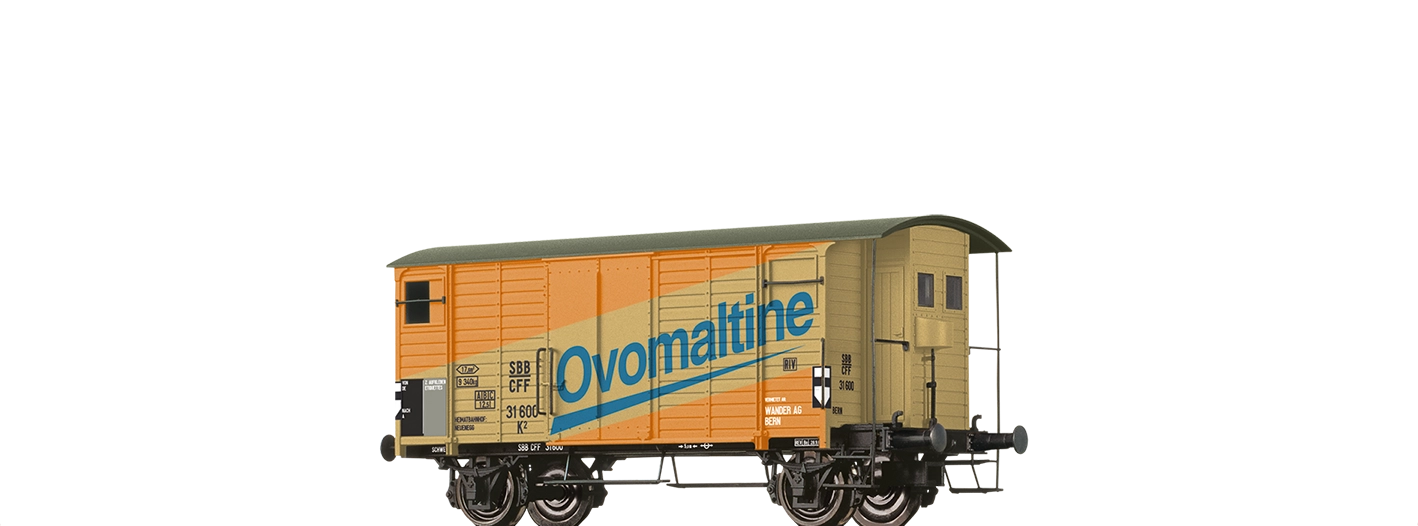
Prototype The Swiss began standardising some types of goods wagons at an early stage. They were then also procured by all private railways in order to improve repairs and spare part stock-keeping. They included closed goods wagons with a 4.5 m wheel base and a frame length of 7.10 m. Later, the wheel base was increased to 5 m in order to improve the running characteristics. In this form, high numbers of the wagons that were given the K2 designation were procured by SBB. Model Tip bearing wheelsets Precise paintwork and painting Metal axle Precise replica of board joints True to original frame construction Metal axles
On order, shipped within 10-15 days

Prototype Due to the rolling process during their production, sheet steel coils are susceptible to moisture. In the 1970s, seeking to protect such coils from corrosion during transport to processing industries, the rail vehicle industry developed a special type of flatcar with three nested sliding hoods – the Shis 708, which was also known as the Shimmns 708 from 1987 onwards. To allow easy loading of the coils, the hoods can be opened as required, exposing the five loading troughs embedded in the vehicle frame. The Federal Railway placed orders for over 2,500 units of Shis/Shimmns 708 in two major batches. The actual number of vehicles of this design is significantly higher due to additional orders from other state railways and leasing companies. As the hoods became increasingly maintenance-intensive with age, DB AG replaced them with sliding tarpaulins on 1,000 carriages and reclassified these vehicles as the Shimmns-ttu 772 from 2002 onwards. However, private operators continue to utilise some vehicles in their original condition. Model Sliding hoods not movable Lots of design differences Variants with parking and handbrake Lots of extra details Three-point bearing for safe operation Different bogies of several types Variant-appropriate arrangement of the address boards
On order, shipped within 10-15 days