
Locomotives

Exclusive model 2026 The prototype locomotive, now operational with the Preßnitztalbahn, has travelled on many railways during its eventful history: after being withdrawn from the DR, it went to Norway from 1977 to 1984, then until around 1994 to the Öchsle in Baden-Württemberg; it finally passed into private ownership, based in Straupitz and later Putbus. After an overhaul in Romania in 2006, it remained on the island of Rügen and was taken over by the Preßnitztalbahn in 2014. Hand-built Metal Collection model in a highly detailed version with locomotive details true to the prototype. Please note the order deadline of 1.5.2026. Model details of the 99 1594-3 of the Aue depot, Era IV version: Raised water tank filler neck With Reko-type roof and four open hatches Reproduction of the connected heating hoses for train heating Valve gear cast in nickel silver and new valve gear support Lettering with prototype-correct etched plates and pad printing ESU Loksound 5 nano decoder (Henning sound) Warm white LED headlights that change with the direction of travel Switchable firebox flickering Switchable LED cab lighting
- Sound
Pre-order, release expected in Q4 2026

Exclusive model 2026 The prototype locomotive, now operational with the Preßnitztalbahn, has travelled to many railways during its eventful history: after being withdrawn from the DR, it went to Norway from 1977 to 1984, then to the Öchsle in Baden-Württemberg until around 1994; it was eventually sold into private ownership, based at Straupitz and later Putbus. After an overhaul in Romania in 2006, it remained on the island of Rügen and was taken over by the Preßnitztalbahn in 2014. Metal Collection hand-built model in a highly detailed finish, with locomotive details true to the prototype. Please note the order deadline of 1.5.2026. Model details of the 99 594 from the Kirchberg depot, Era III version: tall water tank filler cab of the older-build locomotive with older-build roof ventilators and two open hatches Heberlein equipment valve gear cast in nickel silver and new valve gear support prototypical lettering with etched plates ESU Loksound 5 nano decoder (Henning Sound) direction-dependent warm white LED headlights switchable firebox flickering switchable LED cab lighting
- Sound
Pre-order, release expected in Q4 2026

New tooling for 2026: diesel locomotive of the Steiermärkische Landesbahnen In 1968, the Duro Dakovic company delivered to the Yugoslav State Railways (JZ) the first prototype 740-001 of a newly developed bogie diesel locomotive for trials on the Bosnian Ostbahn. The aim was to rationalise freight traffic and replace steam operation on the narrow-gauge network, which in the 1960s still comprised around 3000 km at a gauge of 760 mm. By 1972, a total of 40 units had been delivered: locomotives 740-001 to 025 without a heating device, and 740-101 to 115 with a heating boiler. As in many other countries, however, they were unable to halt the decline of the narrow-gauge railways, so some of them found new tasks with industrial companies, track-laying firms, or in other countries. The VL 23 also came to the Feistritztalbahn after the closure of the Thörlerbahn. From 1999 to 2003, the orange locomotive was loaned to the Zillertalbahn for timber transport using transporter wagons. In 2015, it left the Feistritztal for the Murtal. Ahead of the resumption of timber traffic on the Zillertalbahn, it received a new livery in the new white/dark blue colours of the Steiermarkbahn StB at Murau, as well as LED headlights. Since April 2021, it has been the regular locomotive for the timber trains on behalf of Binderholz in Fügen. Model version before the repainting in white/dark blue, as also used as a loan locomotive in the Zillertal. A model of the locomotive in its current appearance will be released at a later date. Matching transporter wagons of the Zillertalbahn can be found in the ROCO range. Model version Die-cast chassis Drive and current pick-up on all four axles Sound preparation White/red LED headlights that change over with the direction of travel Digital model with cab lighting Prototypically different bodies, buffer beams, access steps and attached parts Separately applied handrails With bow coupling and Bosna coupling
- Sound
Pre-order, release expected in Q4 2026

New tooling for 2026: diesel locomotive of the Steiermärkische Landesbahnen In 1968, the company Duro Dakovic delivered to the Yugoslav state railway JZ the first prototype, 740-001, of a newly developed bogie diesel locomotive, for trials on the Bosnian Eastern Railway. The aim was to rationalise freight traffic and to replace steam operation on the narrow-gauge network of 760 mm gauge, which in the 1960s still covered around 3,000 km. By 1972, a total of 40 units had been delivered, comprising locomotives 740-001–025 without heating equipment and 740-101–115 with a heating boiler; as in many other countries, however, they could no longer halt the decline of the narrow-gauge railways, so that some of them found new tasks with industrial companies, track-laying firms or in other countries. The Steiermärkische Landesbahnen (StLB) took over the two locomotives 740-023 and 024 in 1980 for freight traffic on the Thörlerbahn and the Feistritztalbahn. The two locomotives VL 22 and 23 received new MTU engines. After the Thörlerbahn closed in 1995, the VL 22 received a more powerful MTU engine and the new red livery of the StLB. When the Feistritztalbahn also lost its freight traffic in 2014, it moved to the Murtal. There it hauls the occasional freight and works trains. The model is modelled as it looked until around 2023, before a switch cabinet and a fire-extinguisher box were fitted to the short hood. Model version Die-cast chassis Drive and current pick-up on all four axles Sound-ready White/red LED headlight that changes with the direction of travel Digital model with cab lighting Prototypically different bodies, buffer beams, steps and fittings Separately applied handrails With bow coupling and Bosna coupling
- Sound
Pre-order, release expected in Q4 2026

New tooling for 2026: Zillertalbahn diesel locomotive In 1968, the Duro Dakovic company delivered the first prototype 740-001 of a newly developed bogie diesel locomotive to the Yugoslav state railway JZ, for testing on the Bosnian Eastern Railway. The aim was to rationalise freight traffic and replace steam operation on the roughly 3,000 km narrow-gauge network with a gauge of 760 mm that still existed in the 1960s. By 1972, a total of 40 units had been delivered, comprising locomotives 740-001 to 025 without heating equipment and 740-101 to 115 with a heating boiler; as in many other countries, however, they could not halt the decline of the narrow-gauge railways, so some of them found new tasks with industrial companies, track-laying firms, or in other countries. Locomotive 740-007 found its way to the Zillertalbahn in 1980 and was given the running number D 10 there. It was fitted with a new engine at the Jenbach works, received a new cab and control desks, as well as train heating for passenger service. In the mid-1990s, the engine was replaced again, and a push-pull control system was installed as a reserve set for shuttle service. In the early 2010s, it was taken out of service following an engine failure. Due to the resumption of timber traffic to Fügen, overhaul work began in the winter of 2021, fitting an MTU engine. The work has still not been completed to this day. Model version with a beige-coloured decorative stripe, as fitted after installation of the push-pull control system. You will find matching Zillertalbahn transporter wagons in the ROCO range. Model version Die-cast chassis Drive and current pick-up on all four axles Sound-prepared White/red LED headlights, changing over with the direction of travel Digital model with cab lighting Prototypically different bodies, buffer beams, access steps and attached parts Attached handrails With bow coupling and Bosna coupling
- Sound
Pre-order, release expected in Q4 2026

The diesel-hydraulic bogie locomotive L45H, built in large numbers between 1967 and 1985 by the vehicle and machinery manufacturer FAUR in Bucharest (Romania), ran on many Eastern European railways and was also used on industrial and works railways. Today, some examples of these 450 hp, 10.25 m long narrow-gauge locomotives for a gauge of 750 to 1000 mm are still in service in their traditional areas of operation in Romania (class 87), Poland (Lxd2), Slovakia, Serbia and Hungary (Mk45). Some have in the meantime also found their way to Germany or Austria as popular departmental locomotives. In 2004, the Chemins de Fer de la Corse acquired nine Romanian L45H diesel locomotives through the Metricrail consortium for track renewal on the Mediterranean island. The machines, designated 60001 to 60009, were converted to metre gauge and, after initial problems, eventually fitted with Caterpillar engines. Further adaptations included a multiple-unit traction capability; externally, other distinguishing details can be found, such as the characteristic double headlamps. Due to the delay, an intermediary supplied three overhauled locomotives, 45001 to 45003, so that a total of 12 locomotives could be used for engineer's train service on the island. After the end of their service there, the machines used there found further new areas of operation, for example as track-construction locomotives in Italy/France or at the Baie de Somme heritage railway. The locomotive model is available in H0e under item number 1020 926! Model version Die-cast chassis Drive and current pick-up on all four axles Sound-prepared LED headlights, changing over with the direction of travel Attached handrails Attached wind deflectors Attached windscreen wipers Etched steps and fan cover Can be converted to H0e (replacement wheelsets available as an option)
On order, shipped within 10-21 days

The diesel-hydraulic bogie locomotive L45H, built in large numbers between 1967 and 1985 by the vehicle and machinery manufacturer FAUR in Bucharest (Romania), ran on many Eastern European railways and was also used on industrial and works railways. Today, some examples of these 450 hp, 10.25 m long narrow-gauge locomotives for a gauge of 750 to 1000 mm are still in service in their traditional areas of operation in Romania (class 87), Poland (Lxd2), Slovakia, Serbia and Hungary (Mk45). Some have in the meantime also found their way to Germany or Austria as popular departmental locomotives. In 2004, the Chemins de Fer de la Corse acquired nine Romanian L45H diesel locomotives through the Metricrail consortium for track renewal on the Mediterranean island. The machines, designated 60001 to 60009, were converted to metre gauge and, after initial problems, eventually fitted with Caterpillar engines. Further adaptations included a multiple-unit traction capability; externally, other distinguishing details can be found, such as the characteristic double headlamps. Due to the delay, an intermediary supplied three overhauled locomotives, 45001 to 45003, so that a total of 12 locomotives could be used for engineer's train service on the island. After the end of their service there, the machines used there found further new areas of operation, for example as track-construction locomotives in Italy/France or at the Baie de Somme heritage railway. The locomotive model is available in H0e under item number 1020 929! Model version Die-cast chassis Drive and current pick-up on all four axles Sound-prepared LED headlights, changing over with the direction of travel Attached handrails Attached wind deflectors Attached windscreen wipers Etched steps and fan cover Can be converted to H0e (replacement wheelsets available as an option)
On order, shipped within 10-21 days

Following positive operating experience with the first bogie locomotives with individual axle drive at BLS, the RhB adopted this new drive concept when modernising its vehicle fleet. Between 1947 and 1953, SLM delivered ten Ge 4/4 I 601-610 locomotives rated at 1560 hp with a top speed of 75 km/h, in two series which differed by front-end sockets (601-604). From the late 1980s, the ten machines were fundamentally modernised at the Landquart main workshop, receiving among other things a new cab, push-pull train control and the red livery. Subsequently, the scissors-type pantographs were replaced by single-arm pantographs. After the recent withdrawal of two locomotives, two are still in active service as reserve locomotives. Model details New tooling for the die-cast drive and gearbox Replica of the engine room fittings Spring packs fitted to the drive 3+1 white LED headlights LED cab lighting (can be controlled digitally) Sound preparation Drive and current pick-up from all four axles Brake hoses, heating couplings and handrails included for self-assembly
On order, lead time to be confirmed

As early as 1890, the first steam trains ran from the Rhône valley through topographically difficult mountain terrain to Stalden; a year later Zermatt, at the foot of the Matterhorn, was reached. The line towards the Matterhorn was built for mixed adhesion and rack operation. Over six rack sections with a maximum gradient of 125‰, the VZ (later BVZ Zermatt-Bahn, today MGB Matterhorn Gotthard Bahn) climbs an altitude difference of almost 1000 m over a good 35 km. Rising passenger numbers as well as the high operating costs of steam traction prompted the VZ to switch to electric operation towards the end of the 1930s. In 1929-30, five machines were delivered as the initial electric equipment for mixed adhesion and rack operation, following a tender issued by the VZ. Because of the rack sections, single-frame rod-driven electric locomotives were ruled out, and four-axle bogie vehicles were chosen instead. Because of the characteristic hoods on the locomotive bodies, which housed a luggage compartment, the locomotives HGe 4/4 11-15 were given the nickname "Crocodiles". They reach a maximum speed of 45 km/h on adhesion sections, and 25 km/h in rack operation. With the delivery of several railcar series, the locomotives were initially displaced into freight train duties, but were still frequently needed to haul additional passenger trains. It was only with the acquisition of the five modern high-performance locomotives HGe 4/4 II 1-5 in 1990 that the veterans were pushed into secondary duties. In 1992, locomotive 14 was scrapped; between 2002 and 2005, three further machines were broken up, so that today MGB Historic can only operate the last one built, locomotive 15, with modernised ventilation grilles, for special train services. Model details Die-cast chassis Drive and current pick-up from all four axles Working rack drive, Abt system Headlights in the direction of travel Brake hoses, heating couplings and handrails are included for self-assembly Can be converted to H0e, which means rack operation is then no longer possible!
On order, lead time to be confirmed

We are modernising the technology of the Rhaetian Crocodile and equipping it with LED lighting and a Next18 digital interface. For the first time, the digital version is also available with sound and additionally offers lighting in the cab. The replacement of a total of 57 steam locomotives was begun in 1912/13 by the single-frame locomotives Ge 2/4 and Ge 4/6, driven via jackshafts and inclined rods. From 1921 the RhB turned to articulated bogie locomotives: by 1929 SLM/BBC/MFO built a total of 15 of these 1076 hp C'C' locomotives for the newly electrified lines. The legendary RhB "Crocodiles" were able to prove their capability above all on the gradient-rich Albula line. Some locomotives differed in appearance through the installation of additional roof-mounted resistors. The locomotives are not only technical masterpieces but also an important part of the RhB's cultural heritage, which delights railway enthusiasts and tourists alike. Model details Die-cast metal chassis LED cab lighting LED 3+1 headlights that change with the direction of travel Current pick-up on all six axles Drive via both bogies
Pre-order, release expected in Q4 2026

Prototype The replacement of the 57 steam locomotives in total began in 1912/1913 with the Ge 4/6, driven via jackshafts and inclined coupling rods. In addition to these twin-motor rod-coupled locomotives rated at 600 hp, later 800 hp, with a top speed of 55 km/h, seven single-motor Ge 2/4 201-207 of around 300 hp were procured in 1913 for light duties and as pilot locomotives. With the commissioning of the "Crocodiles" Ge 6/6 I 401-415, the Ge 2/4 were increasingly used for shunting duties, where the two driver's cabs and the restricted rearward visibility proved disadvantageous. In 1943 and 1946 respectively, three locomotives were therefore converted into shunting locomotives with a central cab: the Ge 2/4 201+206 became the Ge 2/4 213+212, and the Ge 2/4 202 became the Gea 2/4 211, fitted with an additional battery so that it could serve siding tracks not equipped with overhead contact line. In 1967, this locomotive received a diesel engine in place of the battery drive, and was accordingly redesignated Gem 2/4 211. The new shunting locomotives had their large drive motors exchanged for smaller ones rated at 310 hp. In 1946, two further locomotives, 203 and 204, were modernised, leaving only the Ge 2/4 205 and 207, kept as reserve locomotives, in a condition similar to their original delivery state with two scissors-type pantographs. The two modernised locomotives, designated Ge 2/4 221-222, were intended to take on light line duties and pilot assignments; at 610 hp they had an installed output similar to the oldest Ge 4/6, albeit with a lower adhesive weight. They were also fitted with a powerful electric resistance brake, recognisable by the distinctive roof structure in place of the second scissors-type pantograph. With the delivery of modern line vehicles, these two locomotives eventually also found use in shunting. Apart from the Ge 2/4 205 and 207, preserved in non-operational condition, only locomotive 222 escaped the cutting torch – it now belongs to the RhB's heritage vehicle fleet and can mainly be seen during the summer half-year hauling excursion trains. In reissuing the heritage rod-coupled electric locomotive Ge 2/4 222, we are also taking into account locomotive 221, which has not been available as a model for many years. It was scrapped by the RhB in 1998.
On order, shipped within 10-21 days

Prototype The replacement of the 57 steam locomotives in total was initiated in 1912/1913 by the Ge 4/6, driven via jackshafts and inclined connecting rods. In addition to the twin-motor rod locomotives rated at 600, and later 800, hp with a top speed of 55 km/h, seven single-motor Ge 2/4 201-207 of around 300 hp were acquired in 1913 for light duties and as pilot locomotives. With the introduction of the "Crocodiles" Ge 6/6 I 401-415, the Ge 2/4 were increasingly used for shunting duties, where the two cabs and the restricted rearward visibility proved disadvantageous. In 1943 and 1946 respectively, three machines were therefore converted into shunting locomotives with a central cab: the Ge 2/4 201+206 became the Ge 2/4 213+212, and the Ge 2/4 202 became the Gea 2/4 211, fitted with an additional battery so that it could serve connecting tracks not covered by overhead wire. In 1967, this locomotive received a diesel engine in place of the battery drive, giving it the new designation Gem 2/4 211. The new shunting locomotives exchanged their large traction motors for smaller ones with an output of 310 hp. In 1946, two further locomotives, 203 and 204, were modernised, leaving only the Ge 2/4 205 and 207, kept as reserve locomotives, close to their original delivery condition with two scissors-type pantographs. The two modernised locomotives, designated Ge 2/4 221-222, were intended to take on light line duties as well as pilot duties, and with 610 hp installed had a similar power output to the oldest Ge 4/6 - albeit with a lower adhesive weight. They also received a powerful electric resistance brake, recognisable by the distinctive roof superstructure in place of the second scissors-type pantograph. With the delivery of modern line vehicles, these two machines eventually also found use in shunting. Apart from the Ge 2/4 205 and 207, preserved in non-operational condition, only locomotive 222 escaped the cutting torch - it today belongs to the RhB's heritage fleet, and can be seen above all during the summer half-year at the head of excursion trains.
On order, shipped within 10-21 days

26 years after the Ge 4/4 I 601-604 entered service as the RhB's first bogie electric locomotive with an output of 1184 kW, the thyristor-controlled Ge 4/4 II 611-620 set new standards for train haulage on the Graubünden metre-gauge network in 1973. These modern machines, rated at 1700 kW and capable of up to 90 km/h, were intended to replace various classes of the first generation of electric locomotives, which had rod drives and were no longer up to date in terms of power or top speed. They followed two engineering department vehicles previously procured with thyristor technology and six suburban railcars; experience gained by BLS with its standard-gauge Re 4/4 locomotives was also incorporated into the design. The ten machines, built by SLM/BBC and painted green, met the specified requirements and came close to the performance of the heavier six-axle Ge 6/6 II 701-707. Thanks to their multiple-unit control, the heaviest trains could be hauled in double traction on the main network, making these locomotives general-purpose machines for express, regional and freight services. A second series of 13 Ge 4/4 II 621-633 followed in 1984; these were delivered in red livery from the start. Like the other Ge 4/4 I and Ge 6/6 II locomotives, these machines, fitted with single-arm pantographs, were given coats of arms and names. With the conversion of the Arosa line to AC voltage in 1997 and the acquisition of driving trailers, not only did the area of operation expand, but these locomotives also contributed significantly to the economical shuttle operation of individual line sections. The external appearance of the locomotives changed only slightly: modernised pantograph contact strips, additional roof insulators, rectangular headlights, additional rear-view mirrors, and changes to the electrical and pneumatic coupling elements on the front ends are relatively few changes for around 50 years of service. Since 2007, some machines have carried eye-catching advertising lettering. Model details Die-cast running gear and gearbox Replica of the engine room fittings Spring packs mounted on the running gear LED headlight 3+1 white LED cab lighting (can be switched digitally) Sound preparation Model variant: digital version with curve squeal sound Drive and current pick-up via all axles Brake hoses, heating couplings and handrails included for self-assembly
On order, shipped within 10-21 days

New edition of a bright red Ge 4/4 II with a changed running number and AGZ brake equipment. It replaces locomotive 618 "Bergün", item no. 1258/1358 178, and the Ge 4/4 II 627 "Reichenau-Tamins", item no. 1258/1358 187. Model details Die-cast running gear and gearbox Replica of the engine room fittings Spring packs mounted on the running gear LED headlight 3+1 white LED cab lighting (can be switched digitally) Sound preparation Model variant: digital version with curve squeal sound Drive and current pick-up via all axles Brake hoses, heating couplings and handrails included for self-assembly
On order, shipped within 10-21 days

The latest RhB locomotive colour scheme is the Ge 4/4 II 626, designed by the "pro Salonwagen RhB" association in the style of the "Alpine Classic Pullman Express". It was named "Alby Glatt" in autumn 2025 as part of the "25 years of ACPE" anniversary. This gives the railway a train locomotive matching the saloon coaches in colour, capable of maintaining the required minimum speed in the intensified half-hourly service without delaying other trains. We support the "pro Salonwagen RhB" association with a donation for every locomotive sold, towards their project to reupholster the historic saloon coaches As 1141-1144. Model details Die-cast running gear and gearbox Replica of the engine room fittings Spring packs mounted on the running gear LED headlight 3+1 white LED cab lighting (can be switched digitally) Sound preparation Model variant: digital version with curve squeal sound Drive and current pick-up via all axles Brake hoses, heating couplings and handrails included for self-assembly
Pre-order, release expected in Q4 2026

Prototype 26 years after the Ge 4/4 I 601-604 entered service as the RhB's first bogie electric locomotive with an output of 1184 kW, the thyristor-controlled Ge 4/4 II 611-620 set new standards for train haulage on the metre-gauge tracks of the Grisons in 1973. These modern machines, rated at 1700 kW and capable of a maximum speed of 90 km/h, were intended to replace various classes of the first generation of electric locomotives with rod drive, whose output and maximum speed were no longer up to date. They followed two engineering department vehicles previously procured with thyristor technology and six suburban railcars; experience gained by the BLS with its standard-gauge Re 4/4 locomotives also fed into the development. The ten machines built by SLM/BBC and painted green met the specified requirements and almost reached the performance level of the six-axle and heavier Ge 6/6 II 701-707. Thanks to their multiple-unit control, the heaviest trains could be hauled in double traction on the core network, so that the machines became general-purpose locomotives for express, regional and freight train service. A second series followed in 1984 with the 13 Ge 4/4 II 621-633; these were already delivered in red livery. Like the other Ge 4/4 I and Ge 6/6 II locomotives, the locomotives fitted with single-arm pantographs received crests and names. With the conversion of the Arosa line to AC voltage in 1997 and the procurement of driving trailers, not only did the area of operation expand, they also contributed significantly to the economical shuttle working of individual line sections. The external appearance of the locomotives changed only slightly: modernised pantograph pickup shoes, additional roof insulators, rectangular headlights, additional rear-view mirrors, and changes to the electrical and pneumatic coupling elements on the front ends are relatively minor changes for around 50 years of service. Since 2007, some machines have carried eye-catching advertising lettering. At the end of 2020, shortly before our new items planning was finalised, the Ge 4/4 II 612 "Thusis" received a striking yellow livery with dark grey buffer beams and the lettering of the various companies of the "Burkhalter Gruppe". A public presentation was scheduled for early January 2021. Model details Die-cast chassis and gearbox Reproduction of the engine room fittings Spring packs mounted on the chassis LED headlights, 3+1 white LED cab lighting (can be controlled digitally) Prepared for sound Model variant: digital version with curve squeal sound Drive and current pick-up on all axles Brake hoses, heating couplings and handrails are included for the customer to fit
On order, shipped within 10-21 days

Prototype 26 years after the Ge 4/4 I 601-604 entered service as the RhB's first bogie electric locomotive with an output of 1184 kW, the thyristor-controlled Ge 4/4 II 611-620 set new standards for train haulage on the metre-gauge tracks of the Grisons in 1973. These modern machines, rated at 1700 kW and capable of a maximum speed of 90 km/h, were intended to replace various classes of the first generation of electric locomotives with rod drive, whose output and maximum speed were no longer up to date. They followed two engineering department vehicles previously procured with thyristor technology and six suburban railcars; experience gained by the BLS with its standard-gauge Re 4/4 locomotives also fed into the development. The ten machines built by SLM/BBC and painted green met the specified requirements and almost reached the performance level of the six-axle and heavier Ge 6/6 II 701-707. Thanks to their multiple-unit control, the heaviest trains could be hauled in double traction on the core network, so that the machines became general-purpose locomotives for express, regional and freight train service. A second series followed in 1984 with the 13 Ge 4/4 II 621-633; these were already delivered in red livery. Like the other Ge 4/4 I and Ge 6/6 II locomotives, the locomotives fitted with single-arm pantographs received crests and names. With the conversion of the Arosa line to AC voltage in 1997 and the procurement of driving trailers, not only did the area of operation expand, they also contributed significantly to the economical shuttle working of individual line sections. The external appearance of the locomotives changed only slightly: modernised pantograph pickup shoes, additional roof insulators, rectangular headlights, additional rear-view mirrors, and changes to the electrical and pneumatic coupling elements on the front ends are relatively minor changes for around 50 years of service. Since 2007, some machines have carried eye-catching advertising lettering. In the summer of 2018, the Ge 4/4 II 623 "Bonaduz" was presented as a new advertising carrier for the "Glacier Express". Model details Die-cast chassis and gearbox Reproduction of the engine room fittings Spring packs mounted on the chassis LED headlights, 3+1 white LED cab lighting (can be controlled digitally) Prepared for sound Model variant: digital version with curve squeal sound Drive and current pick-up on all axles Brake hoses, heating couplings and handrails are included for the customer to fit
On order, shipped within 10-21 days

"Heidiland-Bernina Express" The introduction of the EW III standard coaches helped the "Bernina Express" achieve its final breakthrough in 1983: not only in terms of comfort, but also through the visually striking livery of the entire red/dark brown train set. In 1992/93, a further eleven express train coaches arrived on the metre-gauge network of the Grisons with the EW IV standard coaches: the A 1273-1275, B 2491-2497 as well as the BD 2475. In 1995, thanks to the second train formation, the "Heidiland Bernina Express" could be added to the programme, running from Landquart via Davos and Filisur to Tirano. In the summer season, the formation usually consisted of seven coaches. Model details Die-cast chassis Drive and current pick-up on all four axles Digital version with sound LED headlights that change with the direction of travel LED tail lamp Brake hoses, heating couplings and handrails are included for the customer to fit
On order, shipped within 10-21 days

In mid-July, the RhB renewed the livery of the Ge 4/4 646, which advertises the Graubünden general season ticket. On the white body colour, only the left half of the side wall is now covered with the familiar design, on both sides. Prototype To address the locomotive shortage, especially during peak season, the RhB ordered nine powerful electric locomotives from SLM. Building on experience with the SBB's Re 450 and Re 460, the latest locomotive technology was integrated into the Ge 4/4 III 641-649: wheelsets that can be set radially on curves, state-of-the-art converter and three-phase technology, and ergonomically designed controls. In the winter of 93/94, the first of these 3400 hp machines, capable of 100 km/h, entered service. In 1999, three further machines, 650-652, were acquired. The Ge 4/4 8003, taken over in 2019 from the MOB, which operates on DC voltage, has not yet been adapted for RhB operation. After a few years in service, these angular high-performance locomotives began to be leased out as advertising carriers and fitted with colourful advertising liveries – including for the RhB's own purposes. The locomotives are mainly used on the Albula line to haul the Albula articulated trains (AGZ), but also in front of car-carrying trains through the Vereina Tunnel. Model features Die-cast chassis Drive and current pick-up on all four axles 3+1 white LED headlights Brake hoses, heating couplings and handrails included for the customer to fit
On order, shipped within 10-21 days

MOB high-performance locomotive To match the panorama and low-floor coaches in "GoldenPass" design, we offer the visually striking locomotive "Gstaad Mountain Rides" with various sports motifs, for H0 standard gauge in DC and AC. Prototype In its search for a powerful general-purpose locomotive, the MOB joined forces with the western Swiss metre-gauge railway BAM in the series production of the RhB Ge 4/4 III and ordered four locomotives of its own, adapted for operation under DC overhead line. The four Ge 4/4 8001-8004 took over the express train service between Montreux and Zweisimmen and brought relief for the four GDe 4/4 6001-6004 that still existed at the time. After some time, the MOB too began covering the locomotives with advertising films or for its own promotional purposes. The commissioning of the Stadler double railcars Be 4/4 9201-9204 & ABe 4/4 9301-9304 in 2016 was intended to displace the 8000-series locomotives from the premium service with the gauge-changing flagship train "GoldenPass Express" (GPX). As a result, in the summer of 2019 locomotive 8003 was handed over to the RhB, where, however, it has not yet been put into service. Due to the lower output of the new railcars, the three remaining 8000-series locomotives now after all haul the GPX on the MOB line. Model details Die-cast chassis Drive and current pick-up on all four axles LED headlights, 3+1 white Brake hoses, heating couplings and handrails are included for the customer to fit
On order, shipped within 10-21 days

Last summer, the MOB already covered the Ge 4/4 8001 with new decals. It promotes Switzerland Tourism with the slogan "Swisstainable". Three differently coloured locomotives, the Ge 4/4 8001, 8002 and 8004, are thus available for the "Golden-Pass Express" (GPX). In its search for a powerful general-purpose locomotive, the MOB joined forces with the western Swiss metre-gauge railway BAM in the series production of the RhB Ge 4/4 III and ordered four locomotives of its own, adapted for operation under DC overhead line. The four Ge 4/4 8001-8004 took over express train services between Montreux and Zweisimmen, providing relief for the four GDe 4/4 6001-6004 still in service at the time. After some time, the MOB also began covering its locomotives with advertising films or for its own promotional purposes. The commissioning of the Stadler double railcars Be 4/4 9201-9204 & ABe 4/4 9301-9304 in 2016 was intended to displace the 8000-series locomotives from premium service with the gauge-changing flagship train "GoldenPass Express" (GPX). As a result, locomotive 8003 was handed over to the RhB in summer 2019, where it has not yet been put into service. Owing to the lower output of the new railcars, the three remaining 8000-series locomotives nevertheless continue to haul the GPX on the MOB line. For the launch of the GPX in December 2023, a new advertising locomotive "Testuz" was presented. Model features Die-cast chassis Drive and current pick-up on all four axles LED headlights white at the front and red at the rear Brake hoses, heating couplings and handrails included for self-assembly
On order, shipped within 10-21 days

For its 125th anniversary, the MOB covered one of its three Ge 4/4 8000 locomotives in a plain pearl white livery, decorated in the style of traditional Swiss paper-cutting (Scherenschnitt). The design is the work of artist and former railwayman Ueli Hauswirth. The presentation took place on 21 August in Gstaad, deliberately chosen as a location near the language border. At the celebration, the matching GPX set, train 3 "Gstaad", was also presented. Model features Die-cast chassis Drive and current pick-up on all four axles LED headlights white at the front and red at the rear Brake hoses, heating couplings and handrails included for self-assembly
On order, lead time to be confirmed
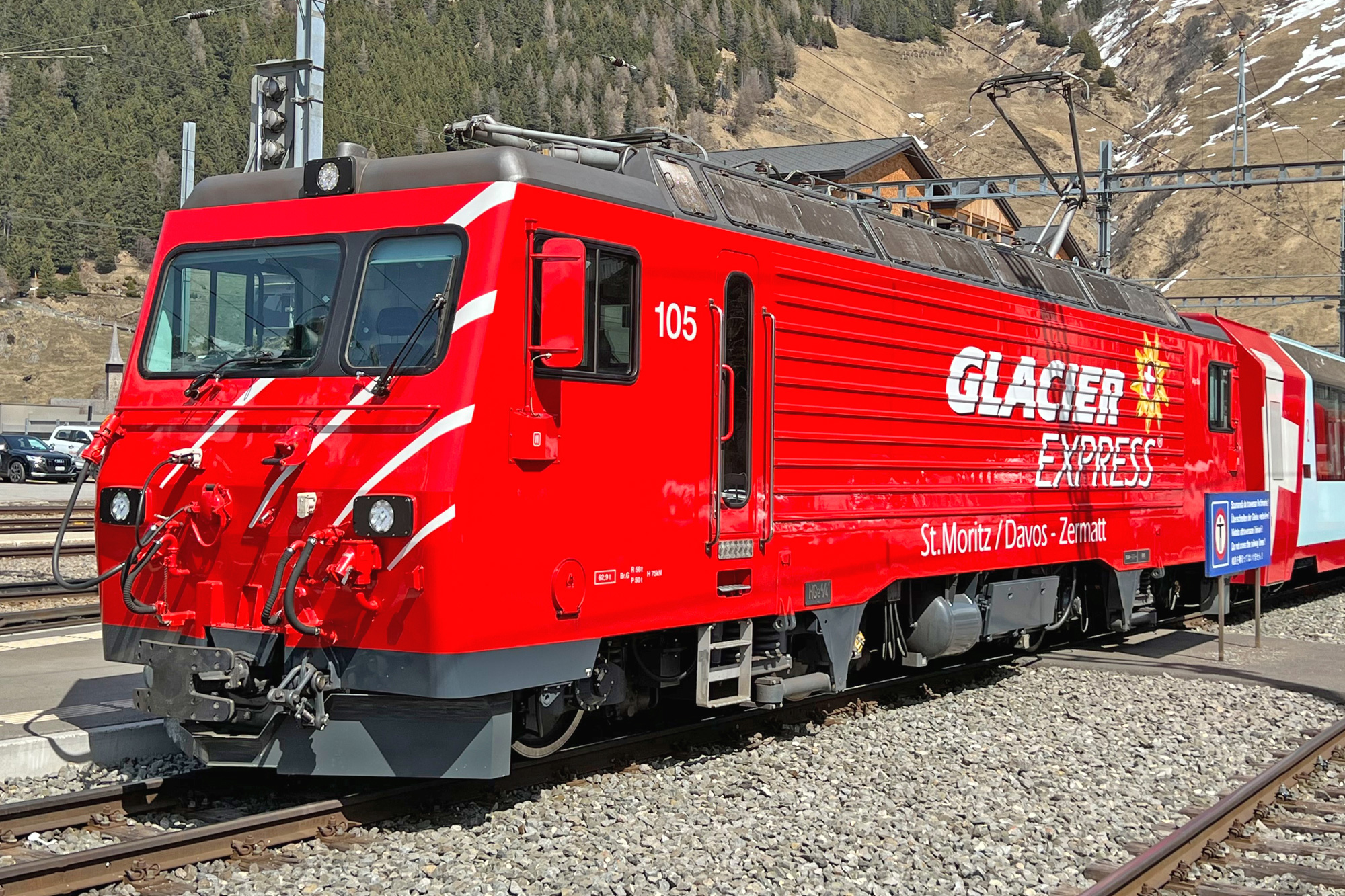
Following a tender issued to SBB, MGB awarded the contract for the refurbishment of nine of its originally 13 HGe 4/4 II rack locomotives, built 1986-1990. The HGe 4/4 II 106 served as the prototype. It was completely stripped out and the parts still fit for use were overhauled. This so-called Refit includes the replacement of the main components. Besides the slightly modified design and the LED headlights, the modern air conditioning unit between the bogies is especially visible from the outside. After the work was completed in 2021 and a successful performance test, locomotives were brought into the Refit programme two at a time. In addition to the eight locomotives 101-108 procured by the FO, it also includes the BVZ's HGe 4/4 1 as the ninth locomotive. Locomotive 105 is the only one to carry advertising livery for the "Glacier Express". Model details Die-cast metal chassis Drive and current pick-up on all four axles Working rack drive, Abt system Headlights in the direction of travel Brake hoses, heating couplings and handrails included for self-assembly Convertible to H0e; this makes operation on the rack no longer possible!
On order, lead time to be confirmed