
Locomotives

New for 2024: The German workhorse locomotive in the version as Am 847 of the Swiss Sersa Group in Era V. The specific features of the prototype were taken into account during the design and precisely transferred to the model. A particular highlight is the locomotive's cooling system with finely etched grilles and the fan wheel visible underneath. The plastic-looking engravings on the hoods and cab additionally structure the functional vehicle body. The overall impression is rounded off by the filigree bogies with numerous separately applied parts. The model comes with switchable cab and control desk lighting from the factory. Thanks to the factory-integrated PSD XP sound decoder with the largest possible speaker, the sound of the prototype is perfectly brought out on the model railway layout.
- 2-rail, direct current
- Sound
In stock: 1 on the shelf, shipped within 1-3 days

New for 2024: The German workhorse locomotive in the version as Am 847 of the Swiss Sersa Group in Era V. The specific features of the prototype were taken into account during construction and precisely transferred to the model. A particular highlight is the locomotive's cooling system with finely etched grilles and the fan wheel visible underneath. The plastic-looking engravings on the hoods and cab additionally structure the functional vehicle body. The overall impression is rounded off by the filigree bogies with numerous separately applied parts. The model features switchable cab and control desk lighting from the factory. Thanks to the factory-integrated PSD XP sound decoder with the largest possible speaker, the sound of the prototype is perfectly reproduced on the model railway layout. The model carries the quality mark "fits mfx®". In order to make digital decoders reliably usable for all users of the current Märklin Digital Central Station, a new quality mark "fits mfx®" was introduced together with Märklin and other manufacturers. This can only be used by digital decoders that have undergone a special mfx® test and passed it comprehensively. These decoders and the locomotives in which they are installed carry the quality mark "fits mfx®", which certifies unrestricted mfx® functionality. This means that PIKO products with the "fits mfx®" logo now fully support the diverse functions of mfx®.
- 3-rail, alternating current
- Sound
In stock: 1 on the shelf, shipped within 1-3 days

New for 2026: Design variant of the DE 18 by Vossloh as a version for SBB Cargo International in Era VI. The model reproduces the proportions, lettering, and the characteristic prototypical decoration. A powerful motor drives all four wheelsets of the model via two cardan shafts. The model features a PluX22 digital interface and is prepared for sound retrofitting with the largest possible speaker.
- 2-rail, direct current
In stock: 1 on the shelf, shipped within 1-3 days

With the locomotives from the PIKO Expert Plus range, operations on the model railway layout can be carried out with even greater prototypical accuracy. Thanks to the development of the new PIKO digital coupling, shunting operations with remote-controlled, trouble-free coupling and uncoupling of coaches and wagons are now possible with selected locomotives, maintaining the high level of operational reliability that PIKO users have come to expect. This combines the advantages of the popular, highly detailed PIKO Expert locomotives with innovative technical features from the latest developments. The power cars of the Expert Plus range impress with realistic, powerful 12-bit sound featuring 8 channels and 128 Mbit storage depth at 2.5 watts output power, fine motor regulation, and a variety of light functions, which, together with the buffer capacitor and the innovative digital coupling, enable a new generation of PIKO locomotives.
- 2-rail, direct current
In stock: 1 on the shelf, shipped within 1-3 days

New for 2026: Siemens Vectron BR 247 diesel locomotive from Sersa in Era VI with large advertising print. For the straightforward installation of a digital decoder, the locomotive is equipped with a PluX22 interface.
- 2-rail, direct current
In stock: 1 on the shelf, shipped within 1-3 days

New for 2026: Diesel locomotive Siemens Vectron BR 247 from Sersa in Era VI with large advertising print. The model comes fitted from the factory with a PIKO XP sound decoder with matching speaker.
- 3-rail, alternating current
- Sound
In stock: 1 on the shelf, shipped within 1-3 days
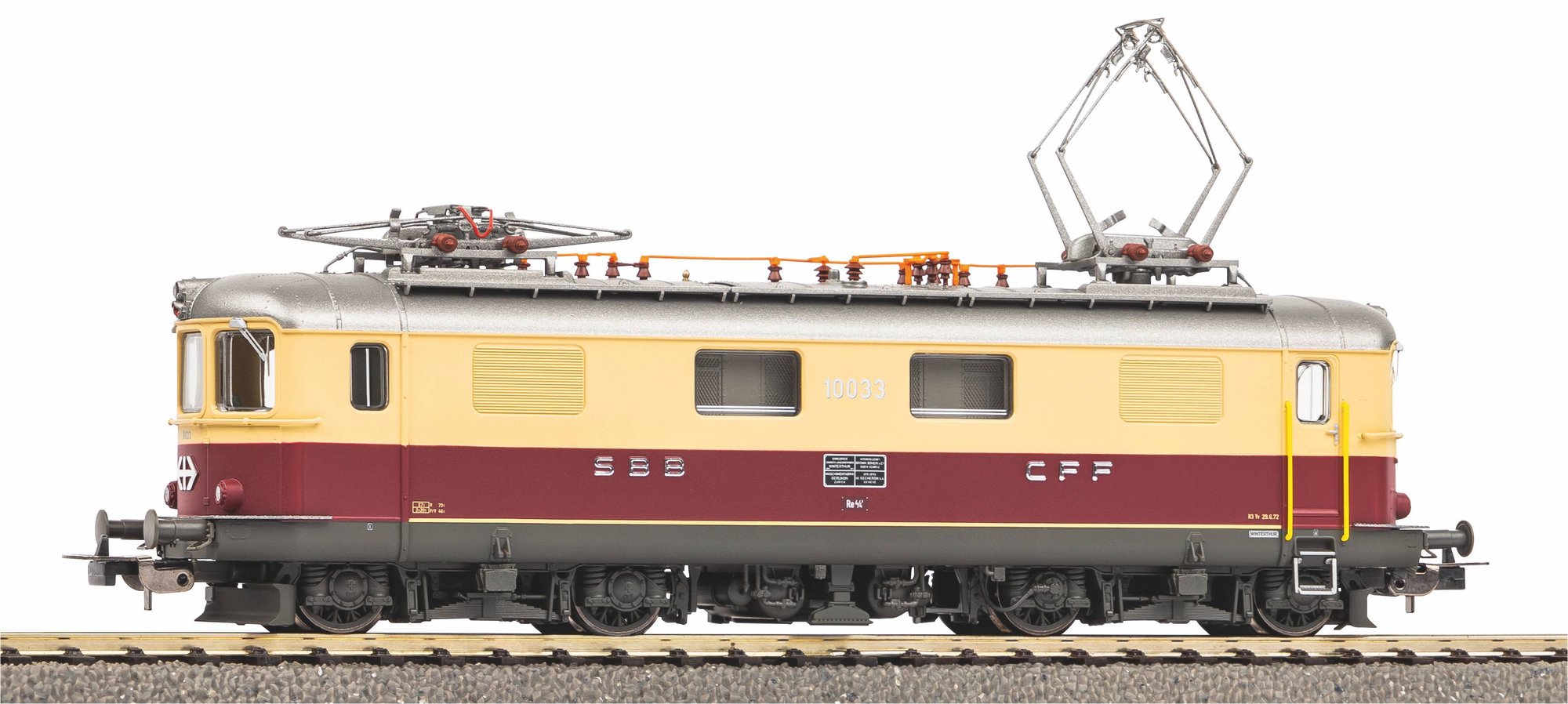
New for 2024: SBB Re 4/4 electric locomotive in TEE livery, Era IV. The model impresses with its well-proportioned body, finely detailed metal pantographs, a prototypical roof equipment layout, and numerous separately applied details. Technologically, the model is up to date, boasting excellent running characteristics and modern LED lighting. The locomotive comes fitted with a PSD XP sound decoder and features a wide range of digital and sound functions.
- 2-rail, direct current
- Sound
In stock: 1 on the shelf, shipped within 1-3 days

Prototype: The SBB Ee 3/3 II electric locomotives are based on the widely used Ee 3/3, differing optically and mechanically only in their dual-system capability for operation under 15 kV 16 ⅔ Hz and the French 25 kV 50 Hz system. After the 25 kV electrification of the western part of Basel SBB station and the Alsace line was commissioned, the SNCF lacked its own dual-system locomotives for freight traffic towards Muttenz marshalling yard. The SNCF therefore purchased nine locomotives of the C 20151–20159 type between 1958 and 1960, technically derived from the Ee 3/3 16505–16506. The locomotives were built by SAAS in Geneva and SLM in Winterthur. After more powerful BB 20200 locomotives took over service in 1970, the SNCF sold its nine locomotives to the SBB between 1971 and 1972, where they were adapted to SBB standards over the years. The locomotives were frequently used in double traction, inter alia in Basel, Bern, Lausanne, Biel, Vallorbe and Delémont. All locomotives were retired between 2004 and 2011 – with the exception of 16515, which was restored in 2020 by the TEAM C-20155 association and preserved in its original SNCF livery. Features and characteristics: Complete new tooling. Metal chassis for optimal tractive effort. All three axles powered. Condition of the 1970s after takeover by the SBB. With SNCF Faiveley pantograph and buffers. Without tool box, earth rod box and rainwater pipe. With air reservoir and original brake hoses. Angled handrails on the shunting steps. With flag holder and roof plate with antenna. Prototypical front lighting. Cab and driver's desk lighting. Impeccable lettering. Extra applied antenna. Fine-spoked wheels, steps and coupling plate. Delicate jackshaft, brake cylinders and separate speedometer drive. In digital operation with switchable cab lighting. Brake hoses and coupling hooks for retrofitting are included. Exclusive model for Switzerland.
- 2-rail, direct current
- Sound
In stock: 1 on the shelf, shipped within 1-3 days

Prototype: The SBB Ee 3/3 II electric locomotives are based on the widely used Ee 3/3, both optically and mechanically, but differ in their dual-system capability for operation under 15 kV 16 ⅔ Hz and the French 25 kV 50 Hz system. After the commissioning of the 25 kV electrification in the western part of Basel SBB station and the Alsace line, the SNCF lacked its own dual-system locomotives for freight traffic towards the Muttenz marshalling yard. Therefore, the SNCF purchased nine locomotives of the type C 20151–20159 between 1958 and 1960, technically derived from the Ee 3/3 16505–16506. The locomotives were built by SAAS in Geneva and SLM in Winterthur. After more powerful locomotives of the type BB 20200 took over service in 1970, the SNCF sold its nine locomotives to the SBB between 1971 and 1972; these were adapted to SBB standards over the years. The locomotives were frequently used in double traction, inter alia in Basel, Bern, Lausanne, Biel, Vallorbe and Delémont. Between 2004 and 2011, all locomotives were retired – with the exception of 16515, which was restored in 2020 by the TEAM C-20155 association and preserved in its original SNCF livery. Features and characteristics: Complete new tooling. Metal chassis for optimal tractive effort. All three axles powered. Condition of the 1970s after takeover by the SBB. With SNCF Faiveley pantograph and buffers. Without tool box, earth rod box and rainwater pipe. With air reservoir and original brake hoses. Angled handrails on the shunting steps. With flag holder and roof plate with antenna. Prototypical front lighting. Cab and control desk lighting. Impeccable lettering. Extra applied antenna. Fine-spoked wheels, steps and coupling plate. Filigree jackshaft, brake cylinders and separate speedometer drive. In digital operation with switchable cab lighting. Brake hoses and coupling hooks for retrofitting are included. Exclusive model for Switzerland.
- 3-rail, alternating current
- Sound
In stock: 1 on the shelf, shipped within 1-3 days

BLS, Re 4/4 167 “Ausserberg” short with driver figurine, BLS anniversary, ep. IV-V, with DCC Sound decoder. H0 scale (1:87).
In stock: 1 on the shelf, shipped within 1-3 days

Diesel locomotive 212 053 of the German Federal Railway. With new running number Perfectly matches the crane train Model equipped with PluX22 Interface and LED headlights In the 1950s, the Deutsche Bundesbahn developed a diesel locomotive type programme for the renewal of their vehicle fleet. The main goal was the replacement of the steam traction on the still quite extensive local lines. For the mixed branch line service, the single-engine V 100 series with 1100 hp engines was developed. Parallel to these V 100.10 were delivered from 1962 to 1965 a total of 380 machines equipped with 1350 hp engines as V 100.20. With the introduction of the computer number, the series designation of the more powerful machines has been changed to 212. After the classic red colour, numerous machines received from 1974/75 a ocean blue / beige coating. After the decommissioning of numerous branch lines, the classic field of use of the V 100 shrank as well. Suburban transport and transfer trains were still on the mission programme. Some machines were used in the construction train service. Numerous locomotives found new owners, among others at the NE railways and track construction companies in Germany and abroad.
In stock: 1 on the shelf, shipped within 1-3 days

Diesel locomotive Am 847 957 "Lotti" (ex DB 211 215) of Sersa AG. ■ Finely detailed model with many separately applied plug-in parts ■ Free cab view ■ Compatible with Digital railway slewing crane item no. 73039 and construction train set item no. 77043 ■ In digital operation with switchable long-distance headlight and individually switchable head or tail lamp After the withdrawal of the V 100 class at Deutsche Bundesbahn, a few locomotives were also purchased by Sersa AG.
In stock: 1 on the shelf, shipped within 1-3 days

Electric locomotive 485 012 of the Swiss railway company BLS Cargo. ■ Version in the current Alpinist livery ■ Pantograph with innovative mounting ■ Extra plug-in parts ■ Rail guards mounted on the chassis ■ Switchable headlights and tail lamps with DIP switch In 2001, BLS Lötschbergbahn AG decided to order ten Traxx locomotives for cross-border freight traffic.
In stock: 1 on the shelf, shipped within 1-3 days

Electric locomotive 193 312 of the DB Cargo. Elaborate printing of the “Das ist grün” design Features prototypical high control panel design in the driver’s cab Service in international freight transport Free-standing handle rails, in part made from metal Switchable high beam and individually switchable headlight or tail light and driver’s cab lighting in digital mode DB Cargo also ordered Vectron locomotives in response to increasing freight transport demand. In 2018, DB Cargo received a total of 60 locomotives with the country packages for Germany, Austria, Switzerland, Italy and the Netherlands. This made it possible for DB Cargo trains to travel continuously without changing locomotives for the first time since the schedule change 2018/2019 - for example on the route from Rotterdam to Verona. Since 2020, these locomotives have also been fitted with the country package for Belgium.
In stock: 1 on the shelf, shipped within 1-3 days

Electric locomotive 193 658 of MRCE, leased to SBB Cargo International, named “Vierwaldstättersee” (Railcolor design, names and outlines of Swiss lakes at the four corners). Finely detailed model with four roof pantographs and free-standing grab rails, some made of metal. In digital operation, switchable long-distance headlight as well as individually switchable headlights/tail lamps and cab lighting. DC, sound decoder (PluX22), 4 axles powered, 1 traction tyre, flywheel, buffer capacitor, LED lighting, NEM-362 coupling with close coupling mechanism, minimum radius 358 mm, length over the buffers 218 mm, Era VI.
In stock: 1 on the shelf, shipped within 1-3 days

Electric locomotive 186 906 “RAlpiercer” of the leasing company Akiem, rented out to SBB Cargo International. Baptised with the name “Katzenberg” Side walls feature different designs Service in international freight transport With separately attached plug-in parts, in part using etching technology Design with snow plough on the chassis Switchable headlight/tail light with DIP switch In cooperation with Railcolor Design The Akiem locomotives 186 901 – 910 have run for SBB Cargo International since December 2020, and are mainly used in RoLa transport between Freiburg and Novara. Due to this, all ten 186 locomotives bear the Ralpin AG lettering on one side and a revision of the existing Alppiercer design on the other. The “Katzenberg” emblem created especially for the locomotive depicts the south portal of the 9.38 km long tunnel, which is located just past the Swiss border and has been a part of the expansion project Basel - Karlsruhe since 2012, when it was put into operation. The Katzenberg tunnel between Bad Bellingen and Effringen Kirchen is one of many strategically important tunnel constructions on the North-South corridor of SBB Cargo International and RAlpin AG.
In stock: 1 on the shelf, shipped within 1-3 days

High-speed steam locomotive 18 201, coal-fired of the railway company of the German Democratic Republic (Deutsche Reichsbahn). Drive on two axles of the tender and via cardan shaft on all three locomotive driving axles. Edition model! Form variation! Update! Prototypical implementation of the design with coal firing For the first time with PluX16 interface and LED lighting Trim line with triple tip Finely-detailed metal wheelsets Smoke generator can be retrofitted The Halle Research Institute needed another high-speed steam locomotive to test new passenger coaches in the 1960s. The new engine 18 201 was created from high-speed tender locomotive 61 002 and parts of high-pressure test locomotive H 25 024. The steam generator was a modified new boiler construction of the class 22 with an extended smoke chamber and Giesl ejector. The machine was equipped with a counter-pressure brake to ensure that the speed was maintained precisely when travelling at high speed. Fast travel meant up to 175 km/h, because the 18 201 was initially approved for this maximum speed – later 180 km/h – but of course only forwards.
- 2-rail, direct current
In stock: 1 on the shelf, shipped within 1-3 days

Steam locomotive class 89.70–75 of the German Federal Railway. Ideal locomotive for use on branch lines LED lighting Metal die-cast undercarriage With switchable sound functions From 1882 to 1910, approximately 1,550 tender locomotives of type T3 in different designs were supplied to the Prussian State Railway (K.P.E.V.) and other state railways. As type Cn2, the M III-4p design of the locomotive had a friction load of 36 tonnes and could travel at a maximum speed of 40 km/h with an output of 300 HPi. Around 70 locomotives remained with the German Federal Railway. The last locomotives were taken out of service around 1961.
- 2-rail, direct current
- Sound
In stock: 1 on the shelf, shipped within 1-3 days

Steam locomotive class PtL 2/2 "Glaskasten" of the Royal Bavarian State Railway. Model with authentic sound functions Authentic livery with fine decorative lines Used at the head of passenger and light goods trains on branch lines The local railway locomotive designated PtL 2/2 (a passenger tender locomotive for branch lines) is undoubtedly one of the most iconic steam engines of the past, especially among railway enthusiasts. Affectionately known by regional nicknames such as 'Glaskastl,' 'Schnauferle,' 'Quietscherle,' and 'Bockl,' it holds a special place in railway history. With a rated power output of 210 hp, it was officially approved for a top speed of 40 km/h: though, according to accounts from train drivers, it often reached 60 km/h or more in actual service.
- 2-rail, direct current
In stock: 1 on the shelf, shipped within 1-3 days

Steam locomotive 230 F 607 of the National French Railways. Edition model! Form variation! Design featuring short chimney Finely-detailed model with many separately attached plug-in parts Wheels with fine spokes Design with rivet tender and Wagner smoke deflectors Driver’s cab and valve gear lighting installed, switchable in digital mode The P 8 was a general-purpose locomotive, and was deployed for all kinds of trains. After the turmoil resulting from the two World Wars, they were used by almost all European railway administrations. They were to be found in Belgium, Denmark, France, Greece, Italy, Yugoslavia, Lithuania, Luxembourg, the Netherlands, Austria, Poland, Romania, Czechoslovakia and the Soviet Union. In 1919, 162 locomotives were sent to France, of which 25 went to AL, 25 to EST, 75 to NORD, 17 to ETAT (as 230.943-959, all 1940s phased out except for the 943) and 20 to MIDI. In 1945, the SNCF received four more machines as the spoils of war.
In stock: 1 on the shelf, shipped within 1-3 days

Electric locomotive double traction Re 10/10 of the Swiss Federal Railways. Tooling variant! ■ Anniversary edition of 1982 “100 Years Gotthard Railway” ■ Consisting of Re 6/6 11626 and Re 4/4ˡˡ 11323 ■ Both locomotives powered ■ With front crests and raised locomotive numbers ■ Fine, separately applied ventilation grilles and windscreen wipers made of etched metal To mark the 175th anniversary of the railway in Switzerland, ROCO presents as a special edition the Re 10/10 pair in anniversary version.
In stock: 1 on the shelf, shipped within 1-3 days

Electric locomotive Re 420 257 of the SBB Cargo. Elaborate printing Finely-detailed, separately attached ventilation grilles and windscreen wipers made from etched sheet Pantographs with invisible fastening Design with retrofitted air conditioning Light functions in accordance with the Swiss prototype Z21 driver’s cab available Since September 2020, the Re 420 257 has been advertising the environmentally-friendly collaborations in recycling economy between the companies SBB Cargo, ACTS and Spross. This recycling economy is characterised by the efficient use of raw materials for as long a period as possible. If material and product cycles are successfully closed, then raw materials can be repeatedly reused. Both the environment and the economy profit from this achievement.
- Sound
In stock: 1 on the shelf, shipped within 1-3 days

Electric locomotive 193 491 of the logistics company Hupac Intermodal. ■ Finely detailed model with four pantographs ■ Prototypical with long rain gutters and high driver's cabs for use in Italy ■ Free-standing grab rails, partly in metal ■ In cooperation with Railcolor Design ■ Sound in cooperation with Leosoundlab The Swiss logistics company for combined transport Hupac ordered eight Vectron MS freight locomotives from Siemens.
In stock: 1 on the shelf, shipped within 1-3 days

Electric locomotive 475 902 of Widmer Rail Services (WRS). ■ Model exclusively available from ROCO ■ Intricate printing with a paper-cut motif ■ Prototypical with a long rain gutter and high driver’s cabs for use in Italy ■ Free-standing grab rails, partially made of metal ■ In digital operation, light functions can be switched according to the Swiss prototype. With the Vectron locomotives Re 475 901 and 902, Widmer Rail Services put two more multi-system locomotives into service.
In stock: 1 on the shelf, shipped within 1-3 days