
H0 and N rolling stock, lighting and cable cars
Brawa, model railways made with care
Locomotives, coaches and wagons in H0 and N, plus street lights, cable cars, bulbs and wiring: the world of a family firm from Waiblingen.
- 1375items in the shop
- H0 and Nthe scales in the range
- 1948the year of the founding
What makes Brawa
- A family firm since 1948: founded by Artur Braun in Waiblingen, in southern Germany, Brawa is run today by the third generation of the family.
- Love of detail: individually fitted handrails, sprung buffers, crisp printing: every model starts from measurements and photographs of the original and a study of the construction drawings.
- Sturdy locomotives: most are largely die-cast zinc, for weight and robustness, for DC or AC, with sound and, on steam locomotives, smoke.
- Cable cars and lighting: H0 cable cars are a house speciality, starting with the Nebelhorn cableway in Oberstdorf; lamps and signals follow, with load-bearing parts made of brass or etched sheet.
Our favourites

Prototype Even before World War I, plans were being made in Prussia to electrify several mountain railways in Silesia, including the so-called “Zackenbahn” (named after the Zacken River) between Hirschberg and Polaun. Given the difficult topographical conditions, this new form of traction promised considerable savings and more cost-effective operation. However, the outbreak of World War I prevented the work from being completed quickly, and it was not until 1923 that continuous operation began. Since operating trains pulled by locomotives was very cumbersome due to fluctuating traffic volumes, considerations were made early on to switch to railcars. The suitability of the ET 88, originally procured for suburban transport in Berlin, prompted the DRG to procure additional four-axle electric railcars. In 1926-1927, LHW Breslau and WUMAG in Görlitz, in collaboration with SSW-Werke, delivered a total of 11 railcars that were to become the symbol of electric train transport in Silesia. The distinctive vehicles with their open entrance platforms were christened “Rübezahl” by the local population, a name that actually refers to a moody mountain spirit from the Giant Mountains. The railcars, which were initially painted green and designated “Breslau 511-521,” were always used in pairs with up to eight light standard branch line cars as trailers. Due to low demand, a single railcar operated between Josephinenhütte and Grünthal. The greatest rush of passengers was on weekends when the weather was nice and during the winter sports season. Up to three railcars with twelve trailers then operated as a train. At the beginning of the 1930s, the railcars were given the new designation elt 1011-1019 and a two-tone paint scheme. In 1941, the four-axle railcars were given their final numbers and became ET 89 01-11. With the exception of ET 89 11, which had to be taken out of service in 1943 due to an accident, all of them survived the war and the end of electric train transport in Silesia. Four railcars were transferred to PKP, but were not used there. The exact whereabouts of three others are unknown. ET 89 01, 04, and 07 ended up in the western occupation zones and thus became part of the DB fleet, which was founded in 1949. Only ET 89 04 was refurbished and served at the Munich Central Station depot. Initially still listed as 2nd and 3rd class cars, later photos show it as a pure 3rd class vehicle, which then exclusively carried 2nd class passengers after the class reform in 1956. On September 2, 1959, its final hour arrived – ET 89 04 was the last of its kind to be taken out of service and dismantled shortly thereafter, leaving only a few photos to remind us of these unique railcars. Model Illuminated upper carriage lanterns and tail lights Separately switchable interior lighting Separately switchable third headlight New motor New sound
In stock: 1 on the shelf, shipped within 1-3 days

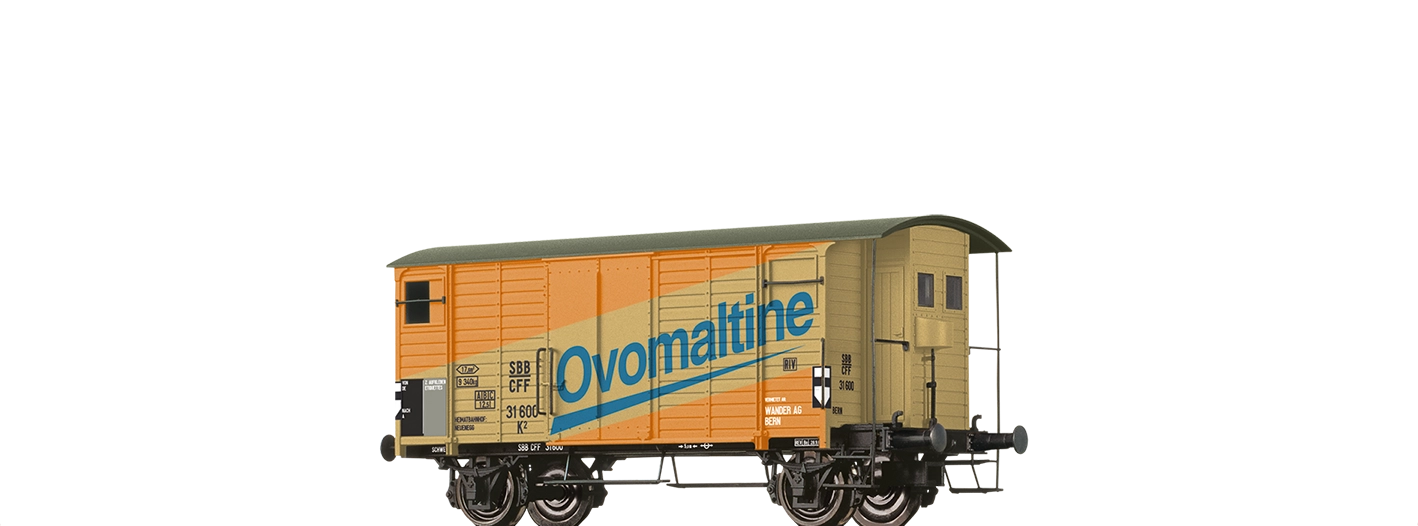
Prototype The Swiss began standardising some types of goods wagons at an early stage. They were then also procured by all private railways in order to improve repairs and spare part stock-keeping. They included closed goods wagons with a 4.5 m wheel base and a frame length of 7.10 m. Later, the wheel base was increased to 5 m in order to improve the running characteristics. In this form, high numbers of the wagons that were given the K2 designation were procured by SBB. Model Precise replica of board joints Finely engraved fan grill Precise paintwork and painting NEM-standard short-coupling Metal wheels True to original frame construction
In stock: 1 on the shelf, shipped within 1-3 days

1 x Wooden-mast Light, Pin-Socket (LED) Height 88 mm Simple handling Time-consuming cable connections between the lamp and the socket are not necessary The lamp can be tilted in the socket up to 10° to compensate for uneven terrain Can be separated electrically Compatible to each other Load-carrying parts made from brass Filigree lattice work Multi-part lampheads Intricately handpainted
In stock, shipped within 1-3 days

1 x Platform Light, Pin-Socket (LED) Height 70 mm Simple handling Time-consuming cable connections between the lamp and the socket are not necessary The lamp can be tilted in the socket up to 10° to compensate for uneven terrain Can be separated electrically Compatible to each other Load-carrying parts made from brass Filigree lattice work Multi-part lampheads Intricately handpainted
In stock: 5 on the shelf, shipped within 1-3 days

1 x Street Light, Pin-Socket (LED) Height 58 mm Simple handling Time-consuming cable connections between the lamp and the socket are not necessary The lamp can be tilted in the socket up to 10° to compensate for uneven terrain Can be separated electrically Compatible to each other Load-carrying parts made from brass Filigree lattice work Multi-part lampheads Intricately handpainted
In stock: 5 on the shelf, shipped within 1-3 days

1 x Telephone Box Swisscom Height 33 mm With lighting Spare bulb 3268
In stock: 1 on the shelf, shipped within 1-3 days
The Brawa families
Rolling stock
 210 itemsLocomotivesLocomotives in H0 and N, from the DB AG TRAXX BR 147 to the DR BR 132.See the items
 56 itemsRailcars and multiple unitsTWINDEXX Vario double-deck trains in N, DRG VT 137 diesel railcar in H0.See the items
 360 itemsPassenger coachesDB express coaches, SBB coaches and complete trains in H0 and N.See the items
 448 itemsFreight wagonsCovered wagons, container wagons and luggage vans, including the SBB K2 "Ovomaltine".See the items
Scenery and cable cars
 117 itemsLighting and scenery accessoriesWooden-mast lights, park lanterns and LED wall lights, clocks and telephone boxes.See the items
 12 itemsCable carsNebelhorn, Hahnenkamm, Kanzelwand, Titlis and chairlift, in H0 and N.See the items
Bulbs and wiring
All Brawa items

Prototype Even on the inaugural runs, it was evident that the new locomotive not only fulfilled, but also surpassed all expectations. Even when operating at high speeds, it demonstrated low-noise running properties and the boiler always delivered plenty of steam to the balanced fourcylinder engine. In July 1907, the locomotive set a new speed record of 154.4 km/h on a test run between Munich and Augsburg. It was the fastest steam locomotive of its era on the entire European continent. When it was commissioned and completed its sensational record runs in 1906, the S 2/6 wore an elegant grey coat of paint. The boiler was clad with a “polished Russian iron jacket”. Model With energy storage (Digital EXTRA Version) Tender body, chassis and boiler in die-cast zinc Fully mobile tender bogie Reproduction of the model-specific tender bogie Short coupling between locomotive and tender 5-pole skew-wound motor with 2 flywheel drives True-to-scale reproduction of the underframe Fine metal spoke wheels True-to-scale lenght over buffer True-to-original reproduction of the boiler back wall Driver´s cab lighting (possibility to switch on and off with digital system) Numerous metal add-on parts Replicated rivets and hatches Filigree reversing gear
On order, shipped within 10-15 days

Prototype With the adoption of the 1955 diesel locomotive type program, the foundation for a success story was laid at the Deutsche Bundesbahn (DB) [German Federal Railway] that, to some extent, continues to the present day. The decision was made to develop a diesel locomotive for the secondary railway service with an engine output of between 1,000 and 1,200 HP, the V100 series. Based upon the slightly older V 80, the Bundesbahn Central Office in Munich issued concrete change requests to the MaK Company in order to significantly reduce the costs for the new locomotives. By 1957, this resulting catalogue of requirements thus lead to a largely completed construction of which the Deutsche Bundesbahn ordered six trial locomotives. MaK manufactured a further locomotive at ist own cost in order to also be able to address customers other than DB. With the V100 000, the first of 744 manufactured locomotives of the V100 series left the MaK factory halls in Kiel in March 1958. Like no other locomotive series, it embodied the structural change on the railway that was inevitibly coming. In the middle of Germany's economic miracle, the crimson locomotives shaped the image of the young, modern Deutsche Bundesbahn and sent numerous old steam locomotives to the blast furnaces. The diverse applicability of all three sub-types ensured that the V100 was widely distributed throughout Germany and kept many less frequented secondary railways alive. Approximately a third of all V100 locomotives were equipped with a push-pull train control and multitraction control ex works in order to do away with the time-intensive shunting in train stations where it was necessary to turn the train around. At the beginning of the 1970s, individual locomotives started to be equipped with front-mounted snow ploughs. The first large quantities of the V100.10 (211) were only withdrawn from service at the end of the 1980s. This process only started approximately 10 years later for the V100.20 (212). A reasonably large amount were sold on to other railway companies abroad. Thanks to their reliability and robustness in particular, there are still a few locomotives in operation today after approximately 50 years of operation and are largely being used by private railway companies in Germany. For reasons of differentiation and as the V100 006 was already equipped with a 1,350 HP engine at the point of the first volume production order, all other trial locomotives as well as the recently ordered 1,100 HP locomotives were operated as the V100.10 series. At first glance, it is difficult to notice the differences between the V100.10 series and the trial locomotives. For instance, simple rods were now used in place of the bow-shaped manoeuvring handles and the lower lights were implemented as dual lights. Model Etched cooler grille and fan grille Free-standing handrails Spring buffers Clear view through the driver's cabin Realistic reproduction of the tubular frame bogies incl. axle drive Reproduction of brake rods All specific details of the different series taken into consideration Completely recreated driver's cab Zinc die-cast chassis and gear housing Lights fitted with maintenance-free LEDs Digital EXTRA: complete with the following features that can be digitally controlled: Sound Automatic decoupling Driver's cabin lighting Driven fans Shunting light and red light can be individually controlled It is possible to retrospectively convert the V 100 from analogue to digital via a PluX22 interface (only sound functions). Please note that it is not possible to retrospectively convert the digital remotecontrol coupling, the driven fan or the additional light functions.
On order, shipped within 10-15 days

Prototype In 1912 the Königlich Bayerische Staats-Eisenbahnen started to electrify the first tracks. Out of the first 17 electric locomotives, there were two which technically speaking distinguished themselves from the conventional ones and then proved to be extremely innovative. Whilst in those days electric locomotives usually had the well known side rod drive from the steam locomotive, these two machines already had a single axle drive, as is standard practice nowadays with all modern electric locomotives. Single axle drive means that every driver axle has its own electric motor. Both locomotives were ordered in 1912 and supplied in 1914 and 1915 by Krauss (technical vehicular components) and Bergmanns Elektrische Werke (electric components). They were stationed in Freilassing and put into service on the hilly route between Freilassing and Berchtesgaden. Both locomotives were originally designated as EG4 X 1/1 in accordance with Bavarian customs. With an overall weight of 56 t they were able to produce a maximum tractive force of 9.300 kg, whilst the maximum speed was set at 50 km/h. They proved to be outstanding, a replica build of this locomotive or development of the drive concept however didn't happen initially, it was only 20 years later that the single axle drive made its breakthrough. The locomotives were obviously ahead of their time. The two Bavarian EG4 X 1/1 still existed after the First World War and had been taken over by the Deutsche Reichsbahn district management of Bavaria. After 1923 the complex designation was replaced by a simple EG 1 and after 1926 they were then allocated the E73 series for the DRG. Both locomotives were always based in Freilassing, in addition to their regular route they were also used for shunting purposes in Salzburg. At the DRG they were obviously very satisfied as well, as the locomotives were only removed from service in 1937 and 1941. One of the two locomotives was converted to a snowplough and it remained in service for many, many years. Model Technically refined and enhanced with new sound Free-standing steps and handrails Extra mounted sandfall pipes Engraved ventilator grill Finely detailed chassis Extra mounted sandbox Spring buffers Multi-part laterns Precise paintwork and painting True to original roof fittings and isolators
On order, shipped within 10-15 days

1 x Curved Mast Light, Pin-Socket (LED) Height 48 mm Practically unlimited lifespan with LED technology Shock-resistant Easy to install; simply insert into pre-installed socket No complex cable connections between light and socket Components can be disconnected while system is live
On order, shipped within 10-15 days

1 x Platform Light, Double, Pin-Socket (LED) Height 55 mm Practically unlimited lifespan with LED technology Shock-resistant Easy to install; simply insert into pre-installed socket No complex cable connections between light and socket Components can be disconnected while system is live
On order, shipped within 10-15 days

1 x Platform Light, Pin-Socket (LED) Height 55 mm Practically unlimited lifespan with LED technology Shock-resistant Easy to install; simply insert into pre-installed socket No complex cable connections between light and socket Components can be disconnected while system is live
On order, shipped within 10-15 days

1 x Extended-head Light, Pin-Socket (LED) Height 70 mm Practically unlimited lifespan with LED technology Shock-resistant Easy to install; simply insert into pre-installed socket No complex cable connections between light and socket Components can be disconnected while system is live
On order, shipped within 10-15 days

1 x Extended-head Light, Double, Pin-Socket (LED) Height 70 mm Practically unlimited lifespan with LED technology Shock-resistant Easy to install; simply insert into pre-installed socket No complex cable connections between light and socket Components can be disconnected while system is live
On order, shipped within 10-15 days

1 x Floodlight, Double, Pin-Socket Height 65 mm Easy to install; simply insert into pre-installed socket No complex cable connections between light and socket Components can be disconnected while system is live
On order, shipped within 10-15 days

1 x Gas Lantern, Pin-Socket with (LED) Height 35 mm Practically unlimited lifespan with LED technology Shock-resistant Easy to install; simply insert into pre-installed socket No complex cable connections between light and socket Components can be disconnected while system is live
On order, shipped within 10-15 days

1 x Park Lantern, Pin-Socket (LED) Höhe 35 mm Practically unlimited lifespan with LED technology Shock-resistant Easy to install; simply insert into pre-installed socket No complex cable connections between light and socket Components can be disconnected while system is live
On order, shipped within 10-15 days

1 x Street Light, Pin-Socket (LED) Height 35 mm Practically unlimited lifespan with LED technology Shock-resistant Easy to install; simply insert into pre-installed socket No complex cable connections between light and socket Components can be disconnected while system is live
On order, shipped within 10-15 days

1 x Wooden-mast Light, Pin-Socket (LED) Height 50 mm Practically unlimited lifespan with LED technology Shock-resistant Easy to install; simply insert into pre-installed socket No complex cable connections between light and socket Components can be disconnected while system is live
On order, shipped within 10-15 days

5 x Pin-socket without lamp (for LED) Suitable for lamps that were produced from 2019 Simple Handling Time-consuming cable connections between the lamp and the socket are not necessary Can be separated electrically
On order, shipped within 10-15 days