
H0 model trains, track and Z21
Roco, Swiss and European railways in H0
Re 460, Re 4/4 II "Swiss Express", BLS Re 465, EW II coaches and Hupac wagons: Roco reproduces Swiss and European railways in 1:87, often for both DC and AC, with its geoLine and RocoLine track and its Z21 digital command station.
- 1714items in the shop
- 1:87for your H0 layout
- Since 1960a brand from Salzburg
What Roco brings to your layout
- Swiss locomotives: SBB Re 460, Re 4/4 II, Re 10/10, Re 420 and Re 482, BLS Re 465 and Re 486, De 4/4 and RABe 502 multiple units.
- Two-rail or three-rail: many models come in a DC version and an AC version, often with sound.
- The Z21 command station: up to 9,999 DCC locomotive decoders, driven with the multiMAUS or the Z21 app for smartphone and tablet (iOS and Android). Updates by smartphone.
- Two track systems: geoLine, the track with integrated ballast, and RocoLine, with or without ballast, flexible track with wooden or concrete sleepers.
Our favourites for a Swiss layout
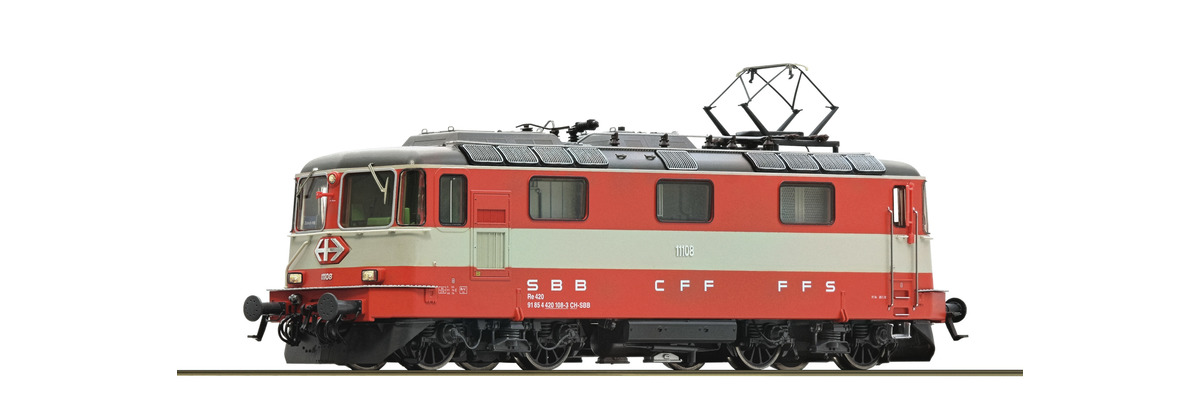
Electric locomotive Re 4/4 II 11108 “Swiss Express” of the Swiss Federal Railways. New design! 1st type series of the class Re 4/4 II Featuring separately attached plug-in parts, in part using etching technology Design in current operating condition with air-conditioning system Rectangular lamps Individually switchable headlight or tail light, driver’s cab lighting and engine room lighting in digital mode Z21 driver’s cab available On 22nd May 1975, the train category “Swiss Express” belonging to the Swiss Federal Railways (SBB) was introduced in conjunction with the commissioning of the Heitersberg line, and remained in existence until the year 1982. This category replaced the former city express trains. At the time, these trains were considered a showpiece for the SBB and operated on the most important transport axis from Geneva to St. Gallen. The trains were hauled by eight Re 4/4 IIs equipped especially for the purpose. Sadly, only the 11108 and the 11109 still bear the original livery. The Re 4/4 11108 represents a particularly popular locomotive. The “Cream cake”, as it was lovingly nicknamed, was regularly operated until the year 2021, after which it was put onto the sidings in Olten. Here it awaits further use.
In stock: 2 on the shelf, shipped within 1-3 days

Electric locomotive Re 465 008 of the Swiss railway company BLS. Elaborately printed model in "Golden Pass" design With extra attached windscreen wipers Fine depiction of the front grab rails Headlight/tail light switchable with a DIP switch The Bern–Lötschberg–Simplon Railway (BLS) ordered an advanced universal locomotive based on the SBB Re 460 from the Swiss manufacturers SLM Winterthur and ABB Zurich, under the series designation 465. Unlike the Re 460, these locomotives have one inverter per axle rather than only one per bogie. This allows the tractive power to be optimally transferred to the rails. BLS uses the 18 locomotives primarily for freight transport, but also in front of commuter trains.
- 2-rail, direct current
In stock: 1 on the shelf, shipped within 1-3 days

Electric locomotive double traction Re 10/10 of the Swiss Federal Railways. Tooling variant! ■ Anniversary edition of 1982 “100 Years Gotthard Railway” ■ Consisting of Re 6/6 11626 and Re 4/4ˡˡ 11323 ■ Both locomotives powered ■ With front crests and raised locomotive numbers ■ Fine, separately applied ventilation grilles and windscreen wipers made of etched metal To mark the 175th anniversary of the railway in Switzerland, ROCO presents as a special edition the Re 10/10 pair in anniversary version.
In stock: 1 on the shelf, shipped within 1-3 days

Electric locomotive 460 078 of the Swiss Federal Railways. Elaborate printing in the “Nendaz and I” design with different side designs Separately attached SBB logo and additional handle rail at the front With switchable high beam and individually switchable headlight or tail light in digital mode Since May 2023, the 460 078 class has been advertising for the “Swisstainable on the Road” campaign by Schweiz Tourismus. Swisstainable is the sustainability strategy of Schweiz Tourismus and the tourism industry. The goal is to promote sustainable travel in a targeted manner. That is why the locomotive bears the advertising message “Nendaz and I”, which refers to travelling from the tourist resort of Nendaz, located in the canton of Valais, into the whole of Switzerland.
In stock: 1 on the shelf, shipped within 1-3 days

Electric luggage railcar De 4/4 1669 of the Swiss Federal Railways. For the first time, available with PluX22 Interface and LED lighting Window in the luggage compartment with replicated grille bars A total of 11 Fe 4/4 units were equipped with an electric brake in 1930/31 and again in 1938 for operation on the Seetalbahn and the steep Vallorbe–Le Pont line. As part of a decision to modernise this sub-series, the Yverdon workshop rebuilt unit De 4/4 1669 in 1965/66. At the time, it was intended to serve as a prototype, was allocated to the Lausanne depot, and was already due for a major overhaul. The rebuilt railcar featured several upgrades, including: a driver's cab adapted for seated operation, new pneumatic equipment, a compressed-air main switch, a new contactor bank, and a closed driver's cab. The only feature that retained its traditional appearance was the classic dark green livery with a light grey underframe.
- 2-rail, direct current
In stock: 1 on the shelf, shipped within 1-3 days

Panorama coach, type Apm, of the Swiss Federal Railways. “Connecting Europe Express” design
In stock: 2 on the shelf, shipped within 1-3 days

Set of two "Seetalbahn" coaches of the société Le Pont-Le Brassus. The set contains a 1st/2nd class coach, type AB and a 2nd class coach, type B. Back in the ROCO range after many years Between 1947 and 1950, the SBB ordered 20 ABi platform coaches and another 20 Bi coaches. The SBB also ordered a few units for branch lines. Le Pont-Le Brassus (PBr, today Travys) also ordered two wagons.
On order, shipped within 10-15 days

Open goods wagon, class Eaos, of the Swiss Federal Railways. ■ New running number ■ Free-standing grab rails ■ Suitable for block trains During the sugar beet campaigns in Switzerland, a large number of open high-sided wagons are required. For this purpose, SBB Cargo hired several types of the Eaos class from France Waggon for an extended period, each receiving an SBB wagon number. Some of them featured distinctive end-wall extensions with a crescent shape.
In stock: 5 on the shelf, shipped within 1-3 days
The Roco families
H0 rolling stock (1:87)
 693 itemsLocomotivesElectric, diesel and steam, from the Re 460 and Re 4/4 II to classes from across Europe.See the items61 itemsMultiple units and railcarsElectric multiple units and diesel railcars, including the De 4/4 and RABe 502.See the items
 247 itemsPassenger coachesSBB EW II, Eurocity and IC2000 coaches, plus coaches from across Europe.See the items248 itemsGoods wagonsCovered and open wagons, Hupac pocket wagons, rolling motorway.See the items
 61 itemsCoach and wagon setsCoach and wagon sets to make up a train.See the items
Track and digital control
 37 itemsgeoLine trackThe track with integrated ballast: straights, curves, points and accessories.See the items
 116 itemsRocoLine trackWith or without ballast, flexible track and 10° and 15° points.See the items
 70 itemsZ21 and electronicsCommand stations, handsets, decoders, cables and electronic accessories.See the items
All Roco items

Goods brake van, class Pwgs, of the Deutsche Reichsbahn. New tooling! Roof lookout with three windows With steps below the loading compartment door Sliding doors can be fitted in either of two positions (closed, half open) Switchable interior lighting and tail lamps in digital operation In the 1950s Waggonbau Bautzen built a short goods brake van on behalf of the DR. More than 200 vans were procured in two construction series. A special feature of the vans was their built-in tail signals, whose red and white surfaces could be covered by rotating shutters.
Pre-order, release expected in Q3 2027

Luggage van, class Daa, of the Deutsche Reichsbahn. New tooling! Roof lookout with two windows Without steps below the loading compartment door Sliding doors can be fitted in either of two positions (closed, half open) In the 1950s Waggonbau Bautzen built a short goods brake van on behalf of the DR. More than 200 vans were procured in two construction series. A special feature of the vans was their built-in tail signals, whose red and white surfaces could be covered by rotating shutters. From 1964 the vans were also used on branch lines in passenger trains. These vans were given lettering according to the passenger coach scheme, with the designation D. From 1977 those used exclusively as luggage vans in passenger trains were redesignated Daa.
Pre-order, release expected in Q3 2027

Variant with sheet metal platform railings
Pre-order, release expected in Q3 2027

Set of eight different goods wagons of the railway company of the German Democratic Republic (Deutsche Reichsbahn). The set contains a covered goods wagon with a barrel roof, a covered goods wagon with a flat roof, a refrigerator wagon, three open goods wagons, a stake wagon and a lidded wagon. With new running numbers All models are finely detailed and printed according to the epoch Complete goods train at a convenient price
On order, shipped within 10-15 days

Steam locomotive class T3 of the Royal Prussian Railway Administration. With new running number Fully movable, delicately crafted Allan controller Metal die-cast undercarriage From 1882 to 1910, approximately 1,550 tender locomotives of the type T3 in different designs were supplied to the Royal Prussian Railway Administration (K.P.E.V.) and other state railways. As the type Cn2, this locomotive had a friction load of 36 t in its M III-4p design, and was able to reach a maximum speed of 40 km/h with an output of 300 PSi.
On order, shipped within 10-15 days

Steam locomotive class 89.70–75 of the railway company of the German Democratic Republic (Deutsche Reichsbahn). With new running number LED lighting Metal die-cast chassis From 1882 to 1910, approximately 1,550 tender locomotives of the type T3 in different designs were supplied to the Prussian State Railway (K.P.E.V.) and other state railways. As the type Cn2, this locomotive had a friction load of 36 t in its M III-4p design, and was able to reach a maximum speed of 40 km/h with an output of 300 PSi. The German State Railway Company (DRG) procured 511 models and designated these as class 89.70–75 in their fleet. Until 1968, the German State Railway (DR) still ran locomotives from this class on branch lines and as factory locomotives.
On order, shipped within 10-15 days

Steam locomotive 77.14 of the Austrian Federal Railways. Design with Giesl ejector Without valve on the steam dome Version with third headlight Finest wheels with low wheel flanges Metal buffer Drive and coupling rods made from fine cast metal The passenger train tender locomotive designated as class 77 by the Austrian Federal Railways was procured in several classes from 1913 (SB/kkStB class 629) until 1927. The Pacific type 2'C1' h2t steam locomotive was authorised for a maximum speed of 85 km/h. With full water tanks and coal bunkers, a range of up to 200 kilometres was possible. Practically every train haulage operation in Austria was equipped with class 77 locomotives at some point. The 77.14, which was designed later, was delivered to BBÖ as the 629.29 with factory number 4379 by the StEG machine factory in 1922. After an eventful fifty years, it was taken out of service in November 1972.
On order, shipped within 10-15 days

Steam locomotive Ty2 (ex DRB class 52) of the Polish State Railways. Drive on two axles of the tender and via cardan shaft on all five drive axles of the locomotive. Design with a green driver's cab and eye-catching decorations With two large lamps at the front and also at the rear of the tender Cowcatcher with rounded clearing plates Authentic smoke deflectors, rounded on the inside Z21 driver's cab available The Class Ty2 steam locomotives of the Polish State Railways (PKP) began operating in 1942. They were Class 52 wartime locomotives of the Deutsche Reichsbahn. After the Second World War, 1.207 of them remained with the PKP. The Ty2 became the largest locomotive series in Poland until the end of the steam traction era. Several locomotives have been preserved to this day.
- Sound
On order, shipped within 10-15 days

Electric locomotive 193 718 of Mitsui Rail Capital Europe (MRCE). With an authentic elevated driver's desk in the cab Multicoloured driver's cab rear wall and control panel Detailed roof design Operation in cross-border freight transport Headlight/tail light switchable with a DIP switch
- 2-rail, direct current
On order, shipped within 10-15 days

Electric locomotive 193 718 of Mitsui Rail Capital Europe (MRCE). With an authentic elevated driver's desk in the cab Multicoloured driver's cab rear wall and control panel Detailed roof design Operation in cross-border freight transport In digital operation with switchable high beam, head/tail light and driver's cab lighting
- 2-rail, direct current
- Sound
On order, shipped within 10-15 days

Steam locomotive 95 0045 of the Deutsche Reichsbahn. Edition model! Mold variant! Version with old boiler without bell Rich detailing on the model with many separately applied plug-in parts Oil tank with ladder Free-standing boiler tubes Filigree chequer plates With fine metal wheelsets Stationed at Railway Mangement Erfurt, Probstzella depot This type of steam locomotive was the most powerful tender locomotive ever procured by the Deutsche Reichsbahn. A total of 45 units of these huge locomotives were built. It was known as the "Mountain Queen" because it was primarily used on the railway lines Sonneberg-Probstzella, Spessartrampe, Frankenwaldbahn, Geislinger Steige, Schiefe Ebene, and Rübelandbahn. After the Second World War, 31 locomotives of this class became part of the Deutsche Reichsbahn's vehicle fleet. In the 1950s, boiler equipment, fittings, pumps, driver's cabs, and more were adapted to DR practices during maintenance, resulting in substantial standardisation. Between 1966 and 1972, 24 locomotives were converted to oil main firing, and 10 had a new boiler without a feed dome. The Eisfeld-Sonneberg railway line was their last field of operation and the locomotives were not scrapped until 1981.
- 2-rail, direct current
On order, shipped within 10-15 days

Steam locomotive 01 0529 of the Deutsche Reichsbahn. Drive on two axles of the tender and via cardan shaft on all three drive axles of the locomotive. Variant with oil firing and a pointed smokebox door Operation condition 1971 with white decorative lines Fine metal wheelsets Stationed at Railway Mangement Erfurt, Erfurt depot The Deutsche Reichsbahn feared that it would have fewer and fewer locomotives for use in its express trains due to the poor condition of some of its class 01s. It was therefore decided to rebuild the 01s, which also meant improving performance and eliminating technical faults, and this was particularly successful with this class. The new welded boiler was fitted with a third safety valve. All the boiler superstructures were clad, the cab was modernised and the Witte smoke deflectors were chamfered at the front. 01 529' was fitted with a combustion chamber boiler, mixing preheater and main oil firing system in 1964. Its last station and place of service was Berlin-Schöneweide. It was taken out of service in July 1983.
- 2-rail, direct current
On order, shipped within 10-15 days

Steam locomotive class 043 of the Deutsche Bundesbahn. Drive on two axles of the tender and via cardan shaft on all five drive axles of the locomotive. With hand-painted boiler rings Used in heavy goods train service Metal wheels with filigree spokes Known as "Jumbos" because of their enormous tractive power, the steam locomotives were used with great success in almost all of Germany and many other European countries. The maximum speed was 80 km/h forward and 50 km/h reverse. Some of these already very powerful locomotives experienced a further increase in power to 2.100 hp (1.546 kW) when they were converted to oil firing by the Deutsche Bundesbahn from 1955 on. The DB's oil-fired locomotives were given the class designation 043 from 1968 on.
- 2-rail, direct current
On order, shipped within 10-15 days

Steam locomotive 086 407 of the Deutsche Bundesbahn. Mold variant! First version with welded DB replacement water boxes and snow plough Coal box with welded attachment Leading and trailing wheelset with 9 spokes With DB reflector lamps At the end of the Second World War, there were 386 class 86 locomotives on West German territory. Most of them could be repaired, so by 1952, the DB had more than 378 of the class in its fleet. Some 86s were later fitted with welded replacement water tanks. In addition to classic branch line trains, the locomotives were regularly used to haul fast trains and to shunt at goods stations. The last DB class 086 locomotives were taken out of service in 1974.
- 2-rail, direct current
On order, shipped within 10-15 days

Steam Locomotive 86 200 of the Deutsche Reichsbahn-Gesellschaft. Mold variant! Short-cut-out water tanks for the first time in a riveted design Fine metal wheelsets With running wheel brakes Authentic twin headlights Some signage is also included as etched parts From 1928 to 1943, almost all German locomotive factories delivered a total of 775 locomotives of this class to the Deutsche Reichsbahn-Gesellschaft. The 1000 hp locomotives were designed for a speed of 70-80 km/h, which meant they could also be used on main and feeder lines, in addition to their primary area of application, the "branch lines".
Pre-order, release expected in Q4 2027

Steam locomotive 86 1563 of the Deutsche Reichsbahn. Mold variant! Version with large smoke deflectors for use on Usedom Long cut-out water tanks Fine metal wheel sets Based at the Rbd Greifswald, depot Heringsdorf
- 2-rail, direct current
On order, shipped within 10-15 days

Czechoslovak State Railways Class 477 steam locomotive. Special edition model! Variant! Available for the first time in a blue livery and as a variant featuring the large, distinctive water tanks Second-series version Particularly intricate pipework beneath the boiler Delicately crafted spoked wheels Parts of the model made from metal Highly detailed design of the driver’s cab Some signage additionally included as etched parts The CSD Class 477.0 represents the final and most technically advanced class of steam locomotive produced by the Czechoslovak State Railways (CSD). A total of 60 units were manufactured between 1951 and 1955 by CKD (CKD Sokolovo in Prague) and the class evolved from the preceding Class 476.1. The locomotives were designed as powerful express tender locomotives with a 2’D2’ wheel arrangement for heavy passenger service and, with a working weight of around 131 tonnes, were considered among the heaviest tender locomotives in Europe at the time. The three-cylinder locomotives reached a maximum speed of around 100 km/h and had a starting tractive effort of almost 110 kN. Visually, the 477.0 class was characterised by striking lines, featuring a streamlined firebox, Witte air deflectors and an elegant, usually colourful paint scheme with decorative stripes. This earned it the nickname ‘Papousek’ (parrot) in everyday service.
Pre-order, release expected in Q4 2027

Steam locomotive type PtL 2/2 "Glaskasten" of the Royal Bavarian State Railway. Authentic livery with fine decorative lines Used at the head of passenger and light goods trains on branch lines The local railway locomotive designated PtL 2/2 (a passenger tender locomotive for branch lines) is undoubtedly one of the most iconic steam engines of the past, especially among railway enthusiasts. Affectionately known by regional nicknames such as 'Glaskastl,' 'Schnauferle,' 'Quietscherle,' and 'Bockl,' it holds a special place in railway history. With a rated power output of 210 hp, it was officially approved for a top speed of 40 km/h: though, according to accounts from train drivers, it often reached 60 km/h or more in actual service.
- 2-rail, direct current
On order, lead time to be confirmed

Steam locomotive class Pt 2/3 of the Royal Bavarian State Railway. Detailed livery with fine decorative lines Movable Heusinger valve gear Ideal complement for the passenger coaches item 6200197 The Pt 2/3 type stood out among the light tender locomotives used for passenger service. Characteristic features included its slender boiler, the wide spacing between the leading axle and the coupled wheels (a remarkable 4000 mm!), and the relatively spacious driver's cab. A door at the rear of the locomotive also allowed the fireman to enter the train to assume the conductor’s duties when needed. The Bavarian State Railway put the first locomotives into service in 1909, the last in 1916. All locomotives (type 1 B h2, maximum speed 65 km/h) were supplied by Krauss in Munich.
- 2-rail, direct current
On order, shipped within 10-15 days

Steam locomotive 150.Y.16 of the French State Railways. Drive on two axles of the tender and via a cardan shaft on all five drive axles of the locomotive. First time in black/green livery Variant with disc leading wheel With fine metal-spoke wheels Driving and coupling rods made of precision-cast metal Z21 driver's cab available In 1943/44, the Société Alsacienne de Constructions Mécaniques (SACM) locomotive factory in Graffenstaden near Strasbourg built over 100 Class 52 locomotives. In 1945/46, a further 17 locomotives were added for the SNCF. There, the Class 52 was designated Class 150 Y. A special feature of the locomotives was the shorter chimney so as not to exceed the French loading gauge. The Class 150 Y hauled both heavy goods trains and passenger trains in the SNCF's eastern region. They were in service there until the end of the 1950s.
- 2-rail, direct current
On order, shipped within 10-15 days

Steam locomotive 50 2146 of the Deutsche Reichsbahn. Drive on two axles of the tender and via a cardan shaft on all five drive axles of the locomotive. Three-domed boiler with Witte smoke deflectors Chassis in red-brown livery Lamps with grab rails on the front buffer beam Version with new build-tender Fine metal wheelsets Allocated to the depots in Dresden and Zwickau The Class 50 played a more significant role in eastern Germany than in the west. In purely numerical terms, relatively few locomotives remained in the Soviet occupation zone at the end of the war, with only 354 units still present. Over time, various locomotive–tender combinations emerged. New tenders from Classes 23.10 and 50.40 were increasingly paired with older Class 50 locomotives after they were withdrawn from service. However, because they lacked a continuous rear wall, this combination was not particularly popular with personnel, especially in winter.
- 2-rail, direct current
On order, shipped within 10-15 days

Steam locomotive 1108 (Class S 10.1) of the Royal Prussian Railway Administration. Update! For the first time with PluX interface and LED lighting For the first time with inset lamp glasses Low-mounted running plate with wheel housings For the first time with striking decorative lines, giving the S 10.1 a particularly elegant design With fine metal spoke wheels While the production of the S 10 was still in its early stages, Henschel was hired to build a compound locomotive. It was hoped that this would help reduce coal consumption. The locomotive, designated S 10.1, was not based on the S 10 but was a new design. The four-cylinder compound engine was of the EN De Glehn type, meaning the outer cylinders at the rear acted on the second coupling axle and the inner cylinders on the first. The locomotives were larger and more powerful than the S 10 and, thanks to the compound engine, also more economical. Between 1911 and 1914, 135 units were built in two different series for Prussia and 17 for Alsace-Lorraine.
- 2-rail, direct current
On order, shipped within 10-15 days

Steam locomotive 39 1052 of the railway company of the German Democratic Republic (Deutsche Reichsbahn). Update! For the first time with PluX16 interface and LED headlights Free-standing boiler lines Delicate chassis on locomotive and tank Version with tank type T34 Based at Rbd Erfurt, Saalfeld depot The new class 22 was created from the class 39.0-2 steam locomotives as part of the so-called reconstruction programme of the railway company of the German Democratic Republic starting in 1958. The previous machines had the major disadvantage that their boilers and technical design did not produce enough steam for the required output. A total of 85 locomotives were converted to class 22. During this conversion, the locomotives were given an extended frame, modified driver's cabs and new welded cylinders.In addition to normal passenger transport, the German State Railway also used class 22 in high-speed express train service in routes with class 01. However, as the locomotives were not designed for such loads, problems began to arise in the fleet of machines that were later redesignated as class 39.10 in accordance with the EDP numbering scheme. By 1970, only a few locomotives were still in service at the Halberstadt and Saalfeld departments before they were taken out of service in 1971.
- 2-rail, direct current
Pre-order, ships on release