
H0 model trains, track and Z21
Roco, Swiss and European railways in H0
Re 460, Re 4/4 II "Swiss Express", BLS Re 465, EW II coaches and Hupac wagons: Roco reproduces Swiss and European railways in 1:87, often for both DC and AC, with its geoLine and RocoLine track and its Z21 digital command station.
- 1714items in the shop
- 1:87for your H0 layout
- Since 1960a brand from Salzburg
What Roco brings to your layout
- Swiss locomotives: SBB Re 460, Re 4/4 II, Re 10/10, Re 420 and Re 482, BLS Re 465 and Re 486, De 4/4 and RABe 502 multiple units.
- Two-rail or three-rail: many models come in a DC version and an AC version, often with sound.
- The Z21 command station: up to 9,999 DCC locomotive decoders, driven with the multiMAUS or the Z21 app for smartphone and tablet (iOS and Android). Updates by smartphone.
- Two track systems: geoLine, the track with integrated ballast, and RocoLine, with or without ballast, flexible track with wooden or concrete sleepers.
Our favourites for a Swiss layout
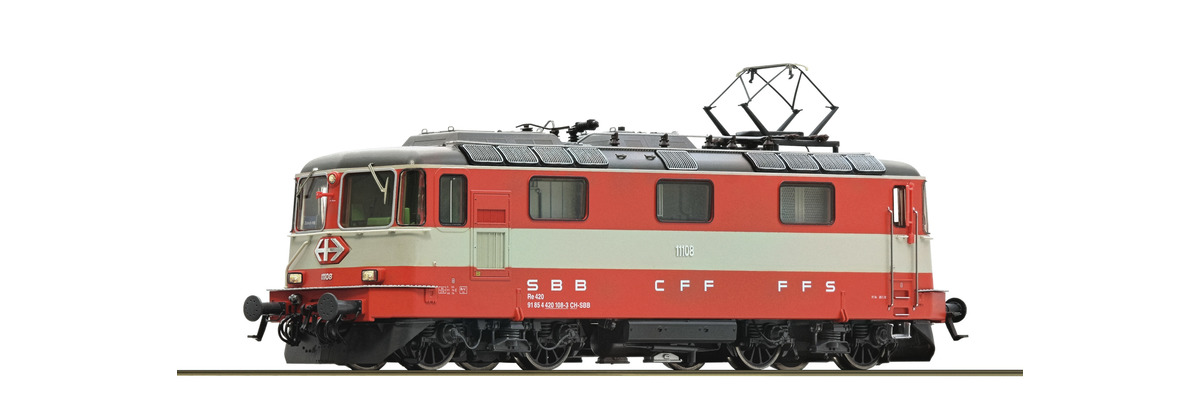
Electric locomotive Re 4/4 II 11108 “Swiss Express” of the Swiss Federal Railways. New design! 1st type series of the class Re 4/4 II Featuring separately attached plug-in parts, in part using etching technology Design in current operating condition with air-conditioning system Rectangular lamps Individually switchable headlight or tail light, driver’s cab lighting and engine room lighting in digital mode Z21 driver’s cab available On 22nd May 1975, the train category “Swiss Express” belonging to the Swiss Federal Railways (SBB) was introduced in conjunction with the commissioning of the Heitersberg line, and remained in existence until the year 1982. This category replaced the former city express trains. At the time, these trains were considered a showpiece for the SBB and operated on the most important transport axis from Geneva to St. Gallen. The trains were hauled by eight Re 4/4 IIs equipped especially for the purpose. Sadly, only the 11108 and the 11109 still bear the original livery. The Re 4/4 11108 represents a particularly popular locomotive. The “Cream cake”, as it was lovingly nicknamed, was regularly operated until the year 2021, after which it was put onto the sidings in Olten. Here it awaits further use.
In stock: 2 on the shelf, shipped within 1-3 days

Electric locomotive Re 465 008 of the Swiss railway company BLS. Elaborately printed model in "Golden Pass" design With extra attached windscreen wipers Fine depiction of the front grab rails Headlight/tail light switchable with a DIP switch The Bern–Lötschberg–Simplon Railway (BLS) ordered an advanced universal locomotive based on the SBB Re 460 from the Swiss manufacturers SLM Winterthur and ABB Zurich, under the series designation 465. Unlike the Re 460, these locomotives have one inverter per axle rather than only one per bogie. This allows the tractive power to be optimally transferred to the rails. BLS uses the 18 locomotives primarily for freight transport, but also in front of commuter trains.
- 2-rail, direct current
In stock: 1 on the shelf, shipped within 1-3 days

Electric locomotive double traction Re 10/10 of the Swiss Federal Railways. Tooling variant! ■ Anniversary edition of 1982 “100 Years Gotthard Railway” ■ Consisting of Re 6/6 11626 and Re 4/4ˡˡ 11323 ■ Both locomotives powered ■ With front crests and raised locomotive numbers ■ Fine, separately applied ventilation grilles and windscreen wipers made of etched metal To mark the 175th anniversary of the railway in Switzerland, ROCO presents as a special edition the Re 10/10 pair in anniversary version.
In stock: 1 on the shelf, shipped within 1-3 days

Electric locomotive 460 078 of the Swiss Federal Railways. Elaborate printing in the “Nendaz and I” design with different side designs Separately attached SBB logo and additional handle rail at the front With switchable high beam and individually switchable headlight or tail light in digital mode Since May 2023, the 460 078 class has been advertising for the “Swisstainable on the Road” campaign by Schweiz Tourismus. Swisstainable is the sustainability strategy of Schweiz Tourismus and the tourism industry. The goal is to promote sustainable travel in a targeted manner. That is why the locomotive bears the advertising message “Nendaz and I”, which refers to travelling from the tourist resort of Nendaz, located in the canton of Valais, into the whole of Switzerland.
In stock: 1 on the shelf, shipped within 1-3 days

Electric luggage railcar De 4/4 1669 of the Swiss Federal Railways. For the first time, available with PluX22 Interface and LED lighting Window in the luggage compartment with replicated grille bars A total of 11 Fe 4/4 units were equipped with an electric brake in 1930/31 and again in 1938 for operation on the Seetalbahn and the steep Vallorbe–Le Pont line. As part of a decision to modernise this sub-series, the Yverdon workshop rebuilt unit De 4/4 1669 in 1965/66. At the time, it was intended to serve as a prototype, was allocated to the Lausanne depot, and was already due for a major overhaul. The rebuilt railcar featured several upgrades, including: a driver's cab adapted for seated operation, new pneumatic equipment, a compressed-air main switch, a new contactor bank, and a closed driver's cab. The only feature that retained its traditional appearance was the classic dark green livery with a light grey underframe.
- 2-rail, direct current
In stock: 1 on the shelf, shipped within 1-3 days

Panorama coach, type Apm, of the Swiss Federal Railways. “Connecting Europe Express” design
In stock: 2 on the shelf, shipped within 1-3 days

Set of two "Seetalbahn" coaches of the société Le Pont-Le Brassus. The set contains a 1st/2nd class coach, type AB and a 2nd class coach, type B. Back in the ROCO range after many years Between 1947 and 1950, the SBB ordered 20 ABi platform coaches and another 20 Bi coaches. The SBB also ordered a few units for branch lines. Le Pont-Le Brassus (PBr, today Travys) also ordered two wagons.
On order, shipped within 10-15 days

Open goods wagon, class Eaos, of the Swiss Federal Railways. ■ New running number ■ Free-standing grab rails ■ Suitable for block trains During the sugar beet campaigns in Switzerland, a large number of open high-sided wagons are required. For this purpose, SBB Cargo hired several types of the Eaos class from France Waggon for an extended period, each receiving an SBB wagon number. Some of them featured distinctive end-wall extensions with a crescent shape.
In stock: 5 on the shelf, shipped within 1-3 days
The Roco families
H0 rolling stock (1:87)
 693 itemsLocomotivesElectric, diesel and steam, from the Re 460 and Re 4/4 II to classes from across Europe.See the items61 itemsMultiple units and railcarsElectric multiple units and diesel railcars, including the De 4/4 and RABe 502.See the items
 247 itemsPassenger coachesSBB EW II, Eurocity and IC2000 coaches, plus coaches from across Europe.See the items248 itemsGoods wagonsCovered and open wagons, Hupac pocket wagons, rolling motorway.See the items
 61 itemsCoach and wagon setsCoach and wagon sets to make up a train.See the items
Track and digital control
 37 itemsgeoLine trackThe track with integrated ballast: straights, curves, points and accessories.See the items
 116 itemsRocoLine trackWith or without ballast, flexible track and 10° and 15° points.See the items
 70 itemsZ21 and electronicsCommand stations, handsets, decoders, cables and electronic accessories.See the items
All Roco items

Diesel locomotive 2067 105 of the Austrian Federal Railways. Version in the Valousek design Hood with accurately reproduced pull-out hood Finely detailed model with many separately applied plug-in parts Fine wheel sets with low flanges In digital operation with switchable shunting light The ÖBB 2067 105 belongs to the tried-and-tested 2067 series of diesel locomotives, which were developed by SGP from 1959 onwards for heavy shunting duties. With its 600-HP diesel engine, distinctive rod drive and robust construction, it was in service for decades at stations throughout Austria. The locomotive features the characteristic Valousek design with a ‘bib’ on the ends, which was introduced on many ÖBB shunting locomotives from the 1990s onwards and made them easier to recognise. The 2067 105 was built in 1977 by SGP-Vienna with the factory number 18530 and delivered to the ÖBB.
Pre-order, release expected in Q2 2027

Diesel locomotive 232 446 of Schienen Güter Logistik GmbH. Powerful, reliable model for authentic long trains In digital mode with switchable shunting light and switchable headlight/tail light SGL – Schienen Güter Logistik GmbH is a specialist provider of rail freight transport and railway construction logistics, based in Dachau. The company is responsible for planning and executing transport operations, as well as all rail-based construction-site logistics. Among other things, it operates powerful Class 232 diesel locomotives, which are particularly suited to heavy freight trains and flexible deployment in construction traffic.
Pre-order, release expected in Q2 2027

Diesel locomotive 754 077 of the Czech State Railways. Version in its current operational condition; a special vehicle in the CD fleet Finely detailed model with many separately applied plug-in parts With supplied sign set In digital mode with light functions based on the CD prototype model The so-called "diving goggles" or "spectacles" locomotive was developed and built by CKD in Prague. The T 478.4, a further development of the T 478.3, was fitted with a more powerful engine and an electric train-heating system. In 1988, the 86 locomotives were assigned the new series designation 754
Pre-order, release expected in Q4 2027

Diesel locomotive 106 094 of the Deutsche Reichsbahn. Era IV version in dark red livery With rain canopies over the side windows Frost protection covers for the ventilation grilles, mountable open or closed Die-cast zinc engine bonnets, providing greater weight and high tractive effort. In digital operation with switchable shunting light, dipped headlight, headlight/tail light, and driver's cab lighting Based at Rbd Greifswald and Bw Pasewalk During the development of the Class V 60 shunting locomotive of the Deutsche Reichsbahn (Ost), testing of the first two prototype locomotives began in 1959. Before series production could begin, a number of design changes were required and were tested in a further small series of five locomotives. Between 1962 and 1964, the first series of 163 locomotives was delivered to the DR by LKM Babelsberg. Whilst the first main series was still under construction, a rain canopy was fitted above the side windows. The front ends of the locomotive hoods were also slightly modified. Unlike the first locomotives, whose hoods had slightly curved front ends around a vertical axis, resulting in protruding lamps mounted on brackets, the new hoods from locomotive number V 60 1053 onwards had straight front ends, except for rounded corners, with the lamps mounted directly on the front.
Pre-order, release expected in Q4 2027

Diesel locomotive T 669 0503 of a Czechoslovak industrial railway. Designed as a Czechoslovak industrial locomotive Free-standing grab rails, some made of metal Ideal for use in front of freight trains In digital operation with switchable shunting light, headlight/tail light and driver's cab lighting The T 669 diesel locomotive class, later designated the 770 class, owes its nickname partly to the Russian series designation ЧМЭ3 ("Chme3"), which sounds similar to the Czech word for bumblebee, "Čmelák", and partly to the humming sound it makes when starting up, which also resembles a bumblebee’s buzz – at least from a distance. With its 1,400 PS, it proved its worth in both light and heavy shunting.
Pre-order, release expected in Q3 2027

Diesel locomotive Class V 100 of the Deutsche Reichsbahn. First series version in burgundy red livery with two decorative stripes Roof hatches integrated into the front end Bogies fully fitted with brake lines High tractive effort and excellent running characteristics In digital mode with switchable headlight/tail light, shunting light and driver's cab lighting The V 100 of the Deutsche Reichsbahn, often referred to as the "V 100 Ost", was one of the most important diesel locomotives in the medium-power range of the former GDR. It was developed from the early 1960s onwards to gradually replace older steam locomotives in passenger and freight services. In total, over 1,100 locomotives of this class were built between 1966 and 1985 at the VEB Lokomotivbau "Karl Marx" in Babelsberg. Each production series differed in specific details. For example, the bonnets and their roofs on the first locomotives (V100 003–043) were designed differently from those on later-series locomotives.
Pre-order, release expected in Q4 2027

Diesel locomotive T 436 4528 of the Ostrau-Karwiner-Steinkohlen-Revieres. Version as a private railway locomotive Finely detailed model with many separately applied plug-in parts Delicate, free-standing grab rails In digital mode with switchable headlight/tail light, shunting light and driver's cab lighting To meet the demand for heavy shunting locomotives, the Deutsche Reichsbahn (DR) ordered 37 locomotives from LEW Hennigsdorf in the late 1970s. LEW had already developed this type for export. Built in three batches between 1981 and 1983, the locomotives were equipped with the proven 1,000 hp engine and a gearbox with a modified gear ratio, similar to that fitted to the first V 100 locomotives. As a result, the maximum speed was limited to 65 km/h. A ballast weight was fitted in place of the steam-heating boiler. Three locomotives were also exported to Czechoslovakia (CSSR) for operation on industrial railways.
Pre-order, release expected in Q4 2027

Diesel locomotive Class T 478.3 of the Czechoslovak State Railways. Finely detailed version of the “Diving Goggles” in green/grey livery Used to haul passenger and goods trains to German and Austrian border stations In digital operation with light functions based on the CSD prototype The so-called "Diving Goggles" or "the Bespectacled" was developed and built by the CKD in Prague. The first prototypes of the diesel locomotive Class T 478.3 originated in 1968. With the idiosyncratic design of the window fronts, visibility for the train drivers was to be improved, especially during coupling operations. Together with the engine room windows, which resembled portholes, this was another reason for the German nickname "Diving Goggles".
Pre-order, release expected in Q4 2027

Diesel locomotive 118 068 of the Deutsche Reichsbahn. Service condition as of October 1977 4-axle version with finely detailed wheel sets With a round door cut-out Finely detailed model with many separately applied plug-in parts With vertical grab rails at the front In digital mode with switchable headlight/tail light, driver's cab and engine room illumination The 118 068 belonged to the V 180 series of diesel locomotives of the Deutsche Reichsbahn. It was used for passenger and goods train services on non-electrified lines. Originally designated V 180 068, it was assigned the running number 118 068-6 in 1970. With its distinctive front end and four-axle design, it was a typical example of the early Class 118.
Pre-order, release expected in Q1 2027

Diesel locomotive 751 174 of ZSSK Cargo. Variant with blue number plate Design of the 3rd production series with corrugated side walls up to the edge of the roof Finely detailed model with many separately applied plug-in parts Light functions based on the ZSSK-prototype model The T 478.1 and T 478.2 classes are diesel-electric mixed-traffic locomotives. They owe their nickname "Bardotka" to the French actress Brigitte Bardot, reflecting their distinctive appearance. Between 1966 and 1971, 230 production locomotives were built for the former CSD at the CKD works in Prague. With the introduction of computerised traction unit numbering in 1988, the locomotives were redesignated as Classes 751 and 752, respectively. Since 1998, ZSSK’s Class 751 locomotives have been painted in a uniform grey and red livery and have been used primarily for freight services.
Pre-order, release expected in Q3 2027

Diesel locomotive 280 008 of the Deutsche Bundesbahn. Separately applied grab rails Elaborately profiled wheel discs In digital mode with switchable headlight/tail light Alongside the V 200 and the VT 11.5 TEE multiple unit, the V 80 is among the best-known and most elegant examples of early Deutsche Bundesbahn diesel rolling stock. Powered by a 1,000 hp diesel engine, the V 80 was designed as a multi-purpose locomotive for hauling light passenger and freight trains on main and branch lines, as well as for shunting duties. The last locomotives were withdrawn from service in 1978.
Pre-order, release expected in Q4 2027

Diesel locomotive S-284 of Nadwislanski Zaklad Transportu Kolejowego. Variant of a Polish private railway Free-standing grab rails, some made of metal Ideal for use in front of goods trains In digital operation with switchable shunting light, headlight/tail light and driver's cab lighting
Pre-order, release expected in Q4 2027

Diesel locomotive Class 203 of DB Netz AG. Mould variant! New frame with separately fitted AK buffer beam First time featuring shunter's grab rails below the buffers PCB update Free-standing, delicate grab rails In digital operation, with switchable headlight/tail light, shunting light and driver's cab illumination New, authentic sound DB Netz AG is the rail infrastructure company of Deutsche Bahn AG. It is responsible for the rail network, which spans just under 33,400 kilometres, including all facilities necessary for operations. To this end, it maintains its own fleet of locomotives and rolling stock.
Pre-order, release expected in Q4 2027

Diesel locomotive 2143 038 of the Austrian Federal Railways. Mould variant! Version from the 3rd production series with a straight frame Valousek design in blood orange/ivory Authentic roof with an antenna Free-standing grab rails, some made of metal In digital operation with switchable high beam, headlight/tail light and driver's cab lighting With new, comprehensive sound The locomotives of the 2143 class were built between 1964 and 1977 and operated on non-electrified main and branch lines, particularly in eastern Austria. They were commonly used for both passenger and goods trains. A total of 77 locomotives were delivered to the ÖBB by the Simmering-Graz-Pauker-Werke. A large part of the 2143 class locomotive stock consisted of the third production series, which was further divided into subclasses. The so-called 3a class included running numbers 2143.34 – 43, while the 3b class covered 2143.44 – 70. All locomotives in the third series share several common features: the frame is straight and, unlike the first series, not cranked. The areas around the driver's cab doors have long rain gutters, and the door windows are framed in metal. Likewise, the fuel-filling areas were redesigned and have different dimensions.
Pre-order, release expected in Q3 2027

Diesel locomotive V 240 001 of the Deutsche Reichsbahn. Model in special livery 6-axle version with finely detailed wheel sets With a round door cut-out Finely detailed model with many separately applied plug-in parts With vertical grab rails at the front In digital operation with switchable headlight/tail light, driver's cab and engine room lighting The V 240 001 was a high-performance test locomotive of the Deutsche Reichsbahn, developed from the V 180 class. The six-axle locomotive had 2 × 1,200 PS and was designed for a top speed of 140 km/h. As a special showcase piece of GDR locomotive engineering, it was also exhibited at the Leipzig Trade Fair.
Pre-order, release expected in Q4 2027

Diesel locomotive D.225.6014 of the Italian State Railways. Equipped with a digital shunting coupler for more play fun Motor bonnet and gearbox block made of die-cast zinc, providing greater weight and high tractive force Finely detailed design with many plug-in parts and free-standing grab rails True-to-prototype lighting and sound functions, switchable via the onboard decoder Unobstructed view through the true-to-original driver's cab Buffer capacitor for uninterruptible power supply The Group 225 shunting locomotives were standard-gauge diesel locomotives that were used in shunting operations across the entire Italian network from 1955 onwards. They were built in four subtypes with different characteristics: D.225.5000, D.225.2100 and D.225.7000 with rod drive, manufactured by various Italian manufacturers, and D.225.6000 with cardan drive, a licensed replica of the Class 2062 built by Jenbacher Werke for the ÖBB. In 1958, Jenbacher Werke delivered two prototypes fitted with different engines, which were added to the locomotive fleet as 225.6098 (corresponding to ÖBB 2060) and 225.6099. A total of 20 production locomotives were manufactured under licence in 1960–61 by Officina Meccanica della Stranga in Padua and Jenbach Diesel Soc.r.l. in Bolzano, and were registered with the running numbers 225.6001 to 6020. A two-stroke diesel engine with hydraulic power transmission provided the locomotive's propulsion. The maximum speed was 30 km/h in shunting gear and 50 km/h in line gear. The model can only be operated to a limited extent with analogue control units.
Pre-order, release expected in Q4 2027

High-speed electric multiple unit ICE 2 class 402 of the Deutsche Bahn. The set contains a motorised power head, a control cab coach and an intermediate coach with an onboard restaurant. Power head and control cab coach with PluX interface LED headlights Model in 1:100 scale Perfectly matches the wagons item no. 54273 and 54274
On order, shipped within 10-15 days

Diesel locomotive T 466 2050 of the Czechoslovak State Railways. New design! Design of the first series with smooth driver’s cab side wall Finely detailed model with many separately attached plug-in parts Free view through the driver’s cab Delicately crafted safety railings Switchable shunting light, individually switchable headlight or tail light and driver's cab lighting in digital mode In the 1970s, the former Czechoslovak State Railway (CSD) were in great need of powerful diesel freight locomotives for medium-weight shunting and line service. For this purpose, the lighter variant T 466.2 was derived from the industrial locomotive type T 448. Starting from 1977, it was manufactured by CKD Prag with 494 units in nine construction series (each with small differences) and came into service until 1986.
- 3-rail, alternating current
- Sound
On order, shipped within 10-15 days

Diesel locomotive "Sik" of the VolkerRail. With digital shunting coupling for more playing enjoyment Engine front end and gearbox block made from die-cast zinc, meaning increased service weight and high tractive force Finely detailed design with many plug-in parts and free-standing handle rails Prototypical light and sound functions, switchable using on-board decoder With switchable flashing light on driver's cab Clear view through the prototypical driver's cab With buffer condenser for uninterrupted power supply The Netherlands State Railway procured the 2-axle shunting diesel locomotives between the years 1934 and 1951 from the manufacturer Werkspoor, as well as one delivery series from CW Zwolle. A total of 169 examples were built in several series, each featuring slightly different designs. Due to the striking noise emitted by the exhaust pipe, these locomotives were known as “Sikken” or “Sik” - the singular for “goat” - amongst railway personnel and enthusiasts. The model can only be operated with analogue controllers to a limited extent.
- 3-rail, alternating current
- Sound
On order, shipped within 10-15 days

Diesel locomotive 118 210 of the Deutsche Reichsbahn. Rich detailing on the model with many separately applied plug-in parts; some made of metal 6-axle version with fine wheelsets With vertical grab rails at the front In digital operation with separately switchable headlights/taillights, driver's cab and engine room illumination Stationed at Railway Mangement Erfurt, Meiningen depot The V 180 series of the Deutsche Reichsbahn was the largest diesel locomotive built in the GDR. It was initially built in a four-axle version with two two-axle bogies, and later in a six-axle version. The low axle load of 15,6 tonnes of the six-axle version is still considered a technical masterstroke, making this locomotive universally usable on branch lines. It is also approved for steep gradients. The resulting versatility is unique among large German diesel locomotives.
- 3-rail, alternating current
- Sound
On order, shipped within 10-15 days

Diesel locomotive 217 003 of the German Federal Railways. New design! All modifications correctly reproduced in the model Separately applied plug-in parts, in part using etching technology With switchable headlight/rear light, driver’s cab lighting and machine room lighting in digital mode Class 217 of the German Federal Railways (DB) was a more powerful advancement of the well-known V-160 family and was a technical interim solution to meet a specific operational need: the use of heavy push-pull trains with electric train heating on non-electrified lines.Between 1965 and 1968, a total of 15 locomotives were built by Krauss-Maffei. These engines are considered the technical precursors of the later class 218, which was equipped with an integrated heating generator at the factory. The locomotives were divided into so-called prototypes (217 001 – 003) and pre-series machines (217 011 – 022).
- 3-rail, alternating current
- Sound
Pre-order, ships on release

Slewing railway crane of the Austrian Federal Railways with authentic operation functions - can be digitally controlled. Edition model! Functions: Self-Drive model Freewheel function in the train is possible The Crane's superstructure with its boom can be rotated 360° The crane boom can be raised or lowered The telescopic boom can be extracted and retracted The crane hooks can be raised or lowered with a multi-stage pulley Crane operator cab with switchable exterior lighting Switchable work lamp on the telescopic boom Model with onboard digital decoder and switchable light and sound functions Movable outriggers Barrier wagon with bearing block, counterweight and support pedestals Control via Z21 multiMAUS or Z21 WLANMAUS Specially adapted crane control in the Z21 App Can be controlled via PS4 controller Fully functional model of a 6-axle slewing railway crane with a movable telescopic boom. The crane is self-drive but can also run along in a train due to a manually unlockable coupling of the gearbox. The crane's superstructure can be rotated 360 ° and has no rotation limit. All turning and lifting movements can be operated with Soft Start and Stop. It's a fun way to playfully lift and relocate bridges or lay switches and track yokes. The horizontal boom is perfect when the crane driver operates the crane. The telescopic boom can be luffed and telescoped in any working position, even with a load on the crane hook.
- 3-rail, alternating current
- Sound
On order, shipped within 10-15 days

Railway slewing crane of the Deutsche Bahn with authentic operating functions – digitally controlled. Edition model! Functions: Self-propelled model Free-wheeling operation in train formation is possible Crane superstructure with jib can be rotated 360° Jib can be raised and lowered Telescopic jib can be extended and retracted Functions: Crane hook can be raised and lowered via a multi-sheave pulley Crane operator's cab with switchable exterior lighting Switchable work lamp on telescopic jib Digital onboard decoder and switchable light and sound functions Movable outriggers Barrier wagon with bearing block, counterweight and support pedestals Control via Z21 multiMAUS or Z21 WLANMAUS Specially adapted crane control in the Z21 app Control via PS4 controller Fully functional model of a 6-axle railway slewing crane with a movable telescopic jib. The crane can operate independently or, after manually unlocking the gear coupling, run in a train formation. The upper structure can rotate 360° without stopping. All turning and lifting movements feature a soft start and stop. This makes it simple and fun to lift bridges, lay switches, and manage track panels. The horizontally positioned jib is suitable for working beneath catenaries. The telescopic jib can be luffed and extended in any working position, even with a load on the crane hook.
- 3-rail, alternating current
- Sound
On order, shipped within 10-15 days

Diesel locomotive No. 1 of the Deutsche Bundespost. For the first time with Next18 interface Locomotive of the Oberpostdirektion in Hannover Enlarged coolant expansion tank In digital operation with switchable shunting light The German Wehrmacht initially deployed the WR 360 C 14 diesel locomotives at key strategic points. Locomotive no. 1 is a replica built by Maschinenbau Kiel (MaK) in 1948. Between 1948 and 1972, the Oberpostdirektion Hannover had its locomotives operating at the Postbahnhof and neighbouring DB stations. There were four locomotives (Nos. 1 to 4) altogether.
- 3-rail, alternating current
- Sound
On order, shipped within 10-15 days