
H0 model trains, track and Z21
Roco, Swiss and European railways in H0
Re 460, Re 4/4 II "Swiss Express", BLS Re 465, EW II coaches and Hupac wagons: Roco reproduces Swiss and European railways in 1:87, often for both DC and AC, with its geoLine and RocoLine track and its Z21 digital command station.
- 1714items in the shop
- 1:87for your H0 layout
- Since 1960a brand from Salzburg
What Roco brings to your layout
- Swiss locomotives: SBB Re 460, Re 4/4 II, Re 10/10, Re 420 and Re 482, BLS Re 465 and Re 486, De 4/4 and RABe 502 multiple units.
- Two-rail or three-rail: many models come in a DC version and an AC version, often with sound.
- The Z21 command station: up to 9,999 DCC locomotive decoders, driven with the multiMAUS or the Z21 app for smartphone and tablet (iOS and Android). Updates by smartphone.
- Two track systems: geoLine, the track with integrated ballast, and RocoLine, with or without ballast, flexible track with wooden or concrete sleepers.
Our favourites for a Swiss layout
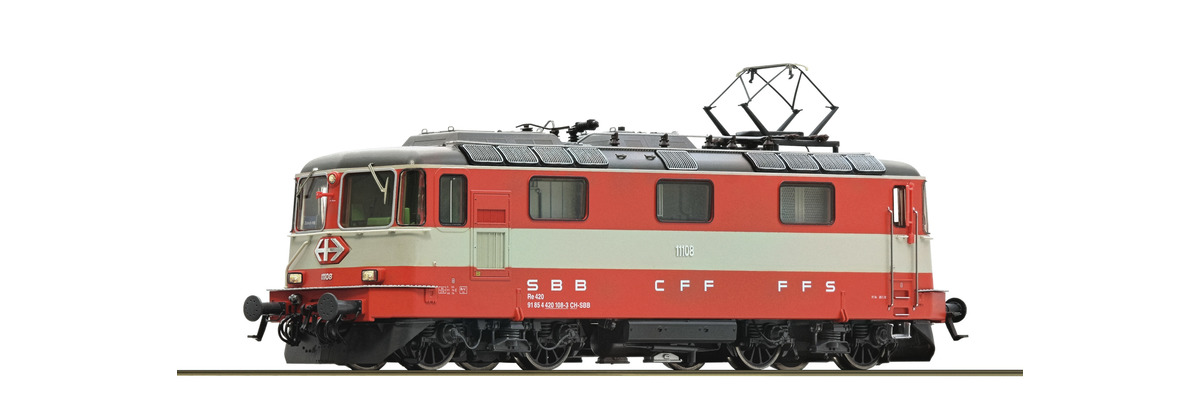
Electric locomotive Re 4/4 II 11108 “Swiss Express” of the Swiss Federal Railways. New design! 1st type series of the class Re 4/4 II Featuring separately attached plug-in parts, in part using etching technology Design in current operating condition with air-conditioning system Rectangular lamps Individually switchable headlight or tail light, driver’s cab lighting and engine room lighting in digital mode Z21 driver’s cab available On 22nd May 1975, the train category “Swiss Express” belonging to the Swiss Federal Railways (SBB) was introduced in conjunction with the commissioning of the Heitersberg line, and remained in existence until the year 1982. This category replaced the former city express trains. At the time, these trains were considered a showpiece for the SBB and operated on the most important transport axis from Geneva to St. Gallen. The trains were hauled by eight Re 4/4 IIs equipped especially for the purpose. Sadly, only the 11108 and the 11109 still bear the original livery. The Re 4/4 11108 represents a particularly popular locomotive. The “Cream cake”, as it was lovingly nicknamed, was regularly operated until the year 2021, after which it was put onto the sidings in Olten. Here it awaits further use.
In stock: 2 on the shelf, shipped within 1-3 days

Electric locomotive Re 465 008 of the Swiss railway company BLS. Elaborately printed model in "Golden Pass" design With extra attached windscreen wipers Fine depiction of the front grab rails Headlight/tail light switchable with a DIP switch The Bern–Lötschberg–Simplon Railway (BLS) ordered an advanced universal locomotive based on the SBB Re 460 from the Swiss manufacturers SLM Winterthur and ABB Zurich, under the series designation 465. Unlike the Re 460, these locomotives have one inverter per axle rather than only one per bogie. This allows the tractive power to be optimally transferred to the rails. BLS uses the 18 locomotives primarily for freight transport, but also in front of commuter trains.
- 2-rail, direct current
In stock: 1 on the shelf, shipped within 1-3 days

Electric locomotive double traction Re 10/10 of the Swiss Federal Railways. Tooling variant! ■ Anniversary edition of 1982 “100 Years Gotthard Railway” ■ Consisting of Re 6/6 11626 and Re 4/4ˡˡ 11323 ■ Both locomotives powered ■ With front crests and raised locomotive numbers ■ Fine, separately applied ventilation grilles and windscreen wipers made of etched metal To mark the 175th anniversary of the railway in Switzerland, ROCO presents as a special edition the Re 10/10 pair in anniversary version.
In stock: 1 on the shelf, shipped within 1-3 days

Electric locomotive 460 078 of the Swiss Federal Railways. Elaborate printing in the “Nendaz and I” design with different side designs Separately attached SBB logo and additional handle rail at the front With switchable high beam and individually switchable headlight or tail light in digital mode Since May 2023, the 460 078 class has been advertising for the “Swisstainable on the Road” campaign by Schweiz Tourismus. Swisstainable is the sustainability strategy of Schweiz Tourismus and the tourism industry. The goal is to promote sustainable travel in a targeted manner. That is why the locomotive bears the advertising message “Nendaz and I”, which refers to travelling from the tourist resort of Nendaz, located in the canton of Valais, into the whole of Switzerland.
In stock: 1 on the shelf, shipped within 1-3 days

Electric luggage railcar De 4/4 1669 of the Swiss Federal Railways. For the first time, available with PluX22 Interface and LED lighting Window in the luggage compartment with replicated grille bars A total of 11 Fe 4/4 units were equipped with an electric brake in 1930/31 and again in 1938 for operation on the Seetalbahn and the steep Vallorbe–Le Pont line. As part of a decision to modernise this sub-series, the Yverdon workshop rebuilt unit De 4/4 1669 in 1965/66. At the time, it was intended to serve as a prototype, was allocated to the Lausanne depot, and was already due for a major overhaul. The rebuilt railcar featured several upgrades, including: a driver's cab adapted for seated operation, new pneumatic equipment, a compressed-air main switch, a new contactor bank, and a closed driver's cab. The only feature that retained its traditional appearance was the classic dark green livery with a light grey underframe.
- 2-rail, direct current
In stock: 1 on the shelf, shipped within 1-3 days

Panorama coach, type Apm, of the Swiss Federal Railways. “Connecting Europe Express” design
In stock: 2 on the shelf, shipped within 1-3 days

Set of two "Seetalbahn" coaches of the société Le Pont-Le Brassus. The set contains a 1st/2nd class coach, type AB and a 2nd class coach, type B. Back in the ROCO range after many years Between 1947 and 1950, the SBB ordered 20 ABi platform coaches and another 20 Bi coaches. The SBB also ordered a few units for branch lines. Le Pont-Le Brassus (PBr, today Travys) also ordered two wagons.
On order, shipped within 10-15 days

Open goods wagon, class Eaos, of the Swiss Federal Railways. ■ New running number ■ Free-standing grab rails ■ Suitable for block trains During the sugar beet campaigns in Switzerland, a large number of open high-sided wagons are required. For this purpose, SBB Cargo hired several types of the Eaos class from France Waggon for an extended period, each receiving an SBB wagon number. Some of them featured distinctive end-wall extensions with a crescent shape.
In stock: 5 on the shelf, shipped within 1-3 days
The Roco families
H0 rolling stock (1:87)
 693 itemsLocomotivesElectric, diesel and steam, from the Re 460 and Re 4/4 II to classes from across Europe.See the items61 itemsMultiple units and railcarsElectric multiple units and diesel railcars, including the De 4/4 and RABe 502.See the items
 247 itemsPassenger coachesSBB EW II, Eurocity and IC2000 coaches, plus coaches from across Europe.See the items248 itemsGoods wagonsCovered and open wagons, Hupac pocket wagons, rolling motorway.See the items
 61 itemsCoach and wagon setsCoach and wagon sets to make up a train.See the items
Track and digital control
 37 itemsgeoLine trackThe track with integrated ballast: straights, curves, points and accessories.See the items
 116 itemsRocoLine trackWith or without ballast, flexible track and 10° and 15° points.See the items
 70 itemsZ21 and electronicsCommand stations, handsets, decoders, cables and electronic accessories.See the items
All Roco items

Electric locomotive 1245 516 of the Austrian Federal Railways. Version with computer numbers Shunting handles in orange, true to the original design As in service from 1987 With authentic sound functions The class 1245 was, following the classes 1045 and 1145, the third Austrian standard electric locomotive with a Bo'Bo' wheel arrangement. It was equipped with four traction motors, had an hourly output of 1,840 kW, reached a top speed of 80 km/h, and weighed 83 tonnes. Thanks to its powerful Sécheron spring drive, it was regarded as reliable and versatile. The locomotives remained in regular service until 1995 and were subsequently withdrawn.
Pre-order, release expected in Q4 2027

Electric locomotive 182 506 of DB Systemtechnik. Version in the "DB Systemtechnik" livery Finely detailed model with many separately applied plug-in parts In digital operation with switchable high beam and headlight/tail light Z21 driver’s cab available The DB Systemtechnik electric locomotive 182 506-6 has been in service since 2013 for measurement, testing and trial runs conducted by DB Systemtechnik. It was originally built in 2002 as ES64 U2-006 and initially served with MRCE-Dispolok before being taken over by DB Systemtechnik. A striking feature is the lettering “DB Systemtechnik – Unser Know-how ist Ihr Erfolg" / “DB Systemtechnik - Our expertise is your success” on the side panels.
Pre-order, release expected in Q2 2027

Electric locomotive 155 213 of IntEgro Verkehr GmbH. Distinctive dark blue livery with white panels and a green decorative stripe Used to haul heavy goods trains, including car and tank wagon trains Version with square buffers Delicate pantographs In digital operation with switchable headlight/tail light and driver's cab lighting The Class 155 electric locomotives were originally developed as the Class 250 of the Deutsche Reichsbahn. Between 1977 and 1984, a total of 273 production locomotives were built by LEW Hennigsdorf. Following German reunification, they continued in service with Deutsche Bahn as Class 155 locomotives. Even after DB AG withdrew them from service, a number of these distinctive locomotives – often referred to as "power containers" due to their angular shape – remained in service with private railway undertakings. One of these is 155 213-2, which became part of the fleet operated by IntEgro Verkehr and the Eisenbahn-Bau- und Betriebsgesellschaft Pressnitztalbahn (PRESS).
Pre-order, release expected in Q3 2027

Electric locomotive Rc4 1145 of Grenland Rail. Finely detailed model with many separately applied plug-in parts Sandboxes on each bogie behind the rail guard In digital mode with switchable high beam and switchable headlight/tail light With the acquisition of several Rc4 locomotives from Green Cargo's fleet, the railway undertaking Grenland Rail is expanding its fleet with tried-and-tested Swedish multi-purpose locomotives. The Rc4 1145 features the distinctive blue-grey corporate livery and is primarily used in cross-border freight transport between Norway and Sweden. Developed by ASEA, this locomotive series has been regarded as reliable and powerful for decades and remains an integral part of Scandinavian rail freight transport to this day.
Pre-order, release expected in Q4 2027

Electric locomotive 1042.47 of the Austrian Federal Railways. New design! Version from the 2nd series Pantograph with an innovative mounting system Roof walkway grilles finely detailed Door handles positioned at the top Version as it appeared in service around 1980, in green paint and with old ÖBB logo Multicolored control panel and cab rear wall, as well as a meticulously recreated engine room Some signage are also included as etched parts In digital operation with switchable high beam, headlight/tail light, driver’s cab lighting, dashboard lighting and engine room lighting With the Class 1042, the Austrian Federal Railways began procuring a powerful four-axle universal locomotive from 1963 onwards for the ever-expanding electric network. The new Bo’Bo’ locomotives were intended to demonstrate their advantages over the heavy six-axle predecessors, particularly on winding mountain routes such as the Semmering Railway. The Class 1042 quickly became a mainstay for both passenger and freight trains and, over the decades, a familiar sight on Austria’s railway lines. The 1042.47, along with a few other locomotives in this class, occupies a special position, as this running number was assigned twice. The model depicts the 1042.47 in its second configuration during the 1970s (originally delivered as 1042.506), fitted with the slower gearbox for 130 km/h. A characteristic feature of the 1042.41–60 and 501–520 (generally referred to as the second series) was the outward-facing knee joint on the single-arm pantograph, together with a different roof structure, differently designed side vents and different roof wiring compared with the first series, 1042.01–40.
Pre-order, release expected in Q4 2027

Electric locomotive 1042 060 of the Austrian Federal Railways. New design! Version from the 2nd series Pantograph with an innovative mounting system Roof walkway grilles finely detailed Door handles positioned at the bottom With two UIC sockets and a step at the buffer Freestanding, separately attached buffer handles Accurate, unobstructed view of the bogie, true to the prototype Delicate engravings on the bogies Multicolored control panel and cab rear wall, as well as a meticulously recreated engine room In digital operation with switchable high beam, headlight/tail light, driver’s cab lighting, dashboard lighting and engine room lighting With the Class 1042, the Austrian Federal Railways began procuring a modern and powerful universal locomotive from 1963 onwards for the increasingly electrified rail network. The four-axle locomotives with the Bo’Bo’ wheel arrangement proved their worth hauling both passenger and freight trains and became a familiar sight on Austria’s railway lines for decades. Built by Simmering-Graz-Pauker at its Floridsdorf works, these locomotives were designed for a top speed of 130 km/h and had a continuous hourly output of around 3,560 kW. Within the class, the 1042 060 also marked the end of the 1042.01 to 1042.60 number range. It remained in regular ÖBB service for a long time, thus embodying that generation of Austrian electric locomotives which played a decisive role in shaping the transition to modern electric rail operations. With the advent of newer generations of traction vehicles, the Class 1042 locomotives increasingly lost their traditional areas of operation from the 1990s onwards and were eventually gradually phased out.
Pre-order, ships on release

Electric locomotive 110 140 of the Deutsche Bundesbahn. New design! Version with single lamps New design of the roof area New DBS 54 scissor pantograph with innovative mounting Exquisitely detailed new bogie sideframes, with a clear view of the wheel discs and brake blocks In digital mode with switchable headlight/tail light, driver's cab lighting, driver's desk lighting and engine room lighting The E 10 class, designated the Class 110 from 1968 onwards, was developed as part of the Deutsche Bundesbahn's standardised locomotive programme. The use of numerous components shared with the E 40, E 41 and E 50 classes was intended to simplify procurement and maintenance. With a power output of around 3,700 kW and a top speed of 150 km/h, these locomotives were ideally suited to high-quality passenger services. The 110 140 represents the classic version, with the characteristic angular locomotive body of the early production series. For many years, these robust electric locomotives were employed to haul D-class, express and, later, local trains. With its reliable technology, the Class 110 shaped electric passenger services on the Deutsche Bundesbahn for decades and became one of the best-known locomotive types of the post-war era.
Pre-order, release expected in Q4 2027

Electric locomotive 139 555 of Lokomotion. New design! Version with twin headlights Front end accurately reproduced in the model New design of the roof area Pantograph with innovative mounting Wheels with low flanges Exquisitely detailed new bogie sideframes, with a clear view of the wheel discs and brake blocks Chassis with track cleaner In digital mode with switchable headlight/tail light, driver's cab lighting, driver's desk lighting and engine room lighting In digital operation, with switchable chassis lighting for the first time The 139 555-7 was delivered to the Deutsche Bundesbahn in 1964 as the E 40 1555. As part of the fleet of locomotives designed for working on steep gradients, it featured an electric rheostatic brake and was classified as Class 139 in 1968. For many decades, this robust standard locomotive served with DB and later DB AG. After its withdrawal from service with DB in 2010, the 139 555 was acquired by Lokomotion Gesellschaft für Schienentraktion. There, this historic locomotive was given the company’s distinctive white-and-blue "Zebra" livery.
Pre-order, release expected in Q4 2027

Electric locomotive 188 125 "Frankreichpiercer" of Railpool leased to SBB Cargo International. New design! Christened as "Tour Eiffel" Multi-coloured control panel and driver’s cab rear wall With detailed roof design Shunting handles fitted separately beneath the buffers Underfloor areas implemented in several sections Cross-border use in freight transport In digital mode with switchable driver’s console lighting and driver’s cab lighting In collaboration with Railcolor Design The TRAXX 3 MS locomotives were developed specifically for cross-border transport on the most important European freight corridors. Thanks to their multi-system equipment, they can operate on various traction power supply systems. The class reaches a top speed of 160 km/h and delivers up to 6,400 kW in AC operation. What sets this TRAXX generation apart is the optional "last-mile" function – a small additional diesel motor with a battery, enabling the electric locomotives to cover short distances on sidings or in ports without overhead lines, entirely without the need for a shunting locomotive.
Pre-order, release expected in Q4 2027

Electric locomotive 188 065 of CFL Cargo. New design! Intricate printing Multi-coloured control panel and driver’s cab rear wall With detailed roof design Cross-border use in freight transport In digital mode with switchable driver’s console lighting and driver’s cab lighting The Class 188 multi-system locomotives belong to the TRAXX MS3 family and were designed specifically for international freight transport. Thanks to their ability to operate on the alternating and direct current systems commonly used in Central Europe, they enable continuous operation across national borders without time-consuming locomotive changes. Modern ETCS equipment and numerous national train protection systems make these locomotives universally deployable across the most important European freight corridors. The locomotives are operated by leasing companies such as Akiem and Railpool, as well as by various freight operators in several European countries. These include, amongst others, CFL Cargo Deutschland, which deploys the locomotives on long-distance routes.
Pre-order, release expected in Q4 2027

Electric locomotive 1144 283 of the Austrian Federal Railways. Current operating condition with the “Pflatsch” logo Roof design with tall ventilators Used on passenger and goods trains in Austria and to Germany In digital mode with switchable main beam, headlight/tail light and driver's cab lighting The distinctive feature of the 1144 283 is its external appearance. In February 2019, following a partial overhaul, the locomotive left the ÖBB workshop in Linz. Among other things, it was given the older ÖBB emblem, the so-called “Pflatsch”, as well as large red running numbers on the ends. This makes it stand out visually from many other locomotives of the 1144 class.
Pre-order, release expected in Q4 2027

Electric locomotive 482 015 of SBB Cargo. Version featuring "ChemOil" lettering as seen in its final operational condition Multicoloured roof accurately modelled after the original Rail clearers attached to the chassis In digital mode with switchable high beam, headlight/tail light and driver's cab lighting The 482 015 electric locomotive belongs to Bombardier’s first generation of TRAXX locomotives and was delivered to SBB Cargo in 2003. Designed for cross-border freight transport between Switzerland and Germany, the locomotive reaches 140 km/h. A distinctive feature is its "ChemOil" lettering, which made it an eye-catching advertising medium for transporting mineral oil and chemical products.
Pre-order, release expected in Q2 2027

Diesel locomotive 2095.11 of the Austrian Federal Railways. Finest details: free-standing grab rails, fine lamp rings and perforated ventilation grille on the roof Model in blood orange livery Roof in ivory livery Headlights switchable with a DIP switch The class 2095 locomotives procured from 1958 onwards formed the backbone of the ÖBB on the diesel-powered narrow-gauge lines for decades. They were used for passenger and freight transport, especially for rolling stock/rolling wagon transport. The 2095s were used on the narrow-gauge lines of the Ybbstalbahn, the Bregenzerwaldbahn, the Krimmlerbahn, the Waldviertelbahn, and the so-called "Krumpe". The latter was the now-disused local railway from Ober-Grafendorf to Gresten.
On order, shipped within 10-15 days

Diesel locomotive Vs 73 (ex 2095 006) of the Pinzgauer Lokalbahn. In current operation condition with ruby red livery Features the "Neukirchen am Großvenediger" coat of arms Finest details: free-standing grab rails, fine lamp rings and a perforated roof ventilation grille Headlights switchable with a DIP switch The class 2095 locomotives, procured from 1958 onwards, formed the backbone of ÖBB's diesel-powered narrow-gauge lines for decades. On 1 July 2008, the state of Salzburg took over the Pinzgauer Lokalbahn from ÖBB and, with it, some of the 600 hp and around 60 km/h fast locomotives. The Vs 73 has been leased to the Zillertalbahn since March 2021.
On order, shipped within 10-15 days

Diesel locomotive 2095.13 of the Austrian Federal Railways. Finished in true to the original paintwork Down to the finest detail: free-standing handle rails, intricate lamp rings and a perforated ventilation grille on the roof Model with embossed trim lines Switchable headlight with DIP switch The class 2095 locomotives procured from 1958 onwards formed the backbone of the ÖBB on the diesel-powered narrow-gauge lines for decades. They were used for passenger and freight traffic, especially for rolling stock/roller wagon transport.The 2095s were used on the narrow-gauge lines of the Ybbstalbahn, the Bregenzerwaldbahn, the Krimmlerbahn, the Waldviertelbahn and on the so-called "Krumpe” lines. The latter formed the now disused local railway from Ober-Grafendorf to Gresten.
On order, shipped within 10-15 days

Narrow gauge electric locomotive 1099.13 of the Austrian Federal Railways. Carmin red/ivory paint finish Epoch III version With Next18 interface Separately attached windscreen wipers Between 1911 and 1914, 16 locomotives of this type, specially designed for the Mariazell railway, were procured by the former Lower Austrian State Railways. Between 1959 and 1962, the locomotives were modernised while retaining the original chassis and, in particular, fitted with new locomotive boxes. The locomotives were able to achieve a maximum speed of 50 km/h and had a power output of 405 kW.
On order, shipped within 10-15 days

Diesel locomotive 2095.11 of the Austrian Federal Railways. Finest details: free-standing grab rails, fine lamp rings and perforated ventilation grille on the roof Model in blood orange livery Roof in ivory livery In digital operation with switchable high beam, shunting light, and driver's cab illumination The class 2095 locomotives procured from 1958 onwards formed the backbone of the ÖBB on the diesel-powered narrow-gauge lines for decades. They were used for passenger and freight transport, especially for rolling stock/rolling wagon transport. The 2095s were used on the narrow-gauge lines of the Ybbstalbahn, the Bregenzerwaldbahn, the Krimmlerbahn, the Waldviertelbahn, and the so-called "Krumpe". The latter was the now-disused local railway from Ober-Grafendorf to Gresten.
- Sound
On order, shipped within 10-15 days

Diesel locomotive Vs 73 (ex 2095 006) of the Pinzgauer Lokalbahn. In current operation condition with ruby red livery Features the "Neukirchen am Großvenediger" coat of arms Finest details: free-standing grab rails, fine lamp rings and a perforated roof ventilation grille In digital operation with switchable high beams, shunting lights and driver's cab illumination The class 2095 locomotives, procured from 1958 onwards, formed the backbone of ÖBB's diesel-powered narrow-gauge lines for decades. On 1 July 2008, the state of Salzburg took over the Pinzgauer Lokalbahn from ÖBB and, with it, some of the 600 hp and around 60 km/h fast locomotives. The Vs 73 has been leased to the Zillertalbahn since March 2021.
- Sound
On order, shipped within 10-15 days

Diesel locomotive 2095.13 of the Austrian Federal Railways. Finished in true to the original paintwork Down to the finest detail: free-standing handle rails, intricate lamp rings and a perforated ventilation grille on the roof Model with embossed trim lines With switchable high beam and shunting light and driver’s cab lighting in digital mode The class 2095 locomotives procured from 1958 onwards formed the backbone of the ÖBB on the diesel-powered narrow-gauge lines for decades. They were used for passenger and freight traffic, especially for rolling stock/roller wagon transport.The 2095s were used on the narrow-gauge lines of the Ybbstalbahn, the Bregenzerwaldbahn, the Krimmlerbahn, the Waldviertelbahn and on the so-called "Krumpe” lines. The latter formed the now disused local railway from Ober-Grafendorf to Gresten.
- Sound
On order, shipped within 10-15 days

Narrow gauge electric locomotive 1099.13 of the Austrian Federal Railways. Carmin red/ivory paint finish Epoch III version With Next18 interface Separately attached windscreen wipers With switchable driver’s cab lighting in digital mode Between 1911 and 1914, 16 locomotives of this type, specially designed for the Mariazell railway, were procured by the former Lower Austrian State Railways. Between 1959 and 1962, the locomotives were modernised while retaining the original chassis and, in particular, fitted with new locomotive boxes. The locomotives were able to achieve a maximum speed of 50 km/h and had a power output of 405 kW.
- Sound
On order, shipped within 10-15 days

Electric locomotive 371 002 of the Czech State Railways. Rich detailing on the model with separately applied plug-in parts Fine spoked wheels In the 1980s, the CSD and the DR made the strategic decision to acquire dual-mode locomotives in order to enhance their ability to manage cross-border traffic operations and the steadily growing traffic volume on the Berlin-Dresden-Prague route in a more efficient manner. Some locomotives were upgraded when the Decín-Prague line was extended and approved for a maximum speed of 160 km/h. From 1994, six Czech Rh 372 locomotives were adapted for faster international passenger services and have since been operating under the class designation 371, which is also known as the 'Turbobastard'. The CD relocated the converted locomotives to the depot in Prag.
On order, shipped within 10-15 days

Electric locomotive 185 077 of the Deutsche Bahn. Elaborate printing on the model in "Stahl auf Stahl" design The order from DB Cargo for 200 units was the primary catalyst for the development of the TRAXX AC1, as the locomotive type was retrospectively designated in 2003. The designation TRAXX stands for for "Transnational Railway Applications with eXtreme fleXibility". The locomotive, derived directly from the 145 series but now with a modified design and series designation, was capable of utilisation for both the 15 kV/16 2/3 Hz and 25 kV/50 Hz AC voltage systems commonly employed in Europe. With a weight of 84 tonnes, it has a continuous output of 5.6 MW and is approved for 140 km/h.
On order, shipped within 10-15 days

Electric locomotive 482 020 of the SBB Cargo International. Elaborate printing on the model in "Alppiercer" design Finely detailed model with elaborate roof design In cooperation with Railcolor-Design The Bombardier TRAXX locomotive platform is a crucial part of many railway companies' transportation concepts. In Switzerland, these locomotives are known as the Re 482 series. The first locomotives of this series were put into service in the spring of 2002. In March 2024, locomotive 482 020 joined the Alppiercer family and was named "Europa."
On order, shipped within 10-15 days

Electric locomotive 103 113 of the Deutsche Bahn. Update! First time with Next18 interface In the design of the DB Museum Short design with red frame Version without skirts and buffer cover Z21 driver's cab available
Pre-order, ships on release