
H0 model trains, track and Z21
Roco, Swiss and European railways in H0
Re 460, Re 4/4 II "Swiss Express", BLS Re 465, EW II coaches and Hupac wagons: Roco reproduces Swiss and European railways in 1:87, often for both DC and AC, with its geoLine and RocoLine track and its Z21 digital command station.
- 1714items in the shop
- 1:87for your H0 layout
- Since 1960a brand from Salzburg
What Roco brings to your layout
- Swiss locomotives: SBB Re 460, Re 4/4 II, Re 10/10, Re 420 and Re 482, BLS Re 465 and Re 486, De 4/4 and RABe 502 multiple units.
- Two-rail or three-rail: many models come in a DC version and an AC version, often with sound.
- The Z21 command station: up to 9,999 DCC locomotive decoders, driven with the multiMAUS or the Z21 app for smartphone and tablet (iOS and Android). Updates by smartphone.
- Two track systems: geoLine, the track with integrated ballast, and RocoLine, with or without ballast, flexible track with wooden or concrete sleepers.
Our favourites for a Swiss layout
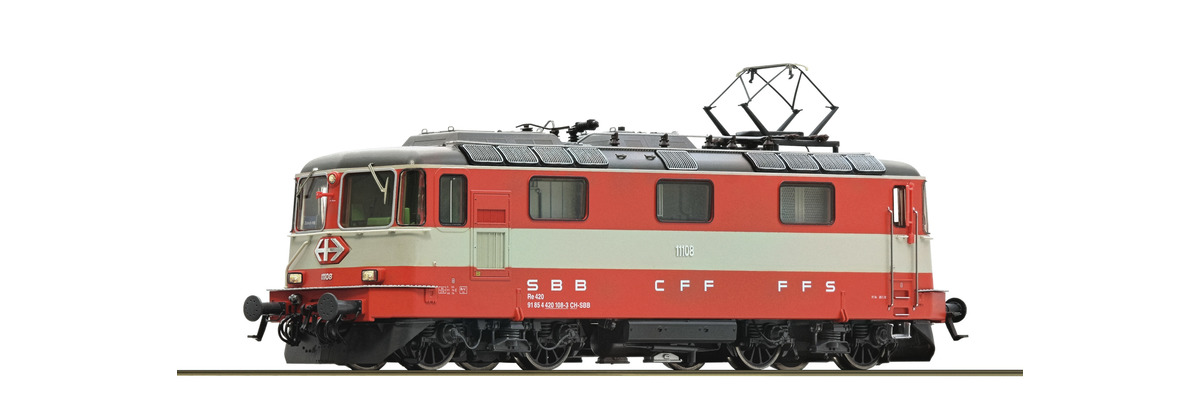
Electric locomotive Re 4/4 II 11108 “Swiss Express” of the Swiss Federal Railways. New design! 1st type series of the class Re 4/4 II Featuring separately attached plug-in parts, in part using etching technology Design in current operating condition with air-conditioning system Rectangular lamps Individually switchable headlight or tail light, driver’s cab lighting and engine room lighting in digital mode Z21 driver’s cab available On 22nd May 1975, the train category “Swiss Express” belonging to the Swiss Federal Railways (SBB) was introduced in conjunction with the commissioning of the Heitersberg line, and remained in existence until the year 1982. This category replaced the former city express trains. At the time, these trains were considered a showpiece for the SBB and operated on the most important transport axis from Geneva to St. Gallen. The trains were hauled by eight Re 4/4 IIs equipped especially for the purpose. Sadly, only the 11108 and the 11109 still bear the original livery. The Re 4/4 11108 represents a particularly popular locomotive. The “Cream cake”, as it was lovingly nicknamed, was regularly operated until the year 2021, after which it was put onto the sidings in Olten. Here it awaits further use.
In stock: 2 on the shelf, shipped within 1-3 days

Electric locomotive Re 465 008 of the Swiss railway company BLS. Elaborately printed model in "Golden Pass" design With extra attached windscreen wipers Fine depiction of the front grab rails Headlight/tail light switchable with a DIP switch The Bern–Lötschberg–Simplon Railway (BLS) ordered an advanced universal locomotive based on the SBB Re 460 from the Swiss manufacturers SLM Winterthur and ABB Zurich, under the series designation 465. Unlike the Re 460, these locomotives have one inverter per axle rather than only one per bogie. This allows the tractive power to be optimally transferred to the rails. BLS uses the 18 locomotives primarily for freight transport, but also in front of commuter trains.
- 2-rail, direct current
In stock: 1 on the shelf, shipped within 1-3 days

Electric locomotive double traction Re 10/10 of the Swiss Federal Railways. Tooling variant! ■ Anniversary edition of 1982 “100 Years Gotthard Railway” ■ Consisting of Re 6/6 11626 and Re 4/4ˡˡ 11323 ■ Both locomotives powered ■ With front crests and raised locomotive numbers ■ Fine, separately applied ventilation grilles and windscreen wipers made of etched metal To mark the 175th anniversary of the railway in Switzerland, ROCO presents as a special edition the Re 10/10 pair in anniversary version.
In stock: 1 on the shelf, shipped within 1-3 days

Electric locomotive 460 078 of the Swiss Federal Railways. Elaborate printing in the “Nendaz and I” design with different side designs Separately attached SBB logo and additional handle rail at the front With switchable high beam and individually switchable headlight or tail light in digital mode Since May 2023, the 460 078 class has been advertising for the “Swisstainable on the Road” campaign by Schweiz Tourismus. Swisstainable is the sustainability strategy of Schweiz Tourismus and the tourism industry. The goal is to promote sustainable travel in a targeted manner. That is why the locomotive bears the advertising message “Nendaz and I”, which refers to travelling from the tourist resort of Nendaz, located in the canton of Valais, into the whole of Switzerland.
In stock: 1 on the shelf, shipped within 1-3 days

Electric luggage railcar De 4/4 1669 of the Swiss Federal Railways. For the first time, available with PluX22 Interface and LED lighting Window in the luggage compartment with replicated grille bars A total of 11 Fe 4/4 units were equipped with an electric brake in 1930/31 and again in 1938 for operation on the Seetalbahn and the steep Vallorbe–Le Pont line. As part of a decision to modernise this sub-series, the Yverdon workshop rebuilt unit De 4/4 1669 in 1965/66. At the time, it was intended to serve as a prototype, was allocated to the Lausanne depot, and was already due for a major overhaul. The rebuilt railcar featured several upgrades, including: a driver's cab adapted for seated operation, new pneumatic equipment, a compressed-air main switch, a new contactor bank, and a closed driver's cab. The only feature that retained its traditional appearance was the classic dark green livery with a light grey underframe.
- 2-rail, direct current
In stock: 1 on the shelf, shipped within 1-3 days

Panorama coach, type Apm, of the Swiss Federal Railways. “Connecting Europe Express” design
In stock: 2 on the shelf, shipped within 1-3 days

Set of two "Seetalbahn" coaches of the société Le Pont-Le Brassus. The set contains a 1st/2nd class coach, type AB and a 2nd class coach, type B. Back in the ROCO range after many years Between 1947 and 1950, the SBB ordered 20 ABi platform coaches and another 20 Bi coaches. The SBB also ordered a few units for branch lines. Le Pont-Le Brassus (PBr, today Travys) also ordered two wagons.
On order, shipped within 10-15 days

Open goods wagon, class Eaos, of the Swiss Federal Railways. ■ New running number ■ Free-standing grab rails ■ Suitable for block trains During the sugar beet campaigns in Switzerland, a large number of open high-sided wagons are required. For this purpose, SBB Cargo hired several types of the Eaos class from France Waggon for an extended period, each receiving an SBB wagon number. Some of them featured distinctive end-wall extensions with a crescent shape.
In stock: 5 on the shelf, shipped within 1-3 days
The Roco families
H0 rolling stock (1:87)
 693 itemsLocomotivesElectric, diesel and steam, from the Re 460 and Re 4/4 II to classes from across Europe.See the items61 itemsMultiple units and railcarsElectric multiple units and diesel railcars, including the De 4/4 and RABe 502.See the items
 247 itemsPassenger coachesSBB EW II, Eurocity and IC2000 coaches, plus coaches from across Europe.See the items248 itemsGoods wagonsCovered and open wagons, Hupac pocket wagons, rolling motorway.See the items
 61 itemsCoach and wagon setsCoach and wagon sets to make up a train.See the items
Track and digital control
 37 itemsgeoLine trackThe track with integrated ballast: straights, curves, points and accessories.See the items
 116 itemsRocoLine trackWith or without ballast, flexible track and 10° and 15° points.See the items
 70 itemsZ21 and electronicsCommand stations, handsets, decoders, cables and electronic accessories.See the items
All Roco items

Set (2): Three flat wagons, type Res, of the Deutsche Reichsbahn. With new running numbers Wagons loaded with sand
On order, shipped within 10-15 days

Set of two telescopic hood wagons, type Shis, VTG.
Pre-order, release expected in Q1 2027

4-piece set: Long-distance double-deck multiple unit RABe 502 405 of Swiss Federal Railways Mold variant! Prototype-accurate modifications to the intermediate carriages in the area of the ventilation grilles and window bands Christened as “Rorschach” Destination displays labelled ‘IC 1’ from Geneva to St Gallen The perfect complement to the RABe 502 from 2025 Version as a 4-part IR 100 Finely detailed model in 1:87 scale Authentic interior design in all coaches Current-carrying couplers between all coaches Elaborate design with many separately applied details In digital mode with switchable high beam and driver’s cab lighting, and with illuminated destination displays at the ends and on all coach bodies With the new IR100 multiple units, Swiss Federal Railways (SBB) are setting another milestone in modern long-distance rail travel. The four-car double-decker trains form part of the fleet originally developed by Bombardier Transportation and now maintained by Alstom. Measuring around 100 metres in length and with a top speed of 200 km/h, they combine high operational efficiency with the SBB’s characteristic standards of comfort, punctuality and reliability. The designation IR100 refers to the approximately 100-metre-long variant, which was specially designed for heavily used InterRegio services.
Pre-order, release expected in Q2 2027

Diesel railcar 5042.10 of the Austrian Federal Railways. Version with modified roof Chassis in grey livery Separately applied plug-in parts, some made of metal With switchable interior lighting In digital operation with switchable headlight/tail light, high beam and shunting light Based on the development of the VT 41 class diesel railcars, the Austrian Federal Railways (ÖBB) acquired larger VT 42 class diesel railcars between 1935 and 1937. These vehicles were equipped with two 210 hp motors designed for a maximum speed of 110 km/h. After World War II, the ÖBB reclassified the railcars under the new series designation 5042. Until their electrification, they were used on the "Westbahn" railway lines, operating in express trains among other services. Following electrification, their main areas of operation then shifted to Villach, Graz, and Lienz, though they continued to serve in fast and express trains.
- 2-rail, direct current
- Sound
Pre-order, ships on release

Diesel railcar 174 001 with a trailer of the Deutsche Reichsbahn. Version in fictitious DR livery Separately applied windscreen wipers Plug-in parts attached to the railcar to provide an authentic reproduction of the front skirt With on-board decoder in the railcar and function decoder in the trailer as well as switchable light and sound functions WHAT IF...? At the Leipzig Spring Fair in 1982, the wagon manufacturer Studenka from the former CSSR exhibited a class M152 railcar at the exhibition centre, along with other rail vehicles. The Deutsche Reichsbahn had been looking for a successor to its Class 171/172 light railcars for some time, so the DR decided to rent this railcar for test purposes and to test its usability. It was to be given the series number 174. It was not used immediately by the DR but several months later test runs could begin on branch lines in the Halle/Magdeburg area in the autumn of 1982. At the DR's request, the manufacturer in Ostrava registered the railcar as class 174 001-8 following DR standards. The multi-coloured livery was retained for the time being. The sidecar delivered a little later was then no longer multi-coloured, but only painted in a plain red. Due to a foreign trade deficit, the GDR (DR) was unable to procure any further railcars in the CSSR and so the rented test vehicles were returned in December 1983.
- 2-rail, direct current
On order, shipped within 10-15 days

Electric luggage railcar De 4/4 1669 of the Swiss Federal Railways. For the first time, available with PluX22 Interface and LED lighting Window in the luggage compartment with replicated grille bars In digital operation with switchable driver's cab lighting With authentic sound functions A total of 11 Fe 4/4 units were equipped with an electric brake in 1930/31 and again in 1938 for operation on the Seetalbahn and the steep Vallorbe–Le Pont line. As part of a decision to modernise this sub-series, the Yverdon workshop rebuilt unit De 4/4 1669 in 1965/66. At the time, it was intended to serve as a prototype, was allocated to the Lausanne depot, and was already due for a major overhaul. The rebuilt railcar featured several upgrades, including: a driver's cab adapted for seated operation, new pneumatic equipment, a compressed-air main switch, a new contactor bank, and a closed driver's cab. The only feature that retained its traditional appearance was the classic dark green livery with a light grey underframe.
- 2-rail, direct current
- Sound
On order, shipped within 10-15 days

Electric multiple unit Plan V 432 of the Dutch State Railways. Version with dark grey chassis Authentic filigree pantographs Rich detailing on the model with many separately applied plug-in parts In digital operation with switchable interior lighting The model is equipped with a sound decoder and a function decoder The two-part Dutch Electric Multiple Unit Plan V that was better known in the Netherlands as "Mat '64" or under the nickname Apekop (Monkey Head), became one of the standard local trains of the Dutch State Railways in the mid-1960s. With 246 units, it was the NS's most-built multiple unit at the time. Plan V1 and V2 were delivered in a green colour scheme with sand-yellow decorative stripes. The Plan V of the 3rd construction series was painted yellow from the factory in 1968. The multiple units delivered earlier were then also repainted yellow between 1969 and 1973. They operated on nearly all electrified railway lines in the Netherlands until their withdrawal from service.
- 2-rail, direct current
- Sound
On order, shipped within 10-15 days

Accumulator railcar 515 537 with control cab coach Class 815 of the Deutsche Bundesbahn. Control cab coach with correctly painted roof area Unobstructed view through the delicately designed passenger saloon and driver’s cab Separately applied plug-in parts, such as windscreen wipers, shunting handles mounted beneath the buffers, and heating cables Rich detailing on the bogies with separately applied parts Decoder in the railcar and control cab coach Z21-Driver's cab available Accumulator railcars were introduced in Germany already before the First World War. The two-part "Wittfeld" Accumulator railcar, whose batteries were housed in the prominent front sections, remained in service until after the Second World War. After 1945, the Deutsche Bundesbahn began to look into this type of traction again. The ETA 176 made a name for itself as the "Limburger Zigarre" (Limburg cigar), but only eight were built. From 1953 onwards, the more cost-effective ETA 150, which had roughly the same performance characteristics, was put into service in large numbers. A total of 232 ETA 150 units (from 1968 onwards, Class 515) were built by 1965. In addition, 216 ESA 150 control cab coaches (later class 815) were put into service.
Pre-order, ships on release

Electric multiple unit ICE 3neo (class 408) "Velaro MS" of the Deutsche Bahn. The 4-part basic set contains a 1st class rear coach, a 1st class converter coach with restaurant, a 2nd class intermediate coach and a 2nd class rear coach. Mold variant! Separately applied antennas in new positions Precise design of the pantographs Elaborate printing in the current design Revised interior of the intermediate coach and end coaches Authentic grille engravings on the skirts Drive in the intermediate coach, power draw from the power heads for accurate braking Each coach with LED interior lighting True-to-scale model Coupling option for double traction With current-carrying couplers Z21 driver's cab available Deutsche Bahn AG has used the “Velaro D” vehicle family from Siemens, designated as the class 407, since 2013. After facing some initial challenges, these trains are now known for their high reliability. In 2019, Deutsche Bahn AG signed a supply contract for up to 90 multiple units, which was planned to allow operation not just in Germany but also in the Netherlands and Belgium. Based on the successful Velaro platform, the first Velaro MS or ICE 3neo trains rolled out on schedule and began operating in December 2022. A total of ninety trains, each consisting of eight units, are set to be delivered by 2028. These trains will be produced at the Siemens factory in Krefeld-Uerdingen. While the design is primarily based on the previous class 407, there have been some modifications. Notably, the roof areas and installed safety systems have been significantly altered. By the end of 2024, the new 408-class trains will gradually replace the older units of class 406, which previously provided transport to Belgium and the Netherlands for the DB Group. The ICE 3neo has become indispensable, especially on the long-distance network within Germany. With its top speed of 300 km/h, the ICE 3neo significantly contributes to implementing the so-called Deutschland Takt.
- 2-rail, direct current
Pre-order, ships on release

Supplementary set with four intermediate coaches for the class 408 "Velaro MS" ICE 3neo electric multiple unit train of the Deutsche Bahn. The 4-part supplementary set contains a 1st class transformer coach, a 2nd class intermediate coach, a 2nd class converter coach and a 2nd class transformer coach. Mold variant! Separately applied antennas in new positions Precise design of the pantographs Authentic grille engravings on the skirts Each coach with LED interior lighting True-to-scale model With current-carrying couplers Deutsche Bahn AG has used the “Velaro D” vehicle family from Siemens, designated as the class 407, since 2013. After facing some initial challenges, these trains are now known for their high reliability. In 2019, Deutsche Bahn AG signed a supply contract for up to 90 multiple units, which was planned to allow operation not just in Germany but also in the Netherlands and Belgium. Based on the successful Velaro platform, the first Velaro MS or ICE 3neo trains rolled out on schedule and began operating in December 2022. A total of ninety trains, each consisting of eight units, are set to be delivered by 2028. These trains will be produced at the Siemens factory in Krefeld-Uerdingen. While the design is primarily based on the previous class 407, there have been some modifications. Notably, the roof areas and installed safety systems have been significantly altered. By the end of 2024, the new 408-class trains will gradually replace the older units of class 406, which previously provided transport to Belgium and the Netherlands for the DB Group. The ICE 3neo has become indispensable, especially on the long-distance network within Germany. With its top speed of 300 km/h, the ICE 3neo significantly contributes to implementing the so-called Deutschland Takt.
Pre-order, ships on release

Diesel railcar Class M 152.0 of the Czechoslovak State Railways. As after workshop repairs; with orange stripes Separately attached windscreen wipers Plug-in parts supplied for an authentic closed front skirt In digital operation with switchable shunting light, headlight/tail light, interior lighting and driver’s cab illumination To replace the M 131.1 series railcars, which were no longer up to date, the Czechoslovak State Railways procured new two-axle diesel railcars with the series designation M 152.0. The vehicles, delivered in series from 1975 onwards, were powered by a 155 kW six-cylinder inline engine and reached a top speed of 80 km/h. The passenger compartment offered 56 seats.
Pre-order, release expected in Q2 2027

Diesel Multiple Unit Class 601 of the Deutsche Bundesbahn. 4-piece basic set with a powered coach, an open seating coach, a dining coach and a non-powered motor coach. Version as IC 1150/1151 “Karwendel” As in service in the 1970s Painted and lettered true to the prototype Sound in both power cars With the introduction of the DB’s series classification scheme on 1 January 1968, the VT 11.5 power cars were redesignated to Class 601, while the intermediate coaches became Class 901. In 1971, the Deutsche Bundesbahn established the Intercity system as a rapid intercity rail service, with 1st coaches running at two-hourly intervals. On average, six units were in service each day.
Pre-order, release expected in Q2 2027

ICE 3neo Multiple Unit Class 408 "Velaro MS" of Deutsche Bahn. 4-piece basic set with a 1st class end coach, a 1st class converter coach with restaurant, a 2nd class intermediate coach and a 2nd class end coach. Version with blue stripes Name "Europa/Europe" Aerials attached separately at new positions Accurate reproduction of the pantographs Modified interior in the intermediate coach and the end coach True to the original grid engravings on the skirts Drive in the intermediate coach, current collection in the power cars for precise braking LED interior lighting fitted as standard in all coaches Scale model Coupling option for double traction With current-conducting couplers Z21 driver’s cab available Deutsche Bahn AG has operated the Siemens “Velaro D” train family as the Class 407 since 2013. After some initial issues, the trains have proven their worth thanks to their high reliability. In 2019, the company signed a supply contract for up to 90 multiple units, intended not only for use in Germany but also for services to the Netherlands and Belgium. Based on the successful Velaro platform, the first Velaro MS or ICE 3neo trains were introduced on schedule in December 2022. A total of 90 trains, each comprising eight-carriage units, will have been delivered by 2028. The trains are being manufactured at the Siemens plant in Krefeld-Uerdingen. While the design is heavily based on the previous Class 407 series, it has been slightly modified in appearance. Notably, the roof sections and safety systems differ significantly. From late 2024, the 408 series will gradually replace the 406 series, which has previously provided services to Belgium and the Netherlands for the DB Group. This series has now become indispensable, particularly on the German domestic long-distance rail network. With a top speed of 300 km/h, the ICE 3neo will play a key role in implementing the so-called “Deutschland Takt” timetable.
Pre-order, release expected in Q3 2027

Supplementary set with four intermediate coaches for the ICE 3neo Multiple Unit Class 408 "Velaro MS" of Deutsche Bahn. 4-part supplementary set with a 1st class transformer wagon, a 2nd class intermediate wagon, a 2nd class converter coach and a 2nd class transformer coach. Version with blue stripes Aerials attached separately at new positions Accurate reproduction of the pantographs True to the original grid engravings on the skirts LED interior lighting fitted as standard Scale model With current-conducting couplers Deutsche Bahn AG has operated the Siemens “Velaro D” train family as the Class 407 since 2013. After some initial issues, the trains have proven their worth thanks to their high reliability. In 2019, the company signed a supply contract for up to 90 multiple units, intended not only for use in Germany but also for services to the Netherlands and Belgium. Based on the successful Velaro platform, the first Velaro MS or ICE 3neo trains were introduced on schedule in December 2022. A total of 90 trains, each comprising eight-carriage units, will have been delivered by 2028. The trains are being manufactured at the Siemens plant in Krefeld-Uerdingen. While the design is heavily based on the previous Class 407 series, it has been slightly modified in appearance. Notably, the roof sections and safety systems differ significantly. From late 2024, the 408 series will gradually replace the 406 series, which has previously provided services to Belgium and the Netherlands for the DB Group. This series has now become indispensable, particularly on the German domestic long-distance rail network. With a top speed of 300 km/h, the ICE 3neo will play a key role in implementing the so-called “Deutschland Takt” timetable.
Pre-order, release expected in Q3 2027

Electrical multiple unit “FLIRT 3”, class 1430, of Bayerische Regiobahn GmbH. Consisting of two motor coaches and four intermediate coaches. New design! Design as ET 302 christened the "Freilassing" Two powerful motors each in the end car Current collector with innovative attachment Elaborately designed roof area, partly with etched sections With switchable high beam, headlight/rear light, driver’s cab lighting, illuminated train destination displays and interior lighting in digital mode The FLIRT 3 (Fast Light Innovative Regional Train) is a modern local transport multiple unit train from Swiss manufacturer Stadler Rail that was specially designed for use in regional and suburban rail traffic. Since its launch in 2012, the FLIRT 3 has been one of the best-selling electric multiple unit train families in Europe, impressing with its modularity, energy efficiency and high level of passenger comfort.The FLIRT 3 is designed as a low-floor electric multiple unit and consists of several wagon units coupled with Jacobs bogies. Depending on customer requirements, configuration of the vehicle length, number of seats and drive power is flexible – typical versions have three to six wagons. The vehicles reach a maximum speed of up to 160 km/h and are designed for high acceleration values in dense interval operation. EDITION FREILASSING Selected models from the former Freilassing railway depot are reproduced under the "Edition Freilassing" label. In 1905, the first locomotives, still steam locomotives at the time, moved into the locomotive depot with its twenty tracks. Around twenty years later, the electric locomotive workshop was built, followed by further buildings in the ensuing years. ROCO is also closely related to the Bavarian town of Freilassing, as the first German sales office was located there. Discover the exceptional models of this exclusive edition!
- 2-rail, direct current
- Sound
Pre-order, ships on release

Electrical multiple unit “FLIRT 3”, class 429, of Arverio Baden-Württemberg GmbH. Consisting of two motor coaches and three intermediate coaches. New design! Two powerful motors each in the end car Pantographs with innovative attachment Elaborately designed roof area, partly with etched sections With switchable high beam, headlight/rear light, driver’s cab lighting, illuminated train destination displays and interior lighting in digital mode The FLIRT 3 (Fast Light Innovative Regional Train) is a modern local transport multiple unit train from Swiss manufacturer Stadler Rail that was specially designed for use in regional and suburban rail traffic. Since its launch in 2012, the FLIRT 3 has been one of the best-selling electric multiple unit train families in Europe, impressing with its modularity, energy efficiency and high level of passenger comfort.The FLIRT 3 is designed as a low-floor electric multiple unit and consists of several wagon units coupled with Jacobs bogies. Depending on customer requirements, configuration of the vehicle length, number of seats and drive power is flexible – typical versions have three to six wagons. The vehicles reach a maximum speed of up to 160 km/h and are designed for high acceleration values in dense interval operation.
- 2-rail, direct current
- Sound
Pre-order, ships on release

Electric Multiple Unit “FLIRT Evo” RABe 533 of the Swiss Federal Railways. The set contains two powered coaches and two intermediate coaches. “Black Edition” Designed as a neutral-colour multiple unit prior to its transfer to the Hochrhein-Bodensee-Express A one-off, limited-run special edition known as the “Black Edition” Elaborately designed roof section, partly featuring etched parts Pantograph with innovative mounting and colour-contrasting discharge horns Two powerful motors, one in each end coach Model can be extended for traction using a coupling rod Switch between different train destinations using the function key, thanks to the mini-display The door buttons can be activated using a function key and are illuminated In digital operation with switchable high beam, headlight/tail light, driver's cab lighting, illuminated destination displays and interior lighting The new generation FLIRT Evo marks the start of a comprehensive modernisation of regional rail services in Switzerland. Developed and built by Swiss manufacturer Stadler, the FLIRT Evo builds on the success of the FLIRT multiple units in service since 2004. To meet various operator requirements, the Evo trains represent a largely new development compared with the previous FLIRT 3 models, reflected not only in the arrangement of windows and doors but also in completely redesigned roof structures and front ends.
Pre-order, release expected in Q4 2027

5-piece tilting electric multiple unit ICN, type RABDe 500, of the Swiss Federal Railways. Mold variant! Update! Back in the ROCO range for a long time Completely technically revised model First time as Epoch VI model in current operating condition Version without INTEGRA magnets on the bogies Named "Auguste & Jacques Piccard" With switchable interior lighting, driver’s cab lighting and illuminated tables lamps in the dining coach in the digital mode The SBB ICN (InterCity tilting train) has been an essential part of Swiss long-distance traffic since the late 1990s and continues to shape the image of modern high-speed trains on winding lines. It was developed by a consortium consisting of Adtranz (now Bombardier), Siemens and Fiat Ferroviaria for fast and comfortable passenger transport on challenging topographical routes. The seven-car motor coach trains connect cities such as Zurich, Basel, Geneva, Lucerne, Lugano and St Gallen with high frequency and reliability. Thanks to its integrated active tilting technology, the ICN can handle curves at speeds up to 30% higher than conventional trains – without compromising on passenger comfort.
- 2-rail, direct current
- Sound
Pre-order, ships on release

Wagon set with two supplementary coaches for tilting electric multiple unit ICN, type RABDe 500, of the Swiss Federal Railways. Equipped with interior lighting ex-works Supplementary coaches to go with 7710036 to form a prototypical seven-piece set
- 2-rail, direct current
Pre-order, ships on release

Diesel railcar Class 810 of the Czech State Railways. Version in white livery, with a blue window band and yellow front end Separately attached windscreen wipers Supplied with plug-in parts to represent the closed front skirt In digital operation with switchable headlight/tail light, shunting light and switchable interior lighting as well as driver's cab lighting To replace the M 131.1 class railcars, which no longer met modern standards, the Czechoslovak State Railways procured new two-axle diesel railcars designated the M 152.0 class. The vehicles, delivered in series from 1975 onwards, were powered by a 155 kW six-cylinder inline engine and reached a top speed of 80 km/h. The passenger compartment offered 56 seats.
Pre-order, release expected in Q4 2027

Electric Multiple Unit "FLIRT Evo" RABe 533 of Thurbo. The set contains two powered coaches and two intermediate coaches. New design! Model elaborately finished with colourful doors Elaborately designed roof section, partly featuring etched parts Pantograph with innovative mounting Two powerful motors, one in each end coach Model can be extended for traction using a coupling rod In digital operation with switchable high beam, headlight/tail light, driver's cab lighting, illuminated destination displays and interior lighting The new generation FLIRT Evo marks the start of a comprehensive modernisation of regional rail services in Switzerland. Developed and built by Swiss manufacturer Stadler, the FLIRT Evo builds on the success of the FLIRT multiple units in service since 2004. To meet various operator requirements, the Evo trains represent a largely new development compared with the previous FLIRT 3 models, reflected not only in the arrangement of windows and doors but also in completely redesigned roof structures and front ends. The regional rail operator Thurbo has played a key role in the launch of operations: the first scheduled services took place on its network, making it a pioneer of the new generation of rolling stock. This also comes in a special year: Thurbo will celebrate its 25th anniversary in 2026.
Pre-order, release expected in Q3 2027

4-piece set: Electric Multiple Unit "FLIRT 3", Class 1428, of Arverio Bayern GmbH. The set contains two powered coaches and two intermediate coaches. New design! Two powerful motors, one in each end coach Pantographs with innovative mounting Highly detailed roof area, partly featuring etched parts Model can be extended as a traction unit using a coupling rod In digital operation with switchable high beam, headlight/tail light, driver’s cab lighting, illuminated destination displays and interior lighting The FLIRT 3 (Flinker Leichter Innovativer Regional-Triebzug) is a modern regional multiple unit from the Swiss manufacturer Stadler Rail, designed specifically for use in regional and suburban rail services. Since its market launch in 2012, the FLIRT 3 has been one of Europe’s best-selling electric multiple unit families, noted for its modularity, energy efficiency and high level of passenger comfort. The FLIRT 3 is a low-floor electric multiple unit comprising several carriage units coupled with Jakobs bogies. Depending on customer requirements, the train length, number of seats and traction power can be flexibly configured – versions with three to six coaches are typical. The trains reach a top speed of up to 160 km/h and are designed for high acceleration in high-frequency services.
Pre-order, release expected in Q4 2027

ICE TD 605 019 test train "Advanced TrainLab" of DB Systemtechnik. Mould variant! The set contains two power cars and two intermediate coaches. ICE TD version as "Advanced TrainLab" With additional roof equipment on the intermediate coaches Scale 1:87 Fitted with a sound decoder and a function decoder From the ICE in international long-distance service to a rolling high-tech laboratory: The two "Advanced TrainLab" trains of the Deutsche Bahn are now among the most extraordinary vehicles on German railways. Behind these test trains lie two former Class 605 diesel multiple units, better known as the ICE TD. Originally developed for fast passenger transport, two examples of this distinctive class were given a completely new role after their regular service ended. The two four-part multiple units, Tz 5517 and Tz 5519, were converted by DB-Systemtechnik into test platforms for developing and testing new railway technologies. The first "Advanced TrainLab" entered service at the end of 2018, with the second following in 2021. Since then, both vehicles have served as versatile test platforms for Deutsche Bahn as well as for partners from industry and academia. With a top speed of 200 km/h, the vehicles enable testing at speeds ranging from walking pace to high-speed conditions. Their drive system, which is independent of the overhead line, also makes them particularly versatile: test runs are possible even on lines without overhead lines.
Pre-order, release expected in Q3 2027

Diesel railcar ALn 448/460 2008 of the Italian State Railways. Available for the first time in an Era V version Used on special train services in the 1990s Modified version without a kitchen Free-standing grab rails Elaborately detailed interior and driver's cabs In digital operation with switchable headlight/tail light and switchable interior lighting The Italian State Railways (FS) procured a total of 9 ALn 442/448 series diesel multiple units from the Italian manufacturer Breda for high-quality passenger services on diesel routes. Until 1972, they were predominantly used to replace locomotive-hauled TEE trains. Meals and drinks were prepared in a specially fitted on-board galley and, as there was no restaurant area, were served directly to passengers at their seats. After their service as TEE trains, the trains were converted: the kitchen was removed, and seats were fitted in its place, which is why the designation was changed to ALn 448/460. The ALn trains were particularly popular with passengers for their high level of comfort and short journey times (the multiple units could reach speeds of 140 km/h).
Pre-order, release expected in Q3 2027