
Locomotives

Prototype The Durango & Silverton Narrow Gauge Railroad, known today as a tourist attraction, was opened in the 1880s. With a length of more than 70 km / 43 miles, it winds along the Animas River and connects the town of Durango with the mining town of Silverton. In the past, the line was used to haul gold and silver ore from the mines of the San Juan area. Today it is used exclusively for tourist passenger service. In addition to the K-36 and K-37 steam locomotives, the line also uses type DL 535 diesel locomotives that came from the White Pass & Yukon and were built by Alco, with a 1,200 horsepower engine. Model Model of the Alco DL 535 E diesel locomotive with running number 101 in the look of the Durango & Silverton Narrow Gauge Railroad. Prototypical paint scheme and lettering. Each of the two trucks is powered by its own powerful, ball-bearing high-performance motor. Built-in mfx/DCC decoder with a variety of authentic sound and light functions that can be controlled digitally. Many applied details, cab doors can be opened. Length over the couplers 63 cm / 24-13/16". Highlights Prototypical paint scheme. mfx/DCC sound decoder. Doors can be opened
- Digital
Pre-order, release expected in December 2026

Prototype The "Rhätia" – originally delivered as "LD 1" – was the first locomotive of the Rhaetian Railway. It is currently being overhauled again and is to return to service in 2024. It is planned to finish the locomotive no longer in the green colour scheme in which it was in use until 2014, but in an approximation of its original condition in black. Model Model of the steam locomotive "Rhätia", the first locomotive of the Rhaetian Railway. Finely detailed model of heavy metal construction with many applied details. It is powered by a high-performance motor, and all driving wheelsets are driven by coupling rods. The doors to the cab and the smoke box door can be opened, and the cab has complete interior details. It has a prototypical black colour scheme and lettering as "LD 1" of Era I, as the locomotive was in use in its original condition and as it is currently planned to be in use again after the overhaul in 2024. The locomotive is equipped with an mfx/DCC decoder with many light and sound functions such as headlights, cab lighting, running sounds, a whistle that can be triggered by a reed switch, and much more. The rear coupler can be operated by remote control in digital operation. The running sounds also work in analogue operation. Built-in smoke generator with steam output synchronised with the wheels, as well as cylinder steam, steam at the exhaust of the vacuum brake, and steam output at the whistle when it is operated. Length over the buffers 35 cm. Highlights mfx/DCC decoder High-performance motor Headlights can be controlled digitally With sound High-end model of metal Prototypical colour scheme
- Digital
- Sound
On order, shipped within 10-15 days

Prototype Diesel railcar VT 137 566 of the DR in Era III. Model This is a model of a diesel railcar. Four wheelsets are powered by two powerful motors. The railcar thus has plenty of pulling power and is capable - like its big prototype - of pulling several coaches too. It is equipped with an mfx/DCC decoder with many light and sound functions. It has interior lighting and cab lighting that can be controlled in digital operation. Length over the buffers 64 cm. Highlights Cab lighting Interior lighting With power storage
- Digital
- Sound
On order, shipped within 10-15 days

"Off to the Zittau Mountains". For more than 130 years, one of the most beautiful regions of Upper Lusatia can be discovered on a romantic narrow gauge railway. Alongside King Steam, a superbly maintained red and beige diesel locomotive has also been humming over the 750-mm gauge tracks to Oybin and Jonsdorf since 2011. She is a little princess next to the rustic steam horses that run most of the trains there. With her output of 700 horsepower, she even overshadows her black colleagues. She was born in 1973 as a rather ugly duckling with the banal designation L45H. The Romanian locomotive factory FAUR built 334 units of this type, mainly for Polish and Romanian narrow gauge railways. Today's 199 018 then served in Transylvania as locomotive 87-0029 until the turn of the millennium – mostly in poor condition and plagued by technical problems. In 2010 she finally came to Upper Lusatia. The Zittau railroaders gave the locomotive an intensive rejuvenation with a more powerful engine, gave her the number 199 018 and installed video cameras in the headlights so that one engineer is enough for operation. Because of the high engine hoods, the L45H otherwise had to be run by two. In Zittau the 199 has long been an indispensable part of the inventory. The new LGB model is a similar enrichment for every garden railroader – as a pretty miniature princess next to the successful LGB steam horses. SOEG diesel locomotive 199 018 in the current Era VI version. Finely detailed model with many applied parts. Cab doors can be opened. Both trucks are powered, minimum radius R1 / 600 mm possible. mfx/DCC decoder with many light and sound functions, factory-installed power buffer. White/red headlights changing over with the direction of travel, can be controlled digitally. Cab with interior details and lighting. Zittau engineer Nicole included. Length over the buffers 52 cm / 20-1/2".
- Digital
- Sound
On order, shipped within 10-15 days

Prototype More than 300 units of the L45H type were built at the 23 August Locomotive Factory in Bucharest, Romania. The L45H was delivered mainly to Poland, Romania and Hungary. The former GDR had not ordered any units of this type. However, after reunification in 1990, various units of this type came to Germany, including the L45H-083. The buyer was BVO Bahn GmbH (Upper and Western Ore Mountains Bus Transport), which at that time operated the Fichtelberg Railway between Cranzahl and Oberwiesenthal. There it first received a blue paint scheme with a yellow decorative stripe and was available for service starting in 2001. Today the Fichtelberg Railway is operated by Sächsische Dampfeisenbahngesellschaft mbH (SDG). Model Model of the L45H-083 in the Era V version of BVO Bahn GmbH in a blue paint scheme. Finely detailed model with many applied parts. Hoods, cab and chassis frame rendered prototypically. Cab doors can be opened. Prototypical Era V paint scheme and lettering. Both trucks powered, minimum radius R1 / 600 mm possible. mfx/DCC decoder with many light and sound functions, factory-installed power buffer. White/red headlights changing over with the direction of travel, can be controlled digitally. Cab with interior details and lighting. With an engineer figure. Length over the buffers 52 cm / 20-1/2". Highlights Both trucks powered Prototypical hoods, cab and fuel tank cap. Cab with interior details Cab lighting. mfx/DCC sound decoder Power buffer
- Digital
- Sound
Pre-order, release expected in Q1 2027

Model Model of the steam locomotive 99 5902 of the Deutsche Reichsbahn. Finely detailed model of heavy metal construction with many separately applied details. It is driven by two high-efficiency motors; all driving wheelsets are powered by means of coupling rods. The doors to the cab and the smoke box door can be opened. Finely detailed Mallet type running gear with many details such as the complete rigging and the drive for the lubrication pump. Prototypical black/red colour scheme and lettering of Era IV, as the locomotive was in service with the DR at that time. All the differences compared with the present-day version of the locomotive are reproduced: like the original, the model has no air pump, since it was equipped with a vacuum pump. The different routing of the lines on the boiler is also reproduced true to the original. It is equipped with an mfx/DCC decoder with many light and sound functions such as headlights, cab lighting, running sounds, a whistle and bell that can be triggered by reed switches, and much more. The running sounds also work in analogue operation. It has a built-in smoke generator with steam exhaust synchronised with the wheels, as well as cylinder steam and steam exhaust at the whistle when it is operated. At both ends there are LGB system couplers that can be controlled digitally; they can be removed. Spring buffers. Length over the buffers 40 cm. Highlights High-end model of heavy metal construction Many fine separately applied details Extensive light and sound functions Running sounds that also work in analogue operation Smoke generator with steam exhaust synchronised with the wheels
- Digital
- Sound
On order, shipped within 10-15 days

Model Model of the electric locomotive of the class Ge 6/6 I of the RhB, the legendary Crocodile. Finely detailed model of heavy metal construction with many separately applied details. Special colour scheme and lettering in the Era VI version, running number 415, as the locomotive is still in use today. It is driven by 2 powerful motors acting on both bogies. It is equipped with an mfx/DCC decoder with many light and sound functions such as headlights, cab lighting, running sounds, a whistle that can be triggered by reed switches, and much more. The running sounds also work in analogue operation. The pantographs are motorised and can be raised and lowered in digital operation; the couplers can likewise be operated by remote control in digital operation. There are many fine details on the body and running gear; the cabs have complete interior details, and the cab doors can be opened. 2 pilots without a recess for the LGB system coupler are included; they can be mounted at one or both ends after removing the motor-driven coupler. The minimum radius for operation is 600 mm. Length over the buffers 60 cm. Highlights One-time edition on the occasion of the "100 Jahre Rhätisches Krokodil" anniversary. Complete, absolutely true-to-scale new tooling High-quality metal construction, die-cast and brass Two powerful motors An mfx/DCC sound decoder provides the many light and sound functions Pantographs that can be raised and lowered in digital operation LGB system couplers that can be operated in digital operation Two additional snowploughs without a recess for the LGB system coupler are included Doors that can be opened Fully fitted-out cabs Cab windows and engine room windows that can be opened Spring buffers
- Digital
- Sound
On order, shipped within 10-15 days

Model Model of the Ge 6/6 I electric locomotive of the RhB, the legendary Crocodile. Finely detailed model in heavy metal construction with many separately applied details. Current colour scheme and lettering from 2025, running number 415 as the locomotive is currently in service. Powered by 2 high-performance motors on both bogies. Equipped with an mfx/DCC digital decoder with many light and sound functions such as headlights, cab lighting, running sound, whistle triggerable by a reed switch, and much more. Running sound also functional in analogue operation. Pantographs with drive, raiseable and lowerable in digital operation, and the couplings can also be operated remotely in digital operation. Many fine details on the body and running gear, engineer's cabs with complete interior details, engineer's cab doors that open. Two pilots are included without a cut-out for the LGB system coupling; these can be fitted on one or both sides after the motor-driven coupling has been removed. The minimum radius for operation is 600 mm. Length over the buffers 60 cm. Highlights High-quality metal version, die-cast zinc and brass Two powerful motors An mfx/DCC sound decoder provides the many light and sound functions The pantograph can be raised and lowered in digital operation LGB system couplings can be operated in digital operation Two additional snowploughs without a cut-out for the LGB system coupling are included Doors that open Fully detailed engineer's cabs Engineer's cab windows and engine room windows that open Sprung buffers
- Digital
- Sound
Pre-order, release expected in Q2 2027

Prototype FZe 6/6 baggage powered rail car of the MOB in a metal version. In the 1930s, suitable locomotives for the steep lines of the MOB were sought for the "Golden Mountain Pullman Express", which was to be run by the CIWL. The decision was made to acquire 2 electric towing rail cars with a baggage compartment. They had an output of more than 1,100 horsepower and were built by SIG/BBC. In 1932/1933, the two units were added to the MOB roster under the class designation FZe 6/6 with running numbers 2001 and 2002. These six-axle Bo'Bo'Bo' rail cars are 17 meters / 55 feet 9 inches long over the buffers and had a maximum speed of 60 km/h / 37 mph. At the time they were among the most powerful electric locomotives running on meter gauge in the world! The two electric rail cars were actually intended to pull the luxury trains, but apart from a few runs they were not used for this, because the global economic crisis around 1930 had eliminated demand for the luxury trains. The MOB therefore used the two rail cars in freight service. Over the years, the two units underwent several renumberings and rebuilds. During the construction of the Hongrin Dam at the end of the 1960s, the two towing rail cars were a great help in bringing the cement needed from Montreux to Allières. At the end of the 1970s, locomotive 2002 received a new overhaul after fire damage. In the mid-1990s the unit was taken out of service because its wheel tires were too thin. In 2008 car 2002 was taken over by the BC (Blonay-Chamby Museum Railway) and reactivated using parts from unit 2001. The articulated rail car 2002 now runs on the Blonay – Chamby museum railway. The model of this articulated rail car is now being produced in 1:22.5 scale in metal as a high-end model. As you are already used to from our other high-end models, the FZe 6/6 is done with a very high level of detail. The paint scheme and printing of MOB FZe 6/6 2002 (today actually the Blonay – Chamby Museum Railway) reflect its current condition. The pantographs and roof equipment also reflect its present museum condition appropriate to the era. An mfx/DCC sound decoder with various light and sound functions, such as the Swiss light changeover, cab and interior lighting, pantographs that can be raised and lowered digitally and much more, provide a high play value when running the 76 cm / 29-15/16" long model, which can also negotiate radius R1 without problems. Highlights Museum locomotive at the Blonay-Chamby Museum Railway (BC) High-end model High level of detail
- Digital
- Sound
Pre-order, release expected in Q2 2027

Prototype FZe 6/6 baggage powered rail car of the MOB in a metal version. In the 1930s, suitable locomotives for the steep lines of the MOB were sought for the "Golden Mountain Pullman Express", which was to be run by the CIWL. The decision was made to acquire 2 electric towing rail cars with a baggage compartment. They had an output of more than 1,100 horsepower and were built by SIG/BBC. In 1932/1933, the two units were added to the MOB roster under the class designation FZe 6/6 with running numbers 2001 and 2002. These six-axle Bo'Bo'Bo' rail cars are 17 meters / 55 feet 9 inches long over the buffers and had a maximum speed of 60 km/h / 37 mph. At the time they were among the most powerful electric locomotives running on meter gauge in the world! The two electric rail cars were actually intended to pull the luxury trains, but apart from a few runs they were not used for this, because the global economic crisis around 1930 had eliminated demand for the luxury trains. The MOB therefore used the two rail cars in freight service. Over the years, the two units underwent several renumberings and rebuilds. During the construction of the Hongrin Dam at the end of the 1960s, the two towing rail cars were a great help in bringing the cement needed from Montreux to Allières. At the end of the 1980s, rail car 2001 was completely dismantled and was to be restored to its original condition. Parts of the towing rail car were refurbished in Montbovon. Parts from 2001 were used to restore 2002 to operating condition. The model of this articulated rail car is now being produced in 1:22.5 scale in metal as a high-end model. Like our other high-end models, it has a very high level of detail. Era II paint scheme and printing. MOB running number 2001. Pantographs and roof equipment appropriate to the era. The paint scheme and printing of FZe 6/6 2001 reflect its condition as delivered by SIG / BBC and placed in service on the MOB around 1933, as do the pantographs and roof equipment. An mfx/DCC sound decoder with various light and sound functions, such as the Swiss light changeover, cab and interior lighting, pantographs that can be raised and lowered digitally and much more, provide a high play value when running the 76 cm / 29-15/16" long model, which can also negotiate radius R1 without problems. Highlights 125th anniversary of the opening of Montreux - Les Avants High-end model Various light and sound functions. Pantographs can be raised and lowered
- Digital
- Sound
Pre-order, release expected in Q2 2027

Prototype Today's locomotive 7 of the Roaring Camp & Big Trees Railroad served for many years as locomotive 7, together with eight other Shays, for the Californian Westside Lumber Company, which operated the last narrow gauge US logging railway until 1962. Model Heavy metal construction with many separately applied details. It is equipped with an mfx/DCC decoder with many light and sound functions. Built-in smoke generator. Length over the running boards 67 cm. Highlights High-end model of heavy metal construction Many fine separately applied details Extensive light and sound functions Smoke box door that can be opened Firebox flickering
- Digital
- Sound
On order, shipped within 10-15 days
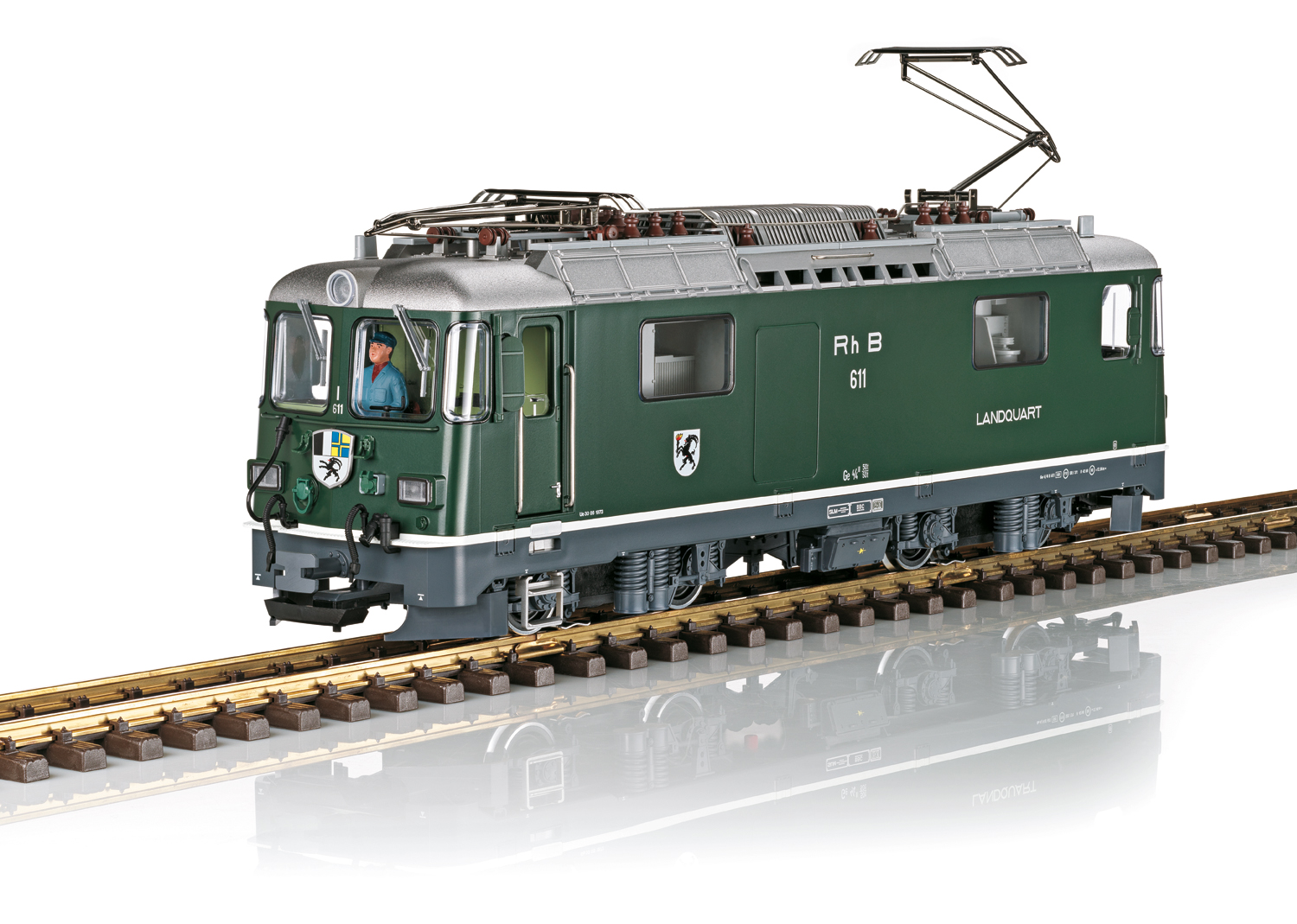
Prototype On the network of the Rhätische Bahn, the locomotives of the class Ge 4/4 II, with their 2,300 PS and their maximum speed of 90 km/h, can be seen at the head of all types of trains. The first locomotive of this series was delivered to the RhB as early as 1973 - at that time still in a dark green paint scheme and with round headlights. Modernised and rebuilt several times - among other things the locomotives were given rectangular headlights - almost all of them are still in service; the locomotives can be experienced on everything from local trains to the Glacier Express. The locomotive with the running number 611 has been painted green again as a historic locomotive, but retains the rectangular headlights. Model The 57 cm long electric locomotive of the series Ge 4/4 II with the running number 611 of the Rhätische Bahn is finished in the historic paint scheme of the Era IV period. All 4 wheelsets are powered by two powerful motors. It is equipped with an mfx/DCC decoder, which offers various light and sound functions as well as the motorised function of the roof pantographs, which can be raised and lowered. Highlights Digitally controlled roof pantographs
- Digital
- Sound
On order, shipped within 10-15 days

Diesel locomotive of the class 251. This machine was originally placed in service at the DB in August 1964 for 750 mm narrow gauge. The machine is currently at the RüBB in Putbus on Rügen. This locomotive has been given a new livery in old red, with lettering from around 1968. Wheel arrangement B'B'. It is equipped with an mfx/DCC decoder with many light and sound functions. Power storage is built in. All axles powered. Traction tyres. Lighting that changes over with the direction of travel, cab lighting, cab doors that can be opened. Length over the buffers 43.6 cm.
- Digital
- Sound
On order, shipped within 10-15 days

This tender can be used to equip the locomotives from most LGB starter sets with additional sound while at the same time increasing pulling power. The built-in electronics reproduce the sounds of the steam exhaust and - triggered by track magnets - the whistle and the bell. The tender is designed for analogue operation only. A track magnet for triggering the bell or whistle and a sheet of stickers for individual decoration are included. Length over the buffers 22 cm.
- Sound
On order, shipped within 10-15 days

The prototype: Between 1905 and 1916, the B ¾ 1301–1369 steam locomotives were handed over to the SBB by SLM.
On order, shipped within 4-5 days

Prototype: Between 1905 and 1916, the steam locomotives B ¾ 1301–1369 were handed over to the Swiss Federal Railways (SBB) by SLM.
On order, lead time to be confirmed

The prototype: Between 1905 and 1916, the steam locomotives B ¾ 1301–1369 were handed over to the SBB by SLM.
On order, shipped within 4-5 days

Prototype: Between 1905 and 1916, the SLM handed over the B ¾ 1301–1369 steam locomotives to the SBB.
On order, lead time to be confirmed

Prototype: Between 1905 and 1916, the SLM handed over the B ¾ 1301–1369 steam locomotives to the SBB.
On order, shipped within 4-5 days

The prototype: Between 1905 and 1916, the steam locomotives B ¾ 1301–1369 were handed over to the SBB by SLM.
On order, lead time to be confirmed

Prototype: Between 1905 and 1916, the SLM handed over the B ¾ 1301–1369 steam locomotives to the SBB.
On order, shipped within 4-5 days

The prototype: Between 1905 and 1916, the steam locomotives B ¾ 1301–1369 were handed over to the SBB by SLM.
On order, lead time to be confirmed

Tank locomotive, Class 84 of the DRB, running number 84 009, operating condition 1936, length over the buffers 179 mm.
On order, lead time to be confirmed

Tank locomotive, Class 84 of the DR, running number 84 002, length over buffers 179 mm.
On order, lead time to be confirmed