
Spörle-Formen · Technique and tools
The Spörle-Formen method, step by step
Plaster or Keraflott, mixing, demoulding, seamless joining, weathering and caring for your moulds: what you need to know before the first casting, and the tools to get there.
- 3:5water to plaster, by volume
- ≈ 20 minbefore demoulding plaster
- 1:3flow improver dilution
Plaster or Keraflott?
Modelling plaster is cheap, sets quickly and reproduces detail faithfully; above all, it can be engraved, scraped and painted better than any other material. Keraflott, a ceramic casting powder, hardens in 30 to 40 minutes, “hard and ringing like porcelain”, with fewer bubbles. The two can be mixed, as long as you test first.
| Modelling plaster | Keraflott | |
|---|---|---|
| Cost and weight | cheap, light | more expensive, heavier |
| Working | can be engraved, scraped, bent | hard, difficult to engrave |
| Bubbles | more frequent | fewer |
| Painting | absorbent: wet-on-wet washes | less absorbent: more opaque colours |
| Best for | landscape, walls, roads | platform edges, ramps, fronts, chimneys, portable layouts |
Use only fresh plaster, kept dry in a sealed container.
Casting in plaster, step by step
- Prepare the mouldLaid flat, wetted with flow improver diluted 1:3 and spread with a brush. Turn it over just before casting to shake out the excess.
- MixAbout 3 parts water to 5 parts plaster, water first. Let it soak in, then whisk to a thick cream.
- PourUp to the rim. Tap, lift the corners and let them drop back to release the bubbles.
- Level offAfter about 5 minutes, remove the water and level off with a straight edge: a smooth back makes fitting easier.
- DemouldAbout 20 minutes later. Ease all the edges free, flex slightly, push from underneath; never “peel” the piece out.
- DryOne to two days, longer for thick pieces or in damp weather. A warped piece can be dampened again and dried under a weight.
For Keraflott, pour the powder into the water while stirring, level off after one to two minutes and demould after 30 to 40 minutes, following the proportions in the instructions.
Keraflott heats up as it sets. As long as the mould is warm, the piece is not ready: wait, otherwise you will damage both the piece and the mould.
Assembling, gluing, painting
- Cutting: score the panel, snap it, sand the edges.
- Seamless joining: rub the two pieces against each other, pressing hard, on a flat, smooth surface, until the joint disappears.
- Gluing: a flexible adhesive, ballast glue or all-purpose glue, reduces resonance and leaves room for correction; a fast white glue is for repairs.
- Painting: matt water-based acrylics. A light, warm primer, a dark wash thinned and applied over a thoroughly dry primer, wiping off, then highlights on the edges. The first coat seals the plaster: no varnish needed.
Bubbles? The plaster was too thick or the mould too dry. A rough surface? Too much flow improver. Never add colour or glue to the plaster; setting and strength suffer. Roads, platforms and concrete are weathered once laid.
Caring for your moulds
- Store them flat and dry, separated by corrugated cardboard: poor storage distorts them.
- A new mould repels water: the first piece often has to be cast again.
- Between castings, rinse with water; at the end of a session, scrape dry before stacking.
- Tiny bubbles in the silicone are normal and disappear under the paint.
- A torn mould cannot be glued, it is vulcanised: Spörle-Formen repairs it free of charge.
- Resin is possible, but it attacks the silicone: demoulding becomes difficult after about 25 pieces.
- Rinse your tools in a bucket, never in the sink: plaster hardens under water and blocks the pipes.
Cast pieces are for your personal use only: the manufacturer's copyright prohibits reselling them.
Tools and materials
Keraflott, flow improver, cranked spatulas with flexible blades from 3.5 to 9.5 cm, concave and convex bending moulds for casting a curved wall in Keraflott, construction aids and printed documentation from Spörle-Formen. Starter set 6000 brings together the essentials to get started.

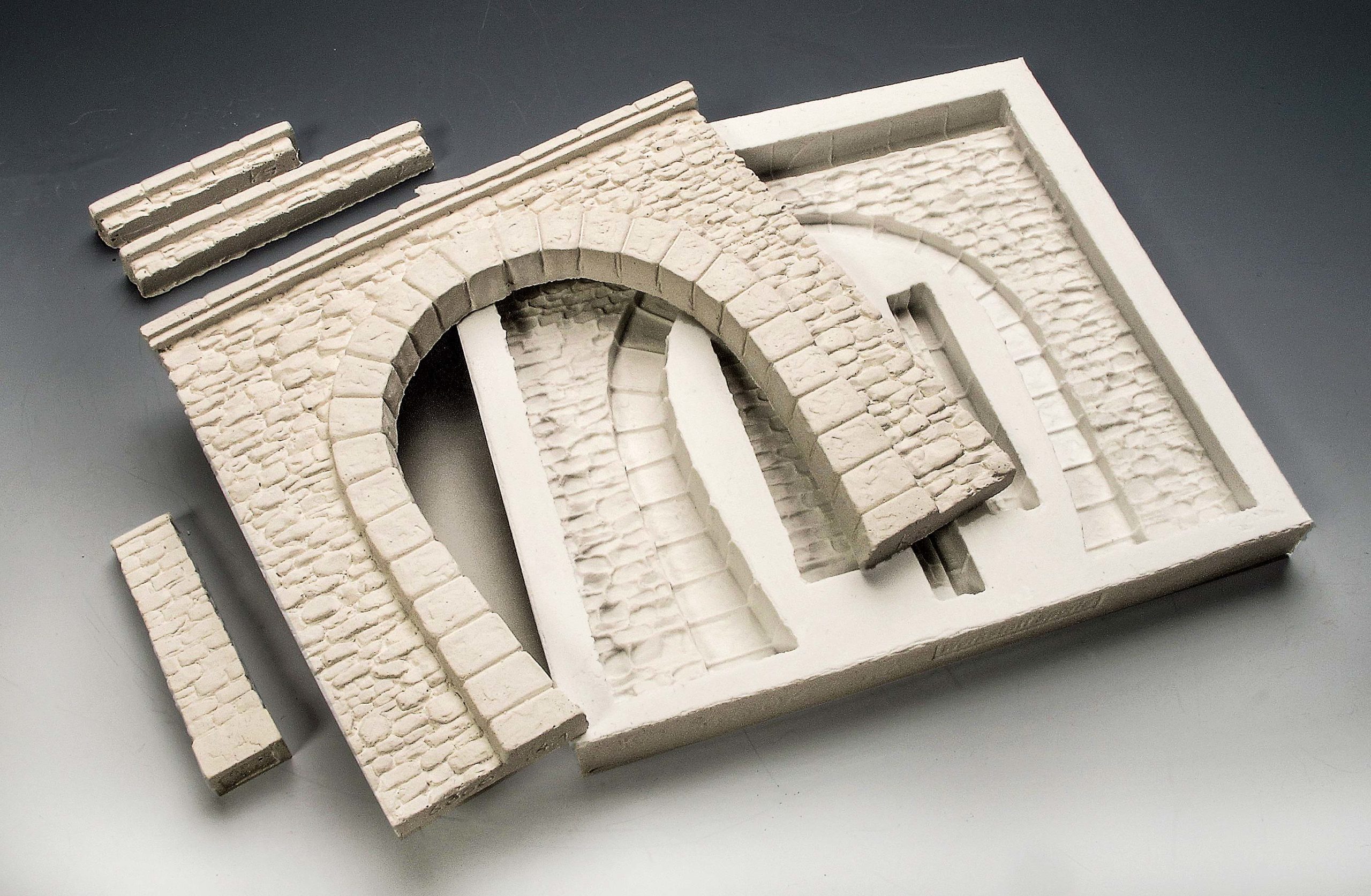
Silicone moulds “Beginner Set” with 2 moulds (tunnel portal, wall), Keraflott, spatula and instructions. Form 6306, tunnel portal, rubble stone, single track, with overhead line equipment, clearance height above top of rail 70–74 mm; width 123 x height 113 mm. Form 6049, silicone mould “wall”, rubble stone, approx. 160 x 100 x 5 mm (wall approx. 160 x 85 mm). 1 kg ceramic casting compound Keraflott. 1 spatula. 1 instruction sheet.
On order, shipped within 10-15 days

Keraflott casting compound 1 kg white colour. Advantages over plaster: Provides a more detailed reproduction. Dries faster. Forms fewer bubbles. Can be poured in a radius of up to 90°.
On order, shipped within 10-15 days

Flow improver with 50 ml. For plaster casting and water-soluble paints. Our wetting agent reduces air bubbles during casting and improves flow behaviour. Dilute up to 1:3 with water, spray into the mould and spread with a soft brush.
In stock, shipped within 1-3 days

Flow improver 100 ml. For plaster casting and water-soluble paints. Our wetting agent reduces air bubbles during casting and improves flow behaviour. Dilute up to 1:3 with water, spray into the mould and spread with a soft brush.
In stock, shipped within 1-3 days

Cranked scraper, spring blade approx. 3.5 cm.
In stock: 3 on the shelf, shipped within 1-3 days

Offset scraper with a bent handle, spring blade approx. 6.5 cm.
In stock: 3 on the shelf, shipped within 1-3 days

Offset scraper with a spring blade, approx. 9.5 cm.
On order, shipped within 10-15 days

Concave bending form With the bending forms you can use, for example, wall forms (e.g. 6009-6019) to cast not only straight sections but also those with a radius (convex or concave). The wall forms must be ordered separately. 1. For casting you do not need plaster but Keraflott (ceramic casting medium). Keraflott sets faster and is more stable afterwards. 2. Prepare the form with a flow improver and lay it flat. 3. Prepare the casting mixture to be quite fluid and pour it into the form. 4. When the surface has dried slightly after a few minutes (the casting medium can no longer run out), place it on its convex or concave base and gently press the surface with a spatula or your hand, smoothing it out. 5. Weight the form on the side or in the middle using aids (a piece of wood, etc.) so that it stays in the curved shape on its own. 6. After about 1 hour you can demould the wall and let it dry. 7. After about 2-3 hours you can continue processing the form. Colouring should only begin the following day.
On order, shipped within 10-15 days

Bending form: convex. With the bending forms you can use, for example, wall forms (e.g. 6009-6019) to cast not only straight sections but also those with a radius (convex or concave). The wall forms must be ordered separately. 1. For casting you do not need plaster but Keraflott (ceramic casting medium). Keraflott sets faster and is more stable afterwards. 2. Prepare the form with a flow improver and lay it flat. 3. Prepare the casting mixture to be quite fluid and pour it into the form. 4. When the surface has dried slightly after a few minutes (the casting medium can no longer run out), place it on its convex or concave base and gently press the surface with a spatula or your hand, then smooth it out. 5. Weight the form on the side or in the middle using aids (a piece of wood, etc.) so that it stays in the curved shape on its own. 6. After approx. 1 hour you can demould the wall and let it dry. 7. After approx. 2-3 hours you can further process the form. Colouring should only begin the following day.
On order, shipped within 10-15 days

Design aids for town planning, bridges and pillars. The four triangles are designed to provide stability and angular accuracy when building houses or walls that require right-angled construction (7110). The large rectangle serves as the upper cover / running surface for bridges (8000, 8100). The round part with masonry can be used, for example, for bay windows on the bridge (8000). The round ring is used, among other things, for constructing a round pillar. Two small squares and two elongated rectangles are used as shims or for height adjustment.
On order, shipped within 10-15 days

Build with plaster, printed version. Instructions for building with plaster.
On order, shipped within 10-15 days

Assembly instructions for house construction, printed version. Instructions for building houses with plaster.
On order, shipped within 10-15 days
Spörle-Formen's guides
Spörle-Formen publishes its guides free of charge, in German, as PDF files: