
Trix H0 and Minitrix
Trix, SBB and European trains in H0 and N
Crocodile, Landilok, Swiss Express Re 4/4 II and Giruno of the SBB, BLS Ae 6/8, plus trains from Germany and across Europe: Trix models the railway in 1:87 on two-rail DC, and in 1:160 with Minitrix.
- 692items in the shop
- 1:87 and 1:160Trix H0 and Minitrix
- Since 1964Minitrix and NEM two-rail
What Trix brings to your layout
- The great Swiss locomotives: Be 6/8 II Crocodile, Ae 8/14 Landilok, Swiss Express Re 4/4 II, Giruno and RAe 4/8 Churchill of the SBB, Ae 6/8 and Re 420 of the BLS.
- Two-rail, direct current: since 1964 Trix has run on two-rail DC to NEM standards. The models run on analogue or DCC layouts and register via mfx in the märklin digital system.
- Minitrix, N scale: launched in 1964, Minitrix covers 1:160: locomotives, coaches, wagons and a complete track system, also with concrete sleepers.
- A Nuremberg house: grown out of the firm J. Hafner, founded in 1838, Trix has been part of the Märklin group since 1997.
Our favourites for a Swiss layout
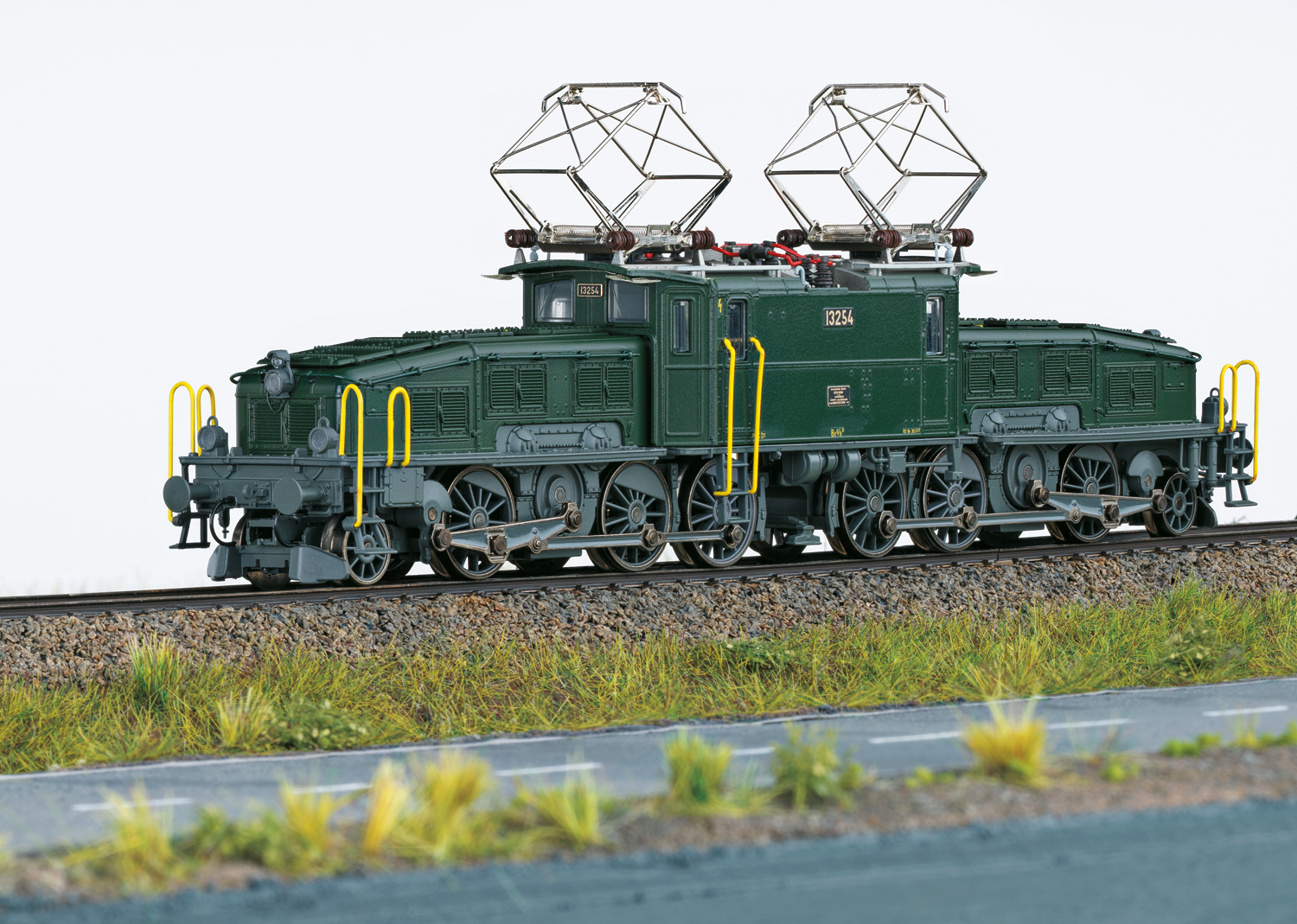
Prototype Electric locomotive, series Be 6/8 II "Krokodil" of the Swiss Federal Railways (SBB). Type from the first production series. Basic fir green paint scheme. With 2 cab doors, wide shunting steps on the engine hoods and bow-shaped grab rails, sleeve buffers, without transition plates, with a wrong-line signal and Signum-Integra magnets. Locomotive running number 13254. The locomotive looks as it did between 1960 and 1965. Model The locomotive has a digital decoder and extensive sound functions. It also has 2 regulated high-performance drives with flywheels, 1 motor in each drive bogie. 3 axles and a jackshaft powered in each. Traction tyres. Articulated running gear able to negotiate tight curves. The triple headlights change over with the direction of travel and 1 white tail lamp (Swiss lighting changeover) will work in conventional operation and can be controlled digitally. The lighting can be switched over to 1 red tail lamp when the locomotive is running alone. Maintenance-free warm white and red LEDs are used for the lighting. Highly detailed metal version with many separately applied details. 3-part locomotive body with engine hoods that swing out. Detailed roof equipment with a safety grille below the pantographs. Length over the buffers 22.3 cm. Highlights Highly detailed metal version Prototypically adapted details with only 2 cab doors and wide shunting steps Locomotive with 2 high-performance drives and flywheels With a RailCom-capable DCC/mfx digital decoder and a variety of operating and sound functions
- 2-rail, direct current
- Digital
- Sound
In stock: 1 on the shelf, shipped within 1-3 days

Prototype EC 250 electric high-speed multiple unit as the RABe 501 "Giruno" of the Swiss Federal Railways (SBB). 1 end car A (Bt1), 2nd class. 1 intermediate car F (B7), 2nd class, with entrances for the handicapped and a pantograph. 1 intermediate car G (WR6), with a restaurant area. 1 intermediate car H (A5), 1st class, with entrances for the handicapped and a pantograph. 1 end car L (At2), 1st class. In use as a multi-system multiple unit between Zurich Airport and Basel as well as across the Alps through the Gotthard Base Tunnel as far as Milan. Approval also planned for Germany and Austria. Train number RABe 501 003, with the "San Gottardo" coat of arms. Current operating condition 2022. Model 5-part base set. The restaurant car G and the two intermediate cars F and H arranged to the left and right of it are permanently coupled to one another by means of the Jacobs bogies. The unit has a digital decoder and extensive sound and light functions. It also has a regulated high-performance motor with a flywheel, centrally mounted in the restaurant car. All 4 axles in both Jacobs bogies to the left and right of the restaurant car powered using cardan shafts. Traction tyres. The cabs in the end cars have interior details. Power supply by way of the leading end car, depending on the direction of travel. Guide mechanism in the Jacobs bogies. The triple headlights and two red tail lamps change over with the direction of travel, will work in conventional operation, and can be controlled digitally. They can be changed over to a single white tail lamp (Swiss lighting changeover). Additional separately controllable light functions. Interior lighting fitted as standard. The interior lighting is supplied by way of the continuous electrical connection running through the whole train. In addition, the cab lighting and the driver's desk lighting can each be controlled separately, digitally. Maintenance-free warm white and red LEDs are used for all of the lighting. The pantographs on the intermediate cars F and H can each be raised and lowered separately as a digital function. True-to-scale reproduction. The minimum radius for operation is 360 mm. Length of the base set approximately 112 cm. Highlights Completely new tooling True-to-scale reproduction 1:87. LED interior lighting fitted as standard Cab lighting and driver's desk lighting can be controlled digitally Pantographs on the intermediate cars F and H can be raised and lowered by means of a digital function Digital decoder with extensive light and sound functions Train number RABe 501 003, with the "San Gottardo" coat of arms Note The 5-part base set 25810 can be expanded with the 2-part add-on car sets 23281, 23282, and 23283 to make a prototypical 11-part multiple unit.
- 2-rail, direct current
- Sound
In stock: 1 on the shelf, shipped within 1-3 days

Prototype Electric locomotive Ae 6/8 of the Bern-Lötschberg-Simplon Railway (BLS). Locomotive from the 2nd production series. Basic dark brown paint scheme with black running gear. Version in the original condition with 2 pantographs and braking resistors in the engine room. With transition plates on the ends and a wrong-line signal. Signum-Integra magnet at locomotive end II. 4 engine room windows and a louvred ventilation grille on each side. Locomotive running number 207. The locomotive looks as it did in the late 1940s/early 1950s. Model The locomotive has a digital decoder and extensive light and sound functions. It also has a regulated high-performance motor with a centrally mounted flywheel. Both outer driving wheelsets in each drive bogie are powered using cardan shafts. Traction tyres. The triple headlights change over with the direction of travel and 1 white tail lamp (Swiss lighting changeover) will work in conventional operation and can be controlled digitally. The lighting can be switched over to 1 red tail lamp when the locomotive is running alone. The wrong-line signal can be controlled separately digitally. The headlights at locomotive ends 2 and 1 can each be switched off separately digitally. Double "A" light function. Additional cab lighting, driver's desk lighting and engine room lighting can each be controlled separately digitally. Maintenance-free warm white and red LEDs are used for the lighting. With a buffer capacitor. Highly detailed metal version with many separately applied details. The minimum radius for operation is 360 mm. Brake hoses and imitation screw couplings are included. Length over the buffers 23.3 cm. Highlights Completely new tooling Locomotive from the 2nd production series with the locomotive number 207 Highly detailed metal version RailCom-capable DCC/mfx digital decoder with extensive operating and sound functions Cab, driver's desk and engine room lighting can be controlled digitally With a buffer capacitor to bridge short sections without power Buffer height to NEM standards Note A matching goods wagon set can be found under item no. 46575 in the Märklin H0 assortment, with information about the DC wheelsets required.
- 2-rail, direct current
- Digital
- Sound
In stock: 1 on the shelf, shipped within 1-3 days

Prototype Heavy double electric locomotive Ae 8/14 "Landilok" of the Swiss Federal Railways (SBB). Basic dark green paint scheme. Version with 2 pantographs. Sleeve buffers with square buffer plates. Locomotive running number 11852. The locomotive looks as it did in the early 1970s. Model The locomotive has a digital decoder and extensive light and sound functions. There is a regulated high-performance motor with a flywheel in each locomotive half. 4 axles powered in each locomotive half. The triple headlights change over with the direction of travel and 1 white tail lamp will work in conventional operation and can be controlled digitally. They can be switched over to 1 red tail lamp when the locomotive is running alone. Double "A" light function. Maintenance-free warm white and red LEDs are used for the lighting. The wrong-line signal, cab lighting and engine room lighting can be controlled digitally. Close couplers guided in a slot at the ends of the locomotive, separable close coupler between the locomotive halves. Detailed roof equipment with roof lines, insulators and roof walks as well as scissors-type pantographs. Both pantographs can be raised and lowered digitally. The minimum radius for operation is 360 mm. The cut-outs in the front aprons next to the standard pocket can be closed with the filler pieces included. Brake hoses and imitation screw couplings are included. Length over the buffers 39.1 cm. Highlights Completely new tooling Highly detailed metal version RailCom-capable DCC/mfx digital decoder with extensive operating and sound functions Cab and engine room lighting can be controlled digitally Red permission-to-proceed signal can also be controlled digitally Buffer height to NEM standards
- 2-rail, direct current
- Digital
- Sound
In stock: 1 on the shelf, shipped within 1-3 days

Prototype Electric locomotive Re 4/4 II, 1st production series, of the Swiss Federal Railways (SBB). Pebble grey/blood orange basic paint scheme as the locomotive for the Swiss Express. Running number 11141. The locomotive looks as it did starting in 1975. Model The locomotive has a digital decoder and extensive sound functions. It also has a regulated high-performance motor with a flywheel, centrally mounted. All four axles powered using cardan shafts. Traction tyres. The triple headlights change over with the direction of travel and, together with one white tail lamp (Swiss lighting changeover), will work in conventional operation and can be controlled digitally. The lighting can be switched over to one red tail lamp when the locomotive is running alone. The headlights at Locomotive End 2 and 1 can each be turned off separately in digital operation. The shunting, warning and wrong-line signals can be controlled digitally. The cab and engine room lighting can be controlled digitally. Maintenance-free warm white and red LEDs are used for the lighting. With a buffer capacitor. Detailed roof fittings with a newly tooled scissors-type pantograph. Many separately applied details such as handrails and the reproduction of the automatic coupler including the transverse linkage. The buffer height conforms to NEM standards. Brake lines, sockets, filler pieces for the pilot and the complete automatic coupler are included as separate plug-in parts. Length over the buffers 17.8 cm. Highlights Completely new tooling in a highly detailed metal version For the "50 Years of the Swiss Express" anniversary. Newly tooled scissors-type pantograph Many separately applied details such as the reproduction of the automatic coupler Cab and engine room lighting can be controlled digitally Shunting, warning and wrong-line signals can also be controlled Close couplers with a guide mechanism With a digital decoder and a wide variety of light and sound functions DCC, mfx and RailCom capable The buffer height conforms to NEM standards. With a buffer capacitor to bridge short sections without power
- 2-rail, direct current
- Digital
- Sound
In stock: 1 on the shelf, shipped within 1-3 days

Prototype Four type EW III standard coaches of the Swiss Federal Railways (SBB/CFF/FFS). One type AD half-luggage coach, 1st class, one type WR restaurant car and two type B high-capacity coaches, 2nd class. Pebble grey/blood orange basic paint scheme of the Swiss Express. Route: Genève-Lausanne-Bern-Zürich HB. Car numbers 1, 13 and 14. Restaurant car without a car number. The coaches look as they did starting in 1975. Model Completely new tooling for the EW III coach family. Multi-coloured interior details. All coaches with LED interior lighting fitted as standard. A buffer capacitor is installed in each coach to bridge over brief interruptions in power. Restaurant car with illuminated table lamps. One high-capacity coach has tail lighting fitted as standard. Equipped with separable, current-conducting close couplers. The interior lighting works in conjunction with the restaurant car; the specified vehicle sequence must be observed for this. There is a digital interface in the restaurant car for fitting a function decoder to control various light functions. Type-specific bogies, roof shapes, side walls and underframes with many applied details. Buffer height according to NEM. Separately applied vents, handrails, control lines and steps on the bogies. Printed destination boards and car numbers. Two plug-in transfer end doors, which were fitted on the prototype for transfer runs, are included with each coach. An imitation of an automatic coupler is also included with the coach with car number 14. All coaches individually packaged in additional outer packaging. The minimum radius for operation is 360 mm. Length over the buffers approx. 113.2 cm. Highlights Completely new tooling for the EW III coach family For the "50 years of the Swiss Express" anniversary. Multi-coloured interior details LED interior lighting fitted as standard with buffer capacitors One coach with built-in tail lighting Restaurant car with illuminated table lamps Restaurant car equipped with a digital interface Separable, current-conducting close couplers Many separately applied details Buffer height according to NEM
In stock: 3 on the shelf, shipped within 1-3 days

Prototype Class Re 420 electric locomotive of the BLS, wheel arrangement Bo´Bo´, built starting in 1966 for the SBB. The locomotive looks as it did around 2017. Basic paint scheme in white aluminium, with square lamps and one single-arm pantograph. Use: Fast passenger trains. Model The locomotive has a built-in digital decoder and sound generator for operation with mfx and DCC. Motor with a flywheel, 4 axles powered, traction tyres. Headlights and tail lamps changing over with the direction of travel, with warm white LEDs (the tail signal can be switched over and turned off), cab lighting, can be controlled digitally. Length over the buffers 93 mm. Highlights Sound Cab lighting
- Digital
- Sound
In stock: 1 on the shelf, shipped within 1-3 days

Prototype 4 different express coaches of the types EW III of the Swiss Federal Railways (SBB) in the Swiss Express paint scheme, consisting of 1x 1st class with baggage compartment (AD), 1x express train restaurant car (WR) and 2x 2nd class (B). The coaches look as they did around 1975. Model With a guide mechanism for close couplers. Prepared for the later installation of interior lighting. Total length over the buffers 616 mm. The matching interior lighting: 66616 LED interior lighting.
In stock: 1 on the shelf, shipped within 1-3 days
The Trix families
For your H0 layout (1:87)
157 itemsLocomotives H0Crocodile, Ae 8/14, Re 4/4 II, Giruno, BLS Ae 6/8 and locomotives from Europe.See the items43 itemsPassenger coaches H0Swiss Express, add-on coaches for the Giruno and trains from Europe.See the items 23 itemsGoods wagons H0Hupac pocket wagons, container wagons, tank wagons and low-sided wagons.See the items
 40 itemsC track H0Straight and curved track, points, double slips and buffer stops.See the items
For your N layout (1:160), Minitrix
82 itemsMinitrix locomotivesRe 460, Re 4/4 II, SBB Cargo International Vectron, BLS Re 420.See the items 85 itemsMinitrix passenger coachesSBB Swiss Express, BLS EW III coaches and trains from Europe.See the items
 50 itemsMinitrix goods wagonsSBB Cargo coop container wagon, tank wagons, self-unloading wagons.See the items
 100 itemsMinitrix trackStraight and curved track, points and crossings, also with concrete sleepers.See the items
All Trix items

Prototype Class VT 18.16 high-speed diesel multiple unit (type SVT "Görlitz"), as the refurbished heritage train set of the SVT Görlitz gGmbH looks. Based on the version of the Deutsche Reichsbahn of the DDR (DR/DDR) from the 1960s and 1970s, as a flagship for international express services. 4-part unit. 1 power car VTa, 1 intermediate car VMc with a dining area and kitchen, 1 intermediate car VMd, 1 power car VTb. Current operating condition from 2025/26. Model 4-part unit. The train has a digital decoder and extensive sound and light functions. It also has a regulated high-performance motor with a flywheel in one power car, all four axles powered using cardan shafts. Traction tyres. The LED interior lighting, cab lighting, driver's desk lighting, engine room lighting, kitchen area lighting, and wall lamps in the dining area, all fitted as standard, can each be controlled digitally. The triple headlights, two red tail lamps, and interior lighting change over with the direction of travel, will work in conventional operation, and can be controlled digitally. All of the lighting uses maintenance-free warm white and red LEDs. Multi-part interior details. Multi-pole current-conducting special couplers guided in a slot between the vehicles. Power supply depending on the direction of travel by way of the leading power car in each case. It has a buffer capacitor. Many separately applied details. A reproduction of the automatic coupler at both ends (non-functional). The minimum radius for operation is 360 mm. Length of the 4-part train set approximately 113 cm. Highlights Completely new tooling True-to-scale reproduction 1:87. Reproduction of the refurbished 4-part heritage train set Highly detailed and heavy metal version High-performance motor with a flywheel in one power car All four axles in one power car powered using cardan shafts Fitted as standard with cab, driver's desk, engine room, and interior lighting RailCom-capable DCC/mfx digital decoder with extensive operating, sound, and light functions With a buffer capacitor to bridge short sections without power Note Märklin is supporting the restoration of this legendary multiple unit with a donation of 25,000.-- euros.
- 2-rail, direct current
- Digital
- Sound
Pre-order, release expected in Q1 2027

Prototype Class 181.2 electric locomotive of the Schlünß Eisenbahn Logistik (SEL). Basic Orient red paint scheme. Running number 181 218-9. The locomotive looks as it did starting in September 2025 with the name "GÖPPINGEN". Model The locomotive has a digital decoder and extensive sound functions. It also has a regulated high-performance motor with a centrally mounted flywheel. All four axles are powered using cardan shafts. Traction tyres. The triple headlights and two red tail lamps change over with the direction of travel, will work in conventional operation, and can be controlled digitally. The headlights at locomotive ends 2 and 1 can each be turned off separately digitally. Double "A" light function. The cab lighting, changing with the direction of travel, and the engine room lighting can be controlled digitally. The lighting uses maintenance-free warm white and red LEDs. It has a buffer capacitor. The pantographs can be raised and lowered digitally. Separately applied wheel imitations, handrails, windscreen wipers, UIC sockets, and roof lines. The buffer height conforms to NEM. Brake lines, screw couplers, and various sockets are included as separate plug-in parts. Length over the buffers 20.5 cm. Highlights Name "GÖPPINGEN". Tooling variation for the correct representation of the Era VI version Fine metal construction with many separately applied details Pantographs can be raised and lowered digitally Pantographs prototypically fitted with different contact strips Cab and engine room lighting can be controlled digitally Separately applied wheel imitations Digital decoder with extensive light and sound functions DCC, mfx, and RailCom capable Buffer height conforms to NEM. With a buffer capacitor to bridge short sections without power
- 2-rail, direct current
- Digital
- Sound
On order, shipped within 10-15 days

Prototype Class EB 3200 electric locomotive (Vectron) of the Danish State Railways (DSB). Running number 3203. The locomotive looks as it did in 2020. Model The locomotive has a digital decoder and extensive sound functions. It also has a regulated high-performance motor. 4 axles powered. Traction tyres. The triple headlights and 2 red tail lamps change over with the direction of travel, will work in conventional operation, and can be controlled digitally. The headlights at Locomotive End 2 and 1 can each be turned off separately digitally. When the headlights are turned off at both ends of the locomotive, the double "A" light function is on at both ends. The long-distance headlights can be controlled separately. The cab lighting can be controlled digitally. The shunting special marker and wrong-line running light functions can be controlled digitally. Maintenance-free warm white and red LEDs are used for the lighting. Plug-in brake hoses are included separately. Length over the buffers 21.9 cm. Highlights Locomotive body and frame of the locomotive constructed of die-cast zinc Many separately applied details Numerous light functions can be controlled digitally Digital decoder with extensive operating and sound functions
- 2-rail, direct current
- Sound
On order, shipped within 10-15 days

Prototype Class 193 electric locomotive (Vectron) of Siemens Dispo GmbH, leased to MRCE, sub-leased to Mercitalia Rail S.r.l. (Rome). Locomotive number X4 E – 643. The locomotive looks as it did in 2016. Model The locomotive has a digital decoder and extensive sound functions. It also has a regulated high-performance motor. Four axles powered. Traction tyres. The dual headlights and two red tail lamps change over with the direction of travel, will work in conventional operation, and can be controlled digitally. The long-distance headlights can be controlled separately. The cab lighting can be controlled digitally. The headlights at Locomotive End 2 and 1 can each be turned off separately digitally. When the headlights are turned off at both ends of the locomotive, the double "A" light function is on at both ends. The wrong-line running and long-distance light functions can be controlled separately digitally. Maintenance-free warm white and red LEDs are used for the lighting. Length over the buffers 21.9 cm. Highlights Locomotive body and frame of the locomotive constructed of die-cast zinc Many separately applied details Cab lighting can be controlled digitally Numerous other light functions can be controlled digitally Digital decoder with extensive operating and sound functions
- 2-rail, direct current
- Sound
On order, shipped within 10-15 days

Prototype Class 370 electric locomotive (Siemens Vectron MS) of PKP Cargo. Running number 370 057. The locomotive looks as it did in 2023. Model The locomotive has a digital decoder and extensive sound functions. It also has a regulated high-performance motor. 4 axles powered. Traction tyres. The triple headlights and 2 red tail lamps change over with the direction of travel, will work in conventional operation, and can be controlled digitally. The long-distance headlights can be controlled separately. The cab lighting can be controlled digitally. The headlights at Locomotive End 2 and 1 can each be turned off separately digitally. When the headlights are turned off at both ends of the locomotive, the double "A" light function is on at both ends. Maintenance-free warm white and red LEDs are used for the lighting. The locomotive has a buffer capacitor. Length over the buffers 21.8 cm. Highlights With a buffer capacitor to bridge short sections without power Locomotive body and frame of the locomotive constructed of die-cast zinc Many separately applied details Cab lighting can be controlled digitally Digital decoder with extensive light and sound functions
- 2-rail, direct current
- Sound
On order, shipped within 10-15 days

Prototype Class 220 diesel locomotive of the Deutsche Bahn AG (DB AG), also known by the nickname "Taigatrommel". With a Soviet-type silencer, intake grilles with vertical louvres, and a radiator fan with fluttering louvres. The locomotive looks as it did in 1994. Running number 220 274. Model The locomotive has a digital decoder and extensive sound functions. It also has a centrally mounted regulated high-performance motor. Two axles in each bogie are powered using cardan shafts. Traction tyres. The triple headlights and 2 red tail lamps change over with the direction of travel, will work in conventional operation, and can be controlled digitally. The headlights at Locomotive End 2 and 1 can each be turned off separately digitally. When the headlights are turned off at both ends of the locomotive, the double "A" light function is on at both ends. The cab lighting changes over with the direction of travel and can be controlled digitally. The engine room lighting can be controlled digitally. Maintenance-free warm white and red LEDs are used for the lighting. Metal grab rails applied on the sides. The front apron can be exchanged for closed front aprons. The DB AG logo is included as a transfer. Length over the buffers approximately 20.2 cm. Highlights With a Soviet-type silencer Buffer height according to NEM. Chassis and body of the locomotive largely constructed of metal Metal grab rails applied on the sides Cab lighting can be controlled digitally Engine room lighting can be controlled digitally DCC/mfx digital decoder with a wide variety of light and sound functions Elaborately designed bogies
- 2-rail, direct current
- Digital
- Sound
On order, shipped within 10-15 days

Prototype Diesel locomotive T 679.1266 of the Czechoslovak State Railways CSD, also known by the nickname "Taigatrommel". With a Soviet-type silencer, intake grilles with horizontal louvres, and a radiator fan with a grille. The locomotive looks as it did around 1980. Model The locomotive has a digital decoder and extensive sound functions. It also has a centrally mounted regulated high-performance motor. Two axles in each bogie are powered using cardan shafts. Traction tyres. The triple headlights and 2 red tail lamps change over with the direction of travel, will work in conventional operation, and can be controlled digitally. The headlights at Locomotive End 2 and 1 can each be turned off separately digitally. When the headlights are turned off at both ends of the locomotive, the double "A" light function is on at both ends. The cab lighting changes over with the direction of travel and can be controlled digitally. The engine room lighting can be controlled digitally. Maintenance-free warm white and red LEDs are used for the lighting. Metal grab rails applied on the sides. The front apron can be exchanged for closed front aprons. Length over the buffers approximately 20.2 cm. Highlights With a Soviet-type silencer Buffer height according to NEM. Chassis and body of the locomotive largely constructed of metal Metal grab rails applied on the sides Cab lighting can be controlled digitally Engine room lighting can be controlled digitally DCC/mfx digital decoder with a wide variety of light and sound functions Elaborately designed bogies
- 2-rail, direct current
- Digital
- Sound
On order, shipped within 10-15 days

Prototype Class 120 diesel locomotive of the German State Railroad (DR), also known by the nickname "Taiga Drum". Version with a Soviet-design muffler. The locomotive looks as it did in 1973. Running number 120 323. Model With a digital decoder and extensive sound functions. Regulated high-performance motor, centrally mounted. Two axles in each truck powered via cardan shafts. Traction tires. Triple headlights and 2 red marker lights that change over with the direction of travel will work in conventional operation and can be controlled digitally. The headlights at Locomotive End 2 and 1 can each be turned off separately in digital operation. When the headlights are off at both ends of the locomotive, the double A light function is on at both ends. Cab lighting changes over with the direction of travel and can be controlled digitally. Engine room lighting can be controlled digitally. Maintenance-free warm white and red LEDs are used for the lighting. Metal grab irons applied on the sides. Front skirting can be replaced with closed front skirting. Length over the buffers approx. 20.2 cm. Highlights With buffer height to NEM standards. Locomotive chassis and body made largely of metal Metal grab irons applied on the sides Cab lighting can be controlled digitally Engine room lighting can be controlled digitally Digital decoder with a variety of light and sound functions Elaborately designed trucks
- 2-rail, direct current
- Sound
On order, shipped within 10-15 days

Prototype Class 193 electric locomotive (Vectron) of SBB Cargo AG in the new design. The locomotive looks as it did in 2024. Model The locomotive has a digital decoder and extensive sound functions. It also has a regulated high-performance motor. 4 axles powered. Traction tyres. The triple headlights and 1 white tail lamp change over with the direction of travel, will work in conventional operation, and can be controlled digitally. The headlights at Locomotive End 2 and 1 can each be turned off separately digitally. When the headlights are turned off at both ends of the locomotive, the "double A light" function is on at both ends. The changeover between the Swiss lighting changeover and the white/red lighting changeover can be controlled. The long-distance headlights can be controlled digitally. The cab lighting can be controlled digitally. The shunting light, the warning signal, and wrong-line running can be controlled digitally. Maintenance-free warm white and red LEDs are used for the lighting. The locomotive has a buffer capacitor. Plug-in brake hoses are included separately. Length over the buffers 21.9 cm. Highlights New design of SBB Cargo AG. Locomotive body and frame of the locomotive constructed of die-cast zinc Many separately applied details Numerous light functions can be controlled separately digitally RailCom-capable DCC/mfx digital decoder with extensive operating and sound functions With a buffer capacitor to bridge short sections without power
- 2-rail, direct current
- Digital
- Sound
On order, shipped within 10-15 days

Prototype Class JT42CWR diesel electric freight locomotive, better known as the Class 66. Diesel locomotive of DB Cargo UK (GB). The locomotive looks as it did in 2025. Model With a digital decoder and extensive sound and light functions. Regulated high-performance motor with a flywheel, centrally mounted. 4 axles powered via cardan shafts. Traction tires. Triple headlights and 2 red marker lights that change over with the direction of travel will work in conventional operation and can be controlled digitally. The headlights at Locomotive End 2 and 1 can each be turned off separately in digital operation. When the headlights are off at both ends of the locomotive, the double A light function is on at both ends. Cab lighting can be controlled digitally. Engineer's console lighting can be controlled digitally. Maintenance-free warm white and red LEDs are used for the lighting. With a buffer capacitor. Factory-installed smoke generator with dynamic smoke output. Many separately applied details. Detailed buffer beam. Brake hoses that can be plugged in are included. Length over the buffers approx. 24.7 cm. Highlights With a buffer capacitor for bridging short sections without power Replica rear-view mirrors Replica uncoupling aid Cab lighting can be controlled digitally Engineer's console lighting can be controlled digitally Factory-installed smoke generator with dynamic smoke output Digital decoder and extensive sound and light functions
- 2-rail, direct current
- Sound
On order, shipped within 10-15 days

Prototype Class Rc 5 electric locomotive of the Swedish State Railways (SJ). Version in an orange basic paint scheme with scissors-type pantographs. The locomotive looks as it did starting in 1990. Model The locomotive has a digital decoder and extensive sound functions. It also has a regulated high-performance motor. Four axles powered. Traction tyres. The quadruple headlights and one red tail lamp change over with the direction of travel, will work in conventional operation, and can be controlled digitally. The cab lighting can be controlled digitally. When the headlights are turned off at both ends of the locomotive, the shunting light is turned on at both ends. Numerous different light signals can be controlled digitally. Maintenance-free warm white and red LEDs are used for the lighting. Applied grab rails of plastic and metal. Buffer height according to NEM. Rear-view mirrors mounted. Brake lines, imitation screw couplings, and a closed pilot are included. Length over the buffers 17.7 cm Highlights Completely new tooling Buffer height according to NEM. Chassis and body largely constructed of metal Numerous separately applied details Cab lighting can be controlled digitally Numerous different light signals can be controlled digitally With a RailCom-capable DCC/mfx digital decoder and extensive sound functions
- 2-rail, direct current
- Digital
- Sound
On order, shipped within 10-15 days

Prototype Class 249 dual-power locomotive (Vectron Dual Mode light) of DB Cargo AG. From the Vectron product family from Siemens. Running number 249 002. Factory condition May 2022. Model The locomotive has a digital decoder and extensive sound functions. It also has a regulated high-performance motor. 4 axles powered. Traction tyres. The triple headlights and 2 red tail lamps change over with the direction of travel, will work in conventional operation, and can be controlled digitally. The headlights at Locomotive End 2 and 1 can each be turned off separately digitally. When the headlights are turned off at both ends of the locomotive, the double "A" light function is on at both ends. The cab lighting changes over with the direction of travel and can be controlled digitally. The engine room lighting can be controlled digitally. The long-distance headlights can be controlled separately digitally. Maintenance-free warm white and red LEDs are used for the lighting. Plug-in brake hoses and a shunting coupler are included separately. Length over the buffers approximately 23.6 cm. Highlights Completely new tooling Buffer height according to NEM. Chassis and body largely constructed of metal Numerous separately applied details Cab lighting can be controlled digitally Engine room lighting can be controlled digitally With a RailCom-capable DCC/mfx digital decoder and extensive sound functions
- 2-rail, direct current
- Digital
- Sound
On order, shipped within 10-15 days

Prototype Class 249 dual-power locomotive (Vectron Dual Mode light) with special decals in the split Ludmilla/V90 design of DB Cargo AG. From the Vectron product family from Siemens. Running number 249 001. The locomotive looks as it did in 2024. Model The locomotive has a digital decoder and extensive sound functions. It also has a regulated high-performance motor. 4 axles powered. Traction tyres. The triple headlights and 2 red tail lamps change over with the direction of travel, will work in conventional operation, and can be controlled digitally. The headlights at Locomotive End 2 and 1 can each be turned off separately digitally. When the headlights are turned off at both ends of the locomotive, the double "A" light function is on at both ends. The cab lighting changes over with the direction of travel and can be controlled digitally. The long-distance headlights can be controlled separately digitally. Maintenance-free warm white and red LEDs are used for the lighting. Plug-in brake hoses and a shunting coupler are included separately. Length over the buffers approximately 23.6 cm. Highlights With an attractive, current special paint scheme Buffer height according to NEM. Chassis and body largely constructed of metal Numerous separately applied details Cab lighting can be controlled digitally Engine room lighting can be controlled digitally With a DCC/mfx digital decoder and extensive sound functions
- 2-rail, direct current
- Digital
- Sound
On order, shipped within 10-15 days

Prototype: Class 248 dual-mode locomotive (Vectron Dual Mode) of the Pressnitztalbahn railroad construction and operating company mbH (PRESS). From the Siemens Vectron product family. Running number 248 105. Operating condition 2023. Highlights Completely new tooling. Buffer height according to NEM. Frame and body made largely of metal. Numerous applied details. Cab lighting can be controlled digitally. Engine room lighting can be controlled digitally. With a RailCom-capable DCC/mfx digital decoder and extensive sound functions. Product description Model: With a digital decoder and extensive sound functions. Controlled high-performance motor. 4 axles powered. Traction tires. Triple headlights and 2 red marker lights that change over with the direction of travel, in operation in conventional mode, can be controlled digitally. Headlights at locomotive end 2 and 1 can each be turned off separately in digital operation. When the headlights are turned off at both ends of the locomotive, the double A light function is active at both ends. Cab lighting changes over with the direction of travel and can be controlled digitally. Engine room lighting can be controlled digitally. Long distance headlights can be controlled separately in digital operation. Maintenance-free warm white and red light emitting diodes (LED) for the lighting. Brake hoses that can be plugged in are included separately. Length over buffers approx. 23 cm. This model can be found in an AC version in the Märklin H0 assortment under item number 39294.
On order, shipped within 10-15 days

Prototype Class 248 dual-power locomotive (Vectron Dual Mode) of BUG Verkehrsbau SE, Berlin. From the Vectron product family from Siemens. Running number 248 024-2. The locomotive looks as it did from 2023. Model The locomotive has a digital decoder and extensive sound functions. It also has a regulated high-performance motor. All four axles powered using cardan shafts. Traction tyres. The triple headlights and two red tail lamps change over with the direction of travel, will work in conventional operation, and can be controlled digitally. The headlights at Locomotive End 2 and 1 can each be turned off separately digitally. Double "A" light function. The cab lighting changes over with the direction of travel and can be controlled digitally. The long-distance headlights can be controlled separately digitally. Maintenance-free warm white and red LEDs are used for the lighting. Buffer height according to NEM. Brake hoses are included as separate plug-in parts. Length over the buffers approximately 23 cm. Highlights Exclusively from Trix, Märklin, and Minitrix Chassis and body largely constructed of metal Numerous separately applied details Cab lighting can be controlled digitally Engine room lighting can be controlled digitally Buffer height according to NEM. Digital decoder with extensive operating and sound functions DCC, mfx, and RailCom capable One-time series This model is available in the H0 and N gauges exclusively from Trix, Märklin, and Minitrix.
- 2-rail, direct current
- Digital
- Sound
On order, shipped within 10-15 days

Prototype Heavy Vossloh G 2000 BB diesel locomotive with a symmetrical cab. Locomotive of ATC AngelTrainsCargo, Antwerp, leased to Rotterdam Rail Feeding (RRF). Yellow/orange basic paint scheme. Running number 1102. Operating condition of Era VI. Model The locomotive has a digital decoder and extensive sound and light functions. It also has a centrally mounted regulated high-performance motor with a flywheel. All 4 axles powered using cardan shafts. Traction tyres. The triple headlights and 2 red tail lamps change over with the direction of travel, will work in conventional operation, and can be controlled digitally. The headlights at Locomotive End 2 and 1 can each be turned off separately digitally. When the headlights are turned off at both ends of the locomotive, the double "A" light function is on at both ends. The cab lighting can be controlled separately digitally for each cab. Maintenance-free warm white and red LEDs are used for the lighting. Many separately applied details. Metal railings along the sides of the frame. Detailed buffer beam. Plug-in brake hoses are included. Enclosed front covers can also be mounted on the buffer beam. Length over the buffers 20 cm. Highlights New running number 1102 Chassis and parts of the body constructed of metal Cab lighting can be controlled separately digitally With a digital decoder and extensive operating and sound functions
- 2-rail, direct current
- Sound
On order, shipped within 10-15 days

Prototype Class 249 dual-power locomotive (Vectron Dual Mode light) of DB Cargo AG. From the Vectron product family from Siemens. Running number 249 006. The locomotive looks as it did in 2024. Model The locomotive has a digital decoder and extensive sound functions. It also has a regulated high-performance motor. 4 axles powered. Traction tyres. The triple headlights and 2 red tail lamps change over with the direction of travel, will work in conventional operation, and can be controlled digitally. The headlights at Locomotive End 2 and 1 can each be turned off separately digitally. When the headlights are turned off at both ends of the locomotive, the double "A" light function is on at both ends. The cab lighting changes over with the direction of travel and can be controlled digitally. The control desk lighting can be controlled digitally. The engine room lighting can be controlled digitally. The long-distance headlights can be controlled separately digitally. Maintenance-free warm white and red LEDs are used for the lighting. The locomotive has a buffer capacitor. The pantographs can be raised and lowered digitally. The Telex coupler on both ends of the locomotive can each be controlled separately digitally. Coupler waltz. Plug-in brake hoses and a shunting coupler are included separately. Length over the buffers approximately 23.6 cm. Highlights Pantographs can be raised and lowered digitally Telex coupler at the front and rear can be controlled separately digitally With a buffer capacitor to bridge short sections without power Coupler waltz Control desk lighting can be controlled digitally Cab lighting can be controlled digitally Engine room lighting can be controlled digitally Buffer height according to NEM. Chassis and body largely constructed of metal Numerous separately applied details Digital decoder and extensive sound functions
- 2-rail, direct current
- Sound
On order, shipped within 10-15 days

Prototype JT42CWRM diesel-electric goods locomotive, better known as the Class 77. Diesel locomotive of DB Cargo AG. The locomotive looks as it did in 2021. Model The locomotive has a digital decoder and extensive sound and light functions. It also has a centrally mounted regulated high-performance motor with a flywheel. 4 axles powered using cardan shafts. Traction tyres. The triple headlights and 2 red tail lamps change over with the direction of travel, will work in conventional operation, and can be controlled digitally. The headlights at Locomotive End 2 and 1 can each be turned off separately digitally. When the headlights are turned off at both ends of the locomotive, the double "A" light function is on at both ends. The cab lighting can be controlled digitally. The control desk lighting can be controlled digitally. Maintenance-free warm white and red LEDs are used for the lighting. Smoke generator fitted as standard. Many separately applied details. Detailed buffer beam. Plug-in brake hoses are included. Length over the buffers approximately 24.7 cm. Highlights Cab lighting can be controlled digitally Control desk lighting can be controlled digitally Smoke generator fitted as standard with dynamic smoke output With a RailCom-capable digital decoder
- 2-rail, direct current
- Sound
On order, shipped within 10-15 days

Prototype Diesel-electric goods locomotive JT42CWR, better known as the Class 66. Diesel locomotive of the RheinCargo GmbH & Co. KG, Neuss. The locomotive looks as it did in 2022. Model The locomotive has a digital decoder and extensive sound and light functions. It also has a regulated high-performance motor with a centrally mounted flywheel. 4 axles powered using cardan shafts. Traction tyres. The triple headlights change over with the direction of travel and, together with 2 red tail lamps, will work in conventional operation and can be controlled digitally. The headlights at Locomotive End 2 and 1 can each be turned off separately in digital operation. When the headlights are turned off at both ends of the locomotive, the double "A" light function works at both ends. The cab lighting can be controlled digitally. The control desk lighting can be controlled digitally. Maintenance-free warm white and red LEDs are used for the lighting. Smoke generator fitted as standard. Many separately applied details. Detailed buffer beam. Plug-in brake hoses are included. Length over the buffers approximately 24.7 cm. Highlights Cab lighting can be controlled digitally Control desk lighting can be controlled digitally Smoke generator with dynamic smoke output fitted as standard With a RailCom-capable digital decoder
- 2-rail, direct current
- Sound
On order, shipped within 10-15 days

Prototype Class 249 dual power locomotive (Vectron Dual Mode light) of the DB Bahnbau Group. From the Siemens Vectron product family. Running number 249 052. The locomotive looks as it did in 2025. Model With a digital decoder and extensive sound functions. Regulated high-performance motor. 4 axles powered. Traction tires. Triple headlights and 2 red marker lights that change over with the direction of travel will work in conventional operation and can be controlled digitally. The headlights at Locomotive End 2 and 1 can each be turned off separately in digital operation. When the headlights are off at both ends of the locomotive, the double A light function is on at both ends. Cab lighting changes over with the direction of travel and can be controlled digitally. Engineer's console lighting can be controlled digitally. Engine room lighting can be controlled digitally. Long distance headlights can be controlled separately digitally. Maintenance-free warm white and red LEDs are used for the lighting. With a buffer capacitor. Pantographs can be raised and lowered digitally. Telex couplers on both ends of the locomotive can each be controlled separately digitally. Coupler slack function. Brake hoses that can be plugged in and a switching coupler are included separately. Length over the buffers approx. 23.6 cm / 9-5/16". Highlights Pantographs can be raised and lowered digitally Telex couplers on the front and rear can be controlled separately digitally With a buffer capacitor for bridging short sections without power Coupler slack function Engineer's console lighting can be controlled digitally Cab lighting can be controlled digitally Engine room lighting can be controlled digitally Buffer height to NEM standards. Chassis and body made largely of metal Numerous applied details Digital decoder and extensive sound functions
- 2-rail, direct current
- Sound
Pre-order, release expected in Q1 2027

Prototype Class Ae 3/5 electric locomotive of the Swiss Federal Railways (SBB/CFF/FFS). With walkover plates on the ends and a wrong track signal above the upper headlight. Basic fir green paint scheme with gray running gear. Locomotive running number 10217. The locomotive looks as it did in 2022. Model With a digital decoder and extensive light and sound functions. Regulated high-performance motor with a flywheel. One axle powered. Traction tires. Triple headlights and 1 white marker light (Swiss light changeover) that change over with the direction of travel will work in conventional operation and can be controlled digitally. For running light, the lighting can be switched to 1 red marker light. Wrong track signal can be controlled separately digitally. The headlights at Locomotive End 2 and 1 can each be turned off separately in digital operation. Double A light function. Additional cab lighting, engineer's console lighting, flashing at the switchgear and engine room lighting can each be controlled separately digitally. Maintenance-free warm white and red LEDs are used for the lighting. With a buffer capacitor. Highly detailed metal version with many separately applied details. Cab and engine room interior details. Detailed roof equipment with roof wiring, insulators and roof walkways as well as a scissors-type pantograph. Minimum radius for operation 360 mm. Brake hoses and prototype screw couplers are included. Length over the buffers approx. 12.8 cm / 5". Highlights Completely new tooling Highly detailed metal version Digital decoder with extensive light and sound functions Cab, engineer's console and engine room lighting can be controlled digitally Flashing at the switchgear can be controlled digitally With a buffer capacitor for bridging short sections without power Buffer height to NEM standards
- 2-rail, direct current
- Sound
Pre-order, release expected in December 2026

Prototype Electric locomotive Ae 3/6 I of the Swiss Federal Railways (SBB). Locomotive from the eighth production lot. Fir green basic paint scheme with grey running gear. With round buffers, bridging plates on the ends and 4 cab doors on the sides. Wrong-line signal above the upper lamp on each end. Locomotive for use hauling light express trains in the lowlands, on the Geneva–Bern–Zurich line. Locomotive running number 10703. The locomotive looks as it did at the beginning of the 1950s. Model The locomotive has a digital decoder and extensive sound and light functions. It also has a regulated high-performance motor with a flywheel. 2 driving wheels powered. Traction tyres. The triple headlights change over with the direction of travel and, together with 1 white tail lamp (Swiss lighting changeover), will work in conventional operation and can be controlled digitally. The lighting can be switched over to 1 red tail lamp when the locomotive is running alone. The movement authorisation signal can be controlled separately in digital operation. The headlights at Locomotive End 2 and 1 can each be turned off separately in digital operation. Double "A" light function. In addition, the cab lighting and the engine room lighting can each be controlled separately in digital operation. Maintenance-free warm white and red LEDs are used for the lighting. Highly detailed metal version with many separately applied details such as cooling pipes for the transformer oil. Reproduction of the cab and engine room. Detailed roof equipment with roof cables, insulators and roof walkways as well as scissors-type pantographs. The minimum radius for operation is 360 mm. Brake hoses and imitation screw couplings are included. Length over the buffers 16.9 cm. Highlights Completely new tooling Highly detailed metal version Digital decoder with extensive operating and sound functions Cab and engine room lighting can be controlled digitally In addition, the red movement authorisation signal can be controlled digitally Note The matching lightweight steel coach set can be found under item no. 23134 in the Trix H0 assortment.
- 2-rail, direct current
- Sound
On order, shipped within 10-15 days

Prototype Electric locomotive class 185.2 in a fictitious version to mark the European Football Championship that took place. Model The locomotive has a digital decoder and extensive sound functions. Special motor, centrally mounted. All four axles powered using cardan shafts. Traction tyres. The triple headlights change over with the direction of travel and, together with two red tail lamps, will work in conventional operation and can be controlled digitally. The headlights at Locomotive End 2 and 1 can each be turned off separately in digital operation. When the headlights are turned off at both ends of the locomotive, the double "A" light function works at both ends. Maintenance-free warm white and red LEDs are used for the lighting. The handrails on the locomotive ends are separately applied. Two mechanically working roof pantographs gold-plated with 24-carat gold. Length over the buffers 21.7 cm. Highlights Attractive design to mark the European Football Championship that took place Pantographs and coupler bows finely gold-plated with 24-carat gold With a certificate of authenticity Locomotive body made of metal Separately applied handrails on the locomotive ends Digital decoder with extensive light and sound functions One-time series This model is being produced in 2024 in a one-time series.
- 2-rail, direct current
- Sound
On order, shipped within 10-15 days

Prototype Three-part electric multiple unit as the class ICM-1 "Koploper" Intercity multiple unit of the Dutch Railways (NS). Version in the "Martinair Holland" livery. 1 powered car as an end car, mBk, 2nd class, 1 intermediate car, AB, 1st/2nd class, 1 driving trailer as an end car, sBk, 2nd class. Multiple unit running number 4012. The train looks as it did in June 1986. Model The train has a digital decoder and extensive sound functions. 3-part version. The chassis on the powered end car is die-cast. Regulated high-performance motor with a flywheel. 2 axles powered in one bogie. Traction tyres. The cabs in both end cars have interior details. Power is supplied by the leading power car depending on the direction of travel. Special close couplers with a guide mechanism. Interior lighting fitted as standard. The triple headlights change over with the direction of travel and, together with 2 red tail lamps as well as the interior lighting, will work in conventional operation and can be controlled digitally. The headlights at End Car End 2 and 1 can each be turned off separately in digital operation. The headlights use prototypical slightly yellow and red LEDs. Warm white LEDs are used for the interior lighting. Detailed version of the running gear and the body. Reproduction of the "Scharfenberg" coupler with a cover on the end cars. An additional rigid coupler connection is included for double heading. In the standard version the end cars have closed gangway doors. A reproduction of the swing doors with a bellows pushed to the side on one end car is possible with the insert part included. Total length of the train 86.6 cm. Highlights Interior lighting fitted as standard With a RailCom-capable DCC/mfx digital decoder and extensive operating and sound functions Destination display: Amsterdam CS, Schiphol
- 2-rail, direct current
- Digital
- Sound
On order, shipped within 10-15 days