
Digital electronics and H0 locomotives
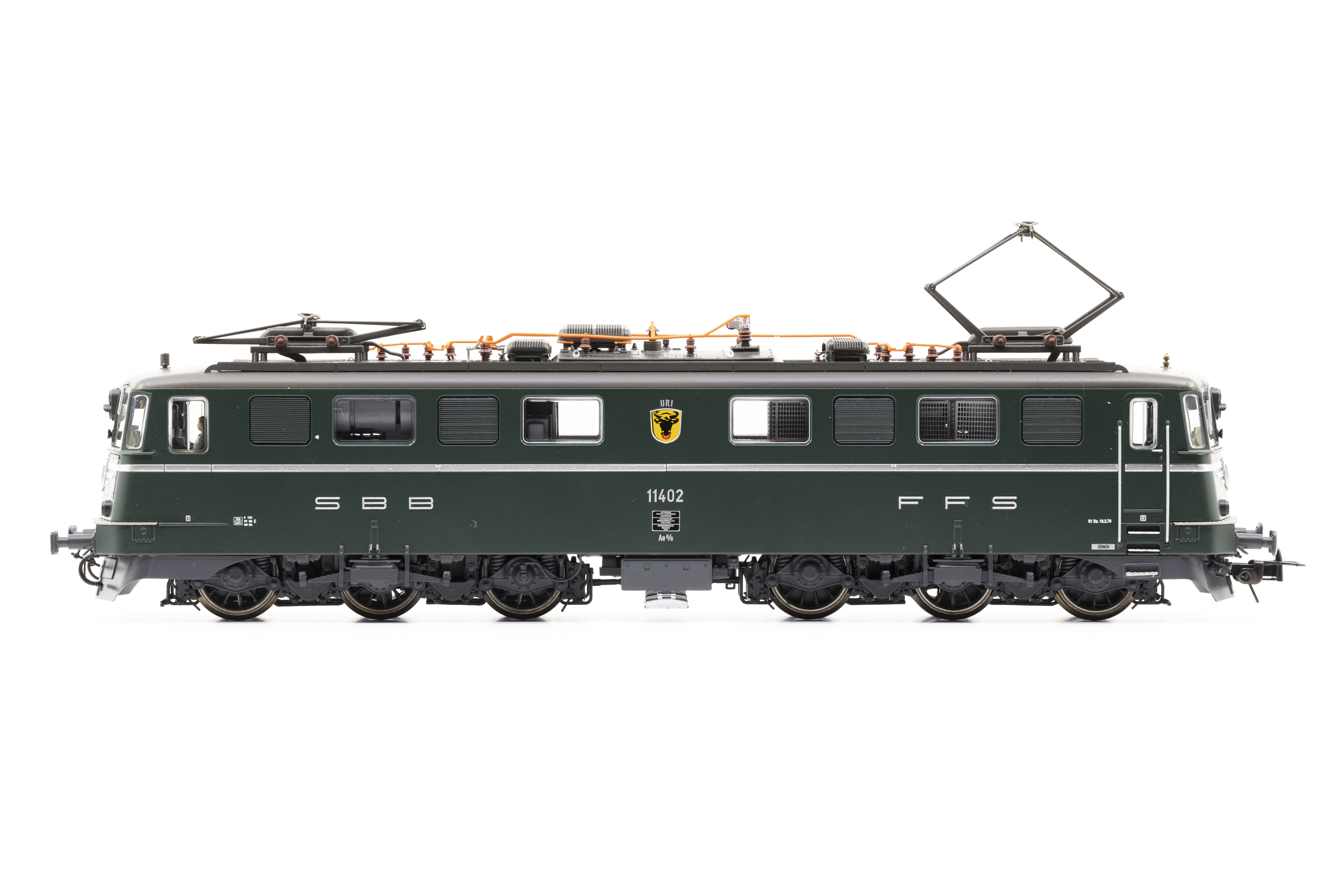
ESU, LokSound sound and the SBB Ae 6/6 in H0
LokSound sound decoders, LokPilot decoders, the ECoS command station, the Mobile Control Pro throttle and SwitchPilot accessory decoders: ESU, based in Neu-Ulm, equips your digital layout from locomotive to turnout, and builds sound-fitted H0 locomotives such as the SBB Ae 6/6.
- 245items in the shop
- Since 1999LokSound sound decoders
- 4 protocolsDCC, Motorola, Selectrix and M4
What ESU brings to your layout
- The SBB Ae 6/6 in H0: metal body structure and frame, digitally raised and lowered pantographs, original Ae 6/6 sounds on a LokSound 5 decoder and two speakers. A plug-in pickup and a switch for two-rail or three-rail running.
- LokSound 5, sound since 1999: up to 10 sound channels at once, at least 10 amplified outputs, DCC, Motorola, Selectrix and M4, and automatic registration with the command station via RailComPlus.
- LokPilot 5 for driving: the same four protocols plus analogue running, at least 10 function outputs of 250 mA, load control adjustable through up to 10 CVs.
- From control desk to turnout: ECoS command station with a 7-inch touchscreen, the wireless Mobile Control Pro throttle, also for Z21 and CS3, and SwitchPilot 3 for turnouts, colour-light signals and up to eight servos.
Our favourites to equip your layout

LokSound 5 DCC/MM/SX/M4 "blank decoder", 21MTC NEM660, with speaker 11x15mm, gauge: 0, H0 The LokSound 5 is the most important member of the LokSound family. Due to the combination of the digital decoder and the sound module on one circuit board we achieve the smallest possible dimensions of 30 mm x 15.5 mm. Therefore it fits into almost any H0 or 0 gauge locomotive. LokSound 5 decoders are available with all popular interface types and are supplied with a sugar cube speaker (11 mm x 15 mm) and a sound enclosure. The LokSound 5 DCC is made for the North American and Australian markets. It is a pure DCC Decoder, which supports RailComPlus and can also be used on DC layouts. Please note the LokSound 5 DCC decoder does not come with a speaker. Operating modes Like all products of the LokSound family the LokSound 5 is a true multi protocol decoder. It supports DCC as well as Motorola®, Selectrix® and M4. Of course it supports 14 through to 128 speed steps as well as 2 and 4 digit addresses in DCC format and up to 32 functions. Thanks to RailComPlus® the decoders register themselves fully automatically on suitable command stations. This decoder supports all DCC programming modes and thanks to RailCom® you may read out the CV values on the main, provided you have a command station supporting RailCom®. There are utility registers for command stations that only facilitate programming of CVs ranging from 1 to 255. Motorola® users benefit from up to 28 speed steps for 255 addresses. Three additional Motorola® addresses facilitate triggering of 16 functions. An integral programming mode even allows programming with the good old Central Unit 6021. The M4 protocol supports the automatic registration on mfx® compatible central units. The LokSound 5 decoder supports the Märklin® braking sections just as well as the ZIMO® HLU braking commands or the Lenz® ABC system. Braking with DCC brake generators or with DC is also possible. Furthermore the locomotive with a LokSound will come to a halt when a Selectrix® braking diode is switched into the circuit. The ABC push-pull feature enables the automatic commuting between two stations. The LokSound 5 decoder is also suitable for analogue DC and AC (!) layouts. Sound The LokSound 5 decoder can reproduce up to 10 channels simultaneously. Each channel offers up to 16 Bit / 31250 kHz and thus we have finally achieved hi-fi sound quality on your layout. For all practical purposes one cannot detect any difference to the original. A class D audio power amplifier with up to 3W output power feeds the speakers with a permitted impedance of 4 – 32 Ohms. The huge 128 MBit sound memory assures sufficient storage capacity. The volume of all individual sound fragments may be adjusted separately. The outstandingly flexible sound engine without a rigid flow chart facilitates a prototypical simulation of all conceivable rail vehicles. Three separately adjustable braking functions and two alternative load scenarios provide you with maximum control of your vehicles. Functions We are quite aware that you want your locomotives to be as realistic as possible. Therefore we have packed many function outputs into it. Subject to the type of interface every LokSound 5 has at least 10 amplified outputs. The decoders with PluX22 or 21MTC interface have an additional 4 outputs for controlling servos or as logic outputs. Of course, all important lighting functions are supported. The brightness of each output may be adjusted separately. The decoder supports the automatic push and pull movements – known as the coupler waltz - required for reliable operation of digital couplers such as the ones by ROCO® and Krois® as well as Telex® couplers. Motor control Motor control of the LokSound 5 has been further improved. A variable PWM pulse frequency ranging from 10 kHz to 50 kHz assures perfect silent operation, particularly for coreless motors. Thus the typical hum is a thing of the past. Load control can now be adjusted with up to 10 separate CVs and thus will manage even the most difficult cases. The unique “Auto Tune” function facilitates the automatic calibration of the decoder to perfectly match the motor. The LokSound 5 decoder supplies up to 1.5A motor current, which is quite sufficient even for older motor types. LokSound 5 DCC The LokSound 5 DCC is made for the North American and Australian markets. It is a pure DCC Decoder, which supports RailComPlus and can also be used on DC layouts. Betrieb unter DCC mit RailComPlus®, M4, Motorola® und Selectrix® 32 Funktionen schaltbar (abhängig von der Zentrale) 32-Bit-Prozessor Digitaler Class-„D“-Verstärker mit bis zu 3 W Leistung (LokSound 5 XL: 13 W) Jeder Kanal in 16-Bit-Auflösung und 31250 kHz Samplerate Geräuschspeicher mit 128 Mbit Kapazität Motorregelung mit 50 kHz Taktfrequenz RC-Servos und Susi-Module ansteuerbar 3 neue, individuell einstellbare Bremsregler Zweistufige Schwerlast-Simulation Updatefähig mit ESU-LokProgrammer LokSound 5 Universal-Sound-Decoder für die Spurweiten H0 und Spur 0 Motorstrom 1,5 A Je nach Schnittstelle bis zu 12 verstärkte Funktionsausgänge für Sonderfunktionen (Total: Bis zu 15 Ausgänge) 10 Soundkanäle gleichzeitig abspielbar Ab Werk mit 11x15-mm-„Zuckerwürfel“-Lautsprecher mit anpassbarem Schallkapsel-Set PowerPack-Speicherkondensator optional anschließbar Abmessungen: 30 mm x 15,5 mm, Höhe abhängig von Schnittstelle 8-pin NEM 652 PluxX22 6-pin NEM 651 21MTC 21MTC MKL Click the image for a bigger view. Instruction manual Art.No. Delivery 58420 LokSound 5 DCC "blank decoder", 8-pin NEM652, gauge: 0, H0 Only available at ESU LLC! 58429 LokSound 5 DCC "blank decoder", 21MTC NEM660, gauge: 0, H0 Only available at ESU LLC! 58410 LokSound 5 DCC/MM/SX/M4 "blank decoder", 8-pin NEM652, with Speaker 11x15mm, gauge: 0, H0 58412 LokSound 5 DCC/MM/SX/M4 "blank decoder", PluX22, with speaker 11x15mm, gauge: 0, H0 58419 LokSound 5 DCC/MM/SX/M4 "blank decoder", 21MTC NEM660, with speaker 11x15mm, gauge: 0, H0 58449 LokSound 5 DCC/MM/SX/M4 "blank decoder", 21MTC "MKL", with speaker 11x15mm, gauge: 0, H0
In stock: 3 on the shelf, shipped within 1-3 days

LokSound 5 micro DCC/MM/SX/M4 "blank decoder", single wires, with Speaker 11x15mm, gauge: N, TT, H0 The LokSound 5 micro is a “little wonder”: With only 21mmx10mm footprint, it is by far one of the smallest LokSound decoders we’ve ever built. Thus it should fit into all N gauge and TT vehicles, but is also suitable for small H0 vehicles. All LokSound decoders are equipped with a Next18 interface and are available with adapter plugs to suit all popular digital interface types. The decoder is supplied with an 11mm x 15mm sugar cube speaker as well as a sound enclosure set. The LokSound 5 micro DCC is made for the North American and Australian markets. It is a pure DCC Decoder, which supports RailComPlus and can also be used on DC layouts. Please note the LokSound 5 DCC decoder does not come with a speaker. Operating modes The LokSound 5 micro is a true multi protocol decoder. It supports DCC as well as Motorola®, Selectrix® and M4. Of course it supports 14 through to 128 speed steps as well as 2 and 4 digit addresses in DCC format and up to 32 functions. Thanks to RailComPlus® the decoders register themselves fully automatically on suitable command stations. This decoder supports all DCC programming modes and thanks to RailCom® you may read out the CV values on the main, provided you have a command station supporting RailCom®. There are utility registers for command stations that only facilitate programming of CVs ranging from 1 to 255. Motorola® users benefit from up to 28 speed steps for 255 addresses. Three additional Motorola® addresses facilitate triggering of 16 functions. An integral programming mode even allows programming with the good old Control Unit 6021. The M4 protocol supports the automatic registration on mfx® compatible central units. The LokSound decoder supports the Märklin® braking sections just as well as the ZIMO® HLU braking commands or the Lenz® ABC system. Braking with DCC brake generators or with DC is also possible. Furthermore the locomotive with a LokSound will come to a halt when a Selectrix® braking diode is switched into the circuit. The ABC push-pull feature enables the automatic commuting between two stations. The LokSound 5 micro decoder is also suitable for analogue DC and AC (!) layouts. Sound The LokSound 5 micro decoder can reproduce up to 10 channels simultaneously. Each channel offers up to 16 Bit / 31250 kHz and thus we have finally achieved hi-fi sound quality on your layout. For all practical purposes one cannot detect any difference to the original. A double class D audio power amplifier with up to 3W output power feeds the speakers with a permitted impedance of 4 – 32 Ohms. The huge 128 MBit sound memory assures sufficient storage capacity. The volume of all individual sound fragments may be adjusted separately. The outstandingly flexible sound engine without a rigid flow chart facilitates a prototypical simulation of all conceivable rail vehicles. Three separately adjustable braking functions and two alternative load scenarios provide you with maximum control of your vehicles. The volume of all individual sound fragments may be adjusted separately. The outstandingly flexible sound engine without a rigid flow chart facilitates a prototypical simulation of all conceivable rail vehicles. Three separately adjustable braking functions and two alternative load scenarios provide you with maximum control of your vehicles. Functions Despite its small dimensions the LokSound 5 micro decoder has at least 6 amplified function outputs as well as one logic output. There are two more logic outputs on the Next18 interface, which alternately may be employed to control RC servos. Of course, all important lighting functions are supported. The brightness of each output may be adjusted separately. The decoder supports the automatic push and pull movements – known as the coupler waltz - required for reliable operation of digital couplers such as the ones by ROCO® and Krois® as well as Telex® couplers. Motor control Motor control of the LokSound 5 micro has been further improved. A variable PWM pulse frequency ranging from 10 kHz to 50 kHz assures perfect silent operation, particularly for coreless motors. Thus the typical hum is a thing of the past. Load control can now be adjusted with up to 10 separate CVs and thus will manage even the most difficult cases. The unique “Auto Tune” function facilitates the automatic calibration of the decoder to perfectly match the motor. The LokSound 5 micro decoder supplies sufficient motor current (up to 0.75 A) for the intended applications. LokSound 5 micro DCC The LokSound 5 Micro DCC is made for the North American and Australian markets. It is a pure DCC Decoder, which supports RailComPlus and can also be used on DC layouts. Betrieb unter DCC mit RailComPlus®, M4, Motorola® und Selectrix® 32 Funktionen schaltbar (abhängig von der Zentrale) 32-Bit-Prozessor Digitaler Class-„D“-Verstärker mit bis zu 3 W Leistung (LokSound 5 XL: 13 W) Jeder Kanal in 16-Bit-Auflösung und 31250 kHz Samplerate Geräuschspeicher mit 128 Mbit Kapazität Motorregelung mit 50 kHz Taktfrequenz RC-Servos und Susi-Module ansteuerbar 3 neue, individuell einstellbare Bremsregler Zweistufige Schwerlast-Simulation Updatefähig mit ESU-LokProgrammer LokSound 5 micro Motorstrom 0,75 A Je nach Schnittstelle bis zu 6 verstärkte Funktionsausgänge für Sonderfunktionen (total: 9 Ausgänge) Next18-Schnittstelle serienmäßig, Adapterkabel für andere Schnittstellen liegen bei Ab Werk mit 11x15-mm-„Zuckerwürfel“-Lautsprecher mit anpassbarem Schallkapsel-Set RC-Servos und Susi-Module ansteuerbar PowerPack-Speicherkondensator optional anschließbar Abmessungen: 21 mm x 10 mm 8-pin NEM 652 PluxX16 6-pin NEM 651 Next18 Click the image for a bigger view. Instruction manual Art.No. Delivery 58820 LokSound 5 micro DCC "blank decoder", 8-pin NEM652, gauge: N, TT, H0 Only available at ESU LLC! 58823 LokSound 5 micro DCC "blank decoder", single wires, gauge: N, TT, H0 Only available at ESU LLC! 58828 LokSound 5 micro DCC "blank decoder", Next18, gauge: N, TT, H0 Only available at ESU LLC! 58810 LokSound 5 micro DCC/MM/SX/M4 "blank decoder", 8-pin NEM652, with Speaker 11x15mm, gauge: N, TT, H0 58813 LokSound 5 micro DCC/MM/SX/M4 "blank decoder", single wires, with Speaker 11x15mm, gauge: N, TT, H0 58816 LokSound 5 micro DCC/MM/SX/M4 "blank decoder", 6-pin NEM651, with Speaker 11x15mm, gauge: N, TT, H0 58818 LokSound 5 micro DCC/MM/SX/M4 "blank decoder", Next18, with Speaker 11x15mm, gauge: N, TT, H0 51993 Wire harness, 18-pin Next18 socket to open wires, 88mm, with heat shrink tube 51994 Adapter board, 18-pin Next-18 socket to NEM651 6-pin, Flex, 88mm, with heat shrink tube 51995 Adapter board, 18-pin Next-18 socket to NEM652 8-pin, Flex, 88mm, with heat shrink tube 51996 Adapter board, 18-pin Next-18 socket to Plux16
In stock: 4 on the shelf, shipped within 1-3 days

LokPilot 5 DCC/MM/SX/M4, PLUX22 NEM658, gauge H0 ,0 The LokPilot 5 is the most important representative of the LokPilot family and is suitable for almost all questions in locomotives of gauge H0 and 0. LokPilot 5 decoders are offered with all common interfaces. Modes The LokPilot 5 is a real multi-protocol decoder. He masters the data format DCC as well as Motorola®, Selectrix® and M4. In DCC format, 14 to 128 speed steps are as natural as 2 and 4-digit addresses and up to 32 functions. Thanks to RailComPlus®, the decoders log on to a suitable digital center fully automatically. It masters all DCC programming modes and, thanks to RailCom®, the CV values on the main track can be read out with suitable control centers. Auxiliary registers exist for control centers that can only program CVs from 1-255. Motorola® users benefit from up to 28 speed steps with 255 addresses. Three additional Motorola® addresses enable the activation of 16 functions. A built-in programming mode also makes reprogramming possible with the venerable Control Unit 6021. The M4 protocol enables automatic registration at mfx®-compatible control centers. All 32 possible function keys are offered here. The LokPilot 5 decoder recognizes the Märklin® braking distances as well as ZIMO® HLU / ZACK commands or the Lenz® ABC system. Braking with DCC brake modules or with DC voltage is also possible. It also stops with a Selectrix® brake diode. An ABC automatic shuttle train enables automatic commuting between two stations. The LokPilot 5 decoder can be used on analog DC and AC railways.The decoder switches between the operating modes fully automatically "on-the-fly". Usually nothing needs to be set. Features We know that you want your locomotives to be as realistic as possible. Therefore, we packed the LokPilot 5 with function outputs. Depending on the interface version, each LokPilot 5 decoder offers at least 10 amplified function outputs with 250mA output current each. In the versions with PluX22 or 21MTC interface, 4 outputs are added to control servos or logic level outputs. All important lighting functions are available. The brightness of each output can be set separately. The decoder masters the automatic pressing and detaching when uncoupling for ROCO®, Krois® and Telex® couplings. Motor control The engine control of the LokPilot 5 has been fundamentally improved again. A variably adjustable PWM clock frequency from 10kHz to 50kHz ensures super quiet operation, especially with bell-armature motors - the typical "hum" is a thing of the past. The load control can now be adapted to difficult cases with up to 10 CVs. The unique "Autotune" function enables the decoder to be automatically calibrated to the motor. With up to 1.5A motor current, the LokPilot 5 decoder provides enough juice even for older motors. Operational safety On request, a PowerPack can be connected to the LokPilot 5 to bridge dirty rail sections. Protection Of course, all function outputs and the motor output are protected against overload. We want you to enjoy your decoder for as long as possible. Possible under Selectrix® operation. Programming must be carried out in DCC mode. Programming with "pure" Selectrix® devices is not possible. Click the image for a bigger view. Betriebsarten: NMRA/DCC mit 14, 28 und 128 Fahrstufen, DCC RailCom® DCC 2-stellige und 4-stellige Adressen (kurze und lange Adressen) Digital Motorola® (alt und neu), bis zu 255 Adressen im Motorola®-Betrieb Selectrix® Fahrbetrieb M4-Betrieb (Automatische Anmeldung an mfx®-kompatiblen Zentralen) Analog Gleichspannung (abschaltbar). Analog Wechselspannung (abschaltbar) Automatische Erkennung der Betriebsart und DCC-Fahrstufeneinstellung Unterstützung der Lenz® LG100, Märklin®, Roco® Bremsstrecken und ZIMO® HLU Befehle Unterstützung für ABC Bremsmodus und ABC-Pendelzugstrecke Falschfahrbit / Speicherung der Betriebszustände Intelligenter Programmiermodus mit Märklin® 6021® Rangiergang und Anfahr- und Bremsverzögerung per Taste schaltbar Fahrtreglerteil: 2,0 A Dauerbelastbarkeit Anschluss von Gleichstrom- Glockenanker- und Wechselstrommotoren (mit Permanentmagnet) Geräuschlose, motorschonende Ansteuerung mit bis zu 50 kHz Taktfrequenz Motorausgang gegen Überlast geschützt. Lastregelung der 5. Generation (abschaltbar) Funktionsausgänge: 10 verstärkte Funktionsausgänge Version mit 21MTC-Schnittstelle zusätzlich 2 Logiklevelausgänge sowie 2 weitere Logiklevelausgänge statt SUSI Version mit PluX22-Schnittstelle 2 Logiklevelausgänge statt SUSI 250mA Belastbarkeit pro verstärktem Ausgang Summenstrom aller Funktionsausgänge ca. 500mA. Ausgänge kurzschlussfest Belegung der Funktionsausgänge frei wählbar (function mapping) Dimensionen: 21,4mm x 15,5mm x 4,5mm Instruction manual Art.No. Delivery 59610 LokPilot 5 DCC/MM/SX/M4, 8-pin NEM652, gauge H0 ,0 59612 LokPilot 5 DCC/MM/SX/M4, PLUX22 NEM658, gauge H0 ,0 59616 LokPilot 5 DCC/MM/SX/M4, 6-pin NEM651, gauge H0 ,0 59619 LokPilot 5 DCC/MM/SX/M4, 21MTC NEM660, gauge H0 ,0 59649 LokPilot 5 DCC/MM/SX/M4, 21MTC MKL, gauge H0 ,0
In stock: 3 on the shelf, shipped within 1-3 days

LokPilot 5 DCC/MM/SX/M4, 21MTC NEM660, gauge H0 ,0 The LokPilot 5 is the most important representative of the LokPilot family and is suitable for almost all questions in locomotives of gauge H0 and 0. LokPilot 5 decoders are offered with all common interfaces. Modes The LokPilot 5 is a real multi-protocol decoder. He masters the data format DCC as well as Motorola®, Selectrix® and M4. In DCC format, 14 to 128 speed steps are as natural as 2 and 4-digit addresses and up to 32 functions. Thanks to RailComPlus®, the decoders log on to a suitable digital center fully automatically. It masters all DCC programming modes and, thanks to RailCom®, the CV values on the main track can be read out with suitable control centers. Auxiliary registers exist for control centers that can only program CVs from 1-255. Motorola® users benefit from up to 28 speed steps with 255 addresses. Three additional Motorola® addresses enable the activation of 16 functions. A built-in programming mode also makes reprogramming possible with the venerable Control Unit 6021. The M4 protocol enables automatic registration at mfx®-compatible control centers. All 32 possible function keys are offered here. The LokPilot 5 decoder recognizes the Märklin® braking distances as well as ZIMO® HLU / ZACK commands or the Lenz® ABC system. Braking with DCC brake modules or with DC voltage is also possible. It also stops with a Selectrix® brake diode. An ABC automatic shuttle train enables automatic commuting between two stations. The LokPilot 5 decoder can be used on analog DC and AC railways.The decoder switches between the operating modes fully automatically "on-the-fly". Usually nothing needs to be set. Features We know that you want your locomotives to be as realistic as possible. Therefore, we packed the LokPilot 5 with function outputs. Depending on the interface version, each LokPilot 5 decoder offers at least 10 amplified function outputs with 250mA output current each. In the versions with PluX22 or 21MTC interface, 4 outputs are added to control servos or logic level outputs. All important lighting functions are available. The brightness of each output can be set separately. The decoder masters the automatic pressing and detaching when uncoupling for ROCO®, Krois® and Telex® couplings. Motor control The engine control of the LokPilot 5 has been fundamentally improved again. A variably adjustable PWM clock frequency from 10kHz to 50kHz ensures super quiet operation, especially with bell-armature motors - the typical "hum" is a thing of the past. The load control can now be adapted to difficult cases with up to 10 CVs. The unique "Autotune" function enables the decoder to be automatically calibrated to the motor. With up to 1.5A motor current, the LokPilot 5 decoder provides enough juice even for older motors. Operational safety On request, a PowerPack can be connected to the LokPilot 5 to bridge dirty rail sections. Protection Of course, all function outputs and the motor output are protected against overload. We want you to enjoy your decoder for as long as possible. Possible under Selectrix® operation. Programming must be carried out in DCC mode. Programming with "pure" Selectrix® devices is not possible. Click the image for a bigger view. Betriebsarten: NMRA/DCC mit 14, 28 und 128 Fahrstufen, DCC RailCom® DCC 2-stellige und 4-stellige Adressen (kurze und lange Adressen) Digital Motorola® (alt und neu), bis zu 255 Adressen im Motorola®-Betrieb Selectrix® Fahrbetrieb M4-Betrieb (Automatische Anmeldung an mfx®-kompatiblen Zentralen) Analog Gleichspannung (abschaltbar). Analog Wechselspannung (abschaltbar) Automatische Erkennung der Betriebsart und DCC-Fahrstufeneinstellung Unterstützung der Lenz® LG100, Märklin®, Roco® Bremsstrecken und ZIMO® HLU Befehle Unterstützung für ABC Bremsmodus und ABC-Pendelzugstrecke Falschfahrbit / Speicherung der Betriebszustände Intelligenter Programmiermodus mit Märklin® 6021® Rangiergang und Anfahr- und Bremsverzögerung per Taste schaltbar Fahrtreglerteil: 2,0 A Dauerbelastbarkeit Anschluss von Gleichstrom- Glockenanker- und Wechselstrommotoren (mit Permanentmagnet) Geräuschlose, motorschonende Ansteuerung mit bis zu 50 kHz Taktfrequenz Motorausgang gegen Überlast geschützt. Lastregelung der 5. Generation (abschaltbar) Funktionsausgänge: 10 verstärkte Funktionsausgänge Version mit 21MTC-Schnittstelle zusätzlich 2 Logiklevelausgänge sowie 2 weitere Logiklevelausgänge statt SUSI Version mit PluX22-Schnittstelle 2 Logiklevelausgänge statt SUSI 250mA Belastbarkeit pro verstärktem Ausgang Summenstrom aller Funktionsausgänge ca. 500mA. Ausgänge kurzschlussfest Belegung der Funktionsausgänge frei wählbar (function mapping) Dimensionen: 21,4mm x 15,5mm x 4,5mm Instruction manual Art.No. Delivery 59610 LokPilot 5 DCC/MM/SX/M4, 8-pin NEM652, gauge H0 ,0 59612 LokPilot 5 DCC/MM/SX/M4, PLUX22 NEM658, gauge H0 ,0 59616 LokPilot 5 DCC/MM/SX/M4, 6-pin NEM651, gauge H0 ,0 59619 LokPilot 5 DCC/MM/SX/M4, 21MTC NEM660, gauge H0 ,0 59649 LokPilot 5 DCC/MM/SX/M4, 21MTC MKL, gauge H0 ,0
In stock: 3 on the shelf, shipped within 1-3 days

SwitchPilot 3 Servo, 8x servo decoder, DCC/MM, OLED, with RC-Feedback, updatable SwitchPilot 3 servo decoders are optimized for stationary use on your system and can control up to eight RC servo drives. In order to facilitate the rather cumbersome configuration of magnetic article decoders, the SwitchPilot 3 Servo has an innovative operating concept consisting of a 4-line, illuminated OLED display and three input buttons. Modes The SwitchPilot 3 servo is multi-protocol and can be used with workstations according to the Märklin® Motorola® system (e.g. 6021, Central Station® or Mobile Station®) as well as DCC-enabled central. The configuration can take place on both the main track and the programming track. Thanks to RailCom®, CVs can also be read out. Functioning The SwitchPilot 3 servo can be supplied directly from the digital system or an external DC or AC voltage source. The SwitchPilot 3 servo has eight outputs for the control of RC servo drives. In doing so, it can control these drives so precisely that, in addition to switching switches, any other slow movement sequences can be controlled. The SwitchPilot 3 servo has a built-in power-on pulse suppression to eliminate or reduce the system-related "twitching" of RC servos when applying the supply voltage. Furthermore, the power supply to the servo can be interrupted to prevent a "hum" of some inexpensive servos. Each of the eight servos can be operated either in "digital mode" or in the "proportional mode" introduced for the first time with the SwitchPilot 3 servo: In digital mode, the servo can start two end positions "A" and "B", depending on the switching position on the control panel. The position of the two end positions as well as the speed at which thethe servo moves in the desired direction, can be individually set on the SwitchPilot 3 servo. The digital mode is perfect for switching switches or signals that should always remain in a fixed position. In proportional mode, the servo can move and stop in any position within the end positions "A" and B. The servo only runs as long as the control panel sends a command. If you release the button, the servo stops. In this way, a servo can be stopped in any desired position. The servo speed can be adjusted individually. The proportional mode is ideal for (water) cranes or engine shed gates or any other application, for which intermediate positions are also required. For each servo, in addition to the end positions and the rotational speeds, it can be determined whether it should rock up when reaching the final position. Furthermore, the generation of the servo pulse can be influenced to adapt to the different RC servos on the market or the power supply of each servo can be switched off individually. In this way, cheap so-called so-called Analog servos as well as modern digital servos (with microcontroller) optimally controlled. Analogue Operation The SwitchPilot 3 servo can be used as a special feature without a digital control panel: On request, up to 16 buttons can be connected for direct switching of the servos. Set The SwitchPilot 3 servo can be flexibly adjusted either on the programming track with DCC control panels or on the main track with POM ("Programming on Main") or can also be read out via RailCom® CVs. On request, he also learns the addresses directly via a programming button. The setting is, of course, the simplest with the integrated OLED displays as well as the three input buttons: All (!) Settings can be checked directly on the decoder and changed on request. "Programming" with the help of your headquarters is not required. It really can't be any easier. The ESU LokProgrammer can be used for firmware updates. Protection As with our locomotive decoders, the outputs of the SwitchPilot 3 servo are protected against overload. We want you to enjoy your decoder for as long as possible.
In stock: 1 on the shelf, shipped within 1-3 days

Servo Motor, precision mini-servo, micro-controlled with metal gearing, incl. mounting kit ESU proudly presents a further, newly-developed servo motor for all ambitious model railway fans. The „Precision Servo Motor - Metal“ is preferred by all model railroaders who look for a powerful servo with metal gearing. Thanks to its metal gearing the servo is able to lift nearly twice the load (1.8 kg) of its plastic gearing brother. Moreover, the „Precision Servo Motor - Metal“ is appropriate for all situations in which splicing and beating claim high mechanical requirements from the servo and where the sound development does not play such an important role. With the same measurements as the Precision Servo Motor, the metal gearing is also equipped with the new, micro-processed control electronics for a precise, sensitive heading to the required position. Therefore the impuls suppression makes sure that there won´t be any tremors on the layout when you switch it on. The 30cm cables makes easy wiring possible. Also, the „Precision Servo Motor - Metal“ comes with innovative and well-proven accessories such as a servo holder and controlling wires. Art.No. 51805 Servo Motor, precision mini-servo, micro-controlled with metal gearing, incl. mounting kit
In stock: 5 on the shelf, shipped within 1-3 days

LokSound 5 DCC/MM/SX/M4 "blank decoder", 21MTC "MKL", with speaker 11x15mm, gauge: 0, H0 The LokSound 5 is the most important member of the LokSound family. Due to the combination of the digital decoder and the sound module on one circuit board we achieve the smallest possible dimensions of 30 mm x 15.5 mm. Therefore it fits into almost any H0 or 0 gauge locomotive. LokSound 5 decoders are available with all popular interface types and are supplied with a sugar cube speaker (11 mm x 15 mm) and a sound enclosure. The LokSound 5 DCC is made for the North American and Australian markets. It is a pure DCC Decoder, which supports RailComPlus and can also be used on DC layouts. Please note the LokSound 5 DCC decoder does not come with a speaker. Operating modes Like all products of the LokSound family the LokSound 5 is a true multi protocol decoder. It supports DCC as well as Motorola®, Selectrix® and M4. Of course it supports 14 through to 128 speed steps as well as 2 and 4 digit addresses in DCC format and up to 32 functions. Thanks to RailComPlus® the decoders register themselves fully automatically on suitable command stations. This decoder supports all DCC programming modes and thanks to RailCom® you may read out the CV values on the main, provided you have a command station supporting RailCom®. There are utility registers for command stations that only facilitate programming of CVs ranging from 1 to 255. Motorola® users benefit from up to 28 speed steps for 255 addresses. Three additional Motorola® addresses facilitate triggering of 16 functions. An integral programming mode even allows programming with the good old Central Unit 6021. The M4 protocol supports the automatic registration on mfx® compatible central units. The LokSound 5 decoder supports the Märklin® braking sections just as well as the ZIMO® HLU braking commands or the Lenz® ABC system. Braking with DCC brake generators or with DC is also possible. Furthermore the locomotive with a LokSound will come to a halt when a Selectrix® braking diode is switched into the circuit. The ABC push-pull feature enables the automatic commuting between two stations. The LokSound 5 decoder is also suitable for analogue DC and AC (!) layouts. Sound The LokSound 5 decoder can reproduce up to 10 channels simultaneously. Each channel offers up to 16 Bit / 31250 kHz and thus we have finally achieved hi-fi sound quality on your layout. For all practical purposes one cannot detect any difference to the original. A class D audio power amplifier with up to 3W output power feeds the speakers with a permitted impedance of 4 – 32 Ohms. The huge 128 MBit sound memory assures sufficient storage capacity. The volume of all individual sound fragments may be adjusted separately. The outstandingly flexible sound engine without a rigid flow chart facilitates a prototypical simulation of all conceivable rail vehicles. Three separately adjustable braking functions and two alternative load scenarios provide you with maximum control of your vehicles. Functions We are quite aware that you want your locomotives to be as realistic as possible. Therefore we have packed many function outputs into it. Subject to the type of interface every LokSound 5 has at least 10 amplified outputs. The decoders with PluX22 or 21MTC interface have an additional 4 outputs for controlling servos or as logic outputs. Of course, all important lighting functions are supported. The brightness of each output may be adjusted separately. The decoder supports the automatic push and pull movements – known as the coupler waltz - required for reliable operation of digital couplers such as the ones by ROCO® and Krois® as well as Telex® couplers. Motor control Motor control of the LokSound 5 has been further improved. A variable PWM pulse frequency ranging from 10 kHz to 50 kHz assures perfect silent operation, particularly for coreless motors. Thus the typical hum is a thing of the past. Load control can now be adjusted with up to 10 separate CVs and thus will manage even the most difficult cases. The unique “Auto Tune” function facilitates the automatic calibration of the decoder to perfectly match the motor. The LokSound 5 decoder supplies up to 1.5A motor current, which is quite sufficient even for older motor types. LokSound 5 DCC The LokSound 5 DCC is made for the North American and Australian markets. It is a pure DCC Decoder, which supports RailComPlus and can also be used on DC layouts. Betrieb unter DCC mit RailComPlus®, M4, Motorola® und Selectrix® 32 Funktionen schaltbar (abhängig von der Zentrale) 32-Bit-Prozessor Digitaler Class-„D“-Verstärker mit bis zu 3 W Leistung (LokSound 5 XL: 13 W) Jeder Kanal in 16-Bit-Auflösung und 31250 kHz Samplerate Geräuschspeicher mit 128 Mbit Kapazität Motorregelung mit 50 kHz Taktfrequenz RC-Servos und Susi-Module ansteuerbar 3 neue, individuell einstellbare Bremsregler Zweistufige Schwerlast-Simulation Updatefähig mit ESU-LokProgrammer LokSound 5 Universal-Sound-Decoder für die Spurweiten H0 und Spur 0 Motorstrom 1,5 A Je nach Schnittstelle bis zu 12 verstärkte Funktionsausgänge für Sonderfunktionen (Total: Bis zu 15 Ausgänge) 10 Soundkanäle gleichzeitig abspielbar Ab Werk mit 11x15-mm-„Zuckerwürfel“-Lautsprecher mit anpassbarem Schallkapsel-Set PowerPack-Speicherkondensator optional anschließbar Abmessungen: 30 mm x 15,5 mm, Höhe abhängig von Schnittstelle 8-pin NEM 652 PluxX22 6-pin NEM 651 21MTC 21MTC MKL Click the image for a bigger view. Instruction manual Art.No. Delivery 58420 LokSound 5 DCC "blank decoder", 8-pin NEM652, gauge: 0, H0 Only available at ESU LLC! 58429 LokSound 5 DCC "blank decoder", 21MTC NEM660, gauge: 0, H0 Only available at ESU LLC! 58410 LokSound 5 DCC/MM/SX/M4 "blank decoder", 8-pin NEM652, with Speaker 11x15mm, gauge: 0, H0 58412 LokSound 5 DCC/MM/SX/M4 "blank decoder", PluX22, with speaker 11x15mm, gauge: 0, H0 58419 LokSound 5 DCC/MM/SX/M4 "blank decoder", 21MTC NEM660, with speaker 11x15mm, gauge: 0, H0 58449 LokSound 5 DCC/MM/SX/M4 "blank decoder", 21MTC "MKL", with speaker 11x15mm, gauge: 0, H0
In stock: 2 on the shelf, shipped within 1-3 days

Interiour lighting set with decoder, Entry+Red marker light, 264mm, divisible, PowerPack Option, 13 LED, warm white With the digital LED interior lights from ESU, you can retrofit your N, TT or H0 gauge passenger cars with prototypical, uniform lighting. Two versions are available to suit the desired location. The digital interior lights are 264mm long, 9mm slim and each fitted with 13 (!) LEDs. In addition to a version with warm white LEDs (50718), there is also a board with yellow LEDs (50719) so that the light color always matches your existing wagons. Features The digital interior lighting consists of a 74 mm long base section, on which a digital decoder and four LEDs are mounted, and eight adjoining sections, each equipped with one LED spaced 24mm apart. The additional sections can be cut off to customize the length to suit the wagon. Furthermore, two additional 4.5mm wide, detachable LED sections are provided on the far left and right sides to illuminate the entry area. The brightness of the LEDs can be set either using a potentiometer or via software CV and remains constant regardless of the track voltage thanks to the built-in constant voltage supply. A built-in buffer capacitor bridges small current interruptions ex works. To completely prevent flickering even with poor power pickup, a special, very compact PowerPack supercapacitor (ESU item no. 50710) can be connected directly upon request. This can power the LEDs for a few seconds. The digital interior lighting comes with a soldered red tail light. Operating modes The decoder, based on the LokPilot 5 Basic and adapted to the intended use, supports the DCC and Märklin® Motorola® protocols. It can handle 2- and 4-digit addresses and can trigger functions up to F31. Thanks to RailComPlus®, the decoders register fully automatically with a suitable DCC command station. It supports all DCC programming modes, and thanks to RailCom®, the CV values can be read on the main track with suitable command stations. Auxiliary registers are available for command stations that can only program CVs 1-255. Alternatively, the decoder can be read on the programming track without an additional load resistor. The digital interior lighting can also be used on analog AC and DC systems. In both operating modes, the direction of travel is correctly detected and the tail light is switched accordingly. Functions The 13 built-in LEDs can be individually controlled in a total of seven groups: The two entrance LEDs can each be switched separately. The tail light can also be switched separately depending on the direction of travel. Furthermore, there is an amplified output and two outputs for connecting additional LEDs (e.g., for headlights on Pilot cars or toilet lighting), which can be wired individually. Various prototypical lighting effects such as soft dimming, neon tube effects, defective neon tubes, battery lighting, and much more ensure a realistic result. The ESU V5 Function Mapping allows the individual assignment of all LED groups to the desired function keys. Robust You can rely on the experience and quality of a renowned brand manufacturer, even when it comes to digital interior lighting.
In stock: 2 on the shelf, shipped within 1-3 days
The ESU families
For your H0 layout (1:87)
 5 itemsSBB locomotivesThe Ae 6/6 'Uri', 'Ticino', 'Glarus' and 'Lausanne', plus an SBB Cargo.See the items
 23 itemsLocomotives H0DB electric and diesel locomotives, Class 66 and KG230 shunters.See the items
 25 itemsCoaches and wagons H0DB n-coaches and Sgmmns container wagons.See the items
To control your layout and give it sound
25 itemsLokSound sound decodersLokSound 5, from micro and Nano up to L and XL.See the items40 itemsLokPilot decodersLokPilot 5 for driving, plus the Fx function decoders.See the items 13 itemsECoS and Mobile ControlECoS command station and modules, Mobile Control Pro throttle, CabControl.See the items13 itemsSwitchPilot and servosTurnout and signal decoders, servo motors and extensions.See the items
 31 itemsSpeakersRound and rectangular speakers for sound decoders.See the items
All ESU items

Diesel loco, H0, G1000, DH 49 HGK, traffic red, Era VI, Sound, DC/AC At the beginning of the 2000s, the Austrian Federal Railways ÖBB ordered 90 Class 2070 shunting locomotives from the Kiel MaK mechanical engineering department. Caterpillar's 12-cylinder diesel engine produces 738 kW at 2100 rpm. The top speed is 100 km/h. These locomotives, which maK refers to as type G 800 BB, are the basis of the manufacturer's 4th type program. The locomotive construction in Kiel was taken over by Vossloh and further developed. As a more powerful version of the G800, the G1000, equipped with an MTU eight-cylinder diesel engine, was launched on the same chassis. The 1100 kW (at 1860 rpm) and 100 km/h fast locomotive can be ordered for axle loads from 18 to 20 t and with country packages for right and left traffic. Between 2002 and 2016, Vossloh delivered 103 copies to railways in Germany, France, Italy, Luxembourg and Switzerland. Deutsche Bahn was also interested in the four-axle and rented locomotives from various landlords for several years. The locomotives reliably provided freight services in almost all federal states. The locomotives are used in heavy shunting service, but also in front of local freight trains. Some G1000 belong to locomotive rental companies such as Northrail in Germany or Ferrotract in France and are employed within the respective national borders, for example, in all sectors of medium-heavy local freight transport, but also in the factory traffic of large industrial enterprises or in sea and inland ports. Various owners such as Spitzke Logistik (D) or Colas Rail (F) use the reliable four-axle axles in construction train traffic. Even after delivery of the Voith Gravita, DB occasionally uses borrowed G1000 in the event of vehicle bottlenecks. Art.No. Delivery 31300 Diesel loco, H0, G1000, 500 1578 MRCE, black, Era VI, Sound, DC/AC in stock 31302 Diesel loco, H0, G1000, DH 49 HGK, traffic red, Era VI, Sound, DC/AC in stock 31303 Diesel loco, H0, G1000, 1271 026-7 Northrail, orange, Era VI, Sound, DC/AC in stock 31304 Diesel loco, H0, G1000, FB 1487 ECR, light grey, Era VI, Sound, DC/AC in stock
- 2-rail, direct current
- 3-rail, alternating current
- Sound
On order, lead time to be confirmed

Diesel loco, H0, G1000, 1271 026-7 Northrail, orange, Era VI, Sound, DC/AC At the beginning of the 2000s, the Austrian Federal Railways ÖBB ordered 90 Class 2070 shunting locomotives from the Kiel MaK mechanical engineering department. Caterpillar's 12-cylinder diesel engine produces 738 kW at 2100 rpm. The top speed is 100 km/h. These locomotives, which maK refers to as type G 800 BB, are the basis of the manufacturer's 4th type program. The locomotive construction in Kiel was taken over by Vossloh and further developed. As a more powerful version of the G800, the G1000, equipped with an MTU eight-cylinder diesel engine, was launched on the same chassis. The 1100 kW (at 1860 rpm) and 100 km/h fast locomotive can be ordered for axle loads from 18 to 20 t and with country packages for right and left traffic. Between 2002 and 2016, Vossloh delivered 103 copies to railways in Germany, France, Italy, Luxembourg and Switzerland. Deutsche Bahn was also interested in the four-axle and rented locomotives from various landlords for several years. The locomotives reliably provided freight services in almost all federal states. The locomotives are used in heavy shunting service, but also in front of local freight trains. Some G1000 belong to locomotive rental companies such as Northrail in Germany or Ferrotract in France and are employed within the respective national borders, for example, in all sectors of medium-heavy local freight transport, but also in the factory traffic of large industrial enterprises or in sea and inland ports. Various owners such as Spitzke Logistik (D) or Colas Rail (F) use the reliable four-axle axles in construction train traffic. Even after delivery of the Voith Gravita, DB occasionally uses borrowed G1000 in the event of vehicle bottlenecks. Art.No. Delivery 31300 Diesel loco, H0, G1000, 500 1578 MRCE, black, Era VI, Sound, DC/AC in stock 31302 Diesel loco, H0, G1000, DH 49 HGK, traffic red, Era VI, Sound, DC/AC in stock 31303 Diesel loco, H0, G1000, 1271 026-7 Northrail, orange, Era VI, Sound, DC/AC in stock 31304 Diesel loco, H0, G1000, FB 1487 ECR, light grey, Era VI, Sound, DC/AC in stock
- 2-rail, direct current
- 3-rail, alternating current
- Sound
On order, lead time to be confirmed

Diesel loco, H0, G1000, FB 1487 ECR, light grey, Era VI, Sound, DC/AC At the beginning of the 2000s, the Austrian Federal Railways ÖBB ordered 90 Class 2070 shunting locomotives from the Kiel MaK mechanical engineering department. Caterpillar's 12-cylinder diesel engine produces 738 kW at 2100 rpm. The top speed is 100 km/h. These locomotives, which maK refers to as type G 800 BB, are the basis of the manufacturer's 4th type program. The locomotive construction in Kiel was taken over by Vossloh and further developed. As a more powerful version of the G800, the G1000, equipped with an MTU eight-cylinder diesel engine, was launched on the same chassis. The 1100 kW (at 1860 rpm) and 100 km/h fast locomotive can be ordered for axle loads from 18 to 20 t and with country packages for right and left traffic. Between 2002 and 2016, Vossloh delivered 103 copies to railways in Germany, France, Italy, Luxembourg and Switzerland. Deutsche Bahn was also interested in the four-axle and rented locomotives from various landlords for several years. The locomotives reliably provided freight services in almost all federal states. The locomotives are used in heavy shunting service, but also in front of local freight trains. Some G1000 belong to locomotive rental companies such as Northrail in Germany or Ferrotract in France and are employed within the respective national borders, for example, in all sectors of medium-heavy local freight transport, but also in the factory traffic of large industrial enterprises or in sea and inland ports. Various owners such as Spitzke Logistik (D) or Colas Rail (F) use the reliable four-axle axles in construction train traffic. Even after delivery of the Voith Gravita, DB occasionally uses borrowed G1000 in the event of vehicle bottlenecks. Art.No. Delivery 31300 Diesel loco, H0, G1000, 500 1578 MRCE, black, Era VI, Sound, DC/AC in stock 31302 Diesel loco, H0, G1000, DH 49 HGK, traffic red, Era VI, Sound, DC/AC in stock 31303 Diesel loco, H0, G1000, 1271 026-7 Northrail, orange, Era VI, Sound, DC/AC in stock 31304 Diesel loco, H0, G1000, FB 1487 ECR, light grey, Era VI, Sound, DC/AC in stock
- 2-rail, direct current
- 3-rail, alternating current
- Sound
On order, lead time to be confirmed

Diesel loco, H0, C77, 266 442 MEG, Era VI, around 2020, traffic red, Sound+Smoke, DC/AC From 2001, the American Electro-Motive Division (EMD) offered the continental European railway companies (EVU) comparatively inexpensive long-distance diesel locomotives for heavy freight trains with the Class 66, which had already been tested in Great Britain. The six-axle vehicles known as the JT 42 CWR are based on the simply designed and very reliable American SD40-2. In 1999, Häfen und Güterverkehr Köln AG HGK was the first railway company to use two of the diesel-electric Class 66s. Since 2006, the modified JT 42 CWR M has been a second series of the Class 66, which is often referred to as the Class 77. The most striking difference to the first series is the single door to the engine room built into the left side of the locomotive. Class 66/77 can also be found today in France, Belgium, the Netherlands, Luxembourg, Denmark, Norway and England. A total of around 650 locomotives were delivered to European customers. The elongated silhouette, adapted to the small English clearance gauge, the angular body and the chassis with the massive bogies and the wild wiring make the Class 66 unmistakable. The GM twelve-cylinder two-stroke engine 12N-710G3B-EC develops an output of 3194 HP (2350kW). The starting traction is 409 kN, the continuous traction is 260 kN. With a maximum speed of 120 km/h, the Class 66 can keep up with other trains even on main routes. Despite the high level of noise in the driver's cab, the locomotives have earned a good reputation among train drivers when it comes to moving heavy trains on slippery rails. Numerous locomotives from other European private railways or lessees are also on the road in Germany. In order to save on the shunting locomotive, the locomotives are usually pre-hauled from the sender's siding to the train's destination, whereby it is accepted that the locomotives also travel under the contact wire. Aufbau, Rahmen und Getriebekästen aus Metall Durchbrochene Lüfter im Dachbereich Mehrfarbiger Führerstand mit Lokführerfigur Mehrteilige Drehgestell-Blenden Separat angesetzte Griffstangen und Trittstufen Kupplung in kulissengeführtem NEM-Schacht Fünfpoliger ESU-Motor mit zwei Schwungmassen Antrieb über Kardan-/Schnecken-Getriebe auf vier Achsen, vier Haftreifen LokSound-Decoder für DCC, Motorola®, M4 und Selectrix-Betrieb Selbständige Anmeldung an Zentralen mit RailComPlus®- oder mfx®-Funktionalität PowerPack-Speicherkondensator für unterbrechungsfreie Spannungsversorgung Doppellautsprecher mit großer Schallkapsel für höchsten Soundgenuss Lastabhängiger Raucherzeuger, synchron zum LokSound Digitalisierte Originalgeräusche Sensorgesteuerte Geräusche bei langsamer Kurvenfahrt Fahrtrichtungsabhängiger Lichtwechsel, länderspezifische Lichtfunktionen, zugseitiges Spitzensignal abschaltbar, Führerstand- und Führerpultbeleuchtung schaltbar Bremsfunken beim scharfen Bremsen Pipette zum Befüllen des Raucherzeugers, Pufferträger-Zurüstteile sowie eine zweite Kupplung liegen bei Befahrbarer Mindestradius = 360 mm Länge über Puffer = 247 mm Art.No. Delivery 31277 Diesel loco, H0, C66, Cargo Net 66402, Era VI, around 2008, dark grey, Sound+Smoke, DC+AC in stock 31283 Diesel loco, H0, C66 Lineas 513-10, Era VI, around 2018, dark blue/turquoise, Sound+Smoke, DC/AC in stock 31284 Diesel loco, H0, C66 Hectorrail, T66 713, Era VI, around 2018, grey/orange, Sound+Smoke, DC/AC in stock 31289 Diesel loco, H0, C77, 66587 ONE, Era VI, around 2020, pink, Sound+Smoke, DC/AC in stock 31360 Diesel loco, H0, C77, 266 442 MEG, Era VI, around 2020, traffic red, Sound+Smoke, DC/AC in stock 31362 Diesel loco, H0, C66, DE 672 HGK, Era VI, around 2014, traffic red, Sound+Smoke, DC/AC in stock 31363 Diesel loco, H0, C66, DE 6301 Crossrail, Era VI, around 2014, traffic red, Sound+Smoke, DC/AC in stock 31364 Diesel loco, H0, C66, 6602 Rail4Chem, Era VI, around 2014, grey/yellow, Sound+Smoke, DC/AC in stock 51990 Suitable smoke liquid, specially for ESU smoke generators, 125 ml bottle available
- 2-rail, direct current
- 3-rail, alternating current
- Sound
On order, lead time to be confirmed

Diesel loco, H0, C66, DE 672 HGK, Era VI, around 2014, traffic red, Sound+Smoke, DC/AC From 2001, the American Electro-Motive Division (EMD) offered the continental European railway companies (EVU) comparatively inexpensive long-distance diesel locomotives for heavy freight trains with the Class 66, which had already been tested in Great Britain. The six-axle vehicles known as the JT 42 CWR are based on the simply designed and very reliable American SD40-2. In 1999, Häfen und Güterverkehr Köln AG HGK was the first railway company to use two of the diesel-electric Class 66s. Since 2006, the modified JT 42 CWR M has been a second series of the Class 66, which is often referred to as the Class 77. The most striking difference to the first series is the single door to the engine room built into the left side of the locomotive. Class 66/77 can also be found today in France, Belgium, the Netherlands, Luxembourg, Denmark, Norway and England. A total of around 650 locomotives were delivered to European customers. The elongated silhouette, adapted to the small English clearance gauge, the angular body and the chassis with the massive bogies and the wild wiring make the Class 66 unmistakable. The GM twelve-cylinder two-stroke engine 12N-710G3B-EC develops an output of 3194 HP (2350kW). The starting traction is 409 kN, the continuous traction is 260 kN. With a maximum speed of 120 km/h, the Class 66 can keep up with other trains even on main routes. Despite the high level of noise in the driver's cab, the locomotives have earned a good reputation among train drivers when it comes to moving heavy trains on slippery rails. Numerous locomotives from other European private railways or lessees are also on the road in Germany. In order to save on the shunting locomotive, the locomotives are usually pre-hauled from the sender's siding to the train's destination, whereby it is accepted that the locomotives also travel under the contact wire. Aufbau, Rahmen und Getriebekästen aus Metall Durchbrochene Lüfter im Dachbereich Mehrfarbiger Führerstand mit Lokführerfigur Mehrteilige Drehgestell-Blenden Separat angesetzte Griffstangen und Trittstufen Kupplung in kulissengeführtem NEM-Schacht Fünfpoliger ESU-Motor mit zwei Schwungmassen Antrieb über Kardan-/Schnecken-Getriebe auf vier Achsen, vier Haftreifen LokSound-Decoder für DCC, Motorola®, M4 und Selectrix-Betrieb Selbständige Anmeldung an Zentralen mit RailComPlus®- oder mfx®-Funktionalität PowerPack-Speicherkondensator für unterbrechungsfreie Spannungsversorgung Doppellautsprecher mit großer Schallkapsel für höchsten Soundgenuss Lastabhängiger Raucherzeuger, synchron zum LokSound Digitalisierte Originalgeräusche Sensorgesteuerte Geräusche bei langsamer Kurvenfahrt Fahrtrichtungsabhängiger Lichtwechsel, länderspezifische Lichtfunktionen, zugseitiges Spitzensignal abschaltbar, Führerstand- und Führerpultbeleuchtung schaltbar Bremsfunken beim scharfen Bremsen Pipette zum Befüllen des Raucherzeugers, Pufferträger-Zurüstteile sowie eine zweite Kupplung liegen bei Befahrbarer Mindestradius = 360 mm Länge über Puffer = 247 mm Art.No. Delivery 31277 Diesel loco, H0, C66, Cargo Net 66402, Era VI, around 2008, dark grey, Sound+Smoke, DC+AC in stock 31283 Diesel loco, H0, C66 Lineas 513-10, Era VI, around 2018, dark blue/turquoise, Sound+Smoke, DC/AC in stock 31284 Diesel loco, H0, C66 Hectorrail, T66 713, Era VI, around 2018, grey/orange, Sound+Smoke, DC/AC in stock 31289 Diesel loco, H0, C77, 66587 ONE, Era VI, around 2020, pink, Sound+Smoke, DC/AC in stock 31360 Diesel loco, H0, C77, 266 442 MEG, Era VI, around 2020, traffic red, Sound+Smoke, DC/AC in stock 31362 Diesel loco, H0, C66, DE 672 HGK, Era VI, around 2014, traffic red, Sound+Smoke, DC/AC in stock 31363 Diesel loco, H0, C66, DE 6301 Crossrail, Era VI, around 2014, traffic red, Sound+Smoke, DC/AC in stock 31364 Diesel loco, H0, C66, 6602 Rail4Chem, Era VI, around 2014, grey/yellow, Sound+Smoke, DC/AC in stock 51990 Suitable smoke liquid, specially for ESU smoke generators, 125 ml bottle available
- 2-rail, direct current
- 3-rail, alternating current
- Sound
On order, lead time to be confirmed

Diesel loco, H0, C66, DE 6301 Crossrail, Era VI, around 2014, traffic red, Sound+Smoke, DC/AC From 2001, the American Electro-Motive Division (EMD) offered the continental European railway companies (EVU) comparatively inexpensive long-distance diesel locomotives for heavy freight trains with the Class 66, which had already been tested in Great Britain. The six-axle vehicles known as the JT 42 CWR are based on the simply designed and very reliable American SD40-2. In 1999, Häfen und Güterverkehr Köln AG HGK was the first railway company to use two of the diesel-electric Class 66s. Since 2006, the modified JT 42 CWR M has been a second series of the Class 66, which is often referred to as the Class 77. The most striking difference to the first series is the single door to the engine room built into the left side of the locomotive. Class 66/77 can also be found today in France, Belgium, the Netherlands, Luxembourg, Denmark, Norway and England. A total of around 650 locomotives were delivered to European customers. The elongated silhouette, adapted to the small English clearance gauge, the angular body and the chassis with the massive bogies and the wild wiring make the Class 66 unmistakable. The GM twelve-cylinder two-stroke engine 12N-710G3B-EC develops an output of 3194 HP (2350kW). The starting traction is 409 kN, the continuous traction is 260 kN. With a maximum speed of 120 km/h, the Class 66 can keep up with other trains even on main routes. Despite the high level of noise in the driver's cab, the locomotives have earned a good reputation among train drivers when it comes to moving heavy trains on slippery rails. Numerous locomotives from other European private railways or lessees are also on the road in Germany. In order to save on the shunting locomotive, the locomotives are usually pre-hauled from the sender's siding to the train's destination, whereby it is accepted that the locomotives also travel under the contact wire. Aufbau, Rahmen und Getriebekästen aus Metall Durchbrochene Lüfter im Dachbereich Mehrfarbiger Führerstand mit Lokführerfigur Mehrteilige Drehgestell-Blenden Separat angesetzte Griffstangen und Trittstufen Kupplung in kulissengeführtem NEM-Schacht Fünfpoliger ESU-Motor mit zwei Schwungmassen Antrieb über Kardan-/Schnecken-Getriebe auf vier Achsen, vier Haftreifen LokSound-Decoder für DCC, Motorola®, M4 und Selectrix-Betrieb Selbständige Anmeldung an Zentralen mit RailComPlus®- oder mfx®-Funktionalität PowerPack-Speicherkondensator für unterbrechungsfreie Spannungsversorgung Doppellautsprecher mit großer Schallkapsel für höchsten Soundgenuss Lastabhängiger Raucherzeuger, synchron zum LokSound Digitalisierte Originalgeräusche Sensorgesteuerte Geräusche bei langsamer Kurvenfahrt Fahrtrichtungsabhängiger Lichtwechsel, länderspezifische Lichtfunktionen, zugseitiges Spitzensignal abschaltbar, Führerstand- und Führerpultbeleuchtung schaltbar Bremsfunken beim scharfen Bremsen Pipette zum Befüllen des Raucherzeugers, Pufferträger-Zurüstteile sowie eine zweite Kupplung liegen bei Befahrbarer Mindestradius = 360 mm Länge über Puffer = 247 mm Art.No. Delivery 31277 Diesel loco, H0, C66, Cargo Net 66402, Era VI, around 2008, dark grey, Sound+Smoke, DC+AC in stock 31283 Diesel loco, H0, C66 Lineas 513-10, Era VI, around 2018, dark blue/turquoise, Sound+Smoke, DC/AC in stock 31284 Diesel loco, H0, C66 Hectorrail, T66 713, Era VI, around 2018, grey/orange, Sound+Smoke, DC/AC in stock 31289 Diesel loco, H0, C77, 66587 ONE, Era VI, around 2020, pink, Sound+Smoke, DC/AC in stock 31360 Diesel loco, H0, C77, 266 442 MEG, Era VI, around 2020, traffic red, Sound+Smoke, DC/AC in stock 31362 Diesel loco, H0, C66, DE 672 HGK, Era VI, around 2014, traffic red, Sound+Smoke, DC/AC in stock 31363 Diesel loco, H0, C66, DE 6301 Crossrail, Era VI, around 2014, traffic red, Sound+Smoke, DC/AC in stock 31364 Diesel loco, H0, C66, 6602 Rail4Chem, Era VI, around 2014, grey/yellow, Sound+Smoke, DC/AC in stock 51990 Suitable smoke liquid, specially for ESU smoke generators, 125 ml bottle available
- 2-rail, direct current
- 3-rail, alternating current
- Sound
On order, lead time to be confirmed

Diesel loco, H0, C66, 6602 Rail4Chem, Era VI, around 2014, grey/yellow, Sound+Smoke, DC/AC From 2001, the American Electro-Motive Division (EMD) offered the continental European railway companies (EVU) comparatively inexpensive long-distance diesel locomotives for heavy freight trains with the Class 66, which had already been tested in Great Britain. The six-axle vehicles known as the JT 42 CWR are based on the simply designed and very reliable American SD40-2. In 1999, Häfen und Güterverkehr Köln AG HGK was the first railway company to use two of the diesel-electric Class 66s. Since 2006, the modified JT 42 CWR M has been a second series of the Class 66, which is often referred to as the Class 77. The most striking difference to the first series is the single door to the engine room built into the left side of the locomotive. Class 66/77 can also be found today in France, Belgium, the Netherlands, Luxembourg, Denmark, Norway and England. A total of around 650 locomotives were delivered to European customers. The elongated silhouette, adapted to the small English clearance gauge, the angular body and the chassis with the massive bogies and the wild wiring make the Class 66 unmistakable. The GM twelve-cylinder two-stroke engine 12N-710G3B-EC develops an output of 3194 HP (2350kW). The starting traction is 409 kN, the continuous traction is 260 kN. With a maximum speed of 120 km/h, the Class 66 can keep up with other trains even on main routes. Despite the high level of noise in the driver's cab, the locomotives have earned a good reputation among train drivers when it comes to moving heavy trains on slippery rails. Numerous locomotives from other European private railways or lessees are also on the road in Germany. In order to save on the shunting locomotive, the locomotives are usually pre-hauled from the sender's siding to the train's destination, whereby it is accepted that the locomotives also travel under the contact wire. Aufbau, Rahmen und Getriebekästen aus Metall Durchbrochene Lüfter im Dachbereich Mehrfarbiger Führerstand mit Lokführerfigur Mehrteilige Drehgestell-Blenden Separat angesetzte Griffstangen und Trittstufen Kupplung in kulissengeführtem NEM-Schacht Fünfpoliger ESU-Motor mit zwei Schwungmassen Antrieb über Kardan-/Schnecken-Getriebe auf vier Achsen, vier Haftreifen LokSound-Decoder für DCC, Motorola®, M4 und Selectrix-Betrieb Selbständige Anmeldung an Zentralen mit RailComPlus®- oder mfx®-Funktionalität PowerPack-Speicherkondensator für unterbrechungsfreie Spannungsversorgung Doppellautsprecher mit großer Schallkapsel für höchsten Soundgenuss Lastabhängiger Raucherzeuger, synchron zum LokSound Digitalisierte Originalgeräusche Sensorgesteuerte Geräusche bei langsamer Kurvenfahrt Fahrtrichtungsabhängiger Lichtwechsel, länderspezifische Lichtfunktionen, zugseitiges Spitzensignal abschaltbar, Führerstand- und Führerpultbeleuchtung schaltbar Bremsfunken beim scharfen Bremsen Pipette zum Befüllen des Raucherzeugers, Pufferträger-Zurüstteile sowie eine zweite Kupplung liegen bei Befahrbarer Mindestradius = 360 mm Länge über Puffer = 247 mm Art.No. Delivery 31277 Diesel loco, H0, C66, Cargo Net 66402, Era VI, around 2008, dark grey, Sound+Smoke, DC+AC in stock 31283 Diesel loco, H0, C66 Lineas 513-10, Era VI, around 2018, dark blue/turquoise, Sound+Smoke, DC/AC in stock 31284 Diesel loco, H0, C66 Hectorrail, T66 713, Era VI, around 2018, grey/orange, Sound+Smoke, DC/AC in stock 31289 Diesel loco, H0, C77, 66587 ONE, Era VI, around 2020, pink, Sound+Smoke, DC/AC in stock 31360 Diesel loco, H0, C77, 266 442 MEG, Era VI, around 2020, traffic red, Sound+Smoke, DC/AC in stock 31362 Diesel loco, H0, C66, DE 672 HGK, Era VI, around 2014, traffic red, Sound+Smoke, DC/AC in stock 31363 Diesel loco, H0, C66, DE 6301 Crossrail, Era VI, around 2014, traffic red, Sound+Smoke, DC/AC in stock 31364 Diesel loco, H0, C66, 6602 Rail4Chem, Era VI, around 2014, grey/yellow, Sound+Smoke, DC/AC in stock 51990 Suitable smoke liquid, specially for ESU smoke generators, 125 ml bottle available
- 2-rail, direct current
- 3-rail, alternating current
- Sound
On order, lead time to be confirmed

Diesel loco, Post Lok 5, red, Ep. IV, prototype around 1987, Sound+Smoke, el. Coupler, DC/AC Starting in 1956 the DB (Deutsche Bundesbahn) commenced the procurement of the three-axle shunting locomotive class V60 in order to modernize shunting operations. It was decided to employ a drive system with coupling rods and a jack shaft. Its maximum speed of 60 km/h in mainline gear matched the then common speed of long distance freight trains. The coal-fired oven (so called Dofa heater) only served for keeping the engine of a parked V60 at a suitable temperature. As from the 1990-ies the DB replaced these heaters with externally powered electric heaters. The DB actually differentiated the serial locomotives between light weight and heavy types. Externally one could not detect any difference. The heavy type with 54 t is constructed with a stronger frame compared to the lighter version with 48 t. With the advent of the computer suitable numbering system in 1968, the DB assigned the lighter version as class 260 and the heavy type as class 261. In 1987 the engine was reclassified as a minor locomotive (Kleinlokomotive - literally: small locomotive or locomotors). Class 260 became class 360 and the 261s became 361s. Its categorisation as a Kleinlok saved staff costs, because the railway no longer had to employ "engine drivers", but only "Kleinlok operators", i.e.: specially trained shunting personnel. The locomotives equipped with automatic coupler (AK) and radio control were reclassified as class 364 (light weight version) and class 365 (heavy type). Class 362 and 363 were only designated in 1992 and denominate locomotives equipped with the Caterpillar engine 3412 DI-TA, which was installed instead of the original Maybach GTO 6 / GTO 6A. The ESU model of the DB class V60 is completely new! Chassis, body, motor, gearbox, centre pick-up including its holding fixture, smoke generator, lighting, digital coupler, speaker as well as all details have been developed from scratch. The headlight inserts have vertical engravings in order to match the appearance of DB standard lanterns. The conversion from AC (as delivered) to DC mode is accomplished by pulling off the centre pick-up and by activating a small sliding switch right in front of the forward axle. The digitally remote controlled electromagnetic coupler (shunting coupler) is inserted into the standard coupler shaft as per NEM 362. The mounting height of the coupler can be adjusted in two steps. If necessary it can be removed and replaced by another (non-digital) coupler without soldering. The newly designed smoke generator supplies a larger amount of exhaust fumes. Of course, the LokSound 5 decoder is completely new. Smooth running characteristics and a number of useful functions and potential settings offer plenty of options for the operation oriented model train enthusiast. There is a function “heavy train” where acceleration and deceleration time are doubled and the motor acoustically works with higher revs. When activating the “locomotive brake”, the locomotive changes to idle and slows down a bit faster than normal – if required, right down to a standstill. This function works independently from the throttle setting. In shunting mode, the locomotive accelerates and slows down faster than in normal mode. Model LokSound decoder for DCC with RailComPlus®, Motorola®, M4 and Selectrix Automatic registration at command stations with RailComPlus® or mfx® functionality Universal electronics with plug-in centre pick-up Newly developed, aerodynamically optimised, load dependent smoke generator synchronised with LokSound Two sugar cube speakers with large sound enclosure under the hood 31 special functions PowerPack storage capacitor for uninterrupted power supply Powerful coreless motor with flywheel Digital remote control for coupler in NEM shaft Prototypical headlights Separately switchable shunting lighting Cab lighting and control panel lighting may be separately switched Switchable under-carriage lighting Engraved fibre-optic light guide Metal chassis and body Perforated fan grills in long hood Robust yet filigree grab irons off metal and plastic Multicoloured cab interior with engineer figure Length over buffers = 121 mm Detail Videos Ihr Browser kann dieses Video nicht wiedergeben. Art.No. Delivery 31423 Diesel loco, Post Lok 5, red, Ep. IV, prototype around 1987, Sound+Smoke, el. Coupler, DC/AC in stock 31741 Diesel loco, 260 610 DB, blue-cream, Era IV, prototype around 1980, Sound+Smoke, el. Coupler, DC/AC (replaces Art.-No: 31411) in stock 31742 Diesel loco, 362 614 DB, traffic red, Era VI, prototype around 2014, Sound+Smoke, el. Coupler, DC/AC in stock 31743 Diesel loco, V60 114 DB/DFS, oldred, Era VI, prototype around 2020, Sound+Smoke, el. Coupler, DC/AC in stock 31744 Diesel loco, 261 652 DB, oldred, Era IV, prototype around 1975, Sound+Smoke, el. Coupler, DC/AC in stock
On order, lead time to be confirmed

Dieselengine, H0, KG230, ThyssenKrupp, blue, Era V, prototype around 2004, LokSound, Smoke unit, Automatic coupler, DC/AC Starting in 1962, German manufacturer Deutz offered the two-axle diesel-hydraulic KG 230 B in the Köf III power class. KG stands for small locomotive with cardan shaft drive, 230 for the power in hp, and B for the wheel arrangement. The in-house air-cooled twelve-cylinder A12L714 engine produced 230 hp at 2000 rpm. The seven KG 230s built for explosion-sensitive factories were equipped with a water-cooled six-cylinder diesel engine. The transmissions of most locomotives were set to a top speed of between 20 and 30 km/h for the sake of tractive power. Depending on the track layout, customers had additional metal installed in the frame area, allowing the locomotives to be ordered with a weight of 26 to 36 tons. The two locomotives of Bayernhafen AG, the BEHALA locomotives, even had multi-control systems. Despite their advanced age, many of the two-axle locomotives still in use today still have their original engines. Since most companies owned only a few traction units, they were kept in good technical condition, as they could not be spared. The list of owners reads like a who's who of major European industries: BP, VTG, Thyssen-Krupp, Mannesmann, Feldmühle AG, Rheinpreußen, to name just a few. The well-known private railway HVLE even painted its KG 275 in its well-known company colors. Port logistics, for example, at Luxport in Luxembourg town Wasserbillig, also relied on the stability and tractive power of the air-cooled two-axle locomotives. The high quality of the construction is demonstrated by the fact that the locomotives are not scrapped but resold when there is no longer any demand. Art.No. Delivery 31431 Dieselengine, H0, KG230, ThyssenKrupp, blue, Era V, prototype around 2004, LokSound, Smoke unit, Automatic coupler, DC/AC on stock 31435 Dieselengine, H0, KG230, 5 VTG, red, Era V, prototype around 1998, LokSound, Smoke unit, Automatic coupler, DC/AC on stock 31436 Dieselengine, H0, KG230, Lok 1 HVLE, orange, Era VI, prototype around 2014, LokSound, Smoke unit, Automatic coupler, DC/AC on stock 31438 Dieselengine, H0, KG230, V19 BP, green, Era V, prototype around 2005, LokSound, Smoke unit, Automatic coupler, DC/AC on stock 31439 Dieselengine, H0, KG230, 26 Mannesmann, yellow, Era IV, prototype around 1982, LokSound, Smoke unit, Automatic coupler, DC/AC on stock 31446 Dieselengine, H0, KG230, Portlux SA, red, Era IV, prototype around 1985, LokSound, Smoke unit, Automatic coupler, DC/AC on stock 51990 Suitable smoke liquid, specially for ESU smoke generators, 125 ml bottle
- 2-rail, direct current
- 3-rail, alternating current
- Sound
On order, lead time to be confirmed

Dieselengine, H0, KG230, 5 VTG, red, Era V, prototype around 1998, LokSound, Smoke unit, Automatic coupler, DC/AC Starting in 1962, German manufacturer Deutz offered the two-axle diesel-hydraulic KG 230 B in the Köf III power class. KG stands for small locomotive with cardan shaft drive, 230 for the power in hp, and B for the wheel arrangement. The in-house air-cooled twelve-cylinder A12L714 engine produced 230 hp at 2000 rpm. The seven KG 230s built for explosion-sensitive factories were equipped with a water-cooled six-cylinder diesel engine. The transmissions of most locomotives were set to a top speed of between 20 and 30 km/h for the sake of tractive power. Depending on the track layout, customers had additional metal installed in the frame area, allowing the locomotives to be ordered with a weight of 26 to 36 tons. The two locomotives of Bayernhafen AG, the BEHALA locomotives, even had multi-control systems. Despite their advanced age, many of the two-axle locomotives still in use today still have their original engines. Since most companies owned only a few traction units, they were kept in good technical condition, as they could not be spared. The list of owners reads like a who's who of major European industries: BP, VTG, Thyssen-Krupp, Mannesmann, Feldmühle AG, Rheinpreußen, to name just a few. The well-known private railway HVLE even painted its KG 275 in its well-known company colors. Port logistics, for example, at Luxport in Luxembourg town Wasserbillig, also relied on the stability and tractive power of the air-cooled two-axle locomotives. The high quality of the construction is demonstrated by the fact that the locomotives are not scrapped but resold when there is no longer any demand. Art.No. Delivery 31431 Dieselengine, H0, KG230, ThyssenKrupp, blue, Era V, prototype around 2004, LokSound, Smoke unit, Automatic coupler, DC/AC on stock 31435 Dieselengine, H0, KG230, 5 VTG, red, Era V, prototype around 1998, LokSound, Smoke unit, Automatic coupler, DC/AC on stock 31436 Dieselengine, H0, KG230, Lok 1 HVLE, orange, Era VI, prototype around 2014, LokSound, Smoke unit, Automatic coupler, DC/AC on stock 31438 Dieselengine, H0, KG230, V19 BP, green, Era V, prototype around 2005, LokSound, Smoke unit, Automatic coupler, DC/AC on stock 31439 Dieselengine, H0, KG230, 26 Mannesmann, yellow, Era IV, prototype around 1982, LokSound, Smoke unit, Automatic coupler, DC/AC on stock 31446 Dieselengine, H0, KG230, Portlux SA, red, Era IV, prototype around 1985, LokSound, Smoke unit, Automatic coupler, DC/AC on stock 51990 Suitable smoke liquid, specially for ESU smoke generators, 125 ml bottle
- 2-rail, direct current
- 3-rail, alternating current
- Sound
On order, lead time to be confirmed

Dieselengine, H0, KG230, Lok 1 HVLE, orange, Era VI, prototype around 2014, LokSound, Smoke unit, Automatic coupler, DC/AC Starting in 1962, German manufacturer Deutz offered the two-axle diesel-hydraulic KG 230 B in the Köf III power class. KG stands for small locomotive with cardan shaft drive, 230 for the power in hp, and B for the wheel arrangement. The in-house air-cooled twelve-cylinder A12L714 engine produced 230 hp at 2000 rpm. The seven KG 230s built for explosion-sensitive factories were equipped with a water-cooled six-cylinder diesel engine. The transmissions of most locomotives were set to a top speed of between 20 and 30 km/h for the sake of tractive power. Depending on the track layout, customers had additional metal installed in the frame area, allowing the locomotives to be ordered with a weight of 26 to 36 tons. The two locomotives of Bayernhafen AG, the BEHALA locomotives, even had multi-control systems. Despite their advanced age, many of the two-axle locomotives still in use today still have their original engines. Since most companies owned only a few traction units, they were kept in good technical condition, as they could not be spared. The list of owners reads like a who's who of major European industries: BP, VTG, Thyssen-Krupp, Mannesmann, Feldmühle AG, Rheinpreußen, to name just a few. The well-known private railway HVLE even painted its KG 275 in its well-known company colors. Port logistics, for example, at Luxport in Luxembourg town Wasserbillig, also relied on the stability and tractive power of the air-cooled two-axle locomotives. The high quality of the construction is demonstrated by the fact that the locomotives are not scrapped but resold when there is no longer any demand. Art.No. Delivery 31431 Dieselengine, H0, KG230, ThyssenKrupp, blue, Era V, prototype around 2004, LokSound, Smoke unit, Automatic coupler, DC/AC on stock 31435 Dieselengine, H0, KG230, 5 VTG, red, Era V, prototype around 1998, LokSound, Smoke unit, Automatic coupler, DC/AC on stock 31436 Dieselengine, H0, KG230, Lok 1 HVLE, orange, Era VI, prototype around 2014, LokSound, Smoke unit, Automatic coupler, DC/AC on stock 31438 Dieselengine, H0, KG230, V19 BP, green, Era V, prototype around 2005, LokSound, Smoke unit, Automatic coupler, DC/AC on stock 31439 Dieselengine, H0, KG230, 26 Mannesmann, yellow, Era IV, prototype around 1982, LokSound, Smoke unit, Automatic coupler, DC/AC on stock 31446 Dieselengine, H0, KG230, Portlux SA, red, Era IV, prototype around 1985, LokSound, Smoke unit, Automatic coupler, DC/AC on stock 51990 Suitable smoke liquid, specially for ESU smoke generators, 125 ml bottle
- 2-rail, direct current
- 3-rail, alternating current
- Sound
On order, lead time to be confirmed

Dieselengine, H0, KG230, V19 BP, green, Era V, prototype around 2005, LokSound, Smoke unit, Automatic coupler, DC/AC Starting in 1962, German manufacturer Deutz offered the two-axle diesel-hydraulic KG 230 B in the Köf III power class. KG stands for small locomotive with cardan shaft drive, 230 for the power in hp, and B for the wheel arrangement. The in-house air-cooled twelve-cylinder A12L714 engine produced 230 hp at 2000 rpm. The seven KG 230s built for explosion-sensitive factories were equipped with a water-cooled six-cylinder diesel engine. The transmissions of most locomotives were set to a top speed of between 20 and 30 km/h for the sake of tractive power. Depending on the track layout, customers had additional metal installed in the frame area, allowing the locomotives to be ordered with a weight of 26 to 36 tons. The two locomotives of Bayernhafen AG, the BEHALA locomotives, even had multi-control systems. Despite their advanced age, many of the two-axle locomotives still in use today still have their original engines. Since most companies owned only a few traction units, they were kept in good technical condition, as they could not be spared. The list of owners reads like a who's who of major European industries: BP, VTG, Thyssen-Krupp, Mannesmann, Feldmühle AG, Rheinpreußen, to name just a few. The well-known private railway HVLE even painted its KG 275 in its well-known company colors. Port logistics, for example, at Luxport in Luxembourg town Wasserbillig, also relied on the stability and tractive power of the air-cooled two-axle locomotives. The high quality of the construction is demonstrated by the fact that the locomotives are not scrapped but resold when there is no longer any demand. Art.No. Delivery 31431 Dieselengine, H0, KG230, ThyssenKrupp, blue, Era V, prototype around 2004, LokSound, Smoke unit, Automatic coupler, DC/AC on stock 31435 Dieselengine, H0, KG230, 5 VTG, red, Era V, prototype around 1998, LokSound, Smoke unit, Automatic coupler, DC/AC on stock 31436 Dieselengine, H0, KG230, Lok 1 HVLE, orange, Era VI, prototype around 2014, LokSound, Smoke unit, Automatic coupler, DC/AC on stock 31438 Dieselengine, H0, KG230, V19 BP, green, Era V, prototype around 2005, LokSound, Smoke unit, Automatic coupler, DC/AC on stock 31439 Dieselengine, H0, KG230, 26 Mannesmann, yellow, Era IV, prototype around 1982, LokSound, Smoke unit, Automatic coupler, DC/AC on stock 31446 Dieselengine, H0, KG230, Portlux SA, red, Era IV, prototype around 1985, LokSound, Smoke unit, Automatic coupler, DC/AC on stock 51990 Suitable smoke liquid, specially for ESU smoke generators, 125 ml bottle
- 2-rail, direct current
- 3-rail, alternating current
- Sound
On order, lead time to be confirmed

Dieselengine, H0, KG230, 26 Mannesmann, yellow, Era IV, prototype around 1982, LokSound, Smoke unit, Automatic coupler, DC/AC Starting in 1962, German manufacturer Deutz offered the two-axle diesel-hydraulic KG 230 B in the Köf III power class. KG stands for small locomotive with cardan shaft drive, 230 for the power in hp, and B for the wheel arrangement. The in-house air-cooled twelve-cylinder A12L714 engine produced 230 hp at 2000 rpm. The seven KG 230s built for explosion-sensitive factories were equipped with a water-cooled six-cylinder diesel engine. The transmissions of most locomotives were set to a top speed of between 20 and 30 km/h for the sake of tractive power. Depending on the track layout, customers had additional metal installed in the frame area, allowing the locomotives to be ordered with a weight of 26 to 36 tons. The two locomotives of Bayernhafen AG, the BEHALA locomotives, even had multi-control systems. Despite their advanced age, many of the two-axle locomotives still in use today still have their original engines. Since most companies owned only a few traction units, they were kept in good technical condition, as they could not be spared. The list of owners reads like a who's who of major European industries: BP, VTG, Thyssen-Krupp, Mannesmann, Feldmühle AG, Rheinpreußen, to name just a few. The well-known private railway HVLE even painted its KG 275 in its well-known company colors. Port logistics, for example, at Luxport in Luxembourg town Wasserbillig, also relied on the stability and tractive power of the air-cooled two-axle locomotives. The high quality of the construction is demonstrated by the fact that the locomotives are not scrapped but resold when there is no longer any demand. Art.No. Delivery 31431 Dieselengine, H0, KG230, ThyssenKrupp, blue, Era V, prototype around 2004, LokSound, Smoke unit, Automatic coupler, DC/AC on stock 31435 Dieselengine, H0, KG230, 5 VTG, red, Era V, prototype around 1998, LokSound, Smoke unit, Automatic coupler, DC/AC on stock 31436 Dieselengine, H0, KG230, Lok 1 HVLE, orange, Era VI, prototype around 2014, LokSound, Smoke unit, Automatic coupler, DC/AC on stock 31438 Dieselengine, H0, KG230, V19 BP, green, Era V, prototype around 2005, LokSound, Smoke unit, Automatic coupler, DC/AC on stock 31439 Dieselengine, H0, KG230, 26 Mannesmann, yellow, Era IV, prototype around 1982, LokSound, Smoke unit, Automatic coupler, DC/AC on stock 31446 Dieselengine, H0, KG230, Portlux SA, red, Era IV, prototype around 1985, LokSound, Smoke unit, Automatic coupler, DC/AC on stock 51990 Suitable smoke liquid, specially for ESU smoke generators, 125 ml bottle
- 2-rail, direct current
- 3-rail, alternating current
- Sound
On order, lead time to be confirmed

Dieselengine, H0, KG230, Portlux SA, red, Era IV, prototype around 1985, LokSound, Smoke unit, Automatic coupler, DC/AC Starting in 1962, German manufacturer Deutz offered the two-axle diesel-hydraulic KG 230 B in the Köf III power class. KG stands for small locomotive with cardan shaft drive, 230 for the power in hp, and B for the wheel arrangement. The in-house air-cooled twelve-cylinder A12L714 engine produced 230 hp at 2000 rpm. The seven KG 230s built for explosion-sensitive factories were equipped with a water-cooled six-cylinder diesel engine. The transmissions of most locomotives were set to a top speed of between 20 and 30 km/h for the sake of tractive power. Depending on the track layout, customers had additional metal installed in the frame area, allowing the locomotives to be ordered with a weight of 26 to 36 tons. The two locomotives of Bayernhafen AG, the BEHALA locomotives, even had multi-control systems. Despite their advanced age, many of the two-axle locomotives still in use today still have their original engines. Since most companies owned only a few traction units, they were kept in good technical condition, as they could not be spared. The list of owners reads like a who's who of major European industries: BP, VTG, Thyssen-Krupp, Mannesmann, Feldmühle AG, Rheinpreußen, to name just a few. The well-known private railway HVLE even painted its KG 275 in its well-known company colors. Port logistics, for example, at Luxport in Luxembourg town Wasserbillig, also relied on the stability and tractive power of the air-cooled two-axle locomotives. The high quality of the construction is demonstrated by the fact that the locomotives are not scrapped but resold when there is no longer any demand. Art.No. Delivery 31431 Dieselengine, H0, KG230, ThyssenKrupp, blue, Era V, prototype around 2004, LokSound, Smoke unit, Automatic coupler, DC/AC on stock 31435 Dieselengine, H0, KG230, 5 VTG, red, Era V, prototype around 1998, LokSound, Smoke unit, Automatic coupler, DC/AC on stock 31436 Dieselengine, H0, KG230, Lok 1 HVLE, orange, Era VI, prototype around 2014, LokSound, Smoke unit, Automatic coupler, DC/AC on stock 31438 Dieselengine, H0, KG230, V19 BP, green, Era V, prototype around 2005, LokSound, Smoke unit, Automatic coupler, DC/AC on stock 31439 Dieselengine, H0, KG230, 26 Mannesmann, yellow, Era IV, prototype around 1982, LokSound, Smoke unit, Automatic coupler, DC/AC on stock 31446 Dieselengine, H0, KG230, Portlux SA, red, Era IV, prototype around 1985, LokSound, Smoke unit, Automatic coupler, DC/AC on stock 51990 Suitable smoke liquid, specially for ESU smoke generators, 125 ml bottle
- 2-rail, direct current
- 3-rail, alternating current
- Sound
On order, lead time to be confirmed
After the Second World War, the famous crocodiles or other older types still dominated the Swiss Gotthard Line.
- 2-rail, direct current
- 3-rail, alternating current
On order, lead time to be confirmed

After the Second World War, the famous crocodiles or other older types still dominated the Swiss Gotthard Line.
- 2-rail, direct current
- 3-rail, alternating current
On order, lead time to be confirmed

610 487-1 Langenthal, DC/AC After the Second World War, the famous Crocodiles and other older types still dominated the Swiss Gotthard line. To meet the demands of increased train weights and the desire for higher speeds, the Swiss Federal Railways SBB commissioned the development of a bogie electric locomotive without carrying axles. Technically, it was to be based on the successful Ae 4/4 of the Bern–Lötschberg–Simplon Railway BLS. SLM and BBC took the lead, handing over the pre-production locomotives Ae 6/6 11401 and 11402 to the SBB in 1952. The six traction motors of all Ae 6/6 locomotives produce 4,300 kW and accelerate them to 125 km/h. The internationally proven BBC spring drive was chosen as the drive system. As a new source of pride for the Swiss railways, the locomotives were fitted with continuous chrome strips, and on the front ends, to the left and right of the Swiss cross, with shorter chrome trim that was bevelled on the outside, known to the Swiss as the "Schnauz". The production locomotives differed markedly from the pre-production examples by virtue of a revised roof arrangement with a new main circuit breaker and the omission of the doors beside the driver's position. As the body began to rust beneath the chrome strips after several years, the SBB ordered the Ae 6/6 from number 11427 onwards without chrome decoration, starting in 1959. During the 1980s many locomotives were repainted red, and in the 1990s the cabs were revised; from 2003 onwards, the cabs of locomotives earmarked for continued use were more extensively rebuilt, which meant, for example, that the windscreen wiper drives, previously mounted above the front windows, were relocated to a lower position. The most striking external change, however, was the repainting of some modernised locomotives in red and blue with a large SBB Cargo logo. By 2013, all Ae 6/6 locomotives not earmarked for preservation as heritage examples had been withdrawn from service.
- 2-rail, direct current
- 3-rail, alternating current
- Sound
On order, shipped within 4-5 days
After the Second World War, the famous crocodiles or other older types still dominated the Swiss Gotthard Line.
- 2-rail, direct current
- 3-rail, alternating current
On order, shipped within 4-5 days

After the Second World War, the famous crocodiles or other older types still dominated the Swiss Gotthard Line.
- 2-rail, direct current
- 3-rail, alternating current
- Sound
On order, shipped within 4-5 days

V100 1063, Era III, DC/AC Removable roof held in place by magnets (Note: do not lift the model by the roof!) Finely detailed, multi-colour cabs, engine driver figure Sprung buffers Pipette for filling the smoke generator is included The minimum radius for operation is 360 mm. Length over the buffers V100.10/Class 211 = 139 mm, Class 212 = 141.4 mm As the smaller sister of the two-engined V200, the DB developed the single-engined V100 for light main-line duties. Both shared the same diesel-hydraulic transmission. The 1955 type programme included the V100, which promised simplified maintenance thanks to its recessed bonnets, a safe working environment for shunters, and, with 1,100 hp, adequate reserves for branch-line service. The mechanical equipment and gearbox had already been proven in the series V200.0, built from 1956, and some teething troubles had been resolved by the time the six pre-production V100 locomotives were ready for test runs in 1958. Following the conclusion of those trials and various design changes, series deliveries began with V100 008. The DB procured 364 examples of the 1,100 hp locomotive, later designated V100.10. In the meantime, V100 006 had had its Maybach MD 650 diesel engine of 1,100 hp replaced by the 1,350 hp Mercedes twelve-cylinder engine MB 835 Ab. Initially, however, the less powerful MB 820 Bb and MD 650 engines were fitted. As operational requirements called for more powerful locomotives, the DB procured a further 370 examples from 1962 onwards of the 1,350 hp version, classified as class V100.20 (later BR 212). This differs from the V100.10 (later BR 211) primarily by its longer front bonnet with a revised cooling system. As the V100.10 locomotives frequently worked at the limit of their output, their reliability declined, and from 1970 onwards a large-scale programme began to replace the engine with the more powerful MTU 12V 652 TA10, which had proved itself in the V100.20 from the factory since 1962. By the 1980s, approximately one third of the class 211 fleet had been fitted with the more powerful engine. A visually distinctive feature was the clip-on snowploughs carried, at least for a time, by around 140 of the 211 and 120 of the 212. Some 55 locomotives of class 211 and 230 examples of class 212 were equipped with push-pull and multiple-traction control. More than 150 examples of both types withdrawn by the DB found new homes in France, and more than 50 further examples in Italy. The Austrian ÖBB addressed a temporary locomotive shortage with 34 class 211 locomotives classified as BR 2048, keeping them in service until 2004. Today, numerous class 211, 212, and 213 locomotives can also be found with private railways in Germany.
- 2-rail, direct current
- 3-rail, alternating current
On order, lead time to be confirmed

Removable roof held by magnets (Note: do not lift the model by the roof!)
- 2-rail, direct current
- 3-rail, alternating current
On order, lead time to be confirmed

Removable roof held by magnets (Note: do not lift the model by the roof!)
- 2-rail, direct current
- 3-rail, alternating current
On order, lead time to be confirmed

Removable roof held by magnets (note: do not lift the model by the roof!)
- 2-rail, direct current
- 3-rail, alternating current
On order, lead time to be confirmed

Removable roof held by magnets (Note: do not lift the model by the roof!)
- 2-rail, direct current
- 3-rail, alternating current
On order, lead time to be confirmed