
Digital electronics and H0 locomotives
ESU, LokSound sound and the SBB Ae 6/6 in H0
LokSound sound decoders, LokPilot decoders, the ECoS command station, the Mobile Control Pro throttle and SwitchPilot accessory decoders: ESU, based in Neu-Ulm, equips your digital layout from locomotive to turnout, and builds sound-fitted H0 locomotives such as the SBB Ae 6/6.
- 245items in the shop
- Since 1999LokSound sound decoders
- 4 protocolsDCC, Motorola, Selectrix and M4
What ESU brings to your layout
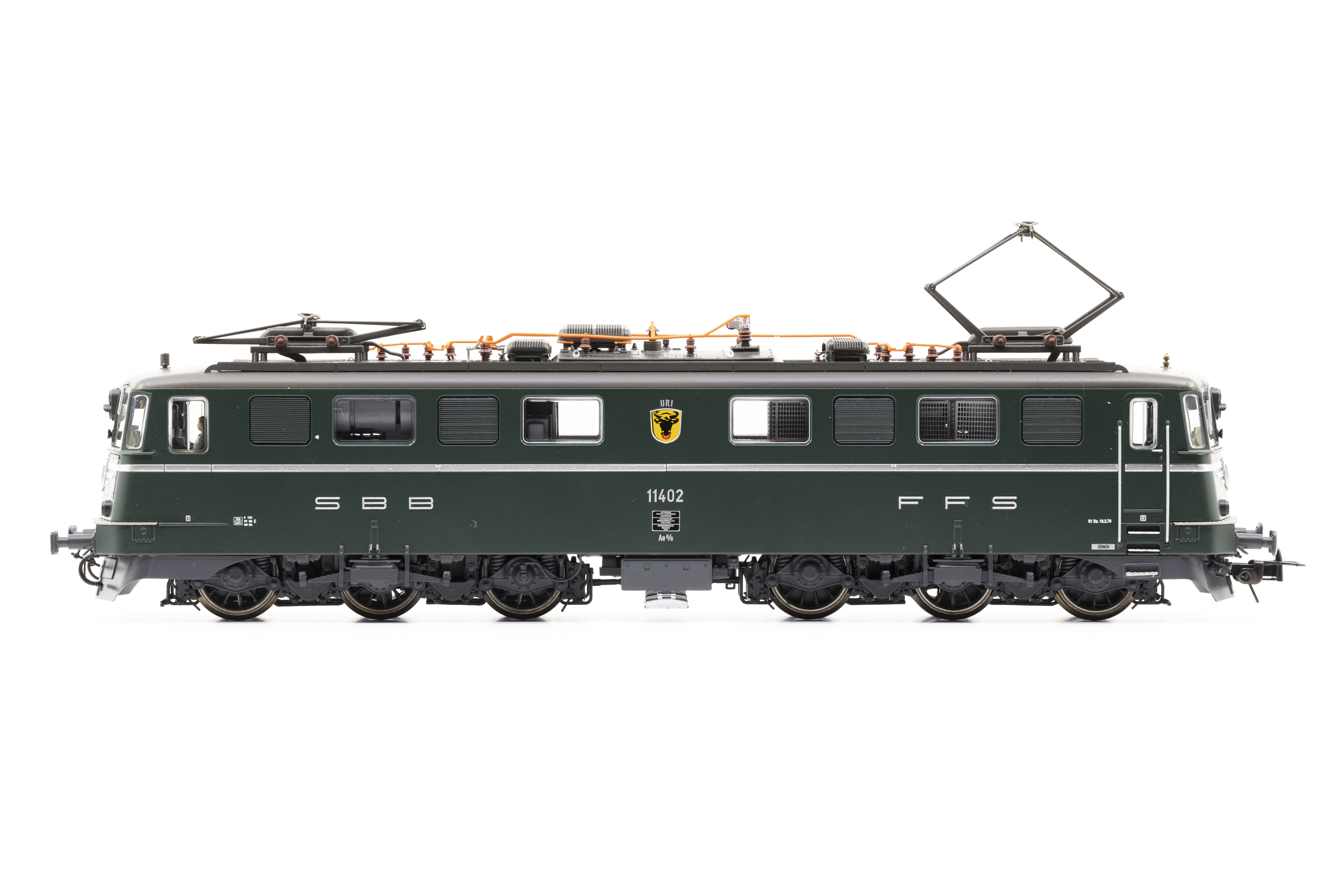
- The SBB Ae 6/6 in H0: metal body structure and frame, digitally raised and lowered pantographs, original Ae 6/6 sounds on a LokSound 5 decoder and two speakers. A plug-in pickup and a switch for two-rail or three-rail running.
- LokSound 5, sound since 1999: up to 10 sound channels at once, at least 10 amplified outputs, DCC, Motorola, Selectrix and M4, and automatic registration with the command station via RailComPlus.
- LokPilot 5 for driving: the same four protocols plus analogue running, at least 10 function outputs of 250 mA, load control adjustable through up to 10 CVs.
- From control desk to turnout: ECoS command station with a 7-inch touchscreen, the wireless Mobile Control Pro throttle, also for Z21 and CS3, and SwitchPilot 3 for turnouts, colour-light signals and up to eight servos.
Our favourites to equip your layout

LokSound 5 DCC/MM/SX/M4 "blank decoder", 21MTC NEM660, with speaker 11x15mm, gauge: 0, H0 The LokSound 5 is the most important member of the LokSound family. Due to the combination of the digital decoder and the sound module on one circuit board we achieve the smallest possible dimensions of 30 mm x 15.5 mm. Therefore it fits into almost any H0 or 0 gauge locomotive. LokSound 5 decoders are available with all popular interface types and are supplied with a sugar cube speaker (11 mm x 15 mm) and a sound enclosure. The LokSound 5 DCC is made for the North American and Australian markets. It is a pure DCC Decoder, which supports RailComPlus and can also be used on DC layouts. Please note the LokSound 5 DCC decoder does not come with a speaker. Operating modes Like all products of the LokSound family the LokSound 5 is a true multi protocol decoder. It supports DCC as well as Motorola®, Selectrix® and M4. Of course it supports 14 through to 128 speed steps as well as 2 and 4 digit addresses in DCC format and up to 32 functions. Thanks to RailComPlus® the decoders register themselves fully automatically on suitable command stations. This decoder supports all DCC programming modes and thanks to RailCom® you may read out the CV values on the main, provided you have a command station supporting RailCom®. There are utility registers for command stations that only facilitate programming of CVs ranging from 1 to 255. Motorola® users benefit from up to 28 speed steps for 255 addresses. Three additional Motorola® addresses facilitate triggering of 16 functions. An integral programming mode even allows programming with the good old Central Unit 6021. The M4 protocol supports the automatic registration on mfx® compatible central units. The LokSound 5 decoder supports the Märklin® braking sections just as well as the ZIMO® HLU braking commands or the Lenz® ABC system. Braking with DCC brake generators or with DC is also possible. Furthermore the locomotive with a LokSound will come to a halt when a Selectrix® braking diode is switched into the circuit. The ABC push-pull feature enables the automatic commuting between two stations. The LokSound 5 decoder is also suitable for analogue DC and AC (!) layouts. Sound The LokSound 5 decoder can reproduce up to 10 channels simultaneously. Each channel offers up to 16 Bit / 31250 kHz and thus we have finally achieved hi-fi sound quality on your layout. For all practical purposes one cannot detect any difference to the original. A class D audio power amplifier with up to 3W output power feeds the speakers with a permitted impedance of 4 – 32 Ohms. The huge 128 MBit sound memory assures sufficient storage capacity. The volume of all individual sound fragments may be adjusted separately. The outstandingly flexible sound engine without a rigid flow chart facilitates a prototypical simulation of all conceivable rail vehicles. Three separately adjustable braking functions and two alternative load scenarios provide you with maximum control of your vehicles. Functions We are quite aware that you want your locomotives to be as realistic as possible. Therefore we have packed many function outputs into it. Subject to the type of interface every LokSound 5 has at least 10 amplified outputs. The decoders with PluX22 or 21MTC interface have an additional 4 outputs for controlling servos or as logic outputs. Of course, all important lighting functions are supported. The brightness of each output may be adjusted separately. The decoder supports the automatic push and pull movements – known as the coupler waltz - required for reliable operation of digital couplers such as the ones by ROCO® and Krois® as well as Telex® couplers. Motor control Motor control of the LokSound 5 has been further improved. A variable PWM pulse frequency ranging from 10 kHz to 50 kHz assures perfect silent operation, particularly for coreless motors. Thus the typical hum is a thing of the past. Load control can now be adjusted with up to 10 separate CVs and thus will manage even the most difficult cases. The unique “Auto Tune” function facilitates the automatic calibration of the decoder to perfectly match the motor. The LokSound 5 decoder supplies up to 1.5A motor current, which is quite sufficient even for older motor types. LokSound 5 DCC The LokSound 5 DCC is made for the North American and Australian markets. It is a pure DCC Decoder, which supports RailComPlus and can also be used on DC layouts. Betrieb unter DCC mit RailComPlus®, M4, Motorola® und Selectrix® 32 Funktionen schaltbar (abhängig von der Zentrale) 32-Bit-Prozessor Digitaler Class-„D“-Verstärker mit bis zu 3 W Leistung (LokSound 5 XL: 13 W) Jeder Kanal in 16-Bit-Auflösung und 31250 kHz Samplerate Geräuschspeicher mit 128 Mbit Kapazität Motorregelung mit 50 kHz Taktfrequenz RC-Servos und Susi-Module ansteuerbar 3 neue, individuell einstellbare Bremsregler Zweistufige Schwerlast-Simulation Updatefähig mit ESU-LokProgrammer LokSound 5 Universal-Sound-Decoder für die Spurweiten H0 und Spur 0 Motorstrom 1,5 A Je nach Schnittstelle bis zu 12 verstärkte Funktionsausgänge für Sonderfunktionen (Total: Bis zu 15 Ausgänge) 10 Soundkanäle gleichzeitig abspielbar Ab Werk mit 11x15-mm-„Zuckerwürfel“-Lautsprecher mit anpassbarem Schallkapsel-Set PowerPack-Speicherkondensator optional anschließbar Abmessungen: 30 mm x 15,5 mm, Höhe abhängig von Schnittstelle 8-pin NEM 652 PluxX22 6-pin NEM 651 21MTC 21MTC MKL Click the image for a bigger view. Instruction manual Art.No. Delivery 58420 LokSound 5 DCC "blank decoder", 8-pin NEM652, gauge: 0, H0 Only available at ESU LLC! 58429 LokSound 5 DCC "blank decoder", 21MTC NEM660, gauge: 0, H0 Only available at ESU LLC! 58410 LokSound 5 DCC/MM/SX/M4 "blank decoder", 8-pin NEM652, with Speaker 11x15mm, gauge: 0, H0 58412 LokSound 5 DCC/MM/SX/M4 "blank decoder", PluX22, with speaker 11x15mm, gauge: 0, H0 58419 LokSound 5 DCC/MM/SX/M4 "blank decoder", 21MTC NEM660, with speaker 11x15mm, gauge: 0, H0 58449 LokSound 5 DCC/MM/SX/M4 "blank decoder", 21MTC "MKL", with speaker 11x15mm, gauge: 0, H0
In stock: 3 on the shelf, shipped within 1-3 days

LokSound 5 micro DCC/MM/SX/M4 "blank decoder", single wires, with Speaker 11x15mm, gauge: N, TT, H0 The LokSound 5 micro is a “little wonder”: With only 21mmx10mm footprint, it is by far one of the smallest LokSound decoders we’ve ever built. Thus it should fit into all N gauge and TT vehicles, but is also suitable for small H0 vehicles. All LokSound decoders are equipped with a Next18 interface and are available with adapter plugs to suit all popular digital interface types. The decoder is supplied with an 11mm x 15mm sugar cube speaker as well as a sound enclosure set. The LokSound 5 micro DCC is made for the North American and Australian markets. It is a pure DCC Decoder, which supports RailComPlus and can also be used on DC layouts. Please note the LokSound 5 DCC decoder does not come with a speaker. Operating modes The LokSound 5 micro is a true multi protocol decoder. It supports DCC as well as Motorola®, Selectrix® and M4. Of course it supports 14 through to 128 speed steps as well as 2 and 4 digit addresses in DCC format and up to 32 functions. Thanks to RailComPlus® the decoders register themselves fully automatically on suitable command stations. This decoder supports all DCC programming modes and thanks to RailCom® you may read out the CV values on the main, provided you have a command station supporting RailCom®. There are utility registers for command stations that only facilitate programming of CVs ranging from 1 to 255. Motorola® users benefit from up to 28 speed steps for 255 addresses. Three additional Motorola® addresses facilitate triggering of 16 functions. An integral programming mode even allows programming with the good old Control Unit 6021. The M4 protocol supports the automatic registration on mfx® compatible central units. The LokSound decoder supports the Märklin® braking sections just as well as the ZIMO® HLU braking commands or the Lenz® ABC system. Braking with DCC brake generators or with DC is also possible. Furthermore the locomotive with a LokSound will come to a halt when a Selectrix® braking diode is switched into the circuit. The ABC push-pull feature enables the automatic commuting between two stations. The LokSound 5 micro decoder is also suitable for analogue DC and AC (!) layouts. Sound The LokSound 5 micro decoder can reproduce up to 10 channels simultaneously. Each channel offers up to 16 Bit / 31250 kHz and thus we have finally achieved hi-fi sound quality on your layout. For all practical purposes one cannot detect any difference to the original. A double class D audio power amplifier with up to 3W output power feeds the speakers with a permitted impedance of 4 – 32 Ohms. The huge 128 MBit sound memory assures sufficient storage capacity. The volume of all individual sound fragments may be adjusted separately. The outstandingly flexible sound engine without a rigid flow chart facilitates a prototypical simulation of all conceivable rail vehicles. Three separately adjustable braking functions and two alternative load scenarios provide you with maximum control of your vehicles. The volume of all individual sound fragments may be adjusted separately. The outstandingly flexible sound engine without a rigid flow chart facilitates a prototypical simulation of all conceivable rail vehicles. Three separately adjustable braking functions and two alternative load scenarios provide you with maximum control of your vehicles. Functions Despite its small dimensions the LokSound 5 micro decoder has at least 6 amplified function outputs as well as one logic output. There are two more logic outputs on the Next18 interface, which alternately may be employed to control RC servos. Of course, all important lighting functions are supported. The brightness of each output may be adjusted separately. The decoder supports the automatic push and pull movements – known as the coupler waltz - required for reliable operation of digital couplers such as the ones by ROCO® and Krois® as well as Telex® couplers. Motor control Motor control of the LokSound 5 micro has been further improved. A variable PWM pulse frequency ranging from 10 kHz to 50 kHz assures perfect silent operation, particularly for coreless motors. Thus the typical hum is a thing of the past. Load control can now be adjusted with up to 10 separate CVs and thus will manage even the most difficult cases. The unique “Auto Tune” function facilitates the automatic calibration of the decoder to perfectly match the motor. The LokSound 5 micro decoder supplies sufficient motor current (up to 0.75 A) for the intended applications. LokSound 5 micro DCC The LokSound 5 Micro DCC is made for the North American and Australian markets. It is a pure DCC Decoder, which supports RailComPlus and can also be used on DC layouts. Betrieb unter DCC mit RailComPlus®, M4, Motorola® und Selectrix® 32 Funktionen schaltbar (abhängig von der Zentrale) 32-Bit-Prozessor Digitaler Class-„D“-Verstärker mit bis zu 3 W Leistung (LokSound 5 XL: 13 W) Jeder Kanal in 16-Bit-Auflösung und 31250 kHz Samplerate Geräuschspeicher mit 128 Mbit Kapazität Motorregelung mit 50 kHz Taktfrequenz RC-Servos und Susi-Module ansteuerbar 3 neue, individuell einstellbare Bremsregler Zweistufige Schwerlast-Simulation Updatefähig mit ESU-LokProgrammer LokSound 5 micro Motorstrom 0,75 A Je nach Schnittstelle bis zu 6 verstärkte Funktionsausgänge für Sonderfunktionen (total: 9 Ausgänge) Next18-Schnittstelle serienmäßig, Adapterkabel für andere Schnittstellen liegen bei Ab Werk mit 11x15-mm-„Zuckerwürfel“-Lautsprecher mit anpassbarem Schallkapsel-Set RC-Servos und Susi-Module ansteuerbar PowerPack-Speicherkondensator optional anschließbar Abmessungen: 21 mm x 10 mm 8-pin NEM 652 PluxX16 6-pin NEM 651 Next18 Click the image for a bigger view. Instruction manual Art.No. Delivery 58820 LokSound 5 micro DCC "blank decoder", 8-pin NEM652, gauge: N, TT, H0 Only available at ESU LLC! 58823 LokSound 5 micro DCC "blank decoder", single wires, gauge: N, TT, H0 Only available at ESU LLC! 58828 LokSound 5 micro DCC "blank decoder", Next18, gauge: N, TT, H0 Only available at ESU LLC! 58810 LokSound 5 micro DCC/MM/SX/M4 "blank decoder", 8-pin NEM652, with Speaker 11x15mm, gauge: N, TT, H0 58813 LokSound 5 micro DCC/MM/SX/M4 "blank decoder", single wires, with Speaker 11x15mm, gauge: N, TT, H0 58816 LokSound 5 micro DCC/MM/SX/M4 "blank decoder", 6-pin NEM651, with Speaker 11x15mm, gauge: N, TT, H0 58818 LokSound 5 micro DCC/MM/SX/M4 "blank decoder", Next18, with Speaker 11x15mm, gauge: N, TT, H0 51993 Wire harness, 18-pin Next18 socket to open wires, 88mm, with heat shrink tube 51994 Adapter board, 18-pin Next-18 socket to NEM651 6-pin, Flex, 88mm, with heat shrink tube 51995 Adapter board, 18-pin Next-18 socket to NEM652 8-pin, Flex, 88mm, with heat shrink tube 51996 Adapter board, 18-pin Next-18 socket to Plux16
In stock: 4 on the shelf, shipped within 1-3 days

LokPilot 5 DCC/MM/SX/M4, PLUX22 NEM658, gauge H0 ,0 The LokPilot 5 is the most important representative of the LokPilot family and is suitable for almost all questions in locomotives of gauge H0 and 0. LokPilot 5 decoders are offered with all common interfaces. Modes The LokPilot 5 is a real multi-protocol decoder. He masters the data format DCC as well as Motorola®, Selectrix® and M4. In DCC format, 14 to 128 speed steps are as natural as 2 and 4-digit addresses and up to 32 functions. Thanks to RailComPlus®, the decoders log on to a suitable digital center fully automatically. It masters all DCC programming modes and, thanks to RailCom®, the CV values on the main track can be read out with suitable control centers. Auxiliary registers exist for control centers that can only program CVs from 1-255. Motorola® users benefit from up to 28 speed steps with 255 addresses. Three additional Motorola® addresses enable the activation of 16 functions. A built-in programming mode also makes reprogramming possible with the venerable Control Unit 6021. The M4 protocol enables automatic registration at mfx®-compatible control centers. All 32 possible function keys are offered here. The LokPilot 5 decoder recognizes the Märklin® braking distances as well as ZIMO® HLU / ZACK commands or the Lenz® ABC system. Braking with DCC brake modules or with DC voltage is also possible. It also stops with a Selectrix® brake diode. An ABC automatic shuttle train enables automatic commuting between two stations. The LokPilot 5 decoder can be used on analog DC and AC railways.The decoder switches between the operating modes fully automatically "on-the-fly". Usually nothing needs to be set. Features We know that you want your locomotives to be as realistic as possible. Therefore, we packed the LokPilot 5 with function outputs. Depending on the interface version, each LokPilot 5 decoder offers at least 10 amplified function outputs with 250mA output current each. In the versions with PluX22 or 21MTC interface, 4 outputs are added to control servos or logic level outputs. All important lighting functions are available. The brightness of each output can be set separately. The decoder masters the automatic pressing and detaching when uncoupling for ROCO®, Krois® and Telex® couplings. Motor control The engine control of the LokPilot 5 has been fundamentally improved again. A variably adjustable PWM clock frequency from 10kHz to 50kHz ensures super quiet operation, especially with bell-armature motors - the typical "hum" is a thing of the past. The load control can now be adapted to difficult cases with up to 10 CVs. The unique "Autotune" function enables the decoder to be automatically calibrated to the motor. With up to 1.5A motor current, the LokPilot 5 decoder provides enough juice even for older motors. Operational safety On request, a PowerPack can be connected to the LokPilot 5 to bridge dirty rail sections. Protection Of course, all function outputs and the motor output are protected against overload. We want you to enjoy your decoder for as long as possible. Possible under Selectrix® operation. Programming must be carried out in DCC mode. Programming with "pure" Selectrix® devices is not possible. Click the image for a bigger view. Betriebsarten: NMRA/DCC mit 14, 28 und 128 Fahrstufen, DCC RailCom® DCC 2-stellige und 4-stellige Adressen (kurze und lange Adressen) Digital Motorola® (alt und neu), bis zu 255 Adressen im Motorola®-Betrieb Selectrix® Fahrbetrieb M4-Betrieb (Automatische Anmeldung an mfx®-kompatiblen Zentralen) Analog Gleichspannung (abschaltbar). Analog Wechselspannung (abschaltbar) Automatische Erkennung der Betriebsart und DCC-Fahrstufeneinstellung Unterstützung der Lenz® LG100, Märklin®, Roco® Bremsstrecken und ZIMO® HLU Befehle Unterstützung für ABC Bremsmodus und ABC-Pendelzugstrecke Falschfahrbit / Speicherung der Betriebszustände Intelligenter Programmiermodus mit Märklin® 6021® Rangiergang und Anfahr- und Bremsverzögerung per Taste schaltbar Fahrtreglerteil: 2,0 A Dauerbelastbarkeit Anschluss von Gleichstrom- Glockenanker- und Wechselstrommotoren (mit Permanentmagnet) Geräuschlose, motorschonende Ansteuerung mit bis zu 50 kHz Taktfrequenz Motorausgang gegen Überlast geschützt. Lastregelung der 5. Generation (abschaltbar) Funktionsausgänge: 10 verstärkte Funktionsausgänge Version mit 21MTC-Schnittstelle zusätzlich 2 Logiklevelausgänge sowie 2 weitere Logiklevelausgänge statt SUSI Version mit PluX22-Schnittstelle 2 Logiklevelausgänge statt SUSI 250mA Belastbarkeit pro verstärktem Ausgang Summenstrom aller Funktionsausgänge ca. 500mA. Ausgänge kurzschlussfest Belegung der Funktionsausgänge frei wählbar (function mapping) Dimensionen: 21,4mm x 15,5mm x 4,5mm Instruction manual Art.No. Delivery 59610 LokPilot 5 DCC/MM/SX/M4, 8-pin NEM652, gauge H0 ,0 59612 LokPilot 5 DCC/MM/SX/M4, PLUX22 NEM658, gauge H0 ,0 59616 LokPilot 5 DCC/MM/SX/M4, 6-pin NEM651, gauge H0 ,0 59619 LokPilot 5 DCC/MM/SX/M4, 21MTC NEM660, gauge H0 ,0 59649 LokPilot 5 DCC/MM/SX/M4, 21MTC MKL, gauge H0 ,0
In stock: 3 on the shelf, shipped within 1-3 days

LokPilot 5 DCC/MM/SX/M4, 21MTC NEM660, gauge H0 ,0 The LokPilot 5 is the most important representative of the LokPilot family and is suitable for almost all questions in locomotives of gauge H0 and 0. LokPilot 5 decoders are offered with all common interfaces. Modes The LokPilot 5 is a real multi-protocol decoder. He masters the data format DCC as well as Motorola®, Selectrix® and M4. In DCC format, 14 to 128 speed steps are as natural as 2 and 4-digit addresses and up to 32 functions. Thanks to RailComPlus®, the decoders log on to a suitable digital center fully automatically. It masters all DCC programming modes and, thanks to RailCom®, the CV values on the main track can be read out with suitable control centers. Auxiliary registers exist for control centers that can only program CVs from 1-255. Motorola® users benefit from up to 28 speed steps with 255 addresses. Three additional Motorola® addresses enable the activation of 16 functions. A built-in programming mode also makes reprogramming possible with the venerable Control Unit 6021. The M4 protocol enables automatic registration at mfx®-compatible control centers. All 32 possible function keys are offered here. The LokPilot 5 decoder recognizes the Märklin® braking distances as well as ZIMO® HLU / ZACK commands or the Lenz® ABC system. Braking with DCC brake modules or with DC voltage is also possible. It also stops with a Selectrix® brake diode. An ABC automatic shuttle train enables automatic commuting between two stations. The LokPilot 5 decoder can be used on analog DC and AC railways.The decoder switches between the operating modes fully automatically "on-the-fly". Usually nothing needs to be set. Features We know that you want your locomotives to be as realistic as possible. Therefore, we packed the LokPilot 5 with function outputs. Depending on the interface version, each LokPilot 5 decoder offers at least 10 amplified function outputs with 250mA output current each. In the versions with PluX22 or 21MTC interface, 4 outputs are added to control servos or logic level outputs. All important lighting functions are available. The brightness of each output can be set separately. The decoder masters the automatic pressing and detaching when uncoupling for ROCO®, Krois® and Telex® couplings. Motor control The engine control of the LokPilot 5 has been fundamentally improved again. A variably adjustable PWM clock frequency from 10kHz to 50kHz ensures super quiet operation, especially with bell-armature motors - the typical "hum" is a thing of the past. The load control can now be adapted to difficult cases with up to 10 CVs. The unique "Autotune" function enables the decoder to be automatically calibrated to the motor. With up to 1.5A motor current, the LokPilot 5 decoder provides enough juice even for older motors. Operational safety On request, a PowerPack can be connected to the LokPilot 5 to bridge dirty rail sections. Protection Of course, all function outputs and the motor output are protected against overload. We want you to enjoy your decoder for as long as possible. Possible under Selectrix® operation. Programming must be carried out in DCC mode. Programming with "pure" Selectrix® devices is not possible. Click the image for a bigger view. Betriebsarten: NMRA/DCC mit 14, 28 und 128 Fahrstufen, DCC RailCom® DCC 2-stellige und 4-stellige Adressen (kurze und lange Adressen) Digital Motorola® (alt und neu), bis zu 255 Adressen im Motorola®-Betrieb Selectrix® Fahrbetrieb M4-Betrieb (Automatische Anmeldung an mfx®-kompatiblen Zentralen) Analog Gleichspannung (abschaltbar). Analog Wechselspannung (abschaltbar) Automatische Erkennung der Betriebsart und DCC-Fahrstufeneinstellung Unterstützung der Lenz® LG100, Märklin®, Roco® Bremsstrecken und ZIMO® HLU Befehle Unterstützung für ABC Bremsmodus und ABC-Pendelzugstrecke Falschfahrbit / Speicherung der Betriebszustände Intelligenter Programmiermodus mit Märklin® 6021® Rangiergang und Anfahr- und Bremsverzögerung per Taste schaltbar Fahrtreglerteil: 2,0 A Dauerbelastbarkeit Anschluss von Gleichstrom- Glockenanker- und Wechselstrommotoren (mit Permanentmagnet) Geräuschlose, motorschonende Ansteuerung mit bis zu 50 kHz Taktfrequenz Motorausgang gegen Überlast geschützt. Lastregelung der 5. Generation (abschaltbar) Funktionsausgänge: 10 verstärkte Funktionsausgänge Version mit 21MTC-Schnittstelle zusätzlich 2 Logiklevelausgänge sowie 2 weitere Logiklevelausgänge statt SUSI Version mit PluX22-Schnittstelle 2 Logiklevelausgänge statt SUSI 250mA Belastbarkeit pro verstärktem Ausgang Summenstrom aller Funktionsausgänge ca. 500mA. Ausgänge kurzschlussfest Belegung der Funktionsausgänge frei wählbar (function mapping) Dimensionen: 21,4mm x 15,5mm x 4,5mm Instruction manual Art.No. Delivery 59610 LokPilot 5 DCC/MM/SX/M4, 8-pin NEM652, gauge H0 ,0 59612 LokPilot 5 DCC/MM/SX/M4, PLUX22 NEM658, gauge H0 ,0 59616 LokPilot 5 DCC/MM/SX/M4, 6-pin NEM651, gauge H0 ,0 59619 LokPilot 5 DCC/MM/SX/M4, 21MTC NEM660, gauge H0 ,0 59649 LokPilot 5 DCC/MM/SX/M4, 21MTC MKL, gauge H0 ,0
In stock: 3 on the shelf, shipped within 1-3 days

SwitchPilot 3 Servo, 8x servo decoder, DCC/MM, OLED, with RC-Feedback, updatable SwitchPilot 3 servo decoders are optimized for stationary use on your system and can control up to eight RC servo drives. In order to facilitate the rather cumbersome configuration of magnetic article decoders, the SwitchPilot 3 Servo has an innovative operating concept consisting of a 4-line, illuminated OLED display and three input buttons. Modes The SwitchPilot 3 servo is multi-protocol and can be used with workstations according to the Märklin® Motorola® system (e.g. 6021, Central Station® or Mobile Station®) as well as DCC-enabled central. The configuration can take place on both the main track and the programming track. Thanks to RailCom®, CVs can also be read out. Functioning The SwitchPilot 3 servo can be supplied directly from the digital system or an external DC or AC voltage source. The SwitchPilot 3 servo has eight outputs for the control of RC servo drives. In doing so, it can control these drives so precisely that, in addition to switching switches, any other slow movement sequences can be controlled. The SwitchPilot 3 servo has a built-in power-on pulse suppression to eliminate or reduce the system-related "twitching" of RC servos when applying the supply voltage. Furthermore, the power supply to the servo can be interrupted to prevent a "hum" of some inexpensive servos. Each of the eight servos can be operated either in "digital mode" or in the "proportional mode" introduced for the first time with the SwitchPilot 3 servo: In digital mode, the servo can start two end positions "A" and "B", depending on the switching position on the control panel. The position of the two end positions as well as the speed at which thethe servo moves in the desired direction, can be individually set on the SwitchPilot 3 servo. The digital mode is perfect for switching switches or signals that should always remain in a fixed position. In proportional mode, the servo can move and stop in any position within the end positions "A" and B. The servo only runs as long as the control panel sends a command. If you release the button, the servo stops. In this way, a servo can be stopped in any desired position. The servo speed can be adjusted individually. The proportional mode is ideal for (water) cranes or engine shed gates or any other application, for which intermediate positions are also required. For each servo, in addition to the end positions and the rotational speeds, it can be determined whether it should rock up when reaching the final position. Furthermore, the generation of the servo pulse can be influenced to adapt to the different RC servos on the market or the power supply of each servo can be switched off individually. In this way, cheap so-called so-called Analog servos as well as modern digital servos (with microcontroller) optimally controlled. Analogue Operation The SwitchPilot 3 servo can be used as a special feature without a digital control panel: On request, up to 16 buttons can be connected for direct switching of the servos. Set The SwitchPilot 3 servo can be flexibly adjusted either on the programming track with DCC control panels or on the main track with POM ("Programming on Main") or can also be read out via RailCom® CVs. On request, he also learns the addresses directly via a programming button. The setting is, of course, the simplest with the integrated OLED displays as well as the three input buttons: All (!) Settings can be checked directly on the decoder and changed on request. "Programming" with the help of your headquarters is not required. It really can't be any easier. The ESU LokProgrammer can be used for firmware updates. Protection As with our locomotive decoders, the outputs of the SwitchPilot 3 servo are protected against overload. We want you to enjoy your decoder for as long as possible.
In stock: 1 on the shelf, shipped within 1-3 days

Servo Motor, precision mini-servo, micro-controlled with metal gearing, incl. mounting kit ESU proudly presents a further, newly-developed servo motor for all ambitious model railway fans. The „Precision Servo Motor - Metal“ is preferred by all model railroaders who look for a powerful servo with metal gearing. Thanks to its metal gearing the servo is able to lift nearly twice the load (1.8 kg) of its plastic gearing brother. Moreover, the „Precision Servo Motor - Metal“ is appropriate for all situations in which splicing and beating claim high mechanical requirements from the servo and where the sound development does not play such an important role. With the same measurements as the Precision Servo Motor, the metal gearing is also equipped with the new, micro-processed control electronics for a precise, sensitive heading to the required position. Therefore the impuls suppression makes sure that there won´t be any tremors on the layout when you switch it on. The 30cm cables makes easy wiring possible. Also, the „Precision Servo Motor - Metal“ comes with innovative and well-proven accessories such as a servo holder and controlling wires. Art.No. 51805 Servo Motor, precision mini-servo, micro-controlled with metal gearing, incl. mounting kit
In stock: 5 on the shelf, shipped within 1-3 days

LokSound 5 DCC/MM/SX/M4 "blank decoder", 21MTC "MKL", with speaker 11x15mm, gauge: 0, H0 The LokSound 5 is the most important member of the LokSound family. Due to the combination of the digital decoder and the sound module on one circuit board we achieve the smallest possible dimensions of 30 mm x 15.5 mm. Therefore it fits into almost any H0 or 0 gauge locomotive. LokSound 5 decoders are available with all popular interface types and are supplied with a sugar cube speaker (11 mm x 15 mm) and a sound enclosure. The LokSound 5 DCC is made for the North American and Australian markets. It is a pure DCC Decoder, which supports RailComPlus and can also be used on DC layouts. Please note the LokSound 5 DCC decoder does not come with a speaker. Operating modes Like all products of the LokSound family the LokSound 5 is a true multi protocol decoder. It supports DCC as well as Motorola®, Selectrix® and M4. Of course it supports 14 through to 128 speed steps as well as 2 and 4 digit addresses in DCC format and up to 32 functions. Thanks to RailComPlus® the decoders register themselves fully automatically on suitable command stations. This decoder supports all DCC programming modes and thanks to RailCom® you may read out the CV values on the main, provided you have a command station supporting RailCom®. There are utility registers for command stations that only facilitate programming of CVs ranging from 1 to 255. Motorola® users benefit from up to 28 speed steps for 255 addresses. Three additional Motorola® addresses facilitate triggering of 16 functions. An integral programming mode even allows programming with the good old Central Unit 6021. The M4 protocol supports the automatic registration on mfx® compatible central units. The LokSound 5 decoder supports the Märklin® braking sections just as well as the ZIMO® HLU braking commands or the Lenz® ABC system. Braking with DCC brake generators or with DC is also possible. Furthermore the locomotive with a LokSound will come to a halt when a Selectrix® braking diode is switched into the circuit. The ABC push-pull feature enables the automatic commuting between two stations. The LokSound 5 decoder is also suitable for analogue DC and AC (!) layouts. Sound The LokSound 5 decoder can reproduce up to 10 channels simultaneously. Each channel offers up to 16 Bit / 31250 kHz and thus we have finally achieved hi-fi sound quality on your layout. For all practical purposes one cannot detect any difference to the original. A class D audio power amplifier with up to 3W output power feeds the speakers with a permitted impedance of 4 – 32 Ohms. The huge 128 MBit sound memory assures sufficient storage capacity. The volume of all individual sound fragments may be adjusted separately. The outstandingly flexible sound engine without a rigid flow chart facilitates a prototypical simulation of all conceivable rail vehicles. Three separately adjustable braking functions and two alternative load scenarios provide you with maximum control of your vehicles. Functions We are quite aware that you want your locomotives to be as realistic as possible. Therefore we have packed many function outputs into it. Subject to the type of interface every LokSound 5 has at least 10 amplified outputs. The decoders with PluX22 or 21MTC interface have an additional 4 outputs for controlling servos or as logic outputs. Of course, all important lighting functions are supported. The brightness of each output may be adjusted separately. The decoder supports the automatic push and pull movements – known as the coupler waltz - required for reliable operation of digital couplers such as the ones by ROCO® and Krois® as well as Telex® couplers. Motor control Motor control of the LokSound 5 has been further improved. A variable PWM pulse frequency ranging from 10 kHz to 50 kHz assures perfect silent operation, particularly for coreless motors. Thus the typical hum is a thing of the past. Load control can now be adjusted with up to 10 separate CVs and thus will manage even the most difficult cases. The unique “Auto Tune” function facilitates the automatic calibration of the decoder to perfectly match the motor. The LokSound 5 decoder supplies up to 1.5A motor current, which is quite sufficient even for older motor types. LokSound 5 DCC The LokSound 5 DCC is made for the North American and Australian markets. It is a pure DCC Decoder, which supports RailComPlus and can also be used on DC layouts. Betrieb unter DCC mit RailComPlus®, M4, Motorola® und Selectrix® 32 Funktionen schaltbar (abhängig von der Zentrale) 32-Bit-Prozessor Digitaler Class-„D“-Verstärker mit bis zu 3 W Leistung (LokSound 5 XL: 13 W) Jeder Kanal in 16-Bit-Auflösung und 31250 kHz Samplerate Geräuschspeicher mit 128 Mbit Kapazität Motorregelung mit 50 kHz Taktfrequenz RC-Servos und Susi-Module ansteuerbar 3 neue, individuell einstellbare Bremsregler Zweistufige Schwerlast-Simulation Updatefähig mit ESU-LokProgrammer LokSound 5 Universal-Sound-Decoder für die Spurweiten H0 und Spur 0 Motorstrom 1,5 A Je nach Schnittstelle bis zu 12 verstärkte Funktionsausgänge für Sonderfunktionen (Total: Bis zu 15 Ausgänge) 10 Soundkanäle gleichzeitig abspielbar Ab Werk mit 11x15-mm-„Zuckerwürfel“-Lautsprecher mit anpassbarem Schallkapsel-Set PowerPack-Speicherkondensator optional anschließbar Abmessungen: 30 mm x 15,5 mm, Höhe abhängig von Schnittstelle 8-pin NEM 652 PluxX22 6-pin NEM 651 21MTC 21MTC MKL Click the image for a bigger view. Instruction manual Art.No. Delivery 58420 LokSound 5 DCC "blank decoder", 8-pin NEM652, gauge: 0, H0 Only available at ESU LLC! 58429 LokSound 5 DCC "blank decoder", 21MTC NEM660, gauge: 0, H0 Only available at ESU LLC! 58410 LokSound 5 DCC/MM/SX/M4 "blank decoder", 8-pin NEM652, with Speaker 11x15mm, gauge: 0, H0 58412 LokSound 5 DCC/MM/SX/M4 "blank decoder", PluX22, with speaker 11x15mm, gauge: 0, H0 58419 LokSound 5 DCC/MM/SX/M4 "blank decoder", 21MTC NEM660, with speaker 11x15mm, gauge: 0, H0 58449 LokSound 5 DCC/MM/SX/M4 "blank decoder", 21MTC "MKL", with speaker 11x15mm, gauge: 0, H0
In stock: 2 on the shelf, shipped within 1-3 days

Interiour lighting set with decoder, Entry+Red marker light, 264mm, divisible, PowerPack Option, 13 LED, warm white With the digital LED interior lights from ESU, you can retrofit your N, TT or H0 gauge passenger cars with prototypical, uniform lighting. Two versions are available to suit the desired location. The digital interior lights are 264mm long, 9mm slim and each fitted with 13 (!) LEDs. In addition to a version with warm white LEDs (50718), there is also a board with yellow LEDs (50719) so that the light color always matches your existing wagons. Features The digital interior lighting consists of a 74 mm long base section, on which a digital decoder and four LEDs are mounted, and eight adjoining sections, each equipped with one LED spaced 24mm apart. The additional sections can be cut off to customize the length to suit the wagon. Furthermore, two additional 4.5mm wide, detachable LED sections are provided on the far left and right sides to illuminate the entry area. The brightness of the LEDs can be set either using a potentiometer or via software CV and remains constant regardless of the track voltage thanks to the built-in constant voltage supply. A built-in buffer capacitor bridges small current interruptions ex works. To completely prevent flickering even with poor power pickup, a special, very compact PowerPack supercapacitor (ESU item no. 50710) can be connected directly upon request. This can power the LEDs for a few seconds. The digital interior lighting comes with a soldered red tail light. Operating modes The decoder, based on the LokPilot 5 Basic and adapted to the intended use, supports the DCC and Märklin® Motorola® protocols. It can handle 2- and 4-digit addresses and can trigger functions up to F31. Thanks to RailComPlus®, the decoders register fully automatically with a suitable DCC command station. It supports all DCC programming modes, and thanks to RailCom®, the CV values can be read on the main track with suitable command stations. Auxiliary registers are available for command stations that can only program CVs 1-255. Alternatively, the decoder can be read on the programming track without an additional load resistor. The digital interior lighting can also be used on analog AC and DC systems. In both operating modes, the direction of travel is correctly detected and the tail light is switched accordingly. Functions The 13 built-in LEDs can be individually controlled in a total of seven groups: The two entrance LEDs can each be switched separately. The tail light can also be switched separately depending on the direction of travel. Furthermore, there is an amplified output and two outputs for connecting additional LEDs (e.g., for headlights on Pilot cars or toilet lighting), which can be wired individually. Various prototypical lighting effects such as soft dimming, neon tube effects, defective neon tubes, battery lighting, and much more ensure a realistic result. The ESU V5 Function Mapping allows the individual assignment of all LED groups to the desired function keys. Robust You can rely on the experience and quality of a renowned brand manufacturer, even when it comes to digital interior lighting.
In stock: 2 on the shelf, shipped within 1-3 days
The ESU families
For your H0 layout (1:87)
 5 itemsSBB locomotivesThe Ae 6/6 'Uri', 'Ticino', 'Glarus' and 'Lausanne', plus an SBB Cargo.See the items
 23 itemsLocomotives H0DB electric and diesel locomotives, Class 66 and KG230 shunters.See the items
 25 itemsCoaches and wagons H0DB n-coaches and Sgmmns container wagons.See the items
To control your layout and give it sound
25 itemsLokSound sound decodersLokSound 5, from micro and Nano up to L and XL.See the items40 itemsLokPilot decodersLokPilot 5 for driving, plus the Fx function decoders.See the items 13 itemsECoS and Mobile ControlECoS command station and modules, Mobile Control Pro throttle, CabControl.See the items13 itemsSwitchPilot and servosTurnout and signal decoders, servo motors and extensions.See the items
 31 itemsSpeakersRound and rectangular speakers for sound decoders.See the items
All ESU items

n-car, H0, Bnrdzf 483.1, 80-35 188-7, Steuerwagen, DB Ep. VI, lichtgrau/gelb/grau, DC Bnrzb778.1, 22-34 021-2, 2. Kl., DB Ep. IV, orange, lichtgrau Art.No. 36478 Bnrzb778.1, 22-34 004-8, 2. Kl., DB Ep. IV, orange, lichtgrau Art.No. 36482 BDnrzf784.1, 82-34 265-2, Steuerwagen, DB Ep. IV, orange, lichtgrau Art.No. 36510 Bnrz 451.4, 22-34-112-9, 2. Kl, DB Ep. VI, lichtgrau/gelb/grau Art.No. 36511 Bnrz 450.3, 22-35 927-9, 2. Kl, DB Ep. VI, lichtgrau/gelb/grau Art.No. 36512 AB nrz 418.4, 31-34 074-0, 1./2. Kl, DB Ep. VI, lichtgrau/gelb/grau Art.No. 36513 Bnrdzf 483.1, 80-35 188-7, Steuerwagen, DB Ep. VI, lichtgrau/gelb/grau Art.No. 36515 Bnrz 450.3, 22-35 932-9, 2. Kl, DB Ep. V/VI, verkehrsrot Prototype Model Picture Gallery Für den Einsatz im Nahverkehr aber auch zur Verstärkung von Schnellzügen beschaffte die Deutsche Bundesbahn DB zwischen 1959 und 1977 insgesamt mehr als 4800 Wagen in drei Grundrissformen: Reine 2. Klasse, 1. und 2. Klasse sowie Steuerwagen mit Gepäck- und 2.-Klasse-Großräumen. Der Wagenfamilie wurde der Gattungs-Buchstabe „n“ zugewiesen. Ein Prototypwagen besaß bereits diefür den Spitznamen „Silberlinge“ verantwortliche, nicht lackierte Außenhaut mit gebürstetem Pfauenaugenmuster. Der Verzicht auf eine Lackierung reduzierte das Gewicht um etwa zwei Tonnen. Mit einem Gesamtgewicht zwischen 27 und 30 t waren beispielsweise die Zweite-Klasse-Wagen mindestens 5t leichter, als die Vorkriegs-Eilzugwagen der Bauart 1936. Der zunächst eingebaute Achsgenerator-Typ D62 beschränkte die Höchstgeschwindigkeit auf 120 km/h. Die lauftechnisch zulässigen 140 km/h durften mit einer anderen Achsgenerator-Bauart oder von den elektrisch vom Triebfahrzeug versorgten Wagen gefahren werden. Die DB beschaffte 1969 insgesamt 180 Exemplare der Bauart Bnrzb724, die im Katastrophenfall einfach zu Lazarettwagen umgerüstet werden können. Markanter Unterschied zu den zuvor gefertigten Wagen ist der nahezu senkrechte Dachabschluss („Steildach“). Die ersten Steuerwagen besaßen am Führerstandsende eine Übergangsmöglichkeit zum nächsten Wagen, weshalb der Lokführer rechts des Ganges in einem zugigen kleinen Räumchen („Hasenkasten“) saß. Ab 1972 erhielt die DB Steuerwagen mit modernem „Karlsruher Kopf“. Um den Nahverkehr attraktiver zu gestalten, ließ die DB ab 1984 mehrere Garnituren innen modernisieren und außen in Kieselgrau-Orange lackieren und setzte sie mit passender 218 unter dem Produktnamen City-Bahn ein. Der Erfolg des Produkts bewog die DB, ab 1990 weitere Wagen durch neu bezogene Sitze, geänderte Gepäckablagen und einen eue Außenlackierung zu modernisieren. Es entstand eine Vielzahl unterschiedlicher Varianten der als Re-Design-Wagen bezeichneten Typen, die zunächst im damals aktuellen Minttürkis-Lichtgrau lackiert wurden. Ab 1993 erhielt die DB Steuerwagen mit an den Triebwagen VT 628 erinnern der Führerstandseite, dem „Wittenberger Kopf“. 2019, also 60 Jahre nach Indienststellung der ersten Silberlinge, befinden sich noch immer Wagen im täglichen Einsatz. Maßstäbliche H0-Modelle der n-Wagen Silberling Mehrfarbige Inneneinrichtung Separat eingesetzte Sitzbänke Steuerwagen mit separat schaltbarer Stirn-, Führerstand-, Gepäckraum- und Fahrgastraumbeleuchtung. Fernlicht beim Wittenberger Steuerwagen Gefederte Faltenbälge Freistehende Griffstangen Trittstufen an den Wagenenden und an den Einstiegen als durchbrochene Ätzteile Nachbildung der Wellenradscheiben bei silbernen, Nachbildung der glatten Scheibenräder bei verkehrsroten Wagen Mehrteilige Drehgestelle mit Nachbildung der Klotz- oder Scheibenbremsanlage Achslagerbleche und Halbachsen für reibungsfreie Achtpunkt-Stromabnahme Einfache Nachrüstung der Sitzwagen mit einer ESU-Innenbeleuchtung Bügelkupplung in kulissengeführtem Normschacht Optionaler AC-Radsatz unter der Art.-Nr. 41200 erhältlich Befahrbarer Mindestradius = 360 mm Länge über Puffer = 303 mm Click the image for a bigger view. Art.No. Delivery 36067 n-car, H0, Bnrz 451.4, 80 22-34 240-8, 2. Kl, GfF Ep. VI, blau-weiß, DC available 36068 n-car, H0, Bnrz 450.3, 80 22-35 706-7, 2. Kl, GfF Ep. VI, blau-weiß, DC available 36069 n-car, H0, AB nrz 418.4, 80 31-34 359-5, 1./2. Kl, GfF Ep. VI, blau-weiß, DC available 36070 n-car, H0, Bnrdzf 483.1, 80 80-35 163-0, Steuerwagen, GfF Ep. VI, blau-weiß, DC available 36477 n-car, H0, Bnrzb778.1, 22-34 021-2, 2. Kl., DB Ep. IV, orange, lichtgrau, DC available 36478 n-car, H0, Bnrzb778.1, 22-34 004-8, 2. Kl., DB Ep. IV, orange, lichtgrau, DC available 36482 n-car, H0, BDnrzf784, 82-34 265-2, Steuerwagen, DB Ep. IV, orange, lichtgrau, DC available 36510 n-car, H0, Bnrz 451.4, 22-34-112-9, 2. Kl, DB Ep. VI, lichtgrau/gelb/grau, DC available 36511 n-car, H0, Bnrz 450.3, 22-35 927-9, 2. Kl, DB Ep. VI, lichtgrau/gelb/grau, DC available 36512 n-car, H0, AB nrz 418.4, 31-34 074-0, 1./2. Kl, DB Ep. VI, lichtgrau/gelb/grau, DC available 36513 n-car, H0, Bnrdzf 483.1, 80-35 188-7, Steuerwagen, DB Ep. VI, lichtgrau/gelb/grau, DC available 36515 n-car, H0, Bnrz 450.3, 22-35 932-9, 2. Kl, DB Ep. V/VI, verkehrsrot, DC available
On order, lead time to be confirmed

Bnrz 446, 22-34 311-7, 2nd class, DB Era V/VI, traffic red Between 1959 and 1977, the German Federal Railway (DB) procured a total of more than 4,800 coaches in three floor plan variants for use on local services as well as to strengthen express trains: pure second class, first and second class, and driving trailers with luggage and second-class high-capacity compartments. The coach family was assigned the class letter "n". A prototype coach already featured the unpainted exterior with a brushed peacock-eye pattern that was responsible for the nickname "Silberlinge" (silver coins). Dispensing with a coat of paint reduced the weight by around two tonnes. With a total weight of between 27 and 30 t, the second-class coaches, for example, were at least 5 t lighter than the pre-war express coaches of the 1936 type. The axle generator type D62 initially fitted limited the maximum speed to 120 km/h. The 140 km/h permitted by the running gear could be achieved with a different type of axle generator or by coaches supplied electrically from the locomotive. In 1969, the DB procured a total of 180 examples of the Bnrzb724 type, which can easily be converted into hospital coaches in the event of a disaster. A notable difference from the coaches built previously is the almost vertical roof end ("steep roof"). The first driving trailers had a gangway connection to the next coach at the cab end, which meant that the driver sat to the right of the corridor in a draughty little compartment (the "Hasenkasten", or rabbit hutch). From 1972, the DB received driving trailers with a modern "Karlsruher Kopf" front end. To make local services more attractive, from 1984 the DB had several sets modernised internally and painted externally in pebble grey and orange, and operated them with a matching Class 218 locomotive under the product name City-Bahn. The success of the product led the DB to modernise further coaches from 1990 onwards with newly upholstered seats, revised luggage racks, and a new exterior livery. A large number of different variants emerged of the types known as Re-Design coaches, which were initially painted in the then-current mint turquoise and light grey. From 1993, the DB received driving trailers with a cab end reminiscent of the VT 628 railcar, the "Wittenberger Kopf". In 2019, sixty years after the first Silberlinge entered service, coaches of this type are still in daily use. True-to-scale H0 models of the n-coach Silberling Multicoloured interior details Separately fitted bench seats Driving trailer with separately switchable head lamp, cab, luggage compartment and Interior lighting. High beam on the Wittenberger driving trailer Sprung bellows Separately applied handrails Steps at the coach ends and at the doorways as open-etched parts Reproduction of the spoked wheel discs for silver, reproduction of the plain Disc wheels on traffic-red wagons Multi-part bogies with reproduction of the block or disc brake system Axlebox plates and half-axles for friction-free eight-point current collection Simple retrofitting of the passenger coaches with an ESU interior lighting Coupler bow in guided NEM pocket Optional AC wheelset available under item no. 41200 The minimum radius for operation is 360 mm Length over the buffers = 303 mm
On order, lead time to be confirmed

n-car, H0, Bnrz 450.3, 22-35 932-9, 2. Kl, DB Ep. V/VI, verkehrsrot, DC Bnrzb778.1, 22-34 021-2, 2. Kl., DB Ep. IV, orange, lichtgrau Art.No. 36478 Bnrzb778.1, 22-34 004-8, 2. Kl., DB Ep. IV, orange, lichtgrau Art.No. 36482 BDnrzf784.1, 82-34 265-2, Steuerwagen, DB Ep. IV, orange, lichtgrau Art.No. 36510 Bnrz 451.4, 22-34-112-9, 2. Kl, DB Ep. VI, lichtgrau/gelb/grau Art.No. 36511 Bnrz 450.3, 22-35 927-9, 2. Kl, DB Ep. VI, lichtgrau/gelb/grau Art.No. 36512 AB nrz 418.4, 31-34 074-0, 1./2. Kl, DB Ep. VI, lichtgrau/gelb/grau Art.No. 36513 Bnrdzf 483.1, 80-35 188-7, Steuerwagen, DB Ep. VI, lichtgrau/gelb/grau Art.No. 36515 Bnrz 450.3, 22-35 932-9, 2. Kl, DB Ep. V/VI, verkehrsrot Prototype Model Picture Gallery Für den Einsatz im Nahverkehr aber auch zur Verstärkung von Schnellzügen beschaffte die Deutsche Bundesbahn DB zwischen 1959 und 1977 insgesamt mehr als 4800 Wagen in drei Grundrissformen: Reine 2. Klasse, 1. und 2. Klasse sowie Steuerwagen mit Gepäck- und 2.-Klasse-Großräumen. Der Wagenfamilie wurde der Gattungs-Buchstabe „n“ zugewiesen. Ein Prototypwagen besaß bereits diefür den Spitznamen „Silberlinge“ verantwortliche, nicht lackierte Außenhaut mit gebürstetem Pfauenaugenmuster. Der Verzicht auf eine Lackierung reduzierte das Gewicht um etwa zwei Tonnen. Mit einem Gesamtgewicht zwischen 27 und 30 t waren beispielsweise die Zweite-Klasse-Wagen mindestens 5t leichter, als die Vorkriegs-Eilzugwagen der Bauart 1936. Der zunächst eingebaute Achsgenerator-Typ D62 beschränkte die Höchstgeschwindigkeit auf 120 km/h. Die lauftechnisch zulässigen 140 km/h durften mit einer anderen Achsgenerator-Bauart oder von den elektrisch vom Triebfahrzeug versorgten Wagen gefahren werden. Die DB beschaffte 1969 insgesamt 180 Exemplare der Bauart Bnrzb724, die im Katastrophenfall einfach zu Lazarettwagen umgerüstet werden können. Markanter Unterschied zu den zuvor gefertigten Wagen ist der nahezu senkrechte Dachabschluss („Steildach“). Die ersten Steuerwagen besaßen am Führerstandsende eine Übergangsmöglichkeit zum nächsten Wagen, weshalb der Lokführer rechts des Ganges in einem zugigen kleinen Räumchen („Hasenkasten“) saß. Ab 1972 erhielt die DB Steuerwagen mit modernem „Karlsruher Kopf“. Um den Nahverkehr attraktiver zu gestalten, ließ die DB ab 1984 mehrere Garnituren innen modernisieren und außen in Kieselgrau-Orange lackieren und setzte sie mit passender 218 unter dem Produktnamen City-Bahn ein. Der Erfolg des Produkts bewog die DB, ab 1990 weitere Wagen durch neu bezogene Sitze, geänderte Gepäckablagen und einen eue Außenlackierung zu modernisieren. Es entstand eine Vielzahl unterschiedlicher Varianten der als Re-Design-Wagen bezeichneten Typen, die zunächst im damals aktuellen Minttürkis-Lichtgrau lackiert wurden. Ab 1993 erhielt die DB Steuerwagen mit an den Triebwagen VT 628 erinnern der Führerstandseite, dem „Wittenberger Kopf“. 2019, also 60 Jahre nach Indienststellung der ersten Silberlinge, befinden sich noch immer Wagen im täglichen Einsatz. Maßstäbliche H0-Modelle der n-Wagen Silberling Mehrfarbige Inneneinrichtung Separat eingesetzte Sitzbänke Steuerwagen mit separat schaltbarer Stirn-, Führerstand-, Gepäckraum- und Fahrgastraumbeleuchtung. Fernlicht beim Wittenberger Steuerwagen Gefederte Faltenbälge Freistehende Griffstangen Trittstufen an den Wagenenden und an den Einstiegen als durchbrochene Ätzteile Nachbildung der Wellenradscheiben bei silbernen, Nachbildung der glatten Scheibenräder bei verkehrsroten Wagen Mehrteilige Drehgestelle mit Nachbildung der Klotz- oder Scheibenbremsanlage Achslagerbleche und Halbachsen für reibungsfreie Achtpunkt-Stromabnahme Einfache Nachrüstung der Sitzwagen mit einer ESU-Innenbeleuchtung Bügelkupplung in kulissengeführtem Normschacht Optionaler AC-Radsatz unter der Art.-Nr. 41200 erhältlich Befahrbarer Mindestradius = 360 mm Länge über Puffer = 303 mm Click the image for a bigger view. Art.No. Delivery 36067 n-car, H0, Bnrz 451.4, 80 22-34 240-8, 2. Kl, GfF Ep. VI, blau-weiß, DC available 36068 n-car, H0, Bnrz 450.3, 80 22-35 706-7, 2. Kl, GfF Ep. VI, blau-weiß, DC available 36069 n-car, H0, AB nrz 418.4, 80 31-34 359-5, 1./2. Kl, GfF Ep. VI, blau-weiß, DC available 36070 n-car, H0, Bnrdzf 483.1, 80 80-35 163-0, Steuerwagen, GfF Ep. VI, blau-weiß, DC available 36477 n-car, H0, Bnrzb778.1, 22-34 021-2, 2. Kl., DB Ep. IV, orange, lichtgrau, DC available 36478 n-car, H0, Bnrzb778.1, 22-34 004-8, 2. Kl., DB Ep. IV, orange, lichtgrau, DC available 36482 n-car, H0, BDnrzf784, 82-34 265-2, Steuerwagen, DB Ep. IV, orange, lichtgrau, DC available 36510 n-car, H0, Bnrz 451.4, 22-34-112-9, 2. Kl, DB Ep. VI, lichtgrau/gelb/grau, DC available 36511 n-car, H0, Bnrz 450.3, 22-35 927-9, 2. Kl, DB Ep. VI, lichtgrau/gelb/grau, DC available 36512 n-car, H0, AB nrz 418.4, 31-34 074-0, 1./2. Kl, DB Ep. VI, lichtgrau/gelb/grau, DC available 36513 n-car, H0, Bnrdzf 483.1, 80-35 188-7, Steuerwagen, DB Ep. VI, lichtgrau/gelb/grau, DC available 36515 n-car, H0, Bnrz 450.3, 22-35 932-9, 2. Kl, DB Ep. V/VI, verkehrsrot, DC available
On order, lead time to be confirmed

AB nrz 418.4, 31-34 264-7, 1st/2nd class, DB Era V/VI, traffic red Between 1959 and 1977, the German Federal Railway (DB) procured a total of more than 4,800 coaches in three floor-plan configurations for use on local services as well as to strengthen express trains: pure second class, first and second class, and driving trailers with luggage and second-class high-capacity compartments. The coach family was assigned the class letter "n". A prototype coach already featured the unpainted exterior with a brushed peacock-eye pattern that was responsible for the nickname "Silberlinge" (silver coins). Dispensing with a coat of paint reduced the weight by around two tonnes. With a total weight of between 27 and 30 t, the second-class coaches, for example, were at least 5 t lighter than the pre-war fast coaches of the 1936 type. The axle generator type D62 initially fitted limited the maximum speed to 120 km/h. The 140 km/h permitted by the running gear could be achieved with a different type of axle generator or by coaches supplied electrically from the traction unit. In 1969, the DB procured a total of 180 examples of the Bnrzb724 type, which can easily be converted into hospital trains in the event of a disaster. A notable difference from the coaches built previously is the almost vertical roof end ("steep roof"). The first driving trailers had a gangway connection to the next coach at the cab end, which meant that the driver sat to the right of the corridor in a draughty little compartment (the "Hasenkasten", or rabbit hutch). From 1972, the DB received driving trailers with a modern "Karlsruher Kopf" front end. To make local services more attractive, from 1984 the DB had several sets modernised internally and painted externally in pebble grey and orange, and operated them with a matching Class 218 locomotive under the product name City-Bahn. The success of the product led the DB, from 1990, to modernise further coaches with newly upholstered seats, revised luggage racks, and a new exterior livery. A large number of different variants emerged of the types known as Re-Design coaches, which were initially painted in the then-current mint turquoise and light grey. From 1993, the DB received driving trailers with a cab end reminiscent of the VT 628 railcar, known as the "Wittenberger Kopf". In 2019, sixty years after the first Silberlinge entered service, coaches of this type are still in daily use. True-to-scale H0 models of the n-coach Silberling Multicoloured interior details Separately fitted bench seats Driving trailer with separately switchable head lamp, cab, luggage compartment and Interior lighting. Main beam headlights on the Wittenberger driving trailer Sprung bellows Separately applied handrails Steps at the coach ends and at the doorways as open-etched parts Reproduction of the spoked wheel discs for silver, reproduction of the plain Disc wheels on traffic-red wagons Multi-part bogies with reproduction of the block or disc brake system Axlebox plates and half-axles for friction-free eight-point current collection Simple retrofitting of the passenger coaches with an ESU interior lighting Coupler bow in guided NEM pocket Optional AC wheelset available under item no. 41200 The minimum radius for operation is 360 mm Length over the buffers = 303 mm
On order, lead time to be confirmed

Bnrdzf 483.1, 80-35 193-7, driving trailer, DB Era V/VI, traffic red Between 1959 and 1977, the German Federal Railway (DB) procured a total of more than 4,800 coaches in three floor plan variants for use on local services as well as to strengthen express trains: pure second class, first and second class, and driving trailers with luggage and second-class high-capacity compartments. The coach family was assigned the type letter "n". A prototype coach already featured the unpainted exterior with a brushed peacock-eye pattern that was responsible for the nickname "Silberlinge" (silver coins). Dispensing with a coat of paint reduced the weight by around two tonnes. With a total weight of between 27 and 30 t, the second-class coaches, for example, were at least 5 t lighter than the pre-war express coaches of the 1936 type. The axle generator type D62 initially fitted restricted the maximum speed to 120 km/h. The 140 km/h permitted by the running gear could be achieved with a different type of axle generator or by coaches supplied electrically from the locomotive. In 1969, the DB procured a total of 180 examples of the Bnrzb724 type, which can easily be converted into hospital coaches in the event of a disaster. A notable difference from the coaches built previously is the almost vertical roof end ("steep roof"). The first driving trailers had a gangway connection to the next coach at the cab end, which meant that the driver sat to the right of the corridor in a draughty little compartment (the "Hasenkasten", or rabbit hutch). From 1972, the DB received driving trailers with a modern "Karlsruher Kopf" front end. To make local services more attractive, from 1984 the DB had several sets modernised internally and painted externally in pebble grey and orange, and operated them with a matching Class 218 locomotive under the product name City-Bahn. The success of the product led the DB, from 1990, to modernise further coaches with newly upholstered seats, revised luggage racks, and a new exterior livery. A large number of different variants emerged of the types known as Re-Design coaches, which were initially painted in the then-current mint turquoise and light grey. From 1993, the DB received driving trailers with a cab front reminiscent of the VT 628 railcar, known as the "Wittenberger Kopf". In 2019, sixty years after the first Silberlinge entered service, coaches of this type are still in daily use. True-to-scale H0 models of the n-Wagen Silberling coaches Multi-coloured interior details Separately fitted bench seats Driving trailer with separately switchable head lamp, cab, luggage compartment and Interior lighting. High beam on the Wittenberger driving trailer Sprung bellows Separately applied handrails Steps at the coach ends and at the doorways as open-etched parts Reproduction of the spoked wheel discs for silver, reproduction of the plain Disc wheels on traffic-red wagons Multi-part bogies with reproduction of the block or disc brake system Axlebox plates and half-axles for friction-free eight-point current collection Simple retrofitting of the passenger coaches with an ESU interior lighting Coupler bow in guided NEM pocket Optional AC wheelset available under item no. 41200 The minimum radius for operation is 360 mm Length over the buffers = 303 mm
On order, lead time to be confirmed

For transporting heavy bulk containers, the freight wagon leasing company AAE, now part of VTG, needed four-axle container wagons with a load capacity of 70 tons.
On order, lead time to be confirmed

For transporting heavy bulk containers, the freight wagon leasing company AAE, now part of VTG, needed four-axle container wagons with a load capacity of 70 tons.
On order, lead time to be confirmed

For transporting heavy bulk containers, the freight wagon leasing company AAE, now part of VTG, needed four-axle container wagons with a load capacity of 70 tons.
On order, lead time to be confirmed

For transporting heavy bulk containers, the freight wagon leasing company AAE, now part of VTG, needed four-axle container wagons with a load capacity of 70 tons.
On order, lead time to be confirmed

For transporting heavy bulk containers, the freight wagon leasing company AAE, now part of VTG, needed four-axle container wagons with a load capacity of 70 tons.
On order, lead time to be confirmed

For transporting heavy bulk containers, the freight wagon leasing company AAE, now part of VTG, needed four-axle container wagons with a load capacity of 70 tons.
On order, lead time to be confirmed

For transporting heavy bulk containers, the freight wagon leasing company AAE, now part of VTG, needed four-axle container wagons with a load capacity of 70 tons.
On order, lead time to be confirmed

For transporting heavy bulk containers, the freight wagon leasing company AAE, now part of VTG, needed four-axle container wagons with a load capacity of 70 tons.
On order, lead time to be confirmed

For transporting heavy bulk containers, the freight wagon leasing company AAE, now part of VTG, needed four-axle container wagons with a load capacity of 70 tons.
On order, lead time to be confirmed

For transporting heavy bulk containers, the freight wagon leasing company AAE, now part of VTG, needed four-axle container wagons with a load capacity of 70 tons.
On order, lead time to be confirmed

For transporting heavy bulk containers, the freight wagon leasing company AAE, now part of VTG, needed four-axle container wagons with a load capacity of 70 tons.
On order, lead time to be confirmed

For transporting heavy bulk containers, the freight wagon leasing company AAE, now part of VTG, needed four-axle container wagons with a load capacity of 70 tons.
On order, lead time to be confirmed

universal coupler, for cars gauge H0, 10 pcs Die ESU Universal-Kurzkupplung passt in jeden NEM-Schacht und ist die perfekte Ergänzung zu unseren Rangierloks aus der ESU Engineering Edition: Sie kuppeln problemlos ein und aus und sind darüber hinaus kompatibel zu allen gängigen Bügelkupplungen sowie der Roco® Universalkupplung und der Märklin® Kurzkupplung. Während der robuste Kupplungsbügel aus Zinkdruckguss besteht, ist die gesamte Kupplung dennoch sehr filigran ausgeführt. Wir liefern die Kurzkupplung im 10er Set. Art.No. Delivery 41000 universal coupler, for cars gauge H0, 10 pcs
On order, shipped within 4-5 days

Conducting coupler for NEM pocket. 2 units package. Gauge H0 Electricity can be transferred reliably from one car to the next with our new current carrying short coupler. This eliminates the need of having to install current pick-up contacts or centre contacts in each car. This helps to reduce unnecessary friction. The two-pole coupler enables you to transfer current for the interior lighting or the end-of-train lights without any hassles. Of course, you can also connect a speaker with our coupler (for instance in a dummy car) and power it with the LokSound decoder installed in the locomotive. The sprung contact can carry up to 1 A. The mechanical (short) coupling is facilitated by a conventional loop and assures a reliable mechanical link between the cars. The short coupler can be inserted into any NEM 652 standardized coupler shaft. The factory installed, extremely flexible stranded wires assure optimal freedom of movement of the bogies and the coupler kinematics. There are two couplers in a package. Art.No. Delivery 41001 Conducting coupler for NEM pocket. 2 units package. Gauge H0
On order, shipped within 4-5 days

automatic, coil-based digital coupler, adjustable height, with two single wires AWG black, length 55mm, 2 pieces The electromagnetic digital coupling, which has been known from the ESU Engineering Edition locomotives since the end of 2021 and has been optimized many times, is now also available separately for retrofitting vehicles with an NEM shaft. Thanks to the integrated height adjustment, the coupler can be easily adapted to the locomotive intended for retrofitting. Two highly flexible cables are already soldered to the coupler. The coupling couples and uncouples all bow couplings commonly available on the market (also made of magnetic material), the ESU and Roco® universal couplings and the Märklin® short coupling. An ESU LokSound 5 or LokPilot 5 is strongly recommended for control, as these have the appropriate control mode. Art.No. Delivery 41002 automatic, coil-based digital coupler, adjustable height, with two single wires AWG black, length 55mm, 2 pieces
On order, shipped within 4-5 days

AC wheelset, diameter=10,8mm, passenger car, axle length=23,1mm. Set of 4 pieces Our Pullman semi-fast train coaches are supplied with DC wheel sets ex works. For trouble free operation on tracks with centre contacts (e.g.: Märklin® C track) we recommend to install our new AC solid wheel sets: due to adapted gauge and wheel flange your Pullman coaches will softly glide even over yard ladders with tight turnouts. There are 4 wheel sets in a package. For Pullman semi-fast train or ESU passenger cars and our Auxiliary emergency coach (EHG 388) or n-Cars "Silberling" you need Item-No. 41200! For your Pullman freight cars you need Item-No. 41201! Art.No. Delivery 41200 AC wheelset, diameter=10,8mm, passenger car, axle length=23,1mm. Set of 4 pieces 41201 AC wheelset, diameter=10,8mm, freight car, axle length=22,0mm. Set of 4 pieces
On order, shipped within 4-5 days

AC wheelset, diameter=10,8mm, freight car, axle length=22,0mm. Set of 4 pieces Our Pullman semi-fast train coaches are supplied with DC wheel sets ex works. For trouble free operation on tracks with centre contacts (e.g.: Märklin® C track) we recommend to install our new AC solid wheel sets: due to adapted gauge and wheel flange your Pullman coaches will softly glide even over yard ladders with tight turnouts. There are 4 wheel sets in a package. For Pullman semi-fast train or ESU passenger cars and our Auxiliary emergency coach (EHG 388) or n-Cars "Silberling" you need Item-No. 41200! For your Pullman freight cars you need Item-No. 41201! Art.No. Delivery 41200 AC wheelset, diameter=10,8mm, passenger car, axle length=23,1mm. Set of 4 pieces 41201 AC wheelset, diameter=10,8mm, freight car, axle length=22,0mm. Set of 4 pieces
On order, shipped within 4-5 days

Docking Station for Mobile Control II / Pro, Desktop/Wallmount, with USB-C cable 1m This docking station is the perfect companion for your ESU Mobile Control II or Mobile Control Pro Wi-Fi radio throttle. The docking station fulfills two tasks: Firstly, it ensures safe storage of the throttle when it is not in use. Secondly, the controller can be charged directly in the docking station. No cables need to be connected: For charging, the docking station connects to the charging points provided on the underside of every Mobile Control II or Mobile Control Pro and charges the device. To do this, the docking station is connected to a USB charger (not included!) using the USB-C cable supplied. Any (cell phone) charger available in the home is suitable. The “desktop” version of the docking station is placed directly on the layout base next to the ECoS Command Station. The angle is designed so that the throttle can be operated like a stationary controller if desired. Alternatively, the base of the docking station can be removed and the mounting plate can be screwed vertically to the layout. In this case too, the wireless controller is held securely and can of course also be charged when mounted vertically.
On order, shipped within 4-5 days

ECoSBoost ext. booster, 7A, MM/DCC/SX/M4, set with power supply 120-240V, EURO + US, manual german / english Indispensable components of any large model railroad are amplifiers (here called „Booster“): If the power consumption of all of your moving trains including their functions, car illumination, and function models is larger than the current the central station is able to put out, you have to split up your layout into several blocks, the power for which is supplied by their own booster. The ECoSBoost(er) is designed for precisely that task: It is matched perfectly for the use with our ESU ECoS or the Märklin® central station. Mode of operations The ECoSBoost is connected directly to the ECoSlink jack, from where it gets its control signals. Basically it is capable of amplifying and delivering to the track these data formats: DCC, Motorola, Selectrix® and mfx®. Which data format will be put out in a given case, depends of course entirely upon the command station that’s being used, and its capabilities: Therefore the booster, connected to an ESU ECoS, will handle DCC, and Selectrix®, while, if attached to a Märklin® central station, it will amplify and deliver Motorola®-, respectively mfx® data signals. Thanks to „Plug&Play“, all ECoSBoost(ers) are included automatically into a list of extern ECoSlink components, and can be controlled and configured centrally on the ECoS display. The correct firmware status is essential to make the ECoSBoost work properly with these command stations: If the interior software is too old, the booster will possibly not be recognized. Please check the sytem reqirements. Functions ECoSBoost amplifies data signals generated by the digital central station, and delivers them to the designated track outlet. ECoSBoost power comes from an included power supply, featuring a stabilized DC output. Each ECoSBoost is controlled and configured comfortably directly by the ECoS: For each booster you can individually determine its max permissible output current. What’s more, the display can be dialled up to show you the present power consumption of each booster, so you know how much „reserves“ you still got. Extremely sensible is the option to tell each booster individually, weather or not to shut down its section in case of a layout short circuit. For example, if you have your switch (turnout) decoders hooked up to a separate ECoSBoost, you can still control your switches reliably in case of a track short. Feedback An ECoSBoost can do more than amplify and deliver track current: Each one has incorporated, as a standard feature, a feed back function (Global Detector) for the NMRA Bidirectional Communication. With its help, appropriately equipped locos can send back information to the ECoS, as soon as the relevant DCC – norm is adopted. This is immensely helpful in finding the loco’s position on the layout, or reading out engine data. ECoSBoost reads the data and sends them via the ECoSlink high speed bus to ECoS for further processing. Protection Each ECoSBoost of course meets the relevant requirements regarding safety and operation on a layout: The track outlet is protected against overload as well as short circuits. Of course ECoSBoost can differentiate between a „genuine“ short, and a momentary current drain when passing over switches or gaps. We place value on the indestructibility of the device, just like we do with our mobile decoders. Future built-in The operational software of each, in an ECoSBoost integrated micro controller can be updated, of course, if need be, and augmented by additional functions: The required upgrade is performed automatically bythe ECoS central station, if necessary. No action on your part is required! In this way your ECoSBoost is literally always „up to date“!
On order, shipped within 4-5 days